Occupational Exposure. Generally, occupational radiation protection is the protection of workers in situations where their exposure is directly related to or required by their work. Radiation Dosimetry
Generally, occupational radiation protection is the protection of workers in situations where their exposure is directly related to or required by their work.
According to ICRP, occupational exposure refers to all exposure incurred by workers in the course of their work, with the exception of
excluded exposures and exposures from exempt activities involving radiation or exempt sources
any medical exposure
the normal local natural background radiation.
Quantities for Occupational Exposure
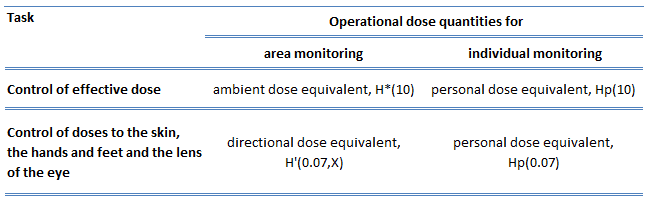
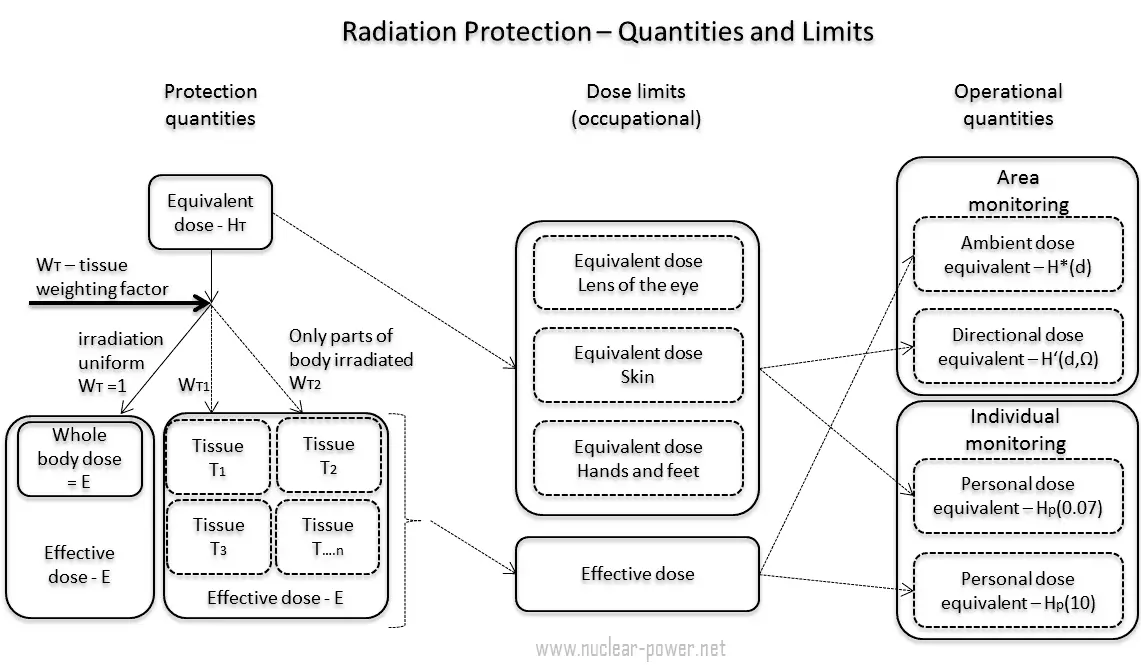
The ICRP also defines operational quantities for area and individual monitoring of external exposures. The operational quantities for area monitoring are:
Ambient dose equivalent, H*(10). The ambient dose equivalent is an operational quantity for area monitoring of strongly penetrating radiation.
Directional dose equivalent, H’ (d,Ω). The directional dose equivalent is an operational quantity for area monitoring of weakly penetrating radiation.
The operational quantities for individual monitoring are:
Personal dose equivalent, Hp(0.07). The Hp(0.07) dose equivalent is an operational quantity for individual monitoring for the assessment of the dose to the skin and to the hands and feet.
Personal dose equivalent, Hp(10). The Hp(10) dose equivalent is an operational quantity for individual monitoring for the assessment of effective dose.
Special Reference: ICRP, 2007. The 2007 Recommendations of the International Commission on Radiological Protection. ICRP Publication 103. Ann. ICRP 37 (2-4).
Dose limits are split into two groups, the public, and occupationally exposed workers.
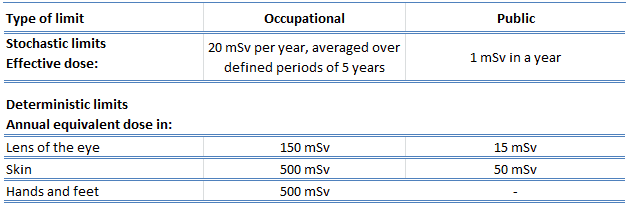
The following table summarizes dose limits for occupationally exposed workers and for the public:
Table of dose limits for occupationally exposed workers and for the public. Source of data: ICRP, 2007. The 2007 Recommendations of the International Commission on Radiological Protection. ICRP Publication 103. Ann. ICRP 37 (2-4).
According to the recommendation of the ICRP in its statement on tissue reactions of 21. April 2011, the equivalent dose limit for the lens of the eye for occupational exposure in planned exposure situations was reduced from 150 mSv/year to 20 mSv/year, averaged over defined periods of 5 years, with no annual dose in a single year exceeding 50 mSv.
Limits on effective dose are for the sum of the relevant effective doses from external exposure in the specified time period and the committed effective dose from intakes of radionuclides in the same period. For adults, the committed effective dose is computed for a 50-year period after intake, whereas for children it is computed for the period up to age 70 years. The effective whole-body dose limit of 20 mSv is an average value over five years. The real limit is 100 mSv in 5 years, with not more than 50 mSv in any one year.
Occupational Exposure – Effective Dose
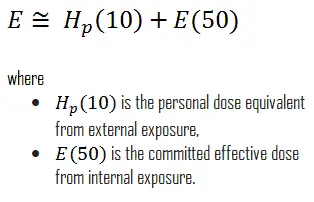
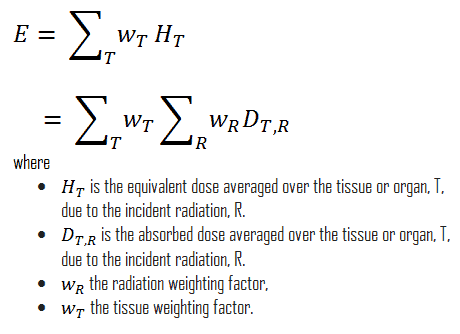
In most situations of occupational exposure the effective dose, E, can be derived from operational quantities using the following formula:
The committed dose is a dose quantity that measures the stochastic health risk due to an intake of radioactive material into the human body.
Robert Reed Burn, Introduction to Nuclear Reactor Operation, 1988.
U.S. Department of Energy, Nuclear Physics and Reactor Theory. DOE Fundamentals Handbook, Volume 1 and 2. January 1993.
Paul Reuss, Neutron Physics. EDP Sciences, 2008. ISBN: 978-2759800414.
See also:
Radiation Monitoring
We hope, this article, Occupational Exposure – Limits and Definition, helps you. If so, give us a like in the sidebar. Main purpose of this website is to help the public to learn some interesting and important information about radiation and dosimeters.
The personal dose equivalent is given the symbol Hp(d). Two common operational quantities for individual monitoring defined by the ICRP are: Personal dose equivalent, Hp(0.07) and Hp(10). Radiation Dosimetry
Personal Dose Equivalent – Hp(10) – Hp(0.07)
Generally, the personal dose equivalent, Hp(d), is an operational quantity for individual monitoring. According to the ICRP, the personal dose equivalent is defined as:
ICRP Publication 103:
“The dose equivalent in soft tissue (commonly interpreted as the ‘ICRU sphere’) at an appropriate depth, d, below a specified point on the human body. ”
The personal dose equivalent is given the symbol Hp(d). Two common operational quantities for individual monitoring defined by the ICRP are:
Personal dose equivalent, Hp(0.07). The Hp(0.07) dose equivalent is an operational quantity for individual monitoring for the assessment of the dose to the skin and to the hands and feet.
Personal dose equivalent, Hp(10). The Hp(10) dose equivalent is an operational quantity for individual monitoring for the assessment of effective dose.
As can be seen, various depths can be used. The personal dose equivalent, Hp(d), can be assessed indirectly with a thin, tissue equivalent detector (radiation dosimeter) that is worn at the surface of the body and covered with an appropriate thickness of tissue equivalent material. The specified point, d, is normally taken to be where the radiation dosimeter is worn.
For assessment of superficial organs and the control of equivalent dose, depths of 0.07 mm for skin and 3 mm for the lens of the eye are employed, and the personal dose equivalents for those depths are denoted by Hp(0.07) and Hp(3), respectively. Hp(0.07) is also called the shallow dose equivalent.
For the assessment of deep organs and the control of effective dose, Hp(10) with a depth d = 10 mm is chosen. Hp(10) is also called the deep dose equivalent. If the personal dosimeter is worn on a position of the body representative of its exposure, at low doses and under the assumption of a uniform whole-body exposure, the value of Hp(10) provides an effective dose value sufficiently precise for radiological protection purposes. Neutron and gamma radiations contribute to both deep and shallow dose, but beta radiation is completely absorbed in the skin and therefore contributes to shallow dose only.
The SI unit of Hp(d) is the sievert (Sv). Unit of sievert was named after the Swedish scientist Rolf Sievert, who did a lot of the early work on dosimetry in radiation therapy. For all types of external radiation, the operational quantities for individual monitoring are defined on the basis of a dose equivalent value at a point in a simple phantom, the ICRU sphere, which is a sphere of tissue-equivalent material (30 cm in diameter, ICRU (soft) tissue with density: 1 g/cm3 , and mass composition: 76.2% oxygen, 11.1% carbon, 10.1% hydrogen, and 2.6% nitrogen).
As was written, operational quantities are measurable unlike an effective dose, and instruments for radiation monitoring are calibrated in terms of these quantities. In monitoring, the values of these operational quantities are taken as a sufficiently precise assessment of effective dose and skin dose, respectively, in particular, if their values are below the protection limits. Numerical links between operational quantities and effective dose is represented by conservative conversion coefficients, which are defined for a reference person. In most practical situations, dosimeters provide reasonable approximations to the personal dose equivalent, Hp(d), at least at the location of the dosimeter. It must be noted, the personal dose equivalent generally overestimates the effective dose. On the other hand, this procedure is valid only at low doses and under the assumption of a uniform whole-body exposure. For high personal doses approaching or exceeding the annual dose limit, or in strongly inhomogeneous radiation fields, however, this procedure might not be sufficient.
Dose limits are split into two groups, the public, and occupationally exposed workers. According to ICRP, occupational exposure refers to all exposure incurred by workers in the course of their work, with the exception of
excluded exposures and exposures from exempt activities involving radiation or exempt sources
any medical exposure
the normal local natural background radiation.
The following table summarizes dose limits for occupationally exposed workers and for the public:
Table of dose limits for occupationally exposed workers and for the public. Source of data: ICRP, 2007. The 2007 Recommendations of the International Commission on Radiological Protection. ICRP Publication 103. Ann. ICRP 37 (2-4).
According to the recommendation of the ICRP in its statement on tissue reactions of 21. April 2011, the equivalent dose limit for the lens of the eye for occupational exposure in planned exposure situations was reduced from 150 mSv/year to 20 mSv/year, averaged over defined periods of 5 years, with no annual dose in a single year exceeding 50 mSv.
Limits on effective dose are for the sum of the relevant effective doses from external exposure in the specified time period and the committed effective dose from intakes of radionuclides in the same period. For adults, the committed effective dose is computed for a 50-year period after intake, whereas for children it is computed for the period up to age 70 years. The effective whole-body dose limit of 20 mSv is an average value over five years. The real limit is 100 mSv in 5 years, with not more than 50 mSv in any one year.
Occupational Exposure – Effective Dose
In most situations of occupational exposure the effective dose, E, can be derived from operational quantities using the following formula:
The committed dose is a dose quantity that measures the stochastic health risk due to an intake of radioactive material into the human body.
Robert Reed Burn, Introduction to Nuclear Reactor Operation, 1988.
U.S. Department of Energy, Nuclear Physics and Reactor Theory. DOE Fundamentals Handbook, Volume 1 and 2. January 1993.
Paul Reuss, Neutron Physics. EDP Sciences, 2008. ISBN: 978-2759800414.
See also:
Radiation Monitoring
We hope, this article, Personal Dose Equivalent – Hp(10) – Hp(0.07), helps you. If so, give us a like in the sidebar. Main purpose of this website is to help the public to learn some interesting and important information about radiation and dosimeters.
In general, the ICRP defines operational quantities for area and individual monitoring. The operational quantities for individual monitoring are the personal dose equivalent, Hp(0.07) and Hp(10). Radiation Dosimetry
In general, the ICRP defines operational quantities for area and individual monitoring of external exposures. The operational quantities for area monitoring are:
Ambient dose equivalent, H*(10). The ambient dose equivalent is an operational quantity for area monitoring of strongly penetrating radiation.
Directional dose equivalent, H’ (d,Ω). The directional dose equivalent is an operational quantity for area monitoring of weakly penetrating radiation.
The operational quantities for individual monitoring are:
Personal dose equivalent, Hp(0.07). The Hp(0.07) dose equivalent is an operational quantity for individual monitoring for the assessment of the dose to the skin and to the hands and feet.
Personal dose equivalent, Hp(10). The Hp(10) dose equivalent is an operational quantity for individual monitoring for the assessment of effective dose.
Special Reference: ICRP, 2007. The 2007 Recommendations of the International Commission on Radiological Protection. ICRP Publication 103. Ann. ICRP 37 (2-4).
Individual Monitoring
Personal Dose Equivalent – Hp(10) – Hp(0.07)
Generally, the personal dose equivalent, Hp(d), is an operational quantity for individual monitoring. According to the ICRP, the personal dose equivalent is defined as:
ICRP Publication 103:
“The dose equivalent in soft tissue (commonly interpreted as the ‘ICRU sphere’) at an appropriate depth, d, below a specified point on the human body. ”
The personal dose equivalent is given the symbol Hp(d). Two common operational quantities for individual monitoring defined by the ICRP are:
Personal dose equivalent, Hp(0.07). The Hp(0.07) dose equivalent is an operational quantity for individual monitoring for the assessment of the dose to the skin and to the hands and feet.
Personal dose equivalent, Hp(10). The Hp(10) dose equivalent is an operational quantity for individual monitoring for the assessment of effective dose.
As can be seen, various depths can be used. The personal dose equivalent, Hp(d), can be assessed indirectly with a thin, tissue equivalent detector (radiation dosimeter) that is worn at the surface of the body and covered with an appropriate thickness of tissue equivalent material. The specified point, d, is normally taken to be where the radiation dosimeter is worn.
For assessment of superficial organs and the control of equivalent dose, depths of 0.07 mm for skin and 3 mm for the lens of the eye are employed, and the personal dose equivalents for those depths are denoted by Hp(0.07) and Hp(3), respectively. Hp(0.07) is also called the shallow dose equivalent.
For the assessment of deep organs and the control of effective dose, Hp(10) with a depth d = 10 mm is chosen. Hp(10) is also called the deep dose equivalent. If the personal dosimeter is worn on a position of the body representative of its exposure, at low doses and under the assumption of a uniform whole-body exposure, the value of Hp(10) provides an effective dose value sufficiently precise for radiological protection purposes. Neutron and gamma radiations contribute to both deep and shallow dose, but beta radiation is completely absorbed in the skin and therefore contributes to shallow dose only.
The SI unit of Hp(d) is the sievert (Sv). Unit of sievert was named after the Swedish scientist Rolf Sievert, who did a lot of the early work on dosimetry in radiation therapy. For all types of external radiation, the operational quantities for individual monitoring are defined on the basis of a dose equivalent value at a point in a simple phantom, the ICRU sphere, which is a sphere of tissue-equivalent material (30 cm in diameter, ICRU (soft) tissue with density: 1 g/cm3 , and mass composition: 76.2% oxygen, 11.1% carbon, 10.1% hydrogen, and 2.6% nitrogen).
As was written, operational quantities are measurable unlike an effective dose, and instruments for radiation monitoring are calibrated in terms of these quantities. In monitoring, the values of these operational quantities are taken as a sufficiently precise assessment of effective dose and skin dose, respectively, in particular, if their values are below the protection limits. Numerical links between operational quantities and effective dose is represented by conservative conversion coefficients, which are defined for a reference person. In most practical situations, dosimeters provide reasonable approximations to the personal dose equivalent, Hp(d), at least at the location of the dosimeter. It must be noted, the personal dose equivalent generally overestimates the effective dose. On the other hand, this procedure is valid only at low doses and under the assumption of a uniform whole-body exposure. For high personal doses approaching or exceeding the annual dose limit, or in strongly inhomogeneous radiation fields, however, this procedure might not be sufficient.
Dose limits are split into two groups, the public, and occupationally exposed workers. According to ICRP, occupational exposure refers to all exposure incurred by workers in the course of their work, with the exception of
excluded exposures and exposures from exempt activities involving radiation or exempt sources
any medical exposure
the normal local natural background radiation.
The following table summarizes dose limits for occupationally exposed workers and for the public:
Table of dose limits for occupationally exposed workers and for the public. Source of data: ICRP, 2007. The 2007 Recommendations of the International Commission on Radiological Protection. ICRP Publication 103. Ann. ICRP 37 (2-4).
According to the recommendation of the ICRP in its statement on tissue reactions of 21. April 2011, the equivalent dose limit for the lens of the eye for occupational exposure in planned exposure situations was reduced from 150 mSv/year to 20 mSv/year, averaged over defined periods of 5 years, with no annual dose in a single year exceeding 50 mSv.
Limits on effective dose are for the sum of the relevant effective doses from external exposure in the specified time period and the committed effective dose from intakes of radionuclides in the same period. For adults, the committed effective dose is computed for a 50-year period after intake, whereas for children it is computed for the period up to age 70 years. The effective whole-body dose limit of 20 mSv is an average value over five years. The real limit is 100 mSv in 5 years, with not more than 50 mSv in any one year.
Occupational Exposure – Effective Dose
In most situations of occupational exposure the effective dose, E, can be derived from operational quantities using the following formula:
The committed dose is a dose quantity that measures the stochastic health risk due to an intake of radioactive material into the human body.
Robert Reed Burn, Introduction to Nuclear Reactor Operation, 1988.
U.S. Department of Energy, Nuclear Physics and Reactor Theory. DOE Fundamentals Handbook, Volume 1 and 2. January 1993.
Paul Reuss, Neutron Physics. EDP Sciences, 2008. ISBN: 978-2759800414.
See also:
Radiation Monitoring
We hope, this article, Individual Monitoring – Radiation Protection, helps you. If so, give us a like in the sidebar. Main purpose of this website is to help the public to learn some interesting and important information about radiation and dosimeters.
The directional dose equivalent is an operational quantity for area monitoring of weakly penetrating radiation. The directional dose equivalent, H’(d,Ω), is the operational quantity for determination of equivalent dose to skin, lens of the eye, etc. Radiation Dosimetry
Directional Dose Equivalent – H’(d,Ω)
The directional dose equivalent is an operational quantity for area monitoring of weakly penetrating radiation. The directional dose equivalent, H’(d,Ω), is the operational quantity for determination of equivalent dose to skin, lens of the eye, etc., also for beta radiation and low-energy photons.
According to the ICRP, the directional dose equivalent is defined as:
ICRP Publication 103:
“The dose equivalent at a point in a radiation field that would be produced by the corresponding expanded field in the ICRU sphere at a depth, d, on a radius in a specified direction, Ω. ”
The directional dose equivalent is given the symbol H’ (0.07,Ω) or, in rare cases, H'(3,Ω). The SI unit of H’ (d,Ω) is the sievert(Sv). Unit of sievert was named after the Swedish scientist Rolf Sievert, who did a lot of the early work on dosimetry in radiation therapy. For all types of external radiation, the operational quantities for area monitoring are defined on the basis of a dose equivalent value at a point in a simple phantom, the ICRU sphere, which is a sphere of tissue-equivalent material (30 cm in diameter, ICRU (soft) tissue with density: 1 g/cm3 , and mass composition: 76.2% oxygen, 11.1% carbon, 10.1% hydrogen, and 2.6% nitrogen).
As was written, operational quantities are measurable unlike an effective dose, and instruments for radiation monitoring are calibrated in terms of these quantities. In monitoring, the values of these operational quantities are taken as a sufficiently precise assessment of effective dose and skin dose, respectively, in particular, if their values are below the protection limits. Numerical links between operational quantities and effective dose is represented by conservative conversion coefficients, which are defined for a reference person.
Dose limits are split into two groups, the public, and occupationally exposed workers. According to ICRP, occupational exposure refers to all exposure incurred by workers in the course of their work, with the exception of
excluded exposures and exposures from exempt activities involving radiation or exempt sources
any medical exposure
the normal local natural background radiation.
The following table summarizes dose limits for occupationally exposed workers and for the public:
Table of dose limits for occupationally exposed workers and for the public. Source of data: ICRP, 2007. The 2007 Recommendations of the International Commission on Radiological Protection. ICRP Publication 103. Ann. ICRP 37 (2-4).
According to the recommendation of the ICRP in its statement on tissue reactions of 21. April 2011, the equivalent dose limit for the lens of the eye for occupational exposure in planned exposure situations was reduced from 150 mSv/year to 20 mSv/year, averaged over defined periods of 5 years, with no annual dose in a single year exceeding 50 mSv.
Limits on effective dose are for the sum of the relevant effective doses from external exposure in the specified time period and the committed effective dose from intakes of radionuclides in the same period. For adults, the committed effective dose is computed for a 50-year period after intake, whereas for children it is computed for the period up to age 70 years. The effective whole-body dose limit of 20 mSv is an average value over five years. The real limit is 100 mSv in 5 years, with not more than 50 mSv in any one year.
Occupational Exposure – Effective Dose
In most situations of occupational exposure the effective dose, E, can be derived from operational quantities using the following formula:
The committed dose is a dose quantity that measures the stochastic health risk due to an intake of radioactive material into the human body.
Robert Reed Burn, Introduction to Nuclear Reactor Operation, 1988.
U.S. Department of Energy, Nuclear Physics and Reactor Theory. DOE Fundamentals Handbook, Volume 1 and 2. January 1993.
Paul Reuss, Neutron Physics. EDP Sciences, 2008. ISBN: 978-2759800414.
See also:
Radiation Monitoring
We hope, this article, Directional Dose Equivalent – H’(d,Ω), helps you. If so, give us a like in the sidebar. Main purpose of this website is to help the public to learn some interesting and important information about radiation and dosimeters.
The ambient dose equivalent is an operational quantity for area monitoring. The ambient dose equivalent is given the symbol H*(10). The SI unit of H*(10) is the sievert (Sv). Radiation Dosimetry
Ambient Dose Equivalent – H*(10)
The ambient dose equivalent is an operational quantity for area monitoring. According to the ICRP, the ambient dose equivalent is defined as:
ICRP Publication 103:
“The dose equivalent at a point in a radiation field that would be produced by the corresponding expanded and aligned field in the ICRU sphere at a depth of 10 mm on the radius vector opposing the direction of the aligned field.”
The ambient dose equivalent is given the symbol H*(10). The SI unit of H*(10) is the sievert(Sv). Unit of sievert was named after the Swedish scientist Rolf Sievert, who did a lot of the early work on dosimetry in radiation therapy. For all types of external radiation, the operational quantities for area monitoring are defined on the basis of a dose equivalent value at a point in a simple phantom, the ICRU sphere, which is a sphere of tissue-equivalent material (30 cm in diameter, ICRU (soft) tissue with density: 1 g/cm3 , and mass composition: 76.2% oxygen, 11.1% carbon, 10.1% hydrogen, and 2.6% nitrogen).
As was written, operational quantities are measurable unlike an effective dose, and instruments for radiation monitoring are calibrated in terms of these quantities. In monitoring, the values of these operational quantities are taken as a sufficiently precise assessment of effective dose and skin dose, respectively, in particular, if their values are below the protection limits. Numerical links between operational quantities and effective dose is represented by conservative conversion coefficients, which are defined for a reference person.
Dose limits are split into two groups, the public, and occupationally exposed workers. According to ICRP, occupational exposure refers to all exposure incurred by workers in the course of their work, with the exception of
excluded exposures and exposures from exempt activities involving radiation or exempt sources
any medical exposure
the normal local natural background radiation.
The following table summarizes dose limits for occupationally exposed workers and for the public:
Table of dose limits for occupationally exposed workers and for the public. Source of data: ICRP, 2007. The 2007 Recommendations of the International Commission on Radiological Protection. ICRP Publication 103. Ann. ICRP 37 (2-4).
According to the recommendation of the ICRP in its statement on tissue reactions of 21. April 2011, the equivalent dose limit for the lens of the eye for occupational exposure in planned exposure situations was reduced from 150 mSv/year to 20 mSv/year, averaged over defined periods of 5 years, with no annual dose in a single year exceeding 50 mSv.
Limits on effective dose are for the sum of the relevant effective doses from external exposure in the specified time period and the committed effective dose from intakes of radionuclides in the same period. For adults, the committed effective dose is computed for a 50-year period after intake, whereas for children it is computed for the period up to age 70 years. The effective whole-body dose limit of 20 mSv is an average value over five years. The real limit is 100 mSv in 5 years, with not more than 50 mSv in any one year.
Occupational Exposure – Effective Dose
In most situations of occupational exposure the effective dose, E, can be derived from operational quantities using the following formula:
The committed dose is a dose quantity that measures the stochastic health risk due to an intake of radioactive material into the human body.
Robert Reed Burn, Introduction to Nuclear Reactor Operation, 1988.
U.S. Department of Energy, Nuclear Physics and Reactor Theory. DOE Fundamentals Handbook, Volume 1 and 2. January 1993.
Paul Reuss, Neutron Physics. EDP Sciences, 2008. ISBN: 978-2759800414.
See also:
Radiation Monitoring
We hope, this article, Ambient Dose Equivalent – H*(10), helps you. If so, give us a like in the sidebar. Main purpose of this website is to help the public to learn some interesting and important information about radiation and dosimeters.
In general, the ICRP defines operational quantities for area monitoring. The operational quantities for area monitoring are the ambient dose equivalent and the directional dose equivalent. Radiation Dosimetry
In general, the ICRP defines operational quantities for area and individual monitoring of external exposures. The operational quantities for area monitoring are:
Ambient dose equivalent, H*(10). The ambient dose equivalent is an operational quantity for area monitoring of strongly penetrating radiation.
Directional dose equivalent, H’ (d,Ω). The directional dose equivalent is an operational quantity for area monitoring of weakly penetrating radiation.
The operational quantities for individual monitoring are:
Personal dose equivalent, Hp(0.07). The Hp(0.07) dose equivalent is an operational quantity for individual monitoring for the assessment of the dose to the skin and to the hands and feet.
Personal dose equivalent, Hp(10). The Hp(10) dose equivalent is an operational quantity for individual monitoring for the assessment of effective dose.
Special Reference: ICRP, 2007. The 2007 Recommendations of the International Commission on Radiological Protection. ICRP Publication 103. Ann. ICRP 37 (2-4).
Area Monitoring
Ambient Dose Equivalent – H*(10)
The ambient dose equivalent is an operational quantity for area monitoring. According to the ICRP, the ambient dose equivalent is defined as:
ICRP Publication 103:
“The dose equivalent at a point in a radiation field that would be produced by the corresponding expanded and aligned field in the ICRU sphere at a depth of 10 mm on the radius vector opposing the direction of the aligned field.”
The ambient dose equivalent is given the symbol H*(10). The SI unit of H*(10) is the sievert(Sv). Unit of sievert was named after the Swedish scientist Rolf Sievert, who did a lot of the early work on dosimetry in radiation therapy. For all types of external radiation, the operational quantities for area monitoring are defined on the basis of a dose equivalent value at a point in a simple phantom, the ICRU sphere, which is a sphere of tissue-equivalent material (30 cm in diameter, ICRU (soft) tissue with density: 1 g/cm3 , and mass composition: 76.2% oxygen, 11.1% carbon, 10.1% hydrogen, and 2.6% nitrogen).
As was written, operational quantities are measurable unlike an effective dose, and instruments for radiation monitoring are calibrated in terms of these quantities. In monitoring, the values of these operational quantities are taken as a sufficiently precise assessment of effective dose and skin dose, respectively, in particular, if their values are below the protection limits. Numerical links between operational quantities and effective dose is represented by conservative conversion coefficients, which are defined for a reference person.
Directional Dose Equivalent – H’(d,Ω)
The directional dose equivalent is an operational quantity for area monitoring of weakly penetrating radiation. The directional dose equivalent, H’(d,Ω), is the operational quantity for determination of equivalent dose to skin, lens of the eye, etc., also for beta radiation and low-energy photons.
According to the ICRP, the directional dose equivalent is defined as:
ICRP Publication 103:
“The dose equivalent at a point in a radiation field that would be produced by the corresponding expanded field in the ICRU sphere at a depth, d, on a radius in a specified direction, Ω. ”
The directional dose equivalent is given the symbol H’ (0.07,Ω) or, in rare cases, H'(3,Ω). The SI unit of H’ (d,Ω) is the sievert(Sv). Unit of sievert was named after the Swedish scientist Rolf Sievert, who did a lot of the early work on dosimetry in radiation therapy. For all types of external radiation, the operational quantities for area monitoring are defined on the basis of a dose equivalent value at a point in a simple phantom, the ICRU sphere, which is a sphere of tissue-equivalent material (30 cm in diameter, ICRU (soft) tissue with density: 1 g/cm3 , and mass composition: 76.2% oxygen, 11.1% carbon, 10.1% hydrogen, and 2.6% nitrogen).
As was written, operational quantities are measurable unlike an effective dose, and instruments for radiation monitoring are calibrated in terms of these quantities. In monitoring, the values of these operational quantities are taken as a sufficiently precise assessment of effective dose and skin dose, respectively, in particular, if their values are below the protection limits. Numerical links between operational quantities and effective dose is represented by conservative conversion coefficients, which are defined for a reference person.
Dose limits are split into two groups, the public, and occupationally exposed workers. According to ICRP, occupational exposure refers to all exposure incurred by workers in the course of their work, with the exception of
excluded exposures and exposures from exempt activities involving radiation or exempt sources
any medical exposure
the normal local natural background radiation.
The following table summarizes dose limits for occupationally exposed workers and for the public:
Table of dose limits for occupationally exposed workers and for the public. Source of data: ICRP, 2007. The 2007 Recommendations of the International Commission on Radiological Protection. ICRP Publication 103. Ann. ICRP 37 (2-4).
According to the recommendation of the ICRP in its statement on tissue reactions of 21. April 2011, the equivalent dose limit for the lens of the eye for occupational exposure in planned exposure situations was reduced from 150 mSv/year to 20 mSv/year, averaged over defined periods of 5 years, with no annual dose in a single year exceeding 50 mSv.
Limits on effective dose are for the sum of the relevant effective doses from external exposure in the specified time period and the committed effective dose from intakes of radionuclides in the same period. For adults, the committed effective dose is computed for a 50-year period after intake, whereas for children it is computed for the period up to age 70 years. The effective whole-body dose limit of 20 mSv is an average value over five years. The real limit is 100 mSv in 5 years, with not more than 50 mSv in any one year.
Occupational Exposure – Effective Dose
In most situations of occupational exposure the effective dose, E, can be derived from operational quantities using the following formula:
The committed dose is a dose quantity that measures the stochastic health risk due to an intake of radioactive material into the human body.
Robert Reed Burn, Introduction to Nuclear Reactor Operation, 1988.
U.S. Department of Energy, Nuclear Physics and Reactor Theory. DOE Fundamentals Handbook, Volume 1 and 2. January 1993.
Paul Reuss, Neutron Physics. EDP Sciences, 2008. ISBN: 978-2759800414.
See also:
Radiation Monitoring
We hope, this article, Area Monitoring – Radiation Protection, helps you. If so, give us a like in the sidebar. Main purpose of this website is to help the public to learn some interesting and important information about radiation and dosimeters.
For radiation dose measuring and monitoring, the ICRP defines operational quantities for area and individual monitoring of external exposures. Operational quantities are measurable unlike an effective dose, and instruments for radiation monitoring are calibrated in terms of these quantities. Radiation Dosimetry
ionizing radiation – hazard symbol
In previous chapters, we described the equivalent dose and the effective dose. But these doses are not directly measurable. For this purpose, the ICRP has introduced and defined a set of operational quantities, which can be measured and which are intended to provide a reasonable estimate for the protection quantities. These quantities aim to provide a conservative estimate for the value of the protection quantities related to an exposure avoiding both underestimation and too much overestimation.
Numerical links between these quantities is represented by conversion coefficients, which are defined for a reference person. It is very important that an internationally agreed set of conversion coefficients is available for general use in radiological protection practice for occupational exposures and exposures of the public. For the calculation of conversion coefficients for external exposure, computational phantoms are used for dose assessment in various radiation fields. For the calculation of dose coefficients from intakes of radionuclides, biokinetic models for radionuclides, reference physiological data, and computational phantoms are used.
A set of evaluated data of conversion coefficients for protection, and operational quantities for external exposure to mono-energetic photon, neutron, and electron radiation under specific irradiation conditions is published in reports (ICRP, 1996b, ICRU, 1997).
In general, the ICRP defines operational quantities for area and individual monitoring of external exposures. The operational quantities for area monitoring are:
Ambient dose equivalent, H*(10). The ambient dose equivalent is an operational quantity for area monitoring of strongly penetrating radiation.
Directional dose equivalent, H’ (d,Ω). The directional dose equivalent is an operational quantity for area monitoring of weakly penetrating radiation.
The operational quantities for individual monitoring are:
Personal dose equivalent, Hp(0.07). The Hp(0.07) dose equivalent is an operational quantity for individual monitoring for the assessment of the dose to the skin and to the hands and feet.
Personal dose equivalent, Hp(10). The Hp(10) dose equivalent is an operational quantity for individual monitoring for the assessment of effective dose.
Special Reference: ICRP, 2007. The 2007 Recommendations of the International Commission on Radiological Protection. ICRP Publication 103. Ann. ICRP 37 (2-4).
Area Monitoring
Ambient Dose Equivalent – H*(10)
The ambient dose equivalent is an operational quantity for area monitoring. According to the ICRP, the ambient dose equivalent is defined as:
ICRP Publication 103:
“The dose equivalent at a point in a radiation field that would be produced by the corresponding expanded and aligned field in the ICRU sphere at a depth of 10 mm on the radius vector opposing the direction of the aligned field.”
The ambient dose equivalent is given the symbol H*(10). The SI unit of H*(10) is the sievert(Sv). Unit of sievert was named after the Swedish scientist Rolf Sievert, who did a lot of the early work on dosimetry in radiation therapy. For all types of external radiation, the operational quantities for area monitoring are defined on the basis of a dose equivalent value at a point in a simple phantom, the ICRU sphere, which is a sphere of tissue-equivalent material (30 cm in diameter, ICRU (soft) tissue with density: 1 g/cm3 , and mass composition: 76.2% oxygen, 11.1% carbon, 10.1% hydrogen, and 2.6% nitrogen).
As was written, operational quantities are measurable unlike an effective dose, and instruments for radiation monitoring are calibrated in terms of these quantities. In monitoring, the values of these operational quantities are taken as a sufficiently precise assessment of effective dose and skin dose, respectively, in particular, if their values are below the protection limits. Numerical links between operational quantities and effective dose is represented by conservative conversion coefficients, which are defined for a reference person.
Directional Dose Equivalent – H’(d,Ω)
The directional dose equivalent is an operational quantity for area monitoring of weakly penetrating radiation. The directional dose equivalent, H’(d,Ω), is the operational quantity for determination of equivalent dose to skin, lens of the eye, etc., also for beta radiation and low-energy photons.
According to the ICRP, the directional dose equivalent is defined as:
ICRP Publication 103:
“The dose equivalent at a point in a radiation field that would be produced by the corresponding expanded field in the ICRU sphere at a depth, d, on a radius in a specified direction, Ω. ”
The directional dose equivalent is given the symbol H’ (0.07,Ω) or, in rare cases, H'(3,Ω). The SI unit of H’ (d,Ω) is the sievert(Sv). Unit of sievert was named after the Swedish scientist Rolf Sievert, who did a lot of the early work on dosimetry in radiation therapy. For all types of external radiation, the operational quantities for area monitoring are defined on the basis of a dose equivalent value at a point in a simple phantom, the ICRU sphere, which is a sphere of tissue-equivalent material (30 cm in diameter, ICRU (soft) tissue with density: 1 g/cm3 , and mass composition: 76.2% oxygen, 11.1% carbon, 10.1% hydrogen, and 2.6% nitrogen).
As was written, operational quantities are measurable unlike an effective dose, and instruments for radiation monitoring are calibrated in terms of these quantities. In monitoring, the values of these operational quantities are taken as a sufficiently precise assessment of effective dose and skin dose, respectively, in particular, if their values are below the protection limits. Numerical links between operational quantities and effective dose is represented by conservative conversion coefficients, which are defined for a reference person.
Individual Monitoring
Personal Dose Equivalent – Hp(10) – Hp(0.07)
Generally, the personal dose equivalent, Hp(d), is an operational quantity for individual monitoring. According to the ICRP, the personal dose equivalent is defined as:
ICRP Publication 103:
“The dose equivalent in soft tissue (commonly interpreted as the ‘ICRU sphere’) at an appropriate depth, d, below a specified point on the human body. ”
The personal dose equivalent is given the symbol Hp(d). Two common operational quantities for individual monitoring defined by the ICRP are:
Personal dose equivalent, Hp(0.07). The Hp(0.07) dose equivalent is an operational quantity for individual monitoring for the assessment of the dose to the skin and to the hands and feet.
Personal dose equivalent, Hp(10). The Hp(10) dose equivalent is an operational quantity for individual monitoring for the assessment of effective dose.
As can be seen, various depths can be used. The personal dose equivalent, Hp(d), can be assessed indirectly with a thin, tissue equivalent detector (radiation dosimeter) that is worn at the surface of the body and covered with an appropriate thickness of tissue equivalent material. The specified point, d, is normally taken to be where the radiation dosimeter is worn.
For assessment of superficial organs and the control of equivalent dose, depths of 0.07 mm for skin and 3 mm for the lens of the eye are employed, and the personal dose equivalents for those depths are denoted by Hp(0.07) and Hp(3), respectively. Hp(0.07) is also called the shallow dose equivalent.
For the assessment of deep organs and the control of effective dose, Hp(10) with a depth d = 10 mm is chosen. Hp(10) is also called the deep dose equivalent. If the personal dosimeter is worn on a position of the body representative of its exposure, at low doses and under the assumption of a uniform whole-body exposure, the value of Hp(10) provides an effective dose value sufficiently precise for radiological protection purposes. Neutron and gamma radiations contribute to both deep and shallow dose, but beta radiation is completely absorbed in the skin and therefore contributes to shallow dose only.
The SI unit of Hp(d) is the sievert (Sv). Unit of sievert was named after the Swedish scientist Rolf Sievert, who did a lot of the early work on dosimetry in radiation therapy. For all types of external radiation, the operational quantities for individual monitoring are defined on the basis of a dose equivalent value at a point in a simple phantom, the ICRU sphere, which is a sphere of tissue-equivalent material (30 cm in diameter, ICRU (soft) tissue with density: 1 g/cm3 , and mass composition: 76.2% oxygen, 11.1% carbon, 10.1% hydrogen, and 2.6% nitrogen).
As was written, operational quantities are measurable unlike an effective dose, and instruments for radiation monitoring are calibrated in terms of these quantities. In monitoring, the values of these operational quantities are taken as a sufficiently precise assessment of effective dose and skin dose, respectively, in particular, if their values are below the protection limits. Numerical links between operational quantities and effective dose is represented by conservative conversion coefficients, which are defined for a reference person. In most practical situations, dosimeters provide reasonable approximations to the personal dose equivalent, Hp(d), at least at the location of the dosimeter. It must be noted, the personal dose equivalent generally overestimates the effective dose. On the other hand, this procedure is valid only at low doses and under the assumption of a uniform whole-body exposure. For high personal doses approaching or exceeding the annual dose limit, or in strongly inhomogeneous radiation fields, however, this procedure might not be sufficient.
Occupational Exposure – Effective Dose
In most situations of occupational exposure the effective dose, E, can be derived from operational quantities using the following formula:
The committed dose is a dose quantity that measures the stochastic health risk due to an intake of radioactive material into the human body.
Dose limits are split into two groups, the public, and occupationally exposed workers. According to ICRP, occupational exposure refers to all exposure incurred by workers in the course of their work, with the exception of
excluded exposures and exposures from exempt activities involving radiation or exempt sources
any medical exposure
the normal local natural background radiation.
The following table summarizes dose limits for occupationally exposed workers and for the public:
Table of dose limits for occupationally exposed workers and for the public. Source of data: ICRP, 2007. The 2007 Recommendations of the International Commission on Radiological Protection. ICRP Publication 103. Ann. ICRP 37 (2-4).
According to the recommendation of the ICRP in its statement on tissue reactions of 21. April 2011, the equivalent dose limit for the lens of the eye for occupational exposure in planned exposure situations was reduced from 150 mSv/year to 20 mSv/year, averaged over defined periods of 5 years, with no annual dose in a single year exceeding 50 mSv.
Limits on effective dose are for the sum of the relevant effective doses from external exposure in the specified time period and the committed effective dose from intakes of radionuclides in the same period. For adults, the committed effective dose is computed for a 50-year period after intake, whereas for children it is computed for the period up to age 70 years. The effective whole-body dose limit of 20 mSv is an average value over five years. The real limit is 100 mSv in 5 years, with not more than 50 mSv in any one year.
Robert Reed Burn, Introduction to Nuclear Reactor Operation, 1988.
U.S. Department of Energy, Nuclear Physics and Reactor Theory. DOE Fundamentals Handbook, Volume 1 and 2. January 1993.
Paul Reuss, Neutron Physics. EDP Sciences, 2008. ISBN: 978-2759800414.
See also:
Nuclear Engineering
We hope, this article, Radiation Dose Measuring and Monitoring – Operational Quantities, helps you. If so, give us a like in the sidebar. Main purpose of this website is to help the public to learn some interesting and important information about radiation and dosimeters.
Dose limits are a fundamental component of radiation protection, and breaching these limits is against radiation regulation in most countries. Dose limits are set to limit stochastic effects and to prevent deterministic effects completely. Radiation Dosimetry
ionizing radiation – hazard symbol
According to the ICRP, the System of Radiological Protection is based on the following three principles:
Justification. “Any decision that alters the radiation exposure situation should do more good than harm.”
Optimisation of Protection. “Doses should all be kept as low as reasonably achievable, taking into account economic and societal factors.” (known as ALARA or ALARP)
Dose Limitation. “The total dose to any individual … should not exceed the appropriate limits.”
The principle of dose limitation means that nobody should be exposed to an unacceptable degree of risk from activities involving radiation exposure. These dose limits are recommended by the International Commission on Radiological Protection (ICRP), they are in place to ensure that the individuals are not exposed to an unnecessarily high amount of ionising radiation. In general, these limits are set to limit stochastic effects to an acceptable level, and to prevent deterministic effects completely. Note that, stochastic effects are those arising from chance: the greater the dose, the more likely the effect. Deterministic effects are those which normally have a threshold: above this, the severity of the effect increases with the dose. Dose limits are a fundamental component of radiation protection, and breaching these limits is against radiation regulation in most countries. Note that, the dose limits described in this article apply to routine operations. They do not apply to an emergency situation when human life is endangered. They do not apply in emergency exposure situations where an individual is attempting to prevent a catastrophic situation.
The limits are split into two groups, the public, and occupationally exposed workers. According to ICRP, occupational exposure refers to all exposure incurred by workers in the course of their work, with the exception of
excluded exposures and exposures from exempt activities involving radiation or exempt sources
any medical exposure
the normal local natural background radiation.
The following table summarizes dose limits for occupationally exposed workers and for the public:
Table of dose limits for occupationally exposed workers and for the public. Source of data: ICRP, 2007. The 2007 Recommendations of the International Commission on Radiological Protection. ICRP Publication 103. Ann. ICRP 37 (2-4).
According to the recommendation of the ICRP in its statement on tissue reactions of 21. April 2011, the equivalent dose limit for the lens of the eye for occupational exposure in planned exposure situations was reduced from 150 mSv/year to 20 mSv/year, averaged over defined periods of 5 years, with no annual dose in a single year exceeding 50 mSv.
Limits on effective dose are for the sum of the relevant effective doses from external exposure in the specified time period and the committed effective dose from intakes of radionuclides in the same period. For adults, the committed effective dose is computed for a 50-year period after intake, whereas for children it is computed for the period up to age 70 years. The effective whole-body dose limit of 20 mSv is an average value over five years. The real limit is 100 mSv in 5 years, with not more than 50 mSv in any one year.
The committed dose is a dose quantity that measures the stochastic health risk due to an intake of radioactive material into the human body. Since the operational dose limit of 20 mSv applies to the sum of the internal and external exposures, if a worker has some external dose, the ALI must be modified or offset to account for the external dose. For example, assume the worker has 10 mSv from external sources of radiation. Only 10 more mSv are allowed from internal radiation before the worker reaches the occupational whole body limit.
Robert Reed Burn, Introduction to Nuclear Reactor Operation, 1988.
U.S. Department of Energy, Nuclear Physics and Reactor Theory. DOE Fundamentals Handbook, Volume 1 and 2. January 1993.
Paul Reuss, Neutron Physics. EDP Sciences, 2008. ISBN: 978-2759800414.
See also:
Protection from Exposures
We hope, this article, Dose Limit – Radiation, helps you. If so, give us a like in the sidebar. Main purpose of this website is to help the public to learn some interesting and important information about radiation and dosimeters.
Quantities and Units of Radiation. There are various quantities and units of radiation. This article describes key differences between activity, kerma and radiation doses. Radiation Dosimetry
This chapter briefly summarizes key differences between quantities and units of radiation.
Activity – Specific Activity
A measure of radioactivity (activity) is based on counting of disintegrations per second. The SI unit of activity is the becquerel (Bq), equal to one reciprocal second. The activity depends only on the number of decays per second, not on the type of decay, the energy of the decay products, or the biological effects of the radiation. It can be used to characterize the rate of emission of ionizing radiation. Specific activity is the activity per quantity of a radionuclide, thus specific activity is defined as the activity per quantity of atoms of a particular radionuclide. It is usually given in units of Bq/g, but another commonly used unit of activity is the curie (Ci) allowing the definition of specific activity in Ci/g.
Units of radioactivity (the curie and the becquerel) can be also used to characterize an overall quantity of controlled or accidental releases of radioactive atoms.
Units of Radioactivity
Becquerel. The becquerel is SI unit of radioactivity defined in 1974. It is named in honour of Henri Becquerel, a French physicist who discovered radioactivity in 1896. One becquerel (1Bq) is equal to 1 disintegration per second.
Curie. The curie is a non-SI unit of radioactivity defined in 1910. It was originally defined as equivalent to the number of disintegrations that one gram of radium-226 will undergo in one second. Currently, a curie is defined as 1Ci = 3.7 x 10¹⁰ disintegrations per second.
Rutherford. Rutherford (symbol Rd) is also a non-SI unit defined as the activity of a quantity of radioactive material in which one million nuclei decay per second.
Exposure
Radiation exposure is defined as the sum of electrical charges (∆q) on all the ions of one sign produced in air when all the electrons, liberated by photons in a volume of air whose mass is ∆m, are completely stopped in air. Radiation exposure is given the symbol X. The SI unit of radiation exposure is the coulomb per kilogram (C/kg), but in practice, the roentgen is used.
Unit of Exposure
Roentgen. The roentgen, abbreviated R, is the unit of radiation exposure. In the original definition 1 R means the amount of X-rays or γ-radiation that is required to liberate positive and negative charges of one electrostatic unit of charge (esu) in 1 cm³ of dry air at standard temperature and pressure (STP).
Kerma
Kerma is a measure of kinetic energy transferred from radiation to matter. It is an acronym for “kinetic energy released per unit mass”. Kerma is given the symbol K and it is measured by the SI unit, the gray.
Absorbed Dose
Absorbed dose is defined as the amount of energy deposited by ionizing radiation in a substance. Absorbed dose is given the symbol D.
Units of Absorbed Dose
Gray. A dose of one gray is equivalent to a unit of energy (joule) deposited in a kilogram of a substance.
RAD. A dose of one rad is equivalent to the deposition of one hundred ergs of energy in one gram of any material.
Equivalent Dose
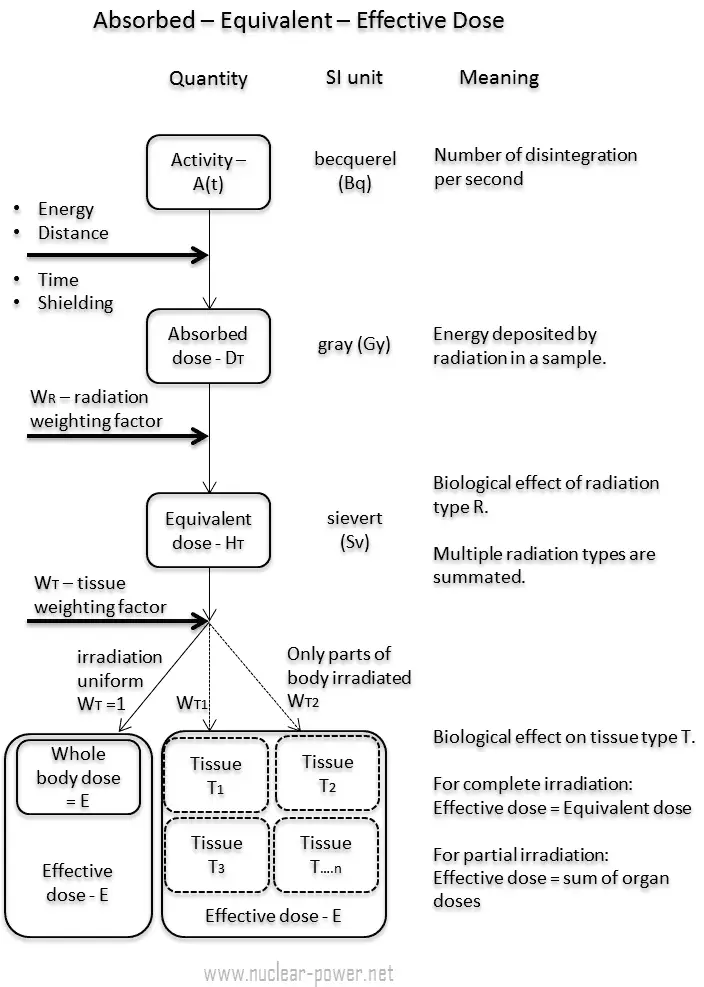
Equivalent dose (symbol HT) is a dose quantity calculated for individual organs (index T – tissue). Equivalent dose is based on the absorbed dose to an organ, adjusted to account for the effectiveness of the type of radiation. Equivalent dose is given the symbol HT.
Units of Equivalent Dose:
Sievert. The sievert is a derived unit of equivalent dose and effective dose and for represents the equivalent biological effect of the deposit of a joule of gamma rays energy in a kilogram of human tissue.
REM. The rem (an abbreviation for Roentgen Equivalent Man) is the non-SI unit of the equivalent dose, which is used predominantly in the USA. It is a term for dose equivalence and equals the biological damage that would be caused by one rad of dose.
Effective Dose
The effective dose is a dose quantity defined as the sum of the tissue-equivalent doses weighted by the ICRP organ (tissue) weighting factors, wT, which takes into account the varying sensitivity of different organs and tissues to radiation.
Units of Effective Dose
Sievert. The sievert is a derived unit of equivalent dose and effective dose and for represents the equivalent biological effect of the deposit of a joule of gamma rays energy in a kilogram of human tissue.
REM. The rem (an abbreviation for Roentgen Equivalent Man) is the non-SI unit of equivalent dose and effective dose dose, which is used predominantly in the USA. It is a term for dose equivalence and equals the biological damage that would be caused by one rad of dose.
Operational Quantities
In general, the ICRP defines operational quantities for area and individual monitoring of external exposures.
Area Monitoring
Ambient dose equivalent, H*(10). The ambient dose equivalent is an operational quantity for area monitoring of strongly penetrating radiation.
Directional dose equivalent, H’ (d,Ω). The directional dose equivalent is an operational quantity for area monitoring of weakly penetrating radiation.
Individual Monitoring
Personal dose equivalent, Hp(0.07). The Hp(0.07) dose equivalent is an operational quantity for individual monitoring for the assessment of the dose to the skin and to the hands and feet.
Personal dose equivalent, Hp(10). The Hp(10) dose equivalent is an operational quantity for individual monitoring for the assessment of effective dose.
Robert Reed Burn, Introduction to Nuclear Reactor Operation, 1988.
U.S. Department of Energy, Nuclear Physics and Reactor Theory. DOE Fundamentals Handbook, Volume 1 and 2. January 1993.
Paul Reuss, Neutron Physics. EDP Sciences, 2008. ISBN: 978-2759800414.
See also:
Radiation Protection
We hope, this article, Quantity and Unit of Radiation, helps you. If so, give us a like in the sidebar. Main purpose of this website is to help the public to learn some interesting and important information about radiation and dosimeters.
Protection from Exposures. The System of Radiological Protection is based on the following three principles: Justification, Optimisation of Protection and Dose Limitation. Radiation Dosimetry
ionizing radiation – hazard symbol
In general, radiation protection is the science and practice of protecting people and the environment from the harmful effects of ionizing radiation.
According to the ICRP (Publication 103), the System of Radiological Protection is based on the following three principles:
Justification. “Any decision that alters the radiation exposure situation should do more good than harm.”
Optimisation of Protection. “Doses should all be kept as low as reasonably achievable, taking into account economic and societal factors.” (known as ALARA or ALARP)
Dose Limitation. “The total dose to any individual … should not exceed the appropriate limits.”
See also: ICRP, 2007. The 2007 Recommendations of the International Commission on Radiological Protection. ICRP Publication 103. Ann. ICRP 37 (2-4).
The following table summarizes dose limits for occupationally exposed workers and for the public:
Table of dose limits for occupationally exposed workers and for the public. Source of data: ICRP, 2007. The 2007 Recommendations of the International Commission on Radiological Protection. ICRP Publication 103. Ann. ICRP 37 (2-4).
According to the recommendation of the ICRP in its statement on tissue reactions of 21. April 2011, the equivalent dose limit for the lens of the eye for occupational exposure in planned exposure situations was reduced from 150 mSv/year to 20 mSv/year, averaged over defined periods of 5 years, with no annual dose in a single year exceeding 50 mSv.
Robert Reed Burn, Introduction to Nuclear Reactor Operation, 1988.
U.S. Department of Energy, Nuclear Physics and Reactor Theory. DOE Fundamentals Handbook, Volume 1 and 2. January 1993.
Paul Reuss, Neutron Physics. EDP Sciences, 2008. ISBN: 978-2759800414.
See also:
Radiation Protection
We hope, this article, Protection from Exposures, helps you. If so, give us a like in the sidebar. Main purpose of this website is to help the public to learn some interesting and important information about radiation and dosimeters.