Thermoluminescent Dosimeter – TLD vs Film Badge Dosimeter. This article summarizes key differences between thermoluminescent dosimeters and film dosimeters. Radiation Dosimetry
TLD – Thermoluminescent Dosimeter
A thermoluminescent dosimeter, abbreviated as TLD, is a passive radiation dosimeter, that measures ionizing radiation exposure by measuring the intensity of visible light emitted from a sensitive crystal in the detector when the crystal is heated. The intensity of light emitted is measure by TLD reader and it is dependent upon the radiation exposure. Thermoluminescent dosimeters was invented in 1954 by Professor Farrington Daniels of the University of Wisconsin-Madison. TLD dosimeters are applicable to situations where real-time information is not needed, but precise accumulated dose monitoring records are desired for comparison to field measurements or for assessing the potential for long term health effects. In dosimetry, both the quartz fiber and film badge types are being superseded by TLDs and EPDs (Electronic Personal Dosimeter).
Advantages and Disadvantages of TLDs
Advantages of TLDs
TLDs are able to measure a greater range of doses in comparison with film badges.
Doses from TLDs may be easily obtained.
TLDs can be read on site instead of being sent away for developing.
TLDs are easily reusable.
Disadvantages of TLDs
Each dose cannot be read out more than once.
The readout process effectively “zeroes” the TLD.
Film Badge Dosimeter
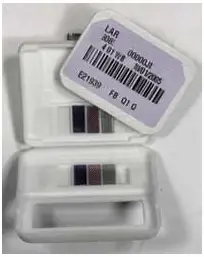
Film badges, film badge dosimeters, are small portable devices for monitoring cumulative radiation dose due to ionizing radiation. Principle of operation is similar as for X-ray pictures. The badge consists of two parts: photographic film, and a holder. The film is contained inside a badge. The piece of photographic film that is the sensitive material and it must be removed monthly and developed. The more radiation exposure, the more blackening of the film. The blackening of the film is linear to the dose, and doses up to about 10 Gy can be measured.
Film Badge. Source: www.nde-ed.org
Advantages and Disadvantages of Film Dosimeters
Advantages of Film Dosimeters
A film badge as a personnel monitoring device are very simple and therefore they are not expensive.
A film badge provides a permanent record.
Film badge dosimeters are very reliable.
A film badge is used to measure and record radiation exposure due to gamma rays, X-rays and beta particles.
Disadvantages of Film Dosimeters
Film dosimeters usually cannot be read on site instead of they have to be sent away for developing.
Film dosimeters are for one-time use only, they cannot be reused.
Exposures of less than 0.2 mSv (20 millirem) of gamma radiation cannot be accurately measured.
Robert Reed Burn, Introduction to Nuclear Reactor Operation, 1988.
U.S. Department of Energy, Nuclear Physics and Reactor Theory. DOE Fundamentals Handbook, Volume 1 and 2. January 1993.
Paul Reuss, Neutron Physics. EDP Sciences, 2008. ISBN: 978-2759800414.
See also:
TLD
We hope, this article, Thermoluminescent Dosimeter – TLD vs Film Badge Dosimeter, helps you. If so, give us a like in the sidebar. Main purpose of this website is to help the public to learn some interesting and important information about radiation and dosimeters.
Portable survey meters are radiation detectors used by radiological technicians to measure ambient dose rate. These portable instruments usually have rate meters. Portable Survey Meters – Gamma Survey Meter
Portable survey meters are radiation detectors used by radiological technicians to measure ambient dose rate. These portable instruments usually have rate meters. In nuclear facilities, these portable survey meters are typically used by radiation protection technicians, which are responsible for following operations in the field to help assure that radiation protection policies are carried out and that jobs are implemented in accordance with the ALARA principle. Their responsibilities include:
Providing assistance and advice to workers to motivate them to adopt an ALARA behaviour.
Following jobs to ensure the respect of safety and radiation protection procedures.
In some plants, stopping work in case of serious deviation from dosimetric objectives, or when there is a significantly increasing radiological risk for workers.
The typical radiation survey meter is, for example, the RDS-31, which is a multi-purpose radiation survey meter that uses a G-M detector. It has optional alpha, beta, and gamma external probes. It measures 3.9 x 2.6 x 1.3 inches and can be handheld, or worn by pocket, belt clip, or pouch. It has a five-digit, backlit, LCD display. Geiger counters operate at such a high voltage that the size of the output pulse is always the same, regardless of how many ion pairs were created in the detector. Geiger counters are mainly used for portable instrumentation due to its sensitivity, simple counting circuit, and ability to detect low-level radiation. Although the major use of Geiger counters is probably in individual particle detection, they are also found in gamma survey meters. They are able to detect almost all types of radiation, but there are slight differences in the Geiger-Mueller tube.
Ambient dose equivalent, H*(10). The ambient dose equivalent is an operational quantity for area monitoring of strongly penetrating radiation.
Directional dose equivalent, H’ (d,Ω). The directional dose equivalent is an operational quantity for area monitoring of weakly penetrating radiation.
See also: Work Management to Optimise Occupational Radiological Protection at Nuclear Power Plants. NUCLEAR ENERGY AGENCY, OECD 2009. ISBN 978-92-64-99089-0.
High-pressure Ionization Chamber – Gamma Survey Meter
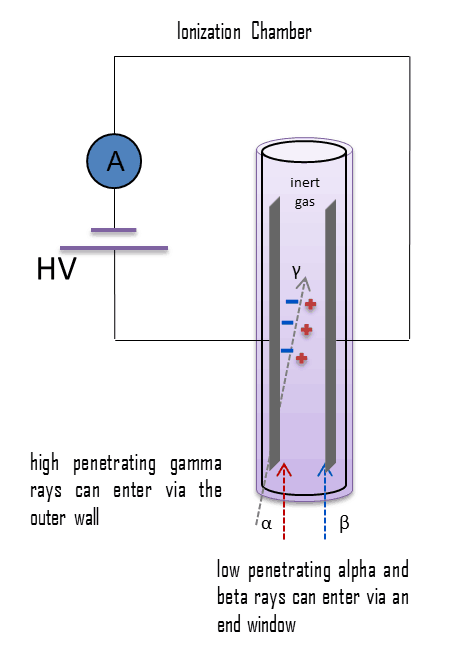
Ion chambers may be also used as the Emergency Gamma Survey Meter, the Beta Survey Meter, and the Tritium-in-Air Monitor. They are very useful for high levels of gamma radiation. But in this case, there are some difficulties.
Gamma rays have very little trouble in penetrating the metal walls of the chamber. Therefore, ionization chambers may be used to detect gamma radiation and X-rays collectively known as photons, and for this the windowless tube is used. Ionization chambers have a good uniform response to radiation over a wide range of energies and are the preferred means of measuring high levels of gamma radiation. Some problems are caused by the fact, that alpha particles are more ionising than beta particles and than gamma rays, so more current is produced in the ionization chamber region by alpha than beta and gamma. Gamma rays deposit significantly lower amount of energy to the detector than other particles.
The efficiency of the chamber can be further increased by the use of a high pressure gas. Typically a pressure of 8-10 atmospheres can be used, and various noble gases are employed. For example, high-pressure xenon (HPXe) ionization chambers are ideal for use in uncontrolled environments, as a detector’s response has been shown to be uniform over large temperature ranges (20–170°C). The higher pressure results in a greater gas density and thereby a greater chance of collision with the fill gas and ion-pair creation by incident gamma radiation. Because of the increased wall thickness required to withstand this high pressure, only gamma radiation can be detected. These detectors are used in survey meters and for environmental monitoring.
Robert Reed Burn, Introduction to Nuclear Reactor Operation, 1988.
U.S. Department of Energy, Nuclear Physics and Reactor Theory. DOE Fundamentals Handbook, Volume 1 and 2. January 1993.
Paul Reuss, Neutron Physics. EDP Sciences, 2008. ISBN: 978-2759800414.
See also:
Dosimetry in NPPs
We hope, this article, Portable Survey Meter – Gamma Survey Meter, helps you. If so, give us a like in the sidebar. Main purpose of this website is to help the public to learn some interesting and important information about radiation and dosimeters.
The radiation monitoring system (RMS) with pre-set alarm levels (e.g. for dose, dose rate or airborne activity) provide a reliable means of real time monitoring of the radiological conditions to which a worker is exposed. Radiation Dosimetry
At nuclear facilities, remote radiation monitoring systems (RMS) are installed to monitor radiation levels at selected plant locations. The radiation monitoring system with pre-set alarm levels (e.g. for dose, dose rate or airborne activity) provide a reliable means of real time monitoring of the radiological conditions to which a worker is exposed. If these levels are exceeded, alarms are activated and in some cases automatic protective functions initiated. Thus the system serves to:
Warn of any radiation health hazard
Give an early warning of a plant malfunction
Initiate automatic protective functions.
All data are collected in a radiation protection control room. The radiation monitoring system may gather all information on the radiological conditions at various working areas, as well as voice and visual feedback, with a minimum presence of RP technicians in radiation areas, therefore reducing dose to such personnel. Several types of radiation monitors are used in the RMS, depending on the source and strength of the radiation source.
Robert Reed Burn, Introduction to Nuclear Reactor Operation, 1988.
U.S. Department of Energy, Nuclear Physics and Reactor Theory. DOE Fundamentals Handbook, Volume 1 and 2. January 1993.
Paul Reuss, Neutron Physics. EDP Sciences, 2008. ISBN: 978-2759800414.
See also:
Dosimetry in NPPs
We hope, this article, Radiation Monitoring System, helps you. If so, give us a like in the sidebar. Main purpose of this website is to help the public to learn some interesting and important information about radiation and dosimeters.
Hand & Shoe Monitors are instruments for surface contamination measurement. In nuclear facilities, Hand & Shoe Monitors are installed usually at the exit from the controlled areas.
Hand & Shoe Monitors are instruments for surface contamination measurement. In nuclear facilities, Hand & Shoe Monitors are installed usually at the exit from the controlled areas and workers are usually required to measure, whether their hands and shoes are contaminated or not. Generally, surface contamination means that radioactive material has been deposited on surfaces. It may be loosely deposited, much like ordinary dust, or it may be quite firmly fixed by chemical reaction. This distinction is important, and we classify surface contamination on the basis of how easily it can be removed.
These monitors may utilize gas-flow proportional counters with a large area, they are used in various locations in the station to detect beta gamma contamination on hands, shoes and clothing. In order to detect beta radiation, these large area detectors have thin Mylar windows to allow low-energy beta particles to enter the detector. For example, they can easily detect the low energy beta particles emitted by carbon-14 (Emax = 156 keV). When instruments are operated in the proportional region, the voltage must be kept constant. If a voltage remains constant the gas amplification factor also does not change. Proportional counter detection instruments are very sensitive to low levels of radiation. By proper functional arrangements, modifications, and biasing, the proportional counter can be used to detect alpha, beta, gamma radiation. The electronics sorts the alpha, the beta-gamma pulses. This feature may be used in alpha, beta-gamma Hand & Shoe Monitors, Full-Body Monitors, some alpha Contamination Monitors. Although such detectors are very sensitive, their drawback is that the windows are punctured quite easily by misuse. The detector is then dead until its window is repaired.
Robert Reed Burn, Introduction to Nuclear Reactor Operation, 1988.
U.S. Department of Energy, Nuclear Physics and Reactor Theory. DOE Fundamentals Handbook, Volume 1 and 2. January 1993.
Paul Reuss, Neutron Physics. EDP Sciences, 2008. ISBN: 978-2759800414.
See also:
Dosimetry in NPPs
We hope, this article, Hand & Shoe Monitor, helps you. If so, give us a like in the sidebar. Main purpose of this website is to help the public to learn some interesting and important information about radiation and dosimeters.
Full-Body Monitors, or Whole-Body Monitors, are instruments for surface contamination measurement. They are used for personnel exit monitoring, which is the term used in radiation protection for checking for external contamination. Radiation Dosimetry
Full-Body Monitors, or Whole-Body Monitors, are instruments for surface contamination measurement. They are used for personnel exit monitoring, which is the term used in radiation protection for checking for external contamination (or surface contamination) of a whole body of a person leaving a radioactive contamination controlled area. The main purpose is to prevent the spread of contamination outside the controlled area. Generally, surface contamination means that radioactive material has been deposited on surfaces. It may be loosely deposited, much like ordinary dust, or it may be quite firmly fixed by chemical reaction. This distinction is important, and we classify surface contamination on the basis of how easily it can be removed.
These monitors may utilize gas-flow proportional counters with a large area, and workers must use it every time they leave the controlled area. These monitors usually require a two-step measurement. First the measured person face the detectors. When they’ve done their thing, the person turn around to monitor his/her back. Proximity sensors check that the person is standing in the right position for the measurement. If not, the monitor actually talks to the person and tells what to do. Full-body monitors are able to detect beta and gamma contamination on the body. In order to detect beta radiation, these large area detectors have thin Mylar windows to allow low-energy beta particles to enter the detector. When instruments are operated in the proportional region, the voltage must be kept constant. If a voltage remains constant the gas amplification factor also does not change. Proportional counter detection instruments are very sensitive to low levels of radiation. By proper functional arrangements, modifications, and biasing, the proportional counter can be used to detect alpha, beta, gamma radiation. The electronics sorts the alpha, the beta-gamma pulses. This feature may be used in alpha, beta-gamma Hand & Shoe Monitors, Full-Body Monitors, some alpha Contamination Monitors. Although such detectors are very sensitive, their drawback is that the windows are punctured quite easily by misuse. The detector is then dead until its window is repaired.
Robert Reed Burn, Introduction to Nuclear Reactor Operation, 1988.
U.S. Department of Energy, Nuclear Physics and Reactor Theory. DOE Fundamentals Handbook, Volume 1 and 2. January 1993.
Paul Reuss, Neutron Physics. EDP Sciences, 2008. ISBN: 978-2759800414.
See also:
Dosimetry in NPPs
We hope, this article, Full-Body Monitor – Whole-Body Monitor, helps you. If so, give us a like in the sidebar. Main purpose of this website is to help the public to learn some interesting and important information about radiation and dosimeters.
Portal monitors, are instruments for external contamination measurement. They are used for monitoring of personnel, which exit a nuclear facility. Portal monitors are usually last line of defence against contaminated people and equipment leaving the station. Radiation Dosimetry
Portal monitors, are instruments for external contamination measurement. They are used for monitoring of personnel, which exit a nuclear facility. Portal monitors are usually last line of defence against contaminated people and equipment leaving the station. These detectors are able to measure simultaneously beta and gamma contamination. The total body surface including hands, head and feet is measured by many beta gas flow proportional counters and several large additional gamma scintillation detectors, which are positioned in the breast area (left and right side). Large scintillation detectors (plastic or liquid) are installed in order to be able to detect the passage of low levels of gamma activity. As they are only sensitive to gamma radiation, they are able to detect incorporated gamma activity if present. In this way, if some internal contamination exists, the worker is immediately sent for whole-body counting and the dose assessment is much more accurate.
Robert Reed Burn, Introduction to Nuclear Reactor Operation, 1988.
U.S. Department of Energy, Nuclear Physics and Reactor Theory. DOE Fundamentals Handbook, Volume 1 and 2. January 1993.
Paul Reuss, Neutron Physics. EDP Sciences, 2008. ISBN: 978-2759800414.
See also:
Dosimetry in NPPs
We hope, this article, Portal Monitor – Radiation, helps you. If so, give us a like in the sidebar. Main purpose of this website is to help the public to learn some interesting and important information about radiation and dosimeters.
Radiation Frisker is a handheld, wand-shaped radiation detector, featuring digital display and an internal pancake, halogen-quenched, Geiger-Mueller detector. Radiation Dosimetry
Radiation Frisker is a handheld, wand-shaped radiation detector, featuring digital display and an internal pancake, halogen-quenched, Geiger-Mueller detector. Geiger counters are mainly used for portable instrumentation due to its sensitivity, simple counting circuit, and ability to detect low-level radiation. Although the major use of Geiger counters is probably in individual particle detection, they are also found in gamma survey meters. They are able to detect almost all types of radiation, but there are slight differences in the Geiger-Mueller tube. For alpha and beta particles to be detected by Geiger counters, they must be provided with a thin window. This “end-window” must be thin enough for the alpha and beta particles to penetrate. However, a window of almost any thickness will prevent an alpha particle from entering the chamber. The window is usually made of mica with a density of about 1.5 – 2.0 mg/cm2 to allow low-energy beta particles (e.g. from carbon-14) to enter the detector. Effective window diameter in a Frisker is about 50 mm.
The Frisker detects alpha, beta, gamma, and X-ray radiation. Typical Frisker detects:
gamma rays and X-rays down to 10 keV typical through the window, 40 keV minimum through the case.
Efficiencies vary, depending on energy and isotope. The Frisker is ideal for general purpose survey in laboratory use, nuclear power plant frisking, emergency response, border patrol, airport security, and other applications.
Robert Reed Burn, Introduction to Nuclear Reactor Operation, 1988.
U.S. Department of Energy, Nuclear Physics and Reactor Theory. DOE Fundamentals Handbook, Volume 1 and 2. January 1993.
Paul Reuss, Neutron Physics. EDP Sciences, 2008. ISBN: 978-2759800414.
See also:
Dosimetry in NPPs
We hope, this article, Radiation Frisker – Contamination Monitor, helps you. If so, give us a like in the sidebar. Main purpose of this website is to help the public to learn some interesting and important information about radiation and dosimeters.
Contamination meters are instruments for surface contamination measurement. These monitors may utilize proportional counters with a large area, thin window detector similar to Hand & Shoe Monitors.
Contamination meters are instruments for surface contamination measurement. Generally, surface contamination means that radioactive material has been deposited on surfaces (such as walls, floors). It may be loosely deposited, much like ordinary dust, or it may be quite firmly fixed by chemical reaction. This distinction is important, and we classify surface contamination on the basis of how easily it can be removed. In nuclear facilities, contamination monitors are installed usually at the exit from the controlled areas. These monitors may utilize proportional counters with a large area, thin window detector similar to Hand & Shoe Monitors. When instruments are operated in the proportional region, the voltage must be kept constant. If a voltage remains constant the gas amplification factor also does not change. Proportional counter detection instruments are very sensitive to low levels of radiation. By proper functional arrangements, modifications, and biasing, the proportional counter can be used to detect alpha, beta, gamma, or neutron radiation in mixed radiation fields. The electronics sorts the alpha, the beta-gamma pulses and displays both in a bar-type display.
Robert Reed Burn, Introduction to Nuclear Reactor Operation, 1988.
U.S. Department of Energy, Nuclear Physics and Reactor Theory. DOE Fundamentals Handbook, Volume 1 and 2. January 1993.
Paul Reuss, Neutron Physics. EDP Sciences, 2008. ISBN: 978-2759800414.
See also:
Dosimetry in NPPs
We hope, this article, Alpha Beta Gamma Contamination Meter, helps you. If so, give us a like in the sidebar. Main purpose of this website is to help the public to learn some interesting and important information about radiation and dosimeters.
There are many types of radiation dosimeters and detectors, and each type has limitations. The passive and the active dosimeters are often used together to complement each other. Radiation Dosimetry
A radiation dosimeter is a device that measures exposure to ionizing radiation. Dosimeters usually record a dose, which is the absorbed radiation energy measured in grays (Gy) or the equivalent dose measured in sieverts (Sv). A personal dosimeter is dosimeter, that is worn at the surface of the body by the person being monitored, and it records of the radiation dose received.
EPD – Electronic Personal Dosimeters
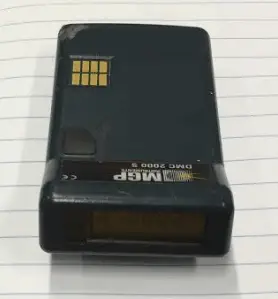
Commercially available dosimeters range from low-cost, passive devices that store personnel dose information for later readout, to more expensive, battery operated devices that display immediate dose and dose rate information (typically an electronic personal dosimeter). Readout method, dose measurement range, size, weight, and price are important selection factors.
There are two kinds of dosimeters:
Passive Dosimeters. Commonly used passive dosimeters are the Thermo Luminescent Dosimeter (TLD) and the film badge. A passive dosimeter produces a radiation-induced signal, which is stored in the device. The dosimeter is then processed and the output is analyzed.
Active Dosimeters. To get a real time value of your exposure you can instead use an active dosimeter, typically an electronic personal dosimeter (EPD). An active dosimeter produces a radiation-induced signal and displays a direct reading of the detected dose or dose rate in real time.
The passive and the active dosimeters are often used together to complement each other. To estimate effective doses, dosimeters must be worn on a position of the body representative of its exposure, typically between the waist and the neck, on the front of the torso, facing the radioactive source. Dosimeters are usually worn on the outside of clothing, around the chest or torso to represent dose to the “whole body”. Dosimeters may also be worn on the extremities or near the eye to measure equivalent dose to these tissues.
Types of Dosimeters
There are many types of radiation dosimeters and detectors, and each type has limitations.
Film Badge Dosimeters
Film badges are small portable devices for monitoring cumulative radiation dose due to ionizing radiation. Principle of operation is similar as for X-ray pictures. The badge consists of two parts: photographic film, and a holder. The film is contained inside a badge. The piece of photographic film that is the sensitive material and it must be removed monthly and developed. The more radiation exposure, the more blackening of the film. The blackening of the film is linear to the dose, and doses up to about 10 Gy can be measured.
See also: Film Badge Dosimeter
TLD – Thermoluminescent Dosimeter
A thermoluminescent dosimeter, abbreviated as TLD, is a passive radiation dosimeter, that measures ionizing radiation exposure by measuring the intensity of visible light emitted from a sensitive crystal in the detector when the crystal is heated. The intensity of light emitted is measure by TLD reader and it is dependent upon the radiation exposure. Thermoluminescent dosimeters was invented in 1954 by Professor Farrington Daniels of the University of Wisconsin-Madison. TLD dosimeters are applicable to situations where real-time information is not needed, but precise accumulated dose monitoring records are desired for comparison to field measurements or for assessing the potential for long term health effects.
See also: TLD – Thermoluminescent Dosimeter
EPD – Electronic Personal Dosimeter
An electronic personal dosimeter is modern dosimeter, which can give a continuous readout of cumulative dose and current dose rate, and can warn the person wearing it when a specified dose rate or a cumulative dose is exceeded. EPDs are especially useful in high dose areas where residence time of the wearer is limited due to dose constraints.
The electronic personal dosimeter, EPD, is able to display a direct reading of the detected dose or dose rate in real time. Electronic dosimeters may be used as a supplemental dosimeter as well a primary dosimeter. The passive dosimeters and the electronic personal dosimeters are often used together to complement each other.
See also: EPD – Electronic Personal Dosimeter
MOSFET Dosimeter
MOSFET dosimeter is a small portable device for monitoring and direct reading of radiation dose rate. Since it is based on the MOSFET transistor, the metal-oxide-semiconductor field-effect transistor (MOSFET), the principle of operation is similar as for semiconductor detectors. MOSFET dosimeters are now used as clinical dosimeters for radiotherapy radiation beams. Their main advantage is their physical size, which is less than 4 mm2. In radiation therapy dosimetry, MOSFET dosimeters often replace TLD dosimeters, since they offer immediate read out.
See also: MOSFET Dosimeter
Self-reading Dosimeter
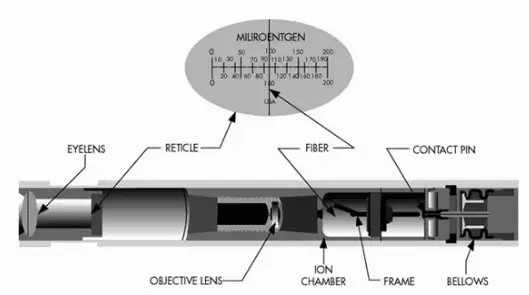
The self indicating pocket dosimeter consists of an ionization chamber, with a volume of approximately two milliliters, which is sensitive to a desired radiation, a quartz fiber electrometer to measure the charge, and a microscope to read the fiber image off a scale. Source: www.nde-ed.org
Self-reading dosimeters are field-readable devices worn on the body to measure accumulated dose. These are unpowered devices that do not contain a battery. Devices in this group include:
Quartz fiber dosimeter. A quartz fiber dosimeter, sometimes called a self indicating pocket dosimeter (SIPD), is a pen-like device that measures the cumulative dose of ionizing radiation received by the device, usually over one work period.
Self-developing photochemical cards. Self-developing photochemical card is a credit card sized, instant color developing emergency dosimeter. It is designed for monitoring exposure in a radiological incident for medical treatment triage and to minimize worry and panic.
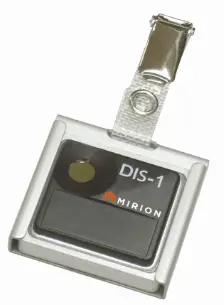
Direct-ion storage dosimeter, DIS, is an electronic dosimeter, from which the dose information for both Hp(10) and Hp(0.07) can be obtained instantly at the workplace by using an electronic reader unit. The DIS dosimeter is based on the combination of an ion chamber and a non-volatile electronic charge storage element. DIS dosimeter use an analog memory cell inside a small, gas-filled, ionization chamber. Incident radiation causes ionizations in the chamber wall and in the gas, and the charge is stored for subsequent readout. The DIS dosimeter is read at the user’s site through connection to an electronic reader unit.
Robert Reed Burn, Introduction to Nuclear Reactor Operation, 1988.
U.S. Department of Energy, Nuclear Physics and Reactor Theory. DOE Fundamentals Handbook, Volume 1 and 2. January 1993.
Paul Reuss, Neutron Physics. EDP Sciences, 2008. ISBN: 978-2759800414.
See also:
Radiation Dosimetry
We hope, this article, Type of Radiation Dosimeters, helps you. If so, give us a like in the sidebar. Main purpose of this website is to help the public to learn some interesting and important information about radiation and dosimeters.
Film badges, film badge dosimeters, are small portable devices for monitoring cumulative radiation dose due to ionizing radiation. The badge consists of two parts: photographic film, and a holder. Radiation Dosimetry
Film Badge. Source: www.nde-ed.org
Film badges, film badge dosimeters, are small portable devices for monitoring cumulative radiation dose due to ionizing radiation. Principle of operation is similar as for X-ray pictures. The badge consists of two parts: photographic film, and a holder. The film is contained inside a badge. The piece of photographic film that is the sensitive material and it must be removed monthly and developed. The more radiation exposure, the more blackening of the film. The blackening of the film is linear to the dose, and doses up to about 10 Gy can be measured. Film badge dosimeters are applicable to situations where real-time information is not needed, but accumulated dose monitoring records are desired for comparison to field measurements or for assessing the potential for long term health effects. In dosimetry, both the quartz fiber and film badge types are being superseded by TLDs and EPDs (Electronic Personal Dosimeter).
Film badge dosimeters are for one-time use only, they cannot be reused. A film badge dosimeter is dosimeter, that is worn at the surface of the body by the person being monitored, and it records of the radiation dose received. The film badge is used to measure and record radiation exposure due to gamma rays, X-rays and beta particles. The badge incorporates a series of filters (lead, tin, cadmium and plastic) to determine the quality of the radiation. To monitor beta particle emission, the filters use various densities of plastic or even label material. It is typical for a single badge to contain a series of filters of different thicknesses and of different materials; the precise choice may be determined by the environment to be monitored.
Examples of filters:
There is an open window that makes it possible for weaker radiations to reach the film.
A thin plastic filter which attenuates beta radiation but passes all other radiations
A thick plastic filter which passes all but the lowest energy photon radiation and absorbs all but the highest beta radiation.
A dural filter which progressively absorbs photon radiation at energies below 65 keV as well as beta radiation.
A tin/lead filter of a thickness which allows an energy independent dose response of the film over the photon energy range 75 keV to 2 MeV.
A cadmium lead filter can be used for thermal neutrons detection. The capture of neutrons ((n,gamma) reactions) by cadmium produces gamma rays which blacken the film thus enabling assessment of exposure to neutrons.
Film dosimeter must be worn on a position of the body representative of its exposure. Therefore, the badge is typically worn on the outside of clothing, around the chest or torso to represent dose to the “whole body”. Today, film badges are still in use worldwide worn by people such as x-ray technicians and nurses, who may be exposed to radiation. On the other hand, there has been a trend towards using other dosimeter materials that are less energy dependent and can more accurately assess radiation dose. Film dosimeters are being replaced usually by thermoluminescent dosimeters (TLDs), aluminium oxide based dosimeters, and electronic personal dosimeters (EPDs).
Advantages and Disadvantages of Film Dosimeters
Advantages of Film Dosimeters
A film badge as a personnel monitoring device are very simple and therefore they are not expensive.
A film badge provides a permanent record.
Film badge dosimeters are very reliable.
A film badge is used to measure and record radiation exposure due to gamma rays, X-rays and beta particles.
Disadvantages of Film Dosimeters
Film dosimeters usually cannot be read on site instead of they have to be sent away for developing.
Film dosimeters are for one-time use only, they cannot be reused.
Exposures of less than 0.2 mSv (20 millirem) of gamma radiation cannot be accurately measured.
Radiation Dose Measuring and Monitoring
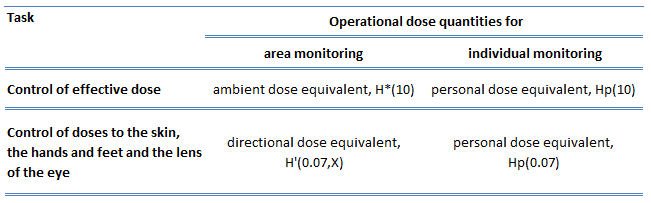
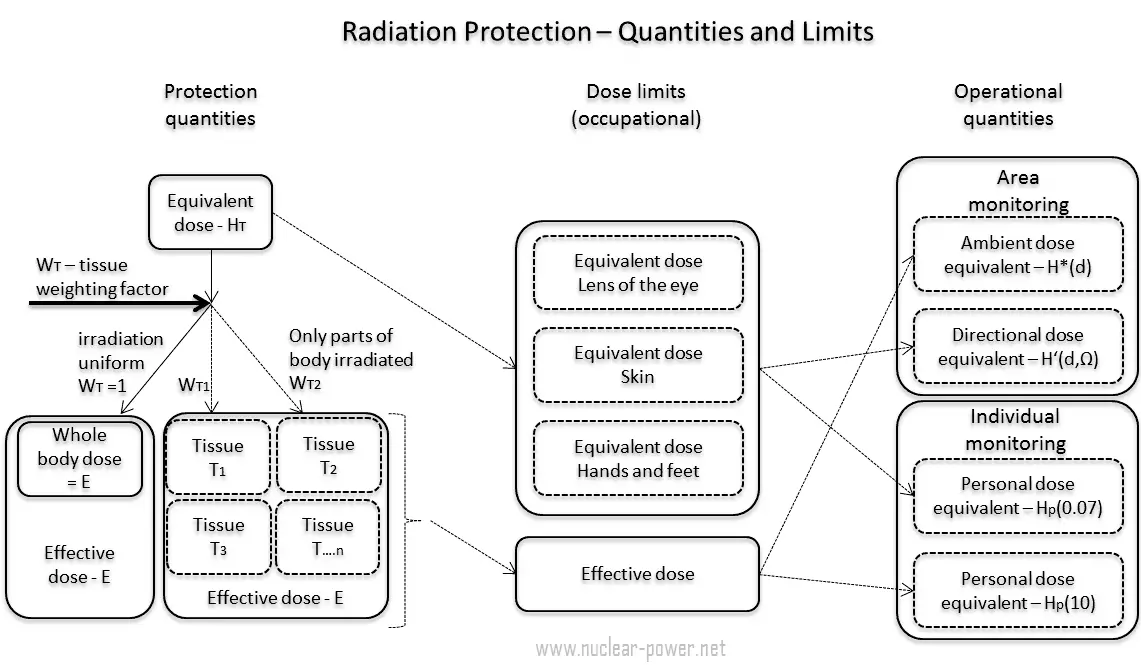
In previous chapters, we described the equivalent dose and the effective dose. But these doses are not directly measurable. For this purpose, the ICRP has introduced and defined a set of operational quantities, which can be measured and which are intended to provide a reasonable estimate for the protection quantities. These quantities aim to provide a conservative estimate for the value of the protection quantities related to an exposure avoiding both underestimation and too much overestimation.
Numerical links between these quantities is represented by conversion coefficients, which are defined for a reference person. It is very important that an internationally agreed set of conversion coefficients is available for general use in radiological protection practice for occupational exposures and exposures of the public. For the calculation of conversion coefficients for external exposure, computational phantoms are used for dose assessment in various radiation fields. For the calculation of dose coefficients from intakes of radionuclides, biokinetic models for radionuclides, reference physiological data, and computational phantoms are used.
A set of evaluated data of conversion coefficients for protection, and operational quantities for external exposure to mono-energetic photon, neutron, and electron radiation under specific irradiation conditions is published in reports (ICRP, 1996b, ICRU, 1997).
In general, the ICRP defines operational quantities for area and individual monitoring of external exposures. The operational quantities for area monitoring are:
Ambient dose equivalent, H*(10). The ambient dose equivalent is an operational quantity for area monitoring of strongly penetrating radiation.
Directional dose equivalent, H’ (d,Ω). The directional dose equivalent is an operational quantity for area monitoring of weakly penetrating radiation.
Personal dose equivalent, Hp(0.07). The Hp(0.07) dose equivalent is an operational quantity for individual monitoring for the assessment of the dose to the skin and to the hands and feet.
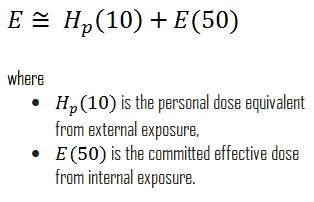
Personal dose equivalent, Hp(10). The Hp(10) dose equivalent is an operational quantity for individual monitoring for the assessment of effective dose.
Special Reference: ICRP, 2007. The 2007 Recommendations of the International Commission on Radiological Protection. ICRP Publication 103. Ann. ICRP 37 (2-4).
Dose limits are split into two groups, the public, and occupationally exposed workers. According to ICRP, occupational exposure refers to all exposure incurred by workers in the course of their work, with the exception of
excluded exposures and exposures from exempt activities involving radiation or exempt sources
any medical exposure
the normal local natural background radiation.
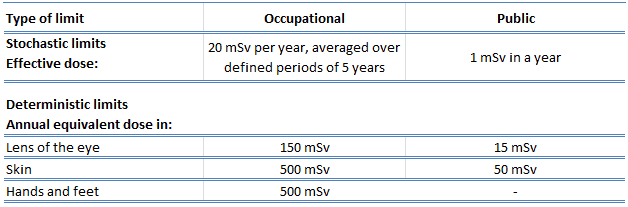
The following table summarizes dose limits for occupationally exposed workers and for the public:
Table of dose limits for occupationally exposed workers and for the public. Source of data: ICRP, 2007. The 2007 Recommendations of the International Commission on Radiological Protection. ICRP Publication 103. Ann. ICRP 37 (2-4).
According to the recommendation of the ICRP in its statement on tissue reactions of 21. April 2011, the equivalent dose limit for the lens of the eye for occupational exposure in planned exposure situations was reduced from 150 mSv/year to 20 mSv/year, averaged over defined periods of 5 years, with no annual dose in a single year exceeding 50 mSv.
Limits on effective dose are for the sum of the relevant effective doses from external exposure in the specified time period and the committed effective dose from intakes of radionuclides in the same period. For adults, the committed effective dose is computed for a 50-year period after intake, whereas for children it is computed for the period up to age 70 years. The effective whole-body dose limit of 20 mSv is an average value over five years. The real limit is 100 mSv in 5 years, with not more than 50 mSv in any one year. Toward that end, employers carefully monitor the exposure of these individuals using instruments called dosimeters worn on a position of the body representative of its exposure. In most situations of occupational exposure the effective dose, E, can be derived from operational quantities using the following formula:
Sievert – Unit of Equivalent Dose
In radiation protection, the sievert is a derived unit of equivalent dose and effective dose. The sievert represents the equivalent biological effect of the deposit of a joule of gamma rays energy in a kilogram of human tissue. Unit of sievert is of importance in radiation protection and was named after the Swedish scientist Rolf Sievert, who did a lot of the early work on radiation dosimetry in radiation therapy.
As was written, the sievert is used for radiation dose quantities such as equivalent dose and effective dose. Equivalent dose (symbol HT) is a dose quantity calculated for individual organs (index T – tissue). Equivalent dose is based on the absorbed dose to an organ, adjusted to account for the effectiveness of the type of radiation. Equivalent dose is given the symbol HT. The SI unit of HT is the sievert (Sv) or but rem (roentgen equivalent man) is still commonly used (1 Sv = 100 rem).
Examples of Doses in Sieverts
We must note that radiation is all around us. In, around, and above the world we live in. It is a natural energy force that surrounds us. It is a part of our natural world that has been here since the birth of our planet. In the following points we try to express enormous ranges of radiation exposure, which can be obtained from various sources.
0.05 µSv – Sleeping next to someone
0.09 µSv – Living within 30 miles of a nuclear power plant for a year
0.1 µSv – Eating one banana
0.3 µSv – Living within 50 miles of a coal power plant for a year
10 µSv – Average daily dose received from natural background
20 µSv – Chest X-ray
40 µSv – A 5-hour airplane flight
600 µSv – mammogram
1 000 µSv – Dose limit for individual members of the public, total effective dose per annum
3 650 µSv – Average yearly dose received from natural background
5 800 µSv – Chest CT scan
10 000 µSv – Average yearly dose received from natural background in Ramsar, Iran
20 000 µSv – single full-body CT scan
175 000 µSv – Annual dose from natural radiation on a monazite beach near Guarapari, Brazil.
5 000 000 µSv – Dose that kills a human with a 50% risk within 30 days (LD50/30), if the dose is received over a very short duration.
Robert Reed Burn, Introduction to Nuclear Reactor Operation, 1988.
U.S. Department of Energy, Nuclear Physics and Reactor Theory. DOE Fundamentals Handbook, Volume 1 and 2. January 1993.
Paul Reuss, Neutron Physics. EDP Sciences, 2008. ISBN: 978-2759800414.
See also:
Radiation Dosimeter
We hope, this article, Film Badge Dosimeter – Film Dosimeter, helps you. If so, give us a like in the sidebar. Main purpose of this website is to help the public to learn some interesting and important information about radiation and dosimeters.