Equivalent doses from global fallout dropped from about 130 μSv/year in 1963 to about 10 μSv/year in recent years. Nuclear Fallout – Radiation Doses
In general, nuclear fallout is the residual radioactive material from a nuclear blast that “falls out” of the sky after an atmospheric explosion. Fallout can also refer to nuclear reactor accidents, although a nuclear reactor does not explode like a nuclear weapon. The isotopic signature of fallout from nuclear blast is very different from the fallout from a serious power reactor accident.
In case of radiation doses from fallout, we consider the residual radioactive material from nuclear tests (not from reactor accidents) that were performed particularly in the two periods from 1954 to 1958 and from 1961 to 1962. According to the UNSCEAR, about 502 atmospheric tests, with a total fission and fusion yield of 440 Mt, were conducted.
Special Reference: Sources and effects of ionizing radiation, Annex B. UNSCEAR. New York, 2010. ISBN: 978-92-1-142274-0.
Fallout from a nuclear tests consist of fission fragments and neutron activation products. When a blast takes place on the ground or in the atmosphere near the ground, large amounts of activation products are formed also from surface materials. The fallout is particularly significant in the neighborhood of the test site, since the larger particles and most of debris lands on the ground (local fallout). But smaller particles may remain aloft in the upper atmosphere for years. These particles can be therefore distributed nearly uniformly around the world, and contribute to so called global fallout. Equivalent doses from global fallout dropped from about 130 μSv/year in 1963 to about 10 μSv/year in recent years.
Robert Reed Burn, Introduction to Nuclear Reactor Operation, 1988.
U.S. Department of Energy, Nuclear Physics and Reactor Theory. DOE Fundamentals Handbook, Volume 1 and 2. January 1993.
Paul Reuss, Neutron Physics. EDP Sciences, 2008. ISBN: 978-2759800414.
See also:
Man-made Sources
We hope, this article, Nuclear Fallout – Radiation Doses, helps you. If so, give us a like in the sidebar. Main purpose of this website is to help the public to learn some interesting and important information about radiation and dosimeters.
Radiation Exposures from Electricity Generation. The coal cycle contributes more than half of the total radiation dose to the global population from electricity generation. The nuclear fuel cycle contributes less than one-fifth of this. Radiation Dosimetry
Radiation is all around us. In, around, and above the world we live in. It is a natural energy force that surrounds us. It is a part of our natural world that has been here since the birth of our planet. All living creatures, from the beginning of time, have been, and are still being, exposed to ionizing radiation. Ionizing radiation is generated through nuclear reactions, nuclear decay, by very high temperature, or via acceleration of charged particles in electromagnetic fields.
Radiation Exposures from Electricity Generation
In this chapter, we would like to discuss a very interesting fact. It is generally known, the increasing use of nuclear power and electricity generation using nuclear reactors will lead to a small but increasing radiation dose to the general public. But it is not generally known, power generation from coal also creates additional exposures, and, what is more interesting, while exposure levels are very low, the coal cycle contributes more than half of the total radiation dose to the global population from electricity generation. The nuclear fuel cycle contributes less than one-fifth of this. The collective dose, which are defined as the sum of all individual effective doses in a group of people over the time period or during the operation being considered due to ionizing radiation, is:
670-1400 manSv for coal cycle, depending on the age of the power plant,
130 man Sv for nuclear fuel cycle,
5-160 man Sv for geothermal power,
55 man Sv for natural gas
0.03 man Sv for oil
Yes, these results should be seen from the perspective of the share of each technology in worldwide electricity production. Since 40 per cent of the world’s energy was produced by the coal cycle in 2010, and 13 per cent by nuclear, the normalized collective dose will be about the same:
0.7 – 1.4 man Sv/GW.a (man sievert per gigawatt year) for coal cycle
0.43 man Sv/GW.a (man sievert per gigawatt year) for nuclear fuel cycle
Special Reference: Sources and effects of ionizing radiation, UNSCEAR 2016 – Annex B. New York, 2017. ISBN: 978-92-1-142316-7.
The above doses are related to public exposure. If we consider occupational exposure, regarding the mining of rare earth metals needed for construction, by far the largest collective dose to workers per unit of electricity generated assessed by the UNSCEAR came from solar power, followed by wind power. For solar power, occupational collective dose normalized to energy is a factor of forty and eighty larger than for the nuclear fuel cycle and coal cycle, respectively.
Note that, the collective effective dose is often used to estimate the total health effects, but according to the ICRP this should be avoided (see more: Collective Dose).
Radiation Exposures from Nuclear Fuel Cycle
The nuclear fuel cycle is a process chain consisting of a series of differing stages. In general, nuclear fuel cycle consists of steps in the front end (the preparation of the fuel), steps in the service period (fuel burnup), and steps in the back end (reprocessing or disposal of spent nuclear fuel). Radiation exposures from nuclear fuel cycle are, according to UNSCEAR, evaluated from entire life cycle of nuclear fuel and this includes:
uranium mining, milling and mill tailings,
fabrication of fuel assemblies
power plant operation (except accidents),
spent fuel storage or reprocessing,
disposal of radioactive waste,
decommissioning activities.
The collective dose, which results from nuclear fuel cycle is:
130 man Sv for nuclear fuel cycle,
Almost half of the contribution to public exposures from the nuclear fuel cycle comes from discharges of natural radionuclides during uranium mining and milling activities.
The normalized collective dose (per gigawatt and year) is:
0.43 man Sv/GW.a (man sievert per gigawatt year) for nuclear fuel cycle
Special Reference: Sources and effects of ionizing radiation, UNSCEAR 2016 – Annex B. New York, 2017. ISBN: 978-92-1-142316-7.
In the following points we try to express ranges of radiation exposure from electricity generation together with doses from, which can be obtained from various sources.
05 µSv – Sleeping next to someone
09 µSv – Living within 30 miles of a nuclear power plant for a year
1 µSv – Eating one banana
3 µSv – Living within 50 miles of a coal power plant for a year
10 µSv – Average daily dose received from natural background
The above doses are related to public exposure. If we consider occupational exposure, regarding the uranium mining, power plant workers etc., the collective dose is higher especially uranium miners. The miners are surrounded by rocks and sloshing through ground water that is exuding radon.
Note that, the collective effective dose is often used to estimate the total health effects, but according to the ICRP this should be avoided.
Radiation Exposures from Coal Cycle
The public is also exposed to radiation from so called “enhanced sources of naturally occurring radioactive material”. This means also industries such as metal mining, coal mining and power production from coal creates additional exposures due to densification of naturally occurring radionuclides. Coal is the predominant source of energy used to produce electricity today. Coal cycle is a process chain consisting of a series of differing stages. For the coal cycle, the life cycle includes:
coal mining,
power plant operation,
coal ash deposits.
According to the UNSCEAR, power generation from coal and entire coal cycle contribute more than half of the total radiation dose to the global population from electricity generation. This statement will seem paradoxical to many readers, since it’s not commonly known that non-nuclear energy sources release any radiation into the environment. But power generation from coal also creates additional exposures to public. Even nuclear fuel cycle releases less radiation into the environment than coal cycle and any other major energy source.
The problem is coal itself and especially coal ash (fly ash). Coal, a combustible black or brownish-black sedimentary rock, contains a substantial amount of the radioactive elements uranium and thorium. According to the UNSCEAR, the average specific activity of both uranium-238 and thorium-232 in coal is generally around 20 Bq/kg (range 5-300 Bq/kg). Coal mines in Freital, Germany, which have uranium concentrations of 15000 Bq/kg coal, are an exception. Burning coal gasifies its organic materials, concentrating its inorganic components into the remaining waste, called fly ash. Around 10% of coal is fly ash. Fly ash is hazardous and toxic to human beings and some other living things, and fly ash also contains the radioactive elements uranium and thorium, which are concentrated by a factor of 10. It must be emphasized, even fly ash does not possess any health hazards to the public. There are a few restrictions on the use of fly ash in landfill and road construction. Most restrictions are on the use in building construction, where it can result in increased exposures especially from radon. In any case, we don’t want to cause any irrational fear of radiation from coal. It does not mean, that it must be dangerous. In case of radiation from electricity generation, the doses are usually very, very low. Moreover, these results cannot be used to determine whether one form of energy generation is preferable to another.
The collective dose, which results from coal cycle is:
670-1400 man Sv for coal cycle, depending on the age of the power plant,
When considering the amount of electricity generated in the year 2010 by each technology, the coal cycle resulted in the largest collective dose to the global public and workers combined, followed by the nuclear fuel cycle. Of the remaining technologies, geothermal energy and combustion of natural gas were the next largest contributors.
The normalized collective dose (per gigawatt and year) is:
0.7 – 1.4 man Sv/GW.a (man sievert per gigawatt year) for coal cycle
Special Reference: Sources and effects of ionizing radiation, UNSCEAR 2016 – Annex B. New York, 2017. ISBN: 978-92-1-142316-7.
In the following points we try to express ranges of radiation exposure from electricity generation together with doses from, which can be obtained from various sources.
05 µSv – Sleeping next to someone
09 µSv – Living within 30 miles of a nuclear power plant for a year
1 µSv – Eating one banana
3 µSv – Living within 50 miles of a coal power plant for a year
10 µSv – Average daily dose received from natural background
The above doses are related to public exposure. If we consider occupational exposure, regarding the coal mining and fly ash deposits, the collective dose is higher especially for coal miners. Coal miners as a group receive the largest collective dose of radiation, through enhanced exposure to naturally occurring radionuclides.
Note that, the collective effective dose is often used to estimate the total health effects, but according to the ICRP this should be avoided (see more: Collective Dose).
Health Effects of Radiation Exposures from Electricity Generation
We must emphasize, eating bananas, working as airline flight crew or living near coal or nuclear power plant increases your annual dose rate. But it does not mean, that it must be dangerous. In each case, intensity of radiation also matters. It is very similar as for heat from a fire (less energetic radiation). If you are too close, the intensity of heat radiation is high and you can get burned. If you are at the right distance, you can withstand there without any problems and moreover it is comfortable. If you are too far from heat source, the insufficiency of heat can also hurt you. This analogy, in a certain sense, can be applied to radiation also from radiation sources.
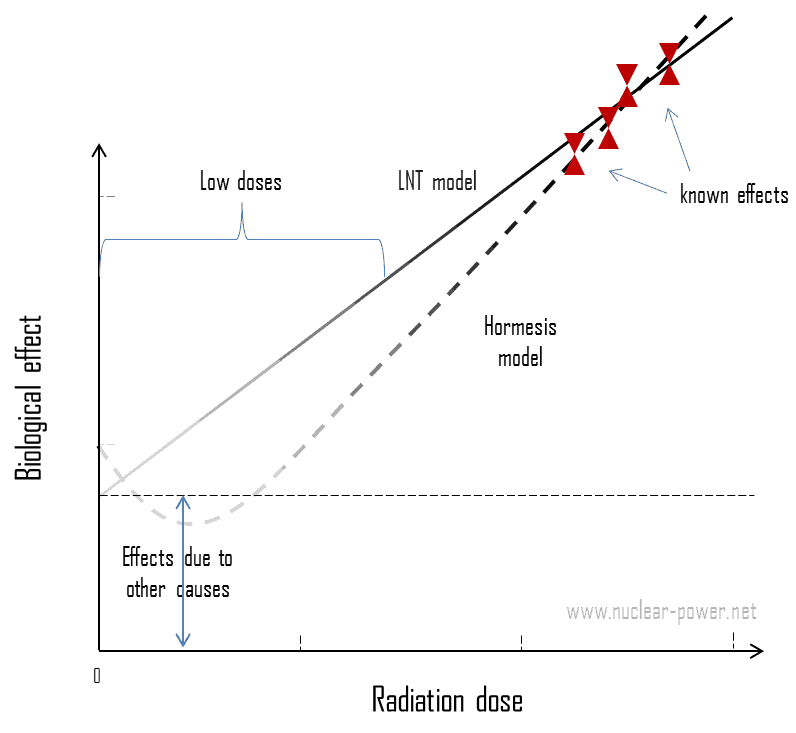
Alternative assumptions for the extrapolation of the cancer risk vs. radiation dose to low-dose levels, given a known risk at a high dose: LNT model, and hormesis model.
In case of radiation from electricity generation, we are talking usually about so called “low doses”. Low dose here means additional small doses comparable to the normal background radiation (10 µSv = average daily dose received from natural background). The doses are very very low and therefore the probability of cancer induction could be almost negligible. Secondly, and this is crucial, the truth about low-dose radiation health effects still needs to be found. It is not exactly known, whether these low doses of radiation are detrimental or beneficial (and where is the threshold). Government and regulatory bodies assume a LNT model instead of a threshold or hormesis not because it is the more scientifically convincing, but because it is the more conservative estimate. Problem of this model is that it neglects a number of defence biological processes that may be crucial at low doses. The research during the last two decades is very interesting and show that small doses of radiation given at a low dose rate stimulate the defense mechanisms. Therefore the LNT model is not universally accepted with some proposing an adaptive dose–response relationship where low doses are protective and high doses are detrimental. Many studies have contradicted the LNT model and many of these have shown adaptive response to low dose radiation resulting in reduced mutations and cancers. This phenomenon is known as radiation hormesis.
Robert Reed Burn, Introduction to Nuclear Reactor Operation, 1988.
U.S. Department of Energy, Nuclear Physics and Reactor Theory. DOE Fundamentals Handbook, Volume 1 and 2. January 1993.
Paul Reuss, Neutron Physics. EDP Sciences, 2008. ISBN: 978-2759800414.
See also:
Man-made Sources
We hope, this article, Radiation Exposure from Electricity Generation, helps you. If so, give us a like in the sidebar. Main purpose of this website is to help the public to learn some interesting and important information about radiation and dosimeters.
Health Effects of Medical Exposures. The medical use of ionizing radiation remains a rapidly changing field. In each case, usefulness of ionizing radiation must be balanced with its hazards. Radiation Dosimetry
In general, radiation exposures from medical diagnostic examinations are low (especially in diagnostic uses). Doses may be also high (only for therapeutic uses), but in each case, they must be always justified by the benefits of accurate diagnosis of possible disease conditions or by benefits of accurate treatment. These doses include contributions from medical and dental diagnostic radiology (diagnostic X-rays), clinical nuclear medicine and radiation therapy.
The medical use of ionizing radiation remains a rapidly changing field. In any case, usefulness of ionizing radiation must be balanced with its hazards. Nowadays a compromise was found and most of uses of radiation are optimized. Today it is almost unbelievable that x-rays was, at one time, used to find the right pair of shoes (i.e. shoe-fitting fluoroscopy). Measurements made in recent years indicate that the doses to the feet were in the range 0.07 – 0.14 Gy for a 20 second exposure. This practice was halted when the risks of ionizing radiation were better understood.
In the following points we try to express enormous ranges of radiation exposure as well as a few doses from medical sources.
1 µSv – Eating one banana
1 µSv – Extremity (hand, foot, etc.) X-ray
5 µSv – Dental X-ray
10 µSv – Average daily dose received from natural background
40 µSv – A 5-hour airplane flight
100 µSv – Chest X-ray
600 µSv – mammogram
1 000 µSv – Dose limit for individual members of the public, total effective dose per annum
3 650 µSv – Average yearly dose received from natural background
5 800 µSv – Chest CT scan
10 000 µSv – Average yearly dose received from natural background in Ramsar, Iran
20 000 µSv – single full-body CT scan
80 000 µSv – The annual local dose to localized spots at the bifurcations of segmental bronchi in the lungs caused by smoking cigarettes (1.5 packs/day).
175 000 µSv – Annual dose from natural radiation on a monazite beach near Guarapari, Brazil.
5 000 000 µSv – Dose that kills a human with a 50% risk within 30 days (LD50/30), if the dose is received over a very short duration.
As can be seen, low-level doses are common for everyday life.
Health Effects of Medical Exposures
The medical use of ionizing radiation remains a rapidly changing field. In each case, usefulness of ionizing radiation must be balanced with its hazards. Nowadays a compromise was found and most of uses of radiation are optimized. We must emphasize, eating bananas, working as airline flight crew or living in locations with, also increase your annual dose. Some medical treatments and diagnostic examinations also cause radiation doses. But it does not mean, that it must be dangerous. In each case, intensity of radiation also matters. It is very similar as for heat from a fire (less energetic radiation). If you are too close, the intensity of heat radiation is high and you can get burned. If you are at the right distance, you can withstand there without any problems and moreover it is comfortable. If you are too far from heat source, the insufficiency of heat can also hurt you. This analogy, in a certain sense, can be applied to radiation also from radiation sources.
Alternative assumptions for the extrapolation of the cancer risk vs. radiation dose to low-dose levels, given a known risk at a high dose: LNT model, and hormesis model.
In some cases of medical exposures, we are talking (except radiotherapy) about so called “low doses”. Low dose here means additional small doses comparable to the normal background radiation (10 µSv = average daily dose received from natural background). The doses are very very low and therefore the probability of cancer induction could be almost negligible. Secondly, and this is crucial, the truth about low-dose radiation health effects still needs to be found. It is not exactly known, whether these low doses of radiation are detrimental or beneficial (and where is the threshold). Government and regulatory bodies assume a LNT modelinstead of a threshold or hormesis not because it is the more scientifically convincing, but because it is the more conservative estimate. Problem of this model is that it neglects a number of defence biological processes that may be crucial at low doses. The research during the last two decades is very interesting and show that small doses of radiation given at a low dose rate stimulate the defense mechanisms. Therefore the LNT model is not universally accepted with some proposing an adaptive dose–response relationship where low doses are protective and high doses are detrimental. Many studies have contradicted the LNT model and many of these have shown adaptive response to low dose radiation resulting in reduced mutations and cancers. This phenomenon is known as radiation hormesis.
Robert Reed Burn, Introduction to Nuclear Reactor Operation, 1988.
U.S. Department of Energy, Nuclear Physics and Reactor Theory. DOE Fundamentals Handbook, Volume 1 and 2. January 1993.
Paul Reuss, Neutron Physics. EDP Sciences, 2008. ISBN: 978-2759800414.
See also:
Medical Exposures
We hope, this article, Health Effect of Medical Exposures, helps you. If so, give us a like in the sidebar. Main purpose of this website is to help the public to learn some interesting and important information about radiation and dosimeters.
Diagnostic X-rays use a very small dose of ionizing radiation to produce pictures of the inside of the body. Diagnostic X-ray exams account for about 90% of the radiation dose the population receives from medical sources. Radiation Dosimetry
Diagnostic X-rays use a very small dose of ionizing radiation to produce pictures of the inside of the body. Diagnostic X-ray exams account for about 90% of the radiation dose the population receives from medical sources. Chest X-rays (about 100 µSv) are the most common and they account for about 25% of all X-ray exams, followed by X-rays of the shoulder, pelvis and limbs (another 25%) and dental X-rays (10%). Note that, there is no direct evidence of radiation ever causing any harm at the exposure levels encountered with diagnostic radiological examinations.
X-rays belong to so called low-LET radiation. It was discovered, biological effects of any radiation increases with the linear energy transfer (LET). In short, the biological damage from high-LET radiation (alpha particles, protons or neutrons) is much greater than that from low-LET radiation (gamma rays, X-rays). This is because the living tissue can more easily repair damage from radiation that is spread over a large area than that which is concentrated in a small area. Of course, at very high levels of exposure X-rays can still cause a great deal of damage to tissues.
In the following points we try to express enormous ranges of radiation exposure as well as a few doses from medical sources.
1 µSv – Eating one banana
1 µSv – Extremity (hand, foot, etc.) X-ray
5 µSv – Dental X-ray
10 µSv – Average daily dose received from natural background
40 µSv – A 5-hour airplane flight
100 µSv – Chest X-ray
600 µSv – mammogram
1 000 µSv – Dose limit for individual members of the public, total effective dose per annum
3 650 µSv – Average yearly dose received from natural background
5 800 µSv – Chest CT scan
10 000 µSv – Average yearly dose received from natural background in Ramsar, Iran
20 000 µSv – single full-body CT scan
80 000 µSv – The annual local dose to localized spots at the bifurcations of segmental bronchi in the lungs caused by smoking cigarettes (1.5 packs/day).
175 000 µSv – Annual dose from natural radiation on a monazite beach near Guarapari, Brazil.
5 000 000 µSv – Dose that kills a human with a 50% risk within 30 days (LD50/30), if the dose is received over a very short duration.
As can be seen, low-level doses are common for everyday life.
Robert Reed Burn, Introduction to Nuclear Reactor Operation, 1988.
U.S. Department of Energy, Nuclear Physics and Reactor Theory. DOE Fundamentals Handbook, Volume 1 and 2. January 1993.
Paul Reuss, Neutron Physics. EDP Sciences, 2008. ISBN: 978-2759800414.
See also:
Medical Exposures
We hope, this article, Diagnostic X-ray – Radiation Doses, helps you. If so, give us a like in the sidebar. Main purpose of this website is to help the public to learn some interesting and important information about radiation and dosimeters.
Average effective dose for most nuclear medicine procedures varies between 0.3 and 20 mSv. Nuclear medicine uses a very small amounts of radioactive materials called radiotracers. Radiation Dosimetry
Nuclear medicine is a medical science that involves the application of radioactive substances for diagnostic and treatment purposes. Nuclear medicine uses a very small amounts of radioactive materials called radiotracers, which are taken internally, for example, intravenously or orally. Then, external detectors (gamma cameras) capture and form images from the radiation emitted by the radiotracers. Sometimes the radioactive drug can be used in the treatment itself: an example is the treatment of thyroid disease with I-131. Nuclear medicine imaging is unlike a diagnostic X-ray, where external radiation is passed through the body to form an image. It also provides unique information that often cannot be obtained using other imaging procedures.
Average effective dose for most nuclear medicine procedures varies between 0.3 and 20 mSv. The common bone scan with 600 MBq of technetium-99m has an effective dose of approximately 3.5 mSv. These doses can be compared with the average annual effective dose from background radiation of about 3 mSv.
In the following points we try to express enormous ranges of radiation exposure as well as a few doses from medical sources.
1 µSv – Eating one banana
1 µSv – Extremity (hand, foot, etc.) X-ray
5 µSv – Dental X-ray
10 µSv – Average daily dose received from natural background
40 µSv – A 5-hour airplane flight
100 µSv – Chest X-ray
600 µSv – mammogram
1 000 µSv – Dose limit for individual members of the public, total effective dose per annum
3 650 µSv – Average yearly dose received from natural background
5 800 µSv – Chest CT scan
10 000 µSv – Average yearly dose received from natural background in Ramsar, Iran
20 000 µSv – single full-body CT scan
80 000 µSv – The annual local dose to localized spots at the bifurcations of segmental bronchi in the lungs caused by smoking cigarettes (1.5 packs/day).
175 000 µSv – Annual dose from natural radiation on a monazite beach near Guarapari, Brazil.
5 000 000 µSv – Dose that kills a human with a 50% risk within 30 days (LD50/30), if the dose is received over a very short duration.
As can be seen, low-level doses are common for everyday life.
Robert Reed Burn, Introduction to Nuclear Reactor Operation, 1988.
U.S. Department of Energy, Nuclear Physics and Reactor Theory. DOE Fundamentals Handbook, Volume 1 and 2. January 1993.
Paul Reuss, Neutron Physics. EDP Sciences, 2008. ISBN: 978-2759800414.
See also:
Medical Exposures
We hope, this article, Nuclear Medicine – Radiation Doses, helps you. If so, give us a like in the sidebar. Main purpose of this website is to help the public to learn some interesting and important information about radiation and dosimeters.
In radiation therapy, the aim of the treatment is to deliver a very high dose to the tumour, but as little dose as possible to the surrounding healthy tissue. Radiation Dosimetry
In radiation therapy, the aim of the treatment is to deliver a very high dose to the tumour, but as little dose as possible to the surrounding healthy tissue. In this case, we are not talking about low doses. Using beams of high-energy gamma rays from cobalt-60 or from accelerators, localized high dose of radiation is delivered to tumour and this radiation tend to kill tumour cells. The amount of radiation used in photon radiation therapy is measured in grays (Gy), and varies depending on the type and stage of cancer being treated.
For curative cases, the typical dose for a solid epithelial tumor ranges from 60 to 80 Gy (locally), while lymphomas are treated with 20 to 40 Gy. Note that, this is not the effective dose. A gray is unit of absorbed dose, which is defined as the amount of energy deposited by ionizing radiation in a tumour.
Robert Reed Burn, Introduction to Nuclear Reactor Operation, 1988.
U.S. Department of Energy, Nuclear Physics and Reactor Theory. DOE Fundamentals Handbook, Volume 1 and 2. January 1993.
Paul Reuss, Neutron Physics. EDP Sciences, 2008. ISBN: 978-2759800414.
See also:
Medical Exposures
We hope, this article, Radiation Therapy – Radiation Doses, helps you. If so, give us a like in the sidebar. Main purpose of this website is to help the public to learn some interesting and important information about radiation and dosimeters.
Radiation Exposures from Coal Cycle. According to the UNSCEAR, power generation from coal and entire coal cycle contribute more than half of the total radiation dose to the global population from electricity generation. Radiation Dosimetry
Radiation is all around us. In, around, and above the world we live in. It is a natural energy force that surrounds us. It is a part of our natural world that has been here since the birth of our planet. All living creatures, from the beginning of time, have been, and are still being, exposed to ionizing radiation. Ionizing radiation is generated through nuclear reactions, nuclear decay, by very high temperature, or via acceleration of charged particles in electromagnetic fields.
Radiation Exposures from Coal Cycle
The public is also exposed to radiation from so called “enhanced sources of naturally occurring radioactive material”. This means also industries such as metal mining, coal mining and power production from coal creates additional exposures due to densification of naturally occurring radionuclides. Coal is the predominant source of energy used to produce electricity today. Coal cycle is a process chain consisting of a series of differing stages. For the coal cycle, the life cycle includes:
coal mining,
power plant operation,
coal ash deposits.
According to the UNSCEAR, power generation from coal and entire coal cycle contribute more than half of the total radiation dose to the global population from electricity generation. This statement will seem paradoxical to many readers, since it’s not commonly known that non-nuclear energy sources release any radiation into the environment. But power generation from coal also creates additional exposures to public. Even nuclear fuel cycle releases less radiation into the environment than coal cycle and any other major energy source.
The problem is coal itself and especially coal ash (fly ash). Coal, a combustible black or brownish-black sedimentary rock, contains a substantial amount of the radioactive elements uranium and thorium. According to the UNSCEAR, the average specific activity of both uranium-238 and thorium-232 in coal is generally around 20 Bq/kg (range 5-300 Bq/kg). Coal mines in Freital, Germany, which have uranium concentrations of 15000 Bq/kg coal, are an exception. Burning coal gasifies its organic materials, concentrating its inorganic components into the remaining waste, called fly ash. Around 10% of coal is fly ash. Fly ash is hazardous and toxic to human beings and some other living things, and fly ash also contains the radioactive elements uranium and thorium, which are concentrated by a factor of 10. It must be emphasized, even fly ash does not possess any health hazards to the public. There are a few restrictions on the use of fly ash in landfill and road construction. Most restrictions are on the use in building construction, where it can result in increased exposures especially from radon. In any case, we don’t want to cause any irrational fear of radiation from coal. It does not mean, that it must be dangerous. In case of radiation from electricity generation, the doses are usually very, very low. Moreover, these results cannot be used to determine whether one form of energy generation is preferable to another.
The collective dose, which results from coal cycle is:
670-1400 man Sv for coal cycle, depending on the age of the power plant,
When considering the amount of electricity generated in the year 2010 by each technology, the coal cycle resulted in the largest collective dose to the global public and workers combined, followed by the nuclear fuel cycle. Of the remaining technologies, geothermal energy and combustion of natural gas were the next largest contributors.
The normalized collective dose (per gigawatt and year) is:
0.7 – 1.4 man Sv/GW.a (man sievert per gigawatt year) for coal cycle
Special Reference: Sources and effects of ionizing radiation, UNSCEAR 2016 – Annex B. New York, 2017. ISBN: 978-92-1-142316-7.
In the following points we try to express ranges of radiation exposure from electricity generation together with doses from, which can be obtained from various sources.
05 µSv – Sleeping next to someone
09 µSv – Living within 30 miles of a nuclear power plant for a year
1 µSv – Eating one banana
3 µSv – Living within 50 miles of a coal power plant for a year
10 µSv – Average daily dose received from natural background
The above doses are related to public exposure. If we consider occupational exposure, regarding the coal mining and fly ash deposits, the collective dose is higher especially for coal miners. Coal miners as a group receive the largest collective dose of radiation, through enhanced exposure to naturally occurring radionuclides.
Note that, the collective effective dose is often used to estimate the total health effects, but according to the ICRP this should be avoided (see more: Collective Dose).
Robert Reed Burn, Introduction to Nuclear Reactor Operation, 1988.
U.S. Department of Energy, Nuclear Physics and Reactor Theory. DOE Fundamentals Handbook, Volume 1 and 2. January 1993.
Paul Reuss, Neutron Physics. EDP Sciences, 2008. ISBN: 978-2759800414.
See also:
Electricity Generation
We hope, this article, Radiation Exposure from Coal Cycle, helps you. If so, give us a like in the sidebar. Main purpose of this website is to help the public to learn some interesting and important information about radiation and dosimeters.
Coal Ash – Fly Ash as Radiation Source. Burning coal gasifies its organic materials, concentrating its inorganic components into the remaining waste, called fly ash. Around 10% of coal is fly ash. Radiation Dosimetry
Radiation is all around us. In, around, and above the world we live in. It is a natural energy force that surrounds us. It is a part of our natural world that has been here since the birth of our planet. All living creatures, from the beginning of time, have been, and are still being, exposed to ionizing radiation. Ionizing radiation is generated through nuclear reactions, nuclear decay, by very high temperature, or via acceleration of charged particles in electromagnetic fields.
Coal Ash – Fly Ash as Radiation Source
According to the UNSCEAR, power generation from coal and entire coal cycle contribute more than half of the total radiation dose to the global population from electricity generation. This statement will seem paradoxical to many readers, since it’s not commonly known that non-nuclear energy sources release any radiation into the environment. But power generation from coal also creates additional exposures to public. Even nuclear fuel cycle releases less radiation into the environment than coal cycle and any other major energy source.
The problem is coal itself and especially coal ash (fly ash). Coal, a combustible black or brownish-black sedimentary rock, contains a substantial amount of the radioactive elements uranium and thorium. According to the UNSCEAR, the average specific activity of both uranium-238 and thorium-232 in coal is generally around 20 Bq/kg (range 5-300 Bq/kg). Coal mines in Freital, Germany, which have uranium concentrations of 15000 Bq/kg coal, are an exception. Burning coal gasifies its organic materials, concentrating its inorganic components into the remaining waste, called fly ash. Around 10% of coal is fly ash. Fly ash is hazardous and toxic to human beings and some other living things, and fly ash also contains the radioactive elements uranium and thorium, which are concentrated by a factor of 10. It must be emphasized, even fly ash does not possess any health hazards to the public. There are a few restrictions on the use of fly ash in landfill and road construction. Most restrictions are on the use in building construction, where it can result in increased exposures especially from radon. In any case, we don’t want to cause any irrational fear of radiation from coal. It does not mean, that it must be dangerous. In case of radiation from electricity generation, the doses are usually very, very low. Moreover, these results cannot be used to determine whether one form of energy generation is preferable to another.
The collective dose, which results from coal cycle is:
670-1400 man Sv for coal cycle, depending on the age of the power plant,
When considering the amount of electricity generated in the year 2010 by each technology, the coal cycle resulted in the largest collective dose to the global public and workers combined, followed by the nuclear fuel cycle. Of the remaining technologies, geothermal energy and combustion of natural gas were the next largest contributors.
The normalized collective dose (per gigawatt and year) is:
0.7 – 1.4 man Sv/GW.a (man sievert per gigawatt year) for coal cycle
Special Reference: Sources and effects of ionizing radiation, UNSCEAR 2016 – Annex B. New York, 2017. ISBN: 978-92-1-142316-7.
In the following points we try to express ranges of radiation exposure from electricity generation together with doses from, which can be obtained from various sources.
05 µSv – Sleeping next to someone
09 µSv – Living within 30 miles of a nuclear power plant for a year
1 µSv – Eating one banana
3 µSv – Living within 50 miles of a coal power plant for a year
10 µSv – Average daily dose received from natural background
The above doses are related to public exposure. If we consider occupational exposure, regarding the coal mining and fly ash deposits, the collective dose is higher especially for coal miners. Coal miners as a group receive the largest collective dose of radiation, through enhanced exposure to naturally occurring radionuclides.
Note that, the collective effective dose is often used to estimate the total health effects, but according to the ICRP this should be avoided (see more: Collective Dose).
Robert Reed Burn, Introduction to Nuclear Reactor Operation, 1988.
U.S. Department of Energy, Nuclear Physics and Reactor Theory. DOE Fundamentals Handbook, Volume 1 and 2. January 1993.
Paul Reuss, Neutron Physics. EDP Sciences, 2008. ISBN: 978-2759800414.
See also:
Electricity Generation
We hope, this article, Coal Ash – Fly Ash as Radiation Source, helps you. If so, give us a like in the sidebar. Main purpose of this website is to help the public to learn some interesting and important information about radiation and dosimeters.
Internal Source of Radiation. Potassium-40 and carbon-40 are largest components of internal radiation exposure from biologically functional components of the human body. Radiation Dosimetry
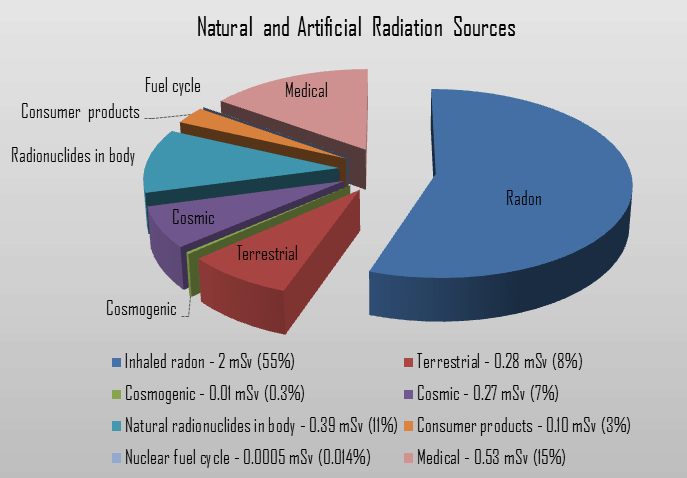
In addition to the cosmic and terrestrial sources, all people also have some radioactive isotopes inside their bodies from birth. These isotopes are especially potassium-40, carbon-14 and also the isotopes of uranium and thorium. The variation in radiation dose from one person to another is not as great as the variation in dose from cosmic and terrestrial sources. The average annual radiation dose to a person from internal radioactive materials other than radon is about 0.3 mSv/year of which:
0.2 mSv/year comes from potassium-40,
0.12 mSv/year comes from the uranium and thorium series,
12 μSv/year comes from carbon-40.
The most important isotope with regard to dose is potassium-40. The dominant component of inhalation exposure is the short-lived decay products of radon. But this issue is so important, that it was treated separately in the previous section (Radon – Health Effects).
Excluding internal contamination by external radioactive material (radon, uranium et.c), potassium-40 and carbon-40 are largest components of internal radiation exposure from biologically functional components of the human body.
Potassium-40
Potassium is a naturally-occurring chemical element with atomic number 19 which means there are 19 protons and 19 electrons in the atomic structure. The chemical symbol for potassium is K (from Neo-Latin kalium).
Natural potassium consists primarily of isotope K-39 (93.26%), therefore the atomic mass of potassium element is close to the atomic mass of K-39 isotope (39.098 u). Natural potassium also consists of two other isotopes: K-41 (6.73%) and K-40 (0.012%). Potassium-40 is an unstable (radioactive) naturally-occurring isotope of potassium. It has a very long half-life of 1.251×10⁹ years. Therefore, this isotope belong to primordial nuclides, because its half-life is comparable to the age of the Earth.
Traces of K-40 are found in all potassium, and it is the most common radioisotope in the human body. K-40 is a radioactive isotope of potassium which has a very long half-life of 1.251×10⁹ years and undergoes both types of beta decay. From this point of view, also a human body can be considered as a source of antimatter.
About 89.28% of the time (10.72% is by electron capture), it decays to calcium-40 with emission of a beta particle (β−, an electron) with a maximum energy of 1.33 MeV and an antineutrino, which is an antiparticle to the neutrino.
Very rarely (0.001% of the time) it will decay to Ar-40 by emitting a positron (β+) and a neutrino.
Potassium-40 inside Body – Radiation Dose
The potassium concentration in the human body is strictly based on the homeostatic principle. Potassium is more or less distributed in the body (especially in soft tissues) following intake in foods. A 70-kg man contains about 126 g of potassium (0.18%), most of that is located in muscles. The daily consumption of potassium is approximately 2.5 gram. Hence the concentration of potassium-40 is nearly stable in all persons at a level of about 55 Bq/kg (3850 Bq in total), which corresponds to the annual effective dose of 0.2 mSv.
Banana Equivalent Dose – BED
Banana equivalent dose, BED, is an informal dose quantity of ionizing radiation exposure. Banana equivalent dose is intended as a general educational example to compare a dose of radioactivity to the dose one is exposed to by eating one average-sized banana. One BED is often correlated to 10-7 Sievert (0.1 µSv).
Bananas contain significantly high potassium concentrations, which is vital for the functioning of all living cells. The transfer of potassium ions through nerve cell membranes is necessary for normal nerve transmission. But natural potassium also contains a radioactive isotope potassium-40 (0.012%). Potassium-40 is a radioactive isotope of potassium which has a very long half-life of 1.251×10⁹ years and undergoes both types of beta decay.
One BED is often correlated to 10-7 Sievert (0.1 µSv). The radiation exposure from consuming a banana is approximately 1% of the average daily exposure to radiation, which is 100 banana equivalent doses (BED). A chest CT scan delivers 58,000 BED (5.8 mSv). A lethal dose, the dose that kills a human with a 50% risk within 30 days (LD50/30) of radiation, is approximately 50,000,000 BED (5000 mSv). However, in practice, this dose is not cumulative, as the principal radioactive component is excreted to maintain metabolic equilibrium. Moreover, there is also a problem with the collective dose.
The BED is only meant to inform the public about the existence of very low levels of natural radioactivity within a natural food and is not a formally adopted dose measurement.
Internal Dose from Uranium and Thorium
As was written, all people also have some radioactive isotopes inside their bodies from birth. These isotopes are especially potassium-40, carbon-14 and isotopes from the uranium and thorium series. The variation in radiation dose from one person to another is not as great as the variation in dose from cosmic and terrestrial sources. The average annual radiation dose to a person from internal radioactive materials other than radon is about 0.3 mSv/year of which:
0.2 mSv/year comes from potassium-40,
0.12 mSv/year comes from the uranium and thorium series,
12 μSv/year comes from carbon-14.
UNSCEAR have, based on a large number of investigations, presented values about the annual intake by humans of the different isotopes. We can mention the following:
Ra-226 (22 Bq/year),
Pb-210 (30 Bq/year),
Po-210 (58 Bq/year) and
Ra-228 (15 Bq/year).
Note that, the dominant component of natural background exposure, which comes from the short-lived decay products of radon, is not involved here. This issue is so important, that it was treated separately in the previous section (Terrestrial Radiation).
As a result, the UNSCEAR 2000 report estimates an annual effective dose of 0.12 mSv, which comes from internal exposure by isotopes of the uranium and thorium series. The main contributor to this dose is Po-210. Note that, polonium-210, the decay product of lead-210, emits a 5.3 MeV alpha particle, which provides most of equivalent dose. The radiation weighting factor for alpha radiation is equal to 20. An absorbed dose of 1 mGy by alpha particles will lead to an equivalent dose of 20 mSv.
Internal Doses from carbon-14 and tritium are described in the following article: Cosmogenic Radionuclides
Internal Radiation – Is it dangerous?
We must emphasize, eating bananas, working as airline flight crew or living in locations with, increases your annual dose rate. But it does not mean, that it must be dangerous. In each case, intensity of radiation also matters. It is very similar as for heat from a fire (less energetic radiation). If you are too close, the intensity of heat radiation is high and you can get burned. If you are at the right distance, you can withstand there without any problems and moreover it is comfortable. If you are too far from heat source, the insufficiency of heat can also hurt you. This analogy, in a certain sense, can be applied to radiation also from radiation sources.
Alternative assumptions for the extrapolation of the cancer risk vs. radiation dose to low-dose levels, given a known risk at a high dose: LNT model, and hormesis model.
In case of internal radiation, we are talking usually about so called “low doses”. Low dose here means additional small doses comparable to the normal background radiation (10 µSv = average daily dose received from natural background). The doses are very very low and therefore the probability of cancer induction could be almost negligible. Secondly, and this is crucial, the truth about low-dose radiation health effects still needs to be found. It is not exactly known, whether these low doses of radiation are detrimental or beneficial (and where is the threshold). Government and regulatory bodies assume a LNT model instead of a threshold or hormesis not because it is the more scientifically convincing, but because it is the more conservative estimate. Problem of this model is that it neglects a number of defence biological processes that may be crucial at low doses. The research during the last two decades is very interesting and show that small doses of radiation given at a low dose rate stimulate the defense mechanisms. Therefore the LNT model is not universally accepted with some proposing an adaptive dose–response relationship where low doses are protective and high doses are detrimental. Many studies have contradicted the LNT model and many of these have shown adaptive response to low dose radiation resulting in reduced mutations and cancers. This phenomenon is known as radiation hormesis.
Robert Reed Burn, Introduction to Nuclear Reactor Operation, 1988.
U.S. Department of Energy, Nuclear Physics and Reactor Theory. DOE Fundamentals Handbook, Volume 1 and 2. January 1993.
Paul Reuss, Neutron Physics. EDP Sciences, 2008. ISBN: 978-2759800414.
See also:
Sources
We hope, this article, Internal Source of Radiation, helps you. If so, give us a like in the sidebar. Main purpose of this website is to help the public to learn some interesting and important information about radiation and dosimeters.
Primordial radionuclides are radionuclides found on the Earth that have existed in their current form since before Earth was formed. Primordial radionuclides are residues from the Big Bang, from cosmogenic sources, and from ancient supernova explosions. Radiation Dosimetry
Primordial radionuclides are radionuclides found on the Earth that have existed in their current form since before Earth was formed. Primordial radionuclides are residues from the Big Bang, from cosmogenic sources, and from ancient supernova explosions which occurred before the formation of the solar system. Bismuth, thorium, uranium and plutonium are primordial radionuclides because they have half-lives long enough to still be found on the Earth. Potassium-40 also belongs to primordial nuclides.
When the Earth was formed, a number of radioactive elements were formed. After the four billion years, all the shorter-lived isotopes have decayed. But some of these isotopes have very long half-lives, billions of years, and are still present. These radionuclides are known as primordial radionuclides and contributes to the annual dose to an individual. Because most of the natural radioactive isotopes are heavy, more than one disintegration is necessary before a stable atom is reached. This sequence of unstable atomic nuclei and their modes of decays, which leads to a stable nucleus, is known as the radioactive series.
Liquid Earth’s Core
All three naturally-occurring isotopes of uranium (238U, 235U and 234U) and naturally-occurring isotope of thorium have very long half-life (e.g. 4.47×10⁹ years for 238U). Because of this very long half-life uranium and thorium are weakly radioactive and contributes to low levels of natural background radiation in the environment. These isotopes are alpha radioactive (emitting alpha particle), but they can also rarely undergo a spontaneous fission.
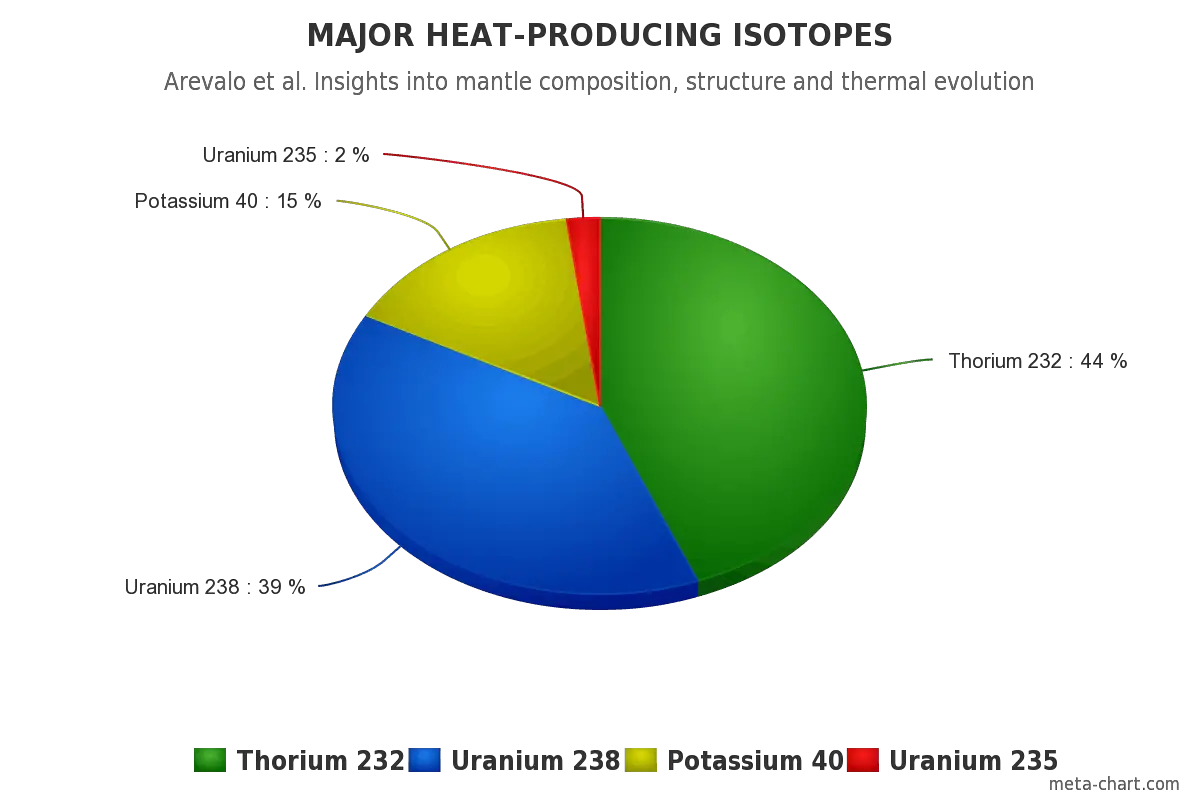
All naturally-occurring isotopes belong to primordial nuclides, because their half-life is comparable to the age of the Earth (~4.54×10⁹ years). Uranium has the second highest atomic mass of these primordial nuclides, lighter only than plutonium. Moreover the decay heat of uranium and thorium and their decay products (e.g. radon, radium etc.) contributes to heating of Earth’s core. Together with potassium-40 in the Earth’s mantle is thought that these elements are the main source of heat that keeps the Earth’s core liquid.
Robert Reed Burn, Introduction to Nuclear Reactor Operation, 1988.
U.S. Department of Energy, Nuclear Physics and Reactor Theory. DOE Fundamentals Handbook, Volume 1 and 2. January 1993.
Paul Reuss, Neutron Physics. EDP Sciences, 2008. ISBN: 978-2759800414.
See also:
Terrestrial Radiation
We hope, this article, Primordial Radionuclide, helps you. If so, give us a like in the sidebar. Main purpose of this website is to help the public to learn some interesting and important information about radiation and dosimeters.