Facebook Instagram Youtube Twitter

What is Natural Background Radiation – Definition

Natural background radiation is ionizing radiation, that originates from a variety of natural sources. This radiation is not associated with any human activity. Radiation Dosimetry

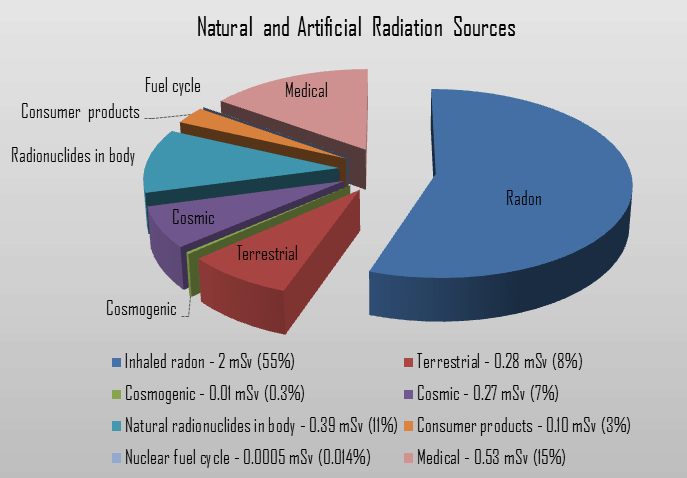
Natural and Artificial Radiation SourcesRadiation is all around us. In, around, and above the world we live in. It is a natural energy force that surrounds us. It is a part of our natural world that has been here since the birth of our planet. All living creatures, from the beginning of time, have been, and are still being, exposed to ionizing radiation. Ionizing radiation is generated through nuclear reactions, nuclear decay, by very high temperature, or via acceleration of charged particles in electromagnetic fields.

Natural Background Radiation

Natural background radiation is ionizing radiation, that originates from a variety of natural sources. All living creatures, from the beginning of time, have been, and are still being, exposed to ionizing radiation. This radiation is not associated with any human activity.  There are radioactive isotopes in our bodies, houses, air, water and in the soil. We all are also exposed to radiation from outer space.

Sources of Natural Background Radiation

We divide all these natural radiation sources into three groups:

Cosmic Radiation
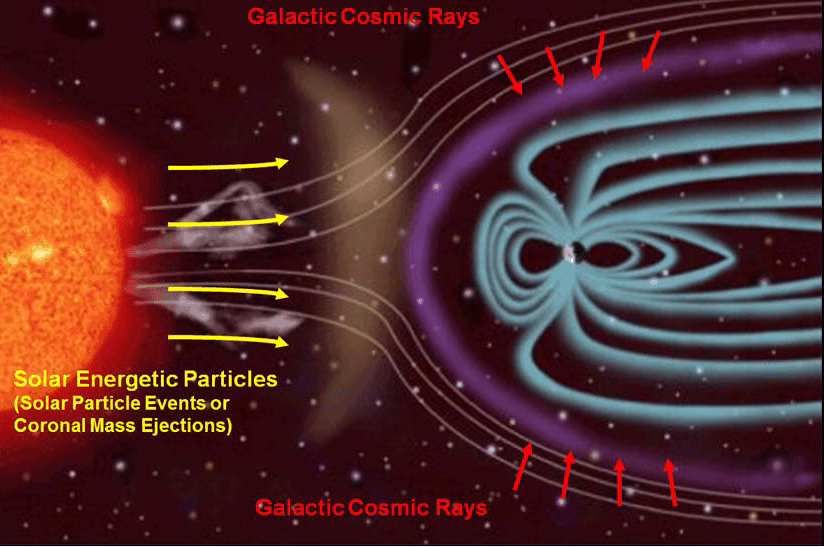
Cosmic Radiation - Natural Source of Radiation
Source: nasa.gov License: Public Domain

Cosmic radiation refers to sources of radiation in the form of cosmic rays that come from the sun or from outer space. At ground level the muons, with energies mostly between 1 and 20 GeV, contribute about 75 % of the absorbed dose rate in free air. The remainder comes from electrons produced by the muons or present in the electromagnetic cascade. The annual cosmic ray dose at sea level is around 0.27 mSv (27 mrem). If you live at higher elevations or are a frequent airline passenger, this exposure can be significantly higher, since the atmosphere is thinner here. The effects of the earth’s magnetic field also determines the dose from cosmic radiation.

Cosmic radiation can be divided into different types according to its origin. There are three main sources of such radiation:

  • Solar Cosmic Radiation. Solar cosmic radiation refers to sources of radiation in the form of high-energy particles (predominantly protons) emitted by the sun, primarily in solar particle events (SPEs).
  • Galactic Cosmic Radiation. Galactic cosmic radiation, GCR, refers to sources of radiation in the form of high-energy particles originating outside the solar system, but generally from within our Milky Way galaxy.
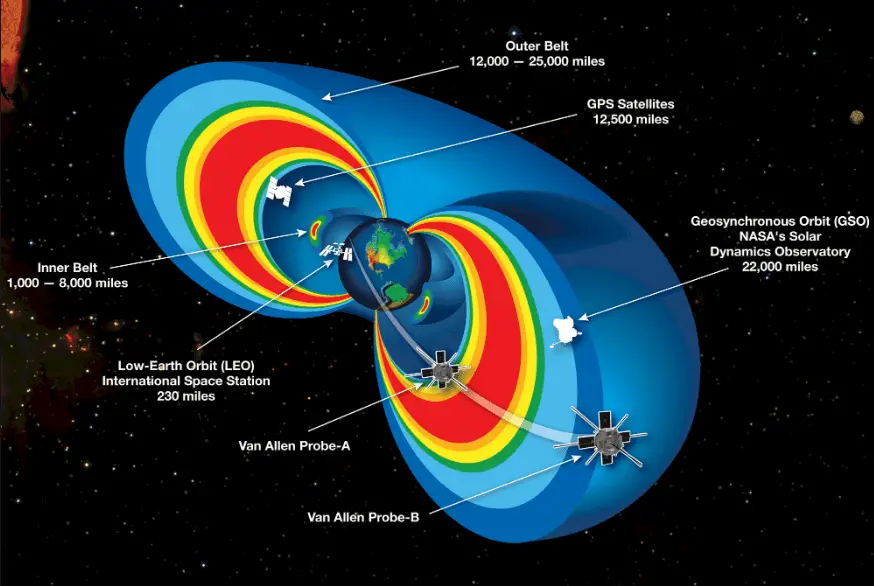
  • Radiation from Earth’s Radiation Belts (van Allen belts). Van Allen radiation belts are zones of high-energy particles (especially protons) trapped by earth’s magnetic field.

Natural Background in Airplane – Radiation in Flight

Exposure to cosmic radiation increases rapidly with altitude. In flight there are two principal sources of natural radiation to consider: Galactic Cosmic Rays which are always present, and Solar Proton Events, sometimes called Solar Cosmic Ray (SCR) events, which occur sporadically. The dose rate from cosmic radiation varies in different parts of the world and it depends strongly on the geomagnetic field, altitude, and solar cycle. The radiation field at aircraft altitudes consist of neutrons, protons and pions. In flight, neutrons contribute 40 – 80% of the equivalent dose, depending on the geomagnetic field, altitude, and solar cycle. The cosmic radiation dose rate on airplanes is so high (but not dangerous) that, according to the United Nations UNSCEAR 2000 Report, airline flight crew workers receive more dose on average than any other worker, including those in nuclear power plants.

The ground level dose rate is on average about 0.10 μSv/h, but at the maximum flight altitude (8.8 km or 29,000 ft) it can reach about 2.0 μSv/h (or even higher values). A dose rate of 4 μSv/h may be used to represent the average dose rate for all long haul flights (due to higher altitudes). It must be added, for supersonic planes like the Concorde, that could make a transatlantic flight in 3.5 hours, the exposure rate (about 9 μSv/h) at their altitude of 18 km was increased enough to result in the same cosmic ray exposure per crossing as for conventional jets trundling along at about 8 km.

Earth’s Magnetic Field as Radiation Shield
magnetosphere - earth magnetic field
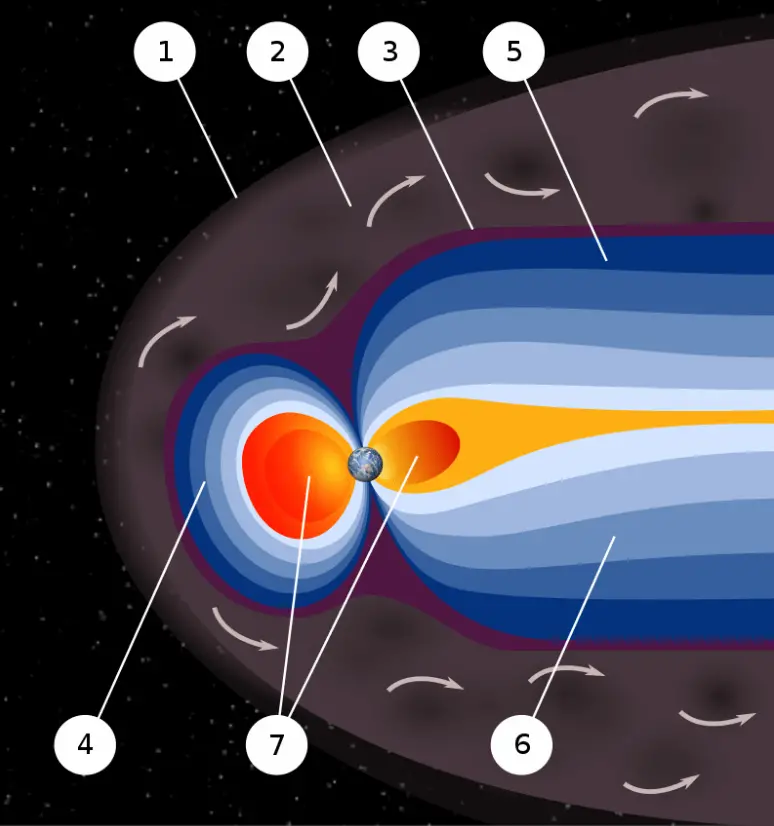
An artist’s rendering of the structure of a magnetosphere: 1) Bow shock. 2) Magnetosheath. 3) Magnetopause. 4) Magnetosphere. 5) Northern tail lobe. 6) Southern tail lobe. 7) Plasmasphere. Source: nasa.gov License: Public Domain

Earth’s magnetic field provides a vital radiation shield of cosmic radiation. In addition to a protective atmosphere, we are also lucky that Earth has a magnetic field. Magnetic field extends several tens of thousands of kilometers into space, protecting the Earth from the charged particles of the solar wind and cosmic rays that would otherwise strip away the upper atmosphere, including the ozone layer that protects the Earth from harmful ultraviolet radiation. It shields us from the full effects of the solar wind and GCR. Without this protection, Earth’s biosphere might not exist as it does today, or would be at least limited to the subsurface.  Earth’s magnetic field provides also a radiation shield for astronauts and the ISS itself, because it is in low Earth orbit.

Calculations of the loss of carbon dioxide from the atmosphere of Mars, resulting from scavenging of ions by the solar wind, indicate that the dissipation of the magnetic field of Mars caused a near total loss of its atmosphere.

Terrestrial Radiation

Terrestrial radiation refers to sources of radiation that are in the soil, water, and vegetation. The major isotopes of concern for terrestrial radiation are uranium and the decay products of uranium, such as thorium, radium, and radon. The average dose rate that originates from terrestrial nuclides (except radon exposure) is about 0.057 µGy/hr. The maximum values have been measured on monazite sand in Guarapari, Brazil (up to 50 µGy/hr and in Kerala, India (about 2 µGy/hr), and on rocks with a high radium concentration in Ramsar, Iran (from 1 to 10 µGy/hr).
radon - mitigation - house
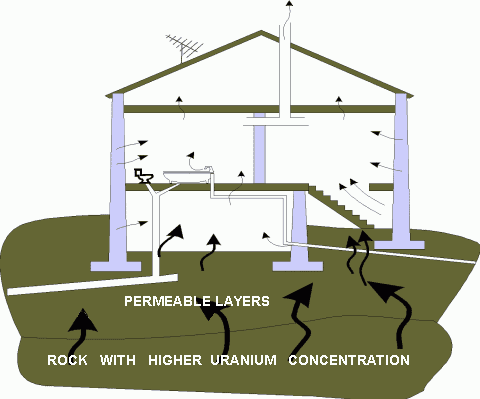
The radon gas can penetrate into the house through cracks (due to a chimney effect) in the floor and walls of the basement. Source: suro.cz

The average annual radiation dose to a person from radon is about 2 mSv/year and it may vary over many orders of magnitude from place to place. Radon is so important, that it is usually treated separately. Radon is a colorless, odorless, tasteless noble gas, which seeps continuously from bedrock but can, because of its high density, accumulate in poorly ventilated houses. The fact radon is gas plays a crucial role in spreading of all its daughter nuclei. Simply radon is a transport medium from bedrock to atmosphere (or inside buildings) for its short-lived decay products (Pb-210 and Po-210), that posses much more health risks.

Internal Radiation

In addition to the cosmic and terrestrial sources, all people also have radioactive potassium-40, carbon-14, lead-210, and other isotopes inside their bodies from birth.

These isotopes are especially potassium-40, carbon-14 and also the isotopes of uranium and thorium. The variation in radiation dose from one person to another is not as great as the variation in dose from cosmic and terrestrial sources. The average annual radiation dose to a person from internal radioactive materials other than radon is about 0.3 mSv/year of which:

  • 0.2 mSv/year comes from potassium-40,
  • 0.12 mSv/year comes from the uranium and thorium series,
  • 12 μSv/year comes from carbon-40.

Background Radiation and Health Hazard

You can not go through life without radiation. The danger of ionizing radiation lies in the fact that the radiation is invisible and not directly detectable by human senses. People can neither see nor feel radiation, yet it deposits energy to the molecules of the body.
LNT Model and Hormesis Model
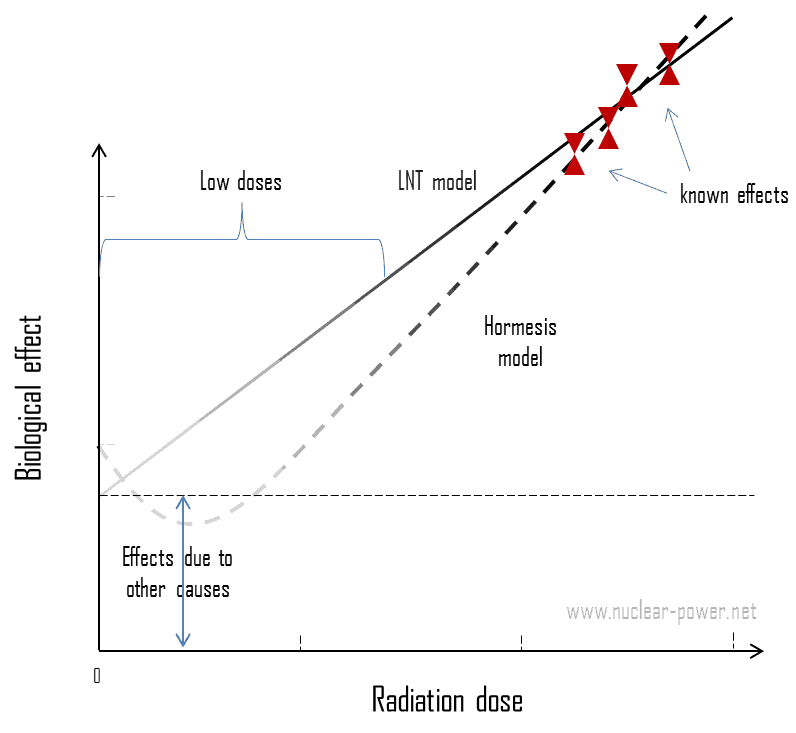
Alternative assumptions for the extrapolation of the cancer risk vs. radiation dose to low-dose levels, given a known risk at a high dose: LNT model, and hormesis model.

But don’t worry, the doses from background radiation are usually very small (except radon exposure). Low dose here means additional small doses comparable to the normal background radiation (10 µSv = average daily dose received from natural background). The problem is that, at very low doses, it is practically impossible to correlate any irradiation with certain biological effects. This is because the baseline cancer rate is already very high and the risk of developing cancer fluctuates 40% because of individual life style and environmental effects, obscuring the subtle effects of low-level radiation.

Secondly, and this is crucial, the truth about low-dose radiation health effects still needs to be found. It is not exactly known, whether these low doses of radiation are detrimental or beneficial (and where is the threshold).  Government and regulatory bodies assume a LNT model instead of a threshold or hormesis not because it is the more scientifically convincing, but because it is the more conservative estimate. Problem of this model is that it neglects a number of defence biological processes that may be crucial at low doses. The research during the last two decades is very interesting and show that small doses of radiation given at a low dose rate stimulate the defense mechanisms. Therefore the LNT model is not universally accepted with some proposing an adaptive dose–response relationship where low doses are protective and high doses are detrimental. Many studies have contradicted the LNT model and many of these have shown adaptive response to low dose radiation resulting in reduced mutations and cancers. This phenomenon is known as radiation hormesis.

According to the radiation hormesis hypothesis, radiation exposure comparable to and just above the natural background level of radiation is not harmful but beneficial, while accepting that much higher levels of radiation are hazardous. Arguments for hormesis center around some large-scale epidemiological studies and the evidence from animal irradiation experiments, but most notably the recent advances in knowledge of the adaptive response. Proponents of radiation hormesis typically claim that radio-protective responses in cells and the immune system not only counter the harmful effects of radiation but additionally act to inhibit spontaneous cancer not related to radiation exposure.

See also: LNT Model

References:

Radiation Protection:

  1. Knoll, Glenn F., Radiation Detection and Measurement 4th Edition, Wiley, 8/2010. ISBN-13: 978-0470131480.
  2. Stabin, Michael G., Radiation Protection and Dosimetry: An Introduction to Health Physics, Springer, 10/2010. ISBN-13: 978-1441923912.
  3. Martin, James E., Physics for Radiation Protection 3rd Edition, Wiley-VCH, 4/2013. ISBN-13: 978-3527411764.
  4. U.S.NRC, NUCLEAR REACTOR CONCEPTS
  5. U.S. Department of Energy, Nuclear Physics and Reactor Theory. DOE Fundamentals Handbook, Volume 1 and 2. January 1993.

Nuclear and Reactor Physics:

  1. J. R. Lamarsh, Introduction to Nuclear Reactor Theory, 2nd ed., Addison-Wesley, Reading, MA (1983).
  2. J. R. Lamarsh, A. J. Baratta, Introduction to Nuclear Engineering, 3d ed., Prentice-Hall, 2001, ISBN: 0-201-82498-1.
  3. W. M. Stacey, Nuclear Reactor Physics, John Wiley & Sons, 2001, ISBN: 0- 471-39127-1.
  4. Glasstone, Sesonske. Nuclear Reactor Engineering: Reactor Systems Engineering, Springer; 4th edition, 1994, ISBN: 978-0412985317
  5. W.S.C. Williams. Nuclear and Particle Physics. Clarendon Press; 1 edition, 1991, ISBN: 978-0198520467
  6. G.R.Keepin. Physics of Nuclear Kinetics. Addison-Wesley Pub. Co; 1st edition, 1965
  7. Robert Reed Burn, Introduction to Nuclear Reactor Operation, 1988.
  8. U.S. Department of Energy, Nuclear Physics and Reactor Theory. DOE Fundamentals Handbook, Volume 1 and 2. January 1993.
  9. Paul Reuss, Neutron Physics. EDP Sciences, 2008. ISBN: 978-2759800414.

See also:

Sources of Radiation

We hope, this article, Natural Background Radiation, helps you. If so, give us a like in the sidebar. Main purpose of this website is to help the public to learn some interesting and important information about radiation and dosimeters.
What is Radiation on Earth and in Space – Definition

All living creatures on Earth and in Space, from the beginning of time, have been, and are still being, exposed to ionizing radiation. Radiation on Earth and in Space

Natural and Artificial Radiation SourcesRadiation is all around us. In, around, and above the world we live in. It is a natural energy force that surrounds us. It is a part of our natural world that has been here since the birth of our planet. All living creatures, from the beginning of time, have been, and are still being, exposed to ionizing radiation. Ionizing radiation is generated through nuclear reactions, nuclear decay, by very high temperature, or via acceleration of charged particles in electromagnetic fields.

Radiation on Earth and in Space

All living creatures, from the beginning of time, have been, and are still being, exposed to ionizing radiation. This radiation is not associated with any human activity.  There are radioactive isotopes in our bodies, houses, air, water and in the soil. We all are also exposed to radiation from outer space.

Radiation on Earth – Natural Background Radiation

We divide all these natural radiation sources into three groups:

  • Cosmic Radiation. Cosmic radiation refers to sources of radiation in the form of cosmic rays that come from the sun or from outer space. At ground level the muons, with energies mostly between 1 and 20 GeV, contribute about 75 % of the absorbed dose rate in free air. The remainder comes from electrons produced by the muons or present in the electromagnetic cascade. The annual cosmic ray dose at sea level is around 0.27 mSv (27 mrem). If you live at higher elevations or are a frequent airline passenger, this exposure can be significantly higher, since the atmosphere is thinner here. The effects of the earth’s magnetic field also determines the dose from cosmic radiation.
  • Terrestrial Radiation. Terrestrial radiation refers to sources of radiation that are in the soil, water, and vegetation. The major isotopes of concern for terrestrial radiation are uranium and the decay products of uranium, such as thorium, radium, and radon. The average dose rate that originates from terrestrial nuclides (except radon exposure) is about 0.057 µGy/hr. The maximum values have been measured on monazite sand in Guarapari, Brazil (up to 50 µGy/hr and in Kerala, India (about 2 µGy/hr), and on rocks with a high radium concentration in Ramsar, Iran (from 1 to 10 µGy/hr). The average annual radiation dose to a person from radon is about 2 mSv/year and it may vary over many orders of magnitude from place to place. Radon is so important, that it is usually treated separately.
  • Internal Radiation. In addition to the cosmic and terrestrial sources, all people also have radioactive potassium-40, carbon-14, lead-210, and other isotopes inside their bodies from birth. The concentration of potassium-40 is nearly stable in all persons at a level of about 55 Bq/kg (3850 Bq in total), which corresponds to the annual effective dose of 0.2 mSv. The annual dose from carbon-14 is estimated to be about 12 μSv/year.

Radiation in Space

Cosmic Radiation - Natural Source of Radiation
Source: nasa.gov License: Public Domain

Cosmic radiation refers to sources of radiation in the form of cosmic rays that come from the Sun or from outer space. The earth has always been bombarded by high-energy particles originating in outer space that generate secondary particle showers in the lower atmosphere. Charged particles (especially high-energy protons) from the sun and outer space interact with the earth’s atmosphere and magnetic field to produce a showerof radiation (i.e. air shower), typically beta and gamma radiation. If you live at higher elevations or are a frequent airline passenger, this exposure can be significantly higher, since the atmosphere is thinner here. The effects of the earth’s magnetic field also determines the dose from cosmic radiation.

Composition of Cosmic Radiation

The primary cosmic radiation consist of a mixture of high-energy protons (~87%), alpha particles (~11%), high-energy electrons (~1%) and a trace of heavier nuclei (~1%). The energy of these particles range between 108 eV and 1020 eV.  A very small fraction are stable particles of antimatter, such as positrons or antiprotons. The precise nature of this remaining fraction is an area of active research.

Energy of Cosmic Rays

The energies of the most energetic ultra-high-energy cosmic rays (UHECRs) have been observed to approach 3 x 10²⁰ eV, about 40 million times the energy of particles accelerated by the Large Hadron Collider. The origin of the high energy particles is from outer space. It is assumed that particles with an energy up to about 1015 eV are coming from our own galaxy, whereas those with the highest energies probably have an extragalactic origin.

Classification of Cosmic Radiation

Cosmic radiation can be divided into different types according to its origin. There are three main sources of such radiation:

  • Solar Cosmic Radiation. Solar cosmic radiation refers to sources of radiation in the form of high-energy particles (predominantly protons) emitted by the sun, primarily in solar particle events (SPEs). Solar radiation is a significant radiation hazard to spacecraft and astronauts, also produces significant dose rates at high altitudes, but only the most energetic radiation contribute to doses at ground level.  Note that, anyone who had been on the Moon’s surface during a particularly violent solar eruption in 2005 would have received a lethal dose.
  • Galactic Cosmic Radiation. Galactic cosmic radiation, GCR, refers to sources of radiation in the form of high-energy particles originating outside the solar system, but generally from within our Milky Way galaxy. The nucleonic component then consist of a mixture of high-energy protons (~86%), alpha particles (~12%), and a trace of heavier nuclei (~1%). GCR are trapped by the galactic magnetic field, therefore they have probably been accelerated within the last few million years, and have traveled many times across the galaxy. Their acceleration mechanism is uncertain, but one of possible mechanisms is that the particle are accelerated by shock waves expanding from supernovas. The energy of these particles range between 108 eV and 1020 eV.
  • van Allen radiation belts - satellites
    Source: nasa.gov License: Public Domain

    Radiation from Earth’s Radiation Belts (van Allen belts). Van Allen radiation belts are zones of high-energy particles (especially protons) trapped by earth’s magnetic field. Most of these high-energy particles originate from the solar wind, that were captured by and held around a planet by that earth’s magnetic field. The van Allen belt is formed like a torus above the equator. There are two van Allen radiation belts, an internal belt is centered at about 3,000 kilometers and an outer belt is centered at about 22,000 kilometers from the earth’s surface. It contains mainly energetic protons in the 10-100 MeV range. Spacecraft travelling beyond low Earth orbit enter the zone of radiation of the Van Allen belts. Beyond the belts, they face additional hazards from cosmic rays and solar particle events. A region between the inner and outer Van Allen belts lies at two to four Earth radii and is sometimes referred to as the “safe zone”.

References:

Radiation Protection:

  1. Knoll, Glenn F., Radiation Detection and Measurement 4th Edition, Wiley, 8/2010. ISBN-13: 978-0470131480.
  2. Stabin, Michael G., Radiation Protection and Dosimetry: An Introduction to Health Physics, Springer, 10/2010. ISBN-13: 978-1441923912.
  3. Martin, James E., Physics for Radiation Protection 3rd Edition, Wiley-VCH, 4/2013. ISBN-13: 978-3527411764.
  4. U.S.NRC, NUCLEAR REACTOR CONCEPTS
  5. U.S. Department of Energy, Nuclear Physics and Reactor Theory. DOE Fundamentals Handbook, Volume 1 and 2. January 1993.

Nuclear and Reactor Physics:

  1. J. R. Lamarsh, Introduction to Nuclear Reactor Theory, 2nd ed., Addison-Wesley, Reading, MA (1983).
  2. J. R. Lamarsh, A. J. Baratta, Introduction to Nuclear Engineering, 3d ed., Prentice-Hall, 2001, ISBN: 0-201-82498-1.
  3. W. M. Stacey, Nuclear Reactor Physics, John Wiley & Sons, 2001, ISBN: 0- 471-39127-1.
  4. Glasstone, Sesonske. Nuclear Reactor Engineering: Reactor Systems Engineering, Springer; 4th edition, 1994, ISBN: 978-0412985317
  5. W.S.C. Williams. Nuclear and Particle Physics. Clarendon Press; 1 edition, 1991, ISBN: 978-0198520467
  6. G.R.Keepin. Physics of Nuclear Kinetics. Addison-Wesley Pub. Co; 1st edition, 1965
  7. Robert Reed Burn, Introduction to Nuclear Reactor Operation, 1988.
  8. U.S. Department of Energy, Nuclear Physics and Reactor Theory. DOE Fundamentals Handbook, Volume 1 and 2. January 1993.
  9. Paul Reuss, Neutron Physics. EDP Sciences, 2008. ISBN: 978-2759800414.

See also:

Sources of Radiation

We hope, this article, Radiation on Earth and in Space, helps you. If so, give us a like in the sidebar. Main purpose of this website is to help the public to learn some interesting and important information about radiation and dosimeters.
What is Man-made Sources of Radiation – Definition

Man-made sources of radiation include medical uses of radiation, residues from nuclear tests, industrial uses of radiation, television, and numerous other radiation producing devices. Radiation Dosimetry

Natural and Artificial Radiation SourcesRadiation is all around us. In, around, and above the world we live in. It is a natural energy force that surrounds us. It is a part of our natural world that has been here since the birth of our planet. All living creatures, from the beginning of time, have been, and are still being, exposed to ionizing radiation. Ionizing radiation is generated through nuclear reactions, nuclear decay, by very high temperature, or via acceleration of charged particles in electromagnetic fields. But in general, there are two broad categories of radiation sources:

  • Natural Background Radiation. Natural background radiation includes radiation produced by the Sun, lightnings, primordial radioisotopes or supernova explosions etc.
  • Man-Made Sources of Radiation. Man-made sources include medical uses of radiation, residues from nuclear tests, industrial uses of radiation etc.

Special Reference: Sources and effects of ionizing radiation, Annex B. UNSCEAR. New York, 2010. ISBN: 978-92-1-142274-0.

Man-made Sources of Radiation

Since ionizing radiation has many industrial, and medical uses, people can be exposed also to man-made sources of radiation. Man-made sources include medical uses of radiation, residues from nuclear tests, industrial uses of radiation, television, and numerous other radiation producing devices. For example, in some kind of smoke detectors, you can meet man-made radionuclides such as americium-241. This man-made radionuclide is used to ionize air and to detect smoke.

It must be noted, most of these exposures are very low in intensity and the total dose and does not posse larger health effects. In each case, usefulness of ionizing radiation must be balanced with its hazards. Nowadays a compromise was found and most of uses of radiation are optimized. Today it is almost unbelievable that x-rays was, at one time, used to find the right pair of shoes (i.e. shoe-fitting fluoroscopy). Measurements made in recent years indicate that the doses to the feet were in the range 0.07 – 0.14 Gy for a 20 second exposure. This practice was halted when the risks of ionizing radiation were better understood.

There are two distinct groups exposed to man-made radiation sources. The United Nations Scientific Committee on the Effects of Atomic Radiation (UNSCEAR) itemized types of human exposures as:

  • public exposure, which is the exposure of individual members of the public and of the population in general
  • occupational radiation exposure, which is the exposure of workers in situations where their exposure is directly related to or required by their work

Public Exposure

In general, the following man-made sources expose the public to radiation:

  • Medical Exposures (by far, the most significant man-made source)
    • Diagnostic x-rays
    • Nuclear medicine procedures (iodine-131, cesium-137, technetium-99m etc.)
  • Consumer Products
    • Building and road construction materials
    • Smoking cigarettes (polonium-210)
    • Combustible fuels, including gas and coal
    • X-ray security systems
    • Televisions
    • Smoke detectors (americium)
    • Lantern mantles (thorium)

To a lesser degree, the public is also exposed to radiation from the nuclear fuel cycle, from uranium mining and milling to disposal of used (spent) fuel. Noteworthy, the public is also exposed to radiation from so called “enhanced sources of naturally occurring radioactive material”. This means also industries such as metal mining, coal mining and power production from coal creates additional exposures due to densification of naturally occurring radionuclides. The public receives some minimal exposure from the transportation of radioactive materials and fallout from nuclear weapons testing and reactor accidents (such as Chernobyl).

For that reason, most regulatory bodies require to limit the maximum radiation exposure to individual members of the public to 100 mrem (1 mSv) per year.

Occupational Exposure

As was written, occupational exposure is the exposure of workers in situations where their exposure is directly related to or required by their work. According to ICRP, occupational exposure refers to all exposure incurred by workers in the course of their work, with the exception of

  1. excluded exposures and exposures from exempt activities involving radiation or exempt sources
  2. any medical exposure
  3. the normal local natural background radiation.

In general, occupationally exposed individuals work in the following areas:

  • Fuel cycle facilities
  • Industrial radiography
  • Radiology departments (medical)
  • Nuclear medicine departments
  • Radiation oncology departments
  • Nuclear power plants
  • Government and university research laboratories

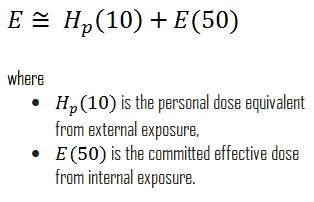
Such individuals are exposed to varying types and amounts of radiation, depending on their specific jobs and the sources with which they work. For that reason, most regulatory bodies require to limit occupational exposure to adults working with radioactive material to 5000 mrem (50 mSv) per year. Toward that end, employers carefully monitor the exposure of these individuals using instruments called dosimeters worn on a position of the body representative of its exposure. In most situations of occupational exposure the effective dose, E, can be derived from operational quantities using the following formula:

Occupational Exposure - External and Internal.

The committed dose is a dose quantity that measures the stochastic health risk due to an intake of radioactive material into the human body.

See also: Dose Monitoring

Medical Exposures – Doses from Medical Radiation Sources

Radiation is used in variety of medical examinations and treatments. Doses from medical radiation sources are naturally determined, whether a person underwent a treatment or not. In general, radiation exposures from medical diagnostic examinations are low (especially in diagnostic uses). Doses may be also high (only for therapeutic uses), but in each case, they must be always justified by the benefits of accurate diagnosis of possible disease conditions or by benefits of accurate treatment. These doses include contributions from medical and dental diagnostic radiology (diagnostic X-rays), clinical nuclear medicine and radiation therapy.

The medical use of ionizing radiation remains a rapidly changing field. In any case, usefulness of ionizing radiation must be balanced with its hazards. Nowadays a compromise was found and most of uses of radiation are optimized. Today it is almost unbelievable that x-rays was, at one time, used to find the right pair of shoes (i.e. shoe-fitting fluoroscopy). Measurements made in recent years indicate that the doses to the feet were in the range 0.07 – 0.14 Gy for a 20 second exposure. This practice was halted when the risks of ionizing radiation were better understood.

In the following points we try to express enormous ranges of radiation exposure as well as a few doses from medical sources.

  • 1 µSv – Eating one banana
  • 1 µSv – Extremity (hand, foot, etc.) X-ray
  • 5 µSv – Dental X-ray
  • 10 µSv – Average daily dose received from natural background
  • 40 µSv – A 5-hour airplane flight
  • 100 µSv – Chest X-ray
  • 600 µSv – mammogram
  • 1 000 µSv – Dose limit for individual members of the public, total effective dose per annum
  • 3 650 µSv – Average yearly dose received from natural background
  • 5 800 µSv – Chest CT scan
  • 10 000 µSv – Average yearly dose received from natural background in Ramsar, Iran
  • 20 000 µSv – single full-body CT scan
  • 80 000 µSv – The annual local dose to localized spots at the bifurcations of segmental bronchi in the lungs caused by smoking cigarettes (1.5 packs/day).
  • 175 000 µSv – Annual dose from natural radiation on a monazite beach near Guarapari, Brazil.
  • 5 000 000 µSv – Dose that kills a human with a 50% risk within 30 days (LD50/30), if the dose is received over a very short duration.

As can be seen, low-level doses are common for everyday life.

Tobacco – Smoking Cigarettes – Radiation Dose

In addition to chemical, nonradioactive carcinogens, tobacco and tobacco smoke contain small amounts of lead-210 and polonium-210 both of which are radioactive carcinogens. It must be emphasized, cigarettes and tobacco contain also polonium-210, originating from the decay products of radon, which stick to tobacco leaves. Polonium-210 emits a 5.3 MeV alpha particle, which provides most of equivalent dose. Due to decay of polonium-210, the annual local dose to localized spots at the bifurcations of segmental bronchi in the lungs caused by smoking cigarettes (1.5 packs/day) is about 80 mSv/year. Heavy smoking results in a dose of 160 mSv/year. This dose is not readily comparable to the radiation protection limits, since the latter deal with whole body doses, while the dose from smoking is delivered to a very small portion of the body. Many researchers believe that doses from polonium-210 are the origin of the high incidence of lung cancer among smokers.

Recall, lead-210 and polonium-210 are daughter nuclei of radon-222. Radon-222 is a gas produced by the decay of radium-226. Both are a part of the natural uranium series. Since uranium is found in soil throughout the world in varying concentrations, also dose from gaseous radon is varying throughout the world. Radon-222 is the most important and most stable isotope of radon. It has a half-life of only 3.8 days, making radon one of the rarest elements since it decays away so quickly. An important source of natural radiation is radon gas, which seeps continuously from bedrock but can, because of its high density, accumulates at the ground. The fact radon is gas plays a crucial role in spreading of all its daughter nuclei. As radon-222 decays into lead-210, lead-210 can be attached to dust of moisture particles and it can be sticked to tobacco leaves. When these particles are concentrated by smoking and inhaled as smoke, some of lead-210 is retained by the body. Since lead-210 is a weak beta emitter, it does not cause major doses, but polonium-210 does.

See also: Radon – Health Effects

The polonium-210, the decay product of lead-210, emits a 5.3 MeV alpha particle, which provides most of equivalent dose. Alpha particles, that belongs to high-LET radiation, are fairly massive and carry a double positive charge, so they tend to travel only a short distance and do not penetrate very far into tissue if at all. However alpha particles will deposit their energy over a smaller volume (possibly only a few cells if they enter a body) and cause more damage to those few cells (more than 80 % of the absorbed energy from radon is due to the alpha particles). Therefore, the radiation weighting factor for alpha radiation is equal to 20. An absorbed dose of 1 mGy by alpha particles will lead to an equivalent dose of 20 mSv.

Special Reference: Sources and effects of ionizing radiation, Annex B. UNSCEAR. New York, 2010. ISBN: 978-92-1-142274-0.

Nuclear Fallout – Radiation Doses

In general, nuclear fallout is the residual radioactive material from a nuclear blast that “falls out” of the sky after an atmospheric explosion.  Fallout can also refer to nuclear reactor accidents, although a nuclear reactor does not explode like a nuclear weapon. The isotopic signature of fallout from nuclear blast is very different from the fallout from a serious power reactor accident.

In case of radiation doses from fallout, we consider the residual radioactive material from nuclear tests (not from reactor accidents) that were performed particularly in the two periods from 1954 to 1958 and from 1961 to 1962. According to the UNSCEAR, about 502 atmospheric tests, with a total fission and fusion yield of 440 Mt, were conducted.

Special Reference: Sources and effects of ionizing radiation, Annex B. UNSCEAR. New York, 2010. ISBN: 978-92-1-142274-0.

Fallout from a nuclear tests consist of fission fragments and neutron activation products. When a blast takes place on the ground or in the atmosphere near the ground, large amounts of activation products are formed also from surface materials. The fallout is particularly significant in the neighborhood of the test site, since the larger particles and most of debris lands on the ground (local fallout). But smaller particles  may remain aloft in the upper atmosphere for years. These particles can be therefore distributed nearly uniformly around the world, and contribute to so called global fallout. Equivalent doses from global fallout dropped from about 130 μSv/year in 1963 to about 10 μSv/year in recent years.

Radiation Exposures from Electricity Generation

In this chapter, we would like to discuss a very interesting fact. It is generally known, the increasing use of nuclear power and electricity generation using nuclear reactors will lead to a small but increasing radiation dose to the general public. But it is not generally known, power generation from coal also creates additional exposures, and, what is more interesting, while exposure levels are very low, the coal cycle contributes more than half of the total radiation dose to the global population from electricity generation. The nuclear fuel cycle contributes less than one-fifth of this. The collective dose, which are defined as the sum of all individual effective doses in a group of people over the time period or during the operation being considered due to ionizing radiation, is:

  • 670-1400 man Sv for coal cycle, depending on the age of the power plant,
  • 130 man Sv for nuclear fuel cycle,
  • 5-160 man Sv for geothermal power,
  • 55 man Sv for natural gas
  • 0.03 man Sv for oil

Yes, these results should be seen from the perspective of the share of each technology in worldwide electricity production. Since 40 per cent of the world’s energy was produced by the coal cycle in 2010, and 13 per cent by nuclear, the normalized collective dose will be about the same:

  • 0.7 – 1.4 man Sv/GW.a (man sievert per gigawatt year) for coal cycle
  • 0.43 man Sv/GW.a (man sievert per gigawatt year) for nuclear fuel cycle

Special Reference: Sources and effects of ionizing radiation, UNSCEAR 2016 – Annex B. New York, 2017. ISBN: 978-92-1-142316-7.

The above doses are related to public exposure. If we consider occupational exposure, regarding the mining of rare earth metals needed for construction, by far the largest collective dose to workers per unit of electricity generated assessed by the UNSCEAR came from solar power, followed by wind power. For solar power, occupational collective dose normalized to energy is a factor of forty and eighty larger than for the nuclear fuel cycle and coal cycle, respectively.

Note that, the collective effective dose is often used to estimate the total health effects, but according to the ICRP this should be avoided (see more: Collective Dose).

References:

Radiation Protection:

  1. Knoll, Glenn F., Radiation Detection and Measurement 4th Edition, Wiley, 8/2010. ISBN-13: 978-0470131480.
  2. Stabin, Michael G., Radiation Protection and Dosimetry: An Introduction to Health Physics, Springer, 10/2010. ISBN-13: 978-1441923912.
  3. Martin, James E., Physics for Radiation Protection 3rd Edition, Wiley-VCH, 4/2013. ISBN-13: 978-3527411764.
  4. U.S.NRC, NUCLEAR REACTOR CONCEPTS
  5. U.S. Department of Energy, Nuclear Physics and Reactor Theory. DOE Fundamentals Handbook, Volume 1 and 2. January 1993.

Nuclear and Reactor Physics:

  1. J. R. Lamarsh, Introduction to Nuclear Reactor Theory, 2nd ed., Addison-Wesley, Reading, MA (1983).
  2. J. R. Lamarsh, A. J. Baratta, Introduction to Nuclear Engineering, 3d ed., Prentice-Hall, 2001, ISBN: 0-201-82498-1.
  3. W. M. Stacey, Nuclear Reactor Physics, John Wiley & Sons, 2001, ISBN: 0- 471-39127-1.
  4. Glasstone, Sesonske. Nuclear Reactor Engineering: Reactor Systems Engineering, Springer; 4th edition, 1994, ISBN: 978-0412985317
  5. W.S.C. Williams. Nuclear and Particle Physics. Clarendon Press; 1 edition, 1991, ISBN: 978-0198520467
  6. G.R.Keepin. Physics of Nuclear Kinetics. Addison-Wesley Pub. Co; 1st edition, 1965
  7. Robert Reed Burn, Introduction to Nuclear Reactor Operation, 1988.
  8. U.S. Department of Energy, Nuclear Physics and Reactor Theory. DOE Fundamentals Handbook, Volume 1 and 2. January 1993.
  9. Paul Reuss, Neutron Physics. EDP Sciences, 2008. ISBN: 978-2759800414.

See also:

Sources of Radiation

We hope, this article, Man-made Sources of Radiation, helps you. If so, give us a like in the sidebar. Main purpose of this website is to help the public to learn some interesting and important information about radiation and dosimeters.

What is Nuclear Reaction – Quiz – Test your Knowledge – Definition

Test your Knowledge – Nuclear Reactions. With our simple quizzes, you can test your knowledge.It is intuitive: start quiz and answer questions. Radiation Dosimetry

[WpProQuiz 1]


Next Quiz:

We hope, this article, Nuclear Reaction – Quiz – Test your Knowledge, helps you. If so, give us a like in the sidebar. Main purpose of this website is to help the public to learn some interesting and important information about radiation and dosimeters.

What is AA – Test – Definition

We hope, this article, AA – Test, helps you. If so, give us a like in the sidebar. Main purpose of this website is to help the public to learn some interesting and important information about radiation and dosimeters.

What is Reactor Dynamics – Quiz – Test your Knowledge – Definition

Test your Knowledge – Reactor Dynamics. With our simple quizzes, you can test your knowledge.It is intuitive: start quiz and answer questions. Radiation Dosimetry

[WpProQuiz 2]


Next Quiz:

We hope, this article, Reactor Dynamics – Quiz – Test your Knowledge, helps you. If so, give us a like in the sidebar. Main purpose of this website is to help the public to learn some interesting and important information about radiation and dosimeters.

What is Public Exposure from Man-made Radiation Sources – Definition

Public Exposure from Man-made Radiation SourcesIn general, the following man-made sources expose the public to radiation: Medical Exposures and Consumer Products. Radiation Dosimetry

There are two distinct groups exposed to man-made radiation sources. The United Nations Scientific Committee on the Effects of Atomic Radiation (UNSCEAR) itemized types of human exposures as:

  • public exposure, which is the exposure of individual members of the public and of the population in general
  • occupational radiation exposure, which is the exposure of workers in situations where their exposure is directly related to or required by their work

Natural and Artificial Radiation Sources

Public Exposure from Man-made Radiation Sources

In general, the following man-made sources expose the public to radiation:

  • Medical Exposures (by far, the most significant man-made source)
    • Diagnostic x-rays
    • Nuclear medicine procedures (iodine-131, cesium-137, technetium-99m etc.)
  • Consumer Products
    • Building and road construction materials
    • Smoking cigarettes (polonium-210)
    • Combustible fuels, including gas and coal
    • X-ray security systems
    • Televisions
    • Smoke detectors (americium)
    • Lantern mantles (thorium)

To a lesser degree, the public is also exposed to radiation from the nuclear fuel cycle, from uranium mining and milling to disposal of used (spent) fuel. Noteworthy, the public is also exposed to radiation from so called “enhanced sources of naturally occurring radioactive material”. This means also industries such as metal mining, coal mining and power production from coal creates additional exposures due to densification of naturally occurring radionuclides. The public receives some minimal exposure from the transportation of radioactive materials and fallout from nuclear weapons testing and reactor accidents (such as Chernobyl).

For that reason, most regulatory bodies require to limit the maximum radiation exposure to individual members of the public to 100 mrem (1 mSv) per year.

References:

Radiation Protection:

  1. Knoll, Glenn F., Radiation Detection and Measurement 4th Edition, Wiley, 8/2010. ISBN-13: 978-0470131480.
  2. Stabin, Michael G., Radiation Protection and Dosimetry: An Introduction to Health Physics, Springer, 10/2010. ISBN-13: 978-1441923912.
  3. Martin, James E., Physics for Radiation Protection 3rd Edition, Wiley-VCH, 4/2013. ISBN-13: 978-3527411764.
  4. U.S.NRC, NUCLEAR REACTOR CONCEPTS
  5. U.S. Department of Energy, Nuclear Physics and Reactor Theory. DOE Fundamentals Handbook, Volume 1 and 2. January 1993.

Nuclear and Reactor Physics:

  1. J. R. Lamarsh, Introduction to Nuclear Reactor Theory, 2nd ed., Addison-Wesley, Reading, MA (1983).
  2. J. R. Lamarsh, A. J. Baratta, Introduction to Nuclear Engineering, 3d ed., Prentice-Hall, 2001, ISBN: 0-201-82498-1.
  3. W. M. Stacey, Nuclear Reactor Physics, John Wiley & Sons, 2001, ISBN: 0- 471-39127-1.
  4. Glasstone, Sesonske. Nuclear Reactor Engineering: Reactor Systems Engineering, Springer; 4th edition, 1994, ISBN: 978-0412985317
  5. W.S.C. Williams. Nuclear and Particle Physics. Clarendon Press; 1 edition, 1991, ISBN: 978-0198520467
  6. G.R.Keepin. Physics of Nuclear Kinetics. Addison-Wesley Pub. Co; 1st edition, 1965
  7. Robert Reed Burn, Introduction to Nuclear Reactor Operation, 1988.
  8. U.S. Department of Energy, Nuclear Physics and Reactor Theory. DOE Fundamentals Handbook, Volume 1 and 2. January 1993.
  9. Paul Reuss, Neutron Physics. EDP Sciences, 2008. ISBN: 978-2759800414.

See also:

Man-made Sources

We hope, this article, Public Exposure from Man-made Radiation Sources, helps you. If so, give us a like in the sidebar. Main purpose of this website is to help the public to learn some interesting and important information about radiation and dosimeters.

What is Occupational Exposure from Man-made Radiation Sources – Definition

Occupational Exposure from Man-made Radiation Sources. Occupational exposure is the exposure of workers in situations where their exposure is directly related to or required by their work. Radiation Dosimetry

Natural and Artificial Radiation Sources

There are two distinct groups exposed to man-made radiation sources. The United Nations Scientific Committee on the Effects of Atomic Radiation (UNSCEAR) itemized types of human exposures as:

  • public exposure, which is the exposure of individual members of the public and of the population in general
  • occupational radiation exposure, which is the exposure of workers in situations where their exposure is directly related to or required by their work

Occupational Exposure from Man-made Radiation Sources

As was written, occupational exposure is the exposure of workers in situations where their exposure is directly related to or required by their work. According to ICRP, occupational exposure refers to all exposure incurred by workers in the course of their work, with the exception of

  1. excluded exposures and exposures from exempt activities involving radiation or exempt sources
  2. any medical exposure
  3. the normal local natural background radiation.

In general, occupationally exposed individuals work in the following areas:

  • Fuel cycle facilities
  • Industrial radiography
  • Radiology departments (medical)
  • Nuclear medicine departments
  • Radiation oncology departments
  • Nuclear power plants
  • Government and university research laboratories

Such individuals are exposed to varying types and amounts of radiation, depending on their specific jobs and the sources with which they work. For that reason, most regulatory bodies require to limit occupational exposure to adults working with radioactive material to 5000 mrem (50 mSv) per year. Toward that end, employers carefully monitor the exposure of these individuals using instruments called dosimeters worn on a position of the body representative of its exposure. In most situations of occupational exposure the effective dose, E, can be derived from operational quantities using the following formula:

Occupational Exposure - External and Internal.

The committed dose is a dose quantity that measures the stochastic health risk due to an intake of radioactive material into the human body.

See also: Dose Monitoring

References:

Radiation Protection:

  1. Knoll, Glenn F., Radiation Detection and Measurement 4th Edition, Wiley, 8/2010. ISBN-13: 978-0470131480.
  2. Stabin, Michael G., Radiation Protection and Dosimetry: An Introduction to Health Physics, Springer, 10/2010. ISBN-13: 978-1441923912.
  3. Martin, James E., Physics for Radiation Protection 3rd Edition, Wiley-VCH, 4/2013. ISBN-13: 978-3527411764.
  4. U.S.NRC, NUCLEAR REACTOR CONCEPTS
  5. U.S. Department of Energy, Nuclear Physics and Reactor Theory. DOE Fundamentals Handbook, Volume 1 and 2. January 1993.

Nuclear and Reactor Physics:

  1. J. R. Lamarsh, Introduction to Nuclear Reactor Theory, 2nd ed., Addison-Wesley, Reading, MA (1983).
  2. J. R. Lamarsh, A. J. Baratta, Introduction to Nuclear Engineering, 3d ed., Prentice-Hall, 2001, ISBN: 0-201-82498-1.
  3. W. M. Stacey, Nuclear Reactor Physics, John Wiley & Sons, 2001, ISBN: 0- 471-39127-1.
  4. Glasstone, Sesonske. Nuclear Reactor Engineering: Reactor Systems Engineering, Springer; 4th edition, 1994, ISBN: 978-0412985317
  5. W.S.C. Williams. Nuclear and Particle Physics. Clarendon Press; 1 edition, 1991, ISBN: 978-0198520467
  6. G.R.Keepin. Physics of Nuclear Kinetics. Addison-Wesley Pub. Co; 1st edition, 1965
  7. Robert Reed Burn, Introduction to Nuclear Reactor Operation, 1988.
  8. U.S. Department of Energy, Nuclear Physics and Reactor Theory. DOE Fundamentals Handbook, Volume 1 and 2. January 1993.
  9. Paul Reuss, Neutron Physics. EDP Sciences, 2008. ISBN: 978-2759800414.

See also:

Man-made Sources

We hope, this article, Occupational Exposure from Man-made Radiation Sources, helps you. If so, give us a like in the sidebar. Main purpose of this website is to help the public to learn some interesting and important information about radiation and dosimeters.

What is Medical Exposures – Doses from Medical Radiation Sources – Definition

Radiation is used in variety of medical examinations and treatments. Medical exposures include contributions from medical and dental diagnostic radiology (diagnostic X-rays), clinical nuclear medicine and radiation therapy. Radiation Dosimetry

Natural and Artificial Radiation Sources

Radiation is used in variety of medical examinations and treatments. Doses from medical radiation sources are determined, whether a person underwent a treatment or not. In general, radiation exposures from medical diagnostic examinations are low (especially in diagnostic uses). Doses may be also high (only for therapeutic uses), but in each case, they must be always justified by the benefits of accurate diagnosis of possible disease conditions or by benefits of accurate treatment. These doses include contributions from medical and dental diagnostic radiology (diagnostic X-rays), clinical nuclear medicine and radiation therapy.

The medical use of ionizing radiation remains a rapidly changing field. In any case, usefulness of ionizing radiation must be balanced with its hazards. Nowadays a compromise was found and most of uses of radiation are optimized. Today it is almost unbelievable that x-rays was, at one time, used to find the right pair of shoes (i.e. shoe-fitting fluoroscopy). Measurements made in recent years indicate that the doses to the feet were in the range 0.07 – 0.14 Gy for a 20 second exposure. This practice was halted when the risks of ionizing radiation were better understood.

In the following points we try to express enormous ranges of radiation exposure as well as a few doses from medical sources.

  • 1 µSv – Eating one banana
  • 1 µSv – Extremity (hand, foot, etc.) X-ray
  • 5 µSv – Dental X-ray
  • 10 µSv – Average daily dose received from natural background
  • 40 µSv – A 5-hour airplane flight
  • 100 µSv – Chest X-ray
  • 600 µSv – mammogram
  • 1 000 µSv – Dose limit for individual members of the public, total effective dose per annum
  • 3 650 µSv – Average yearly dose received from natural background
  • 5 800 µSv – Chest CT scan
  • 10 000 µSv – Average yearly dose received from natural background in Ramsar, Iran
  • 20 000 µSv – single full-body CT scan
  • 80 000 µSv – The annual local dose to localized spots at the bifurcations of segmental bronchi in the lungs caused by smoking cigarettes (1.5 packs/day).
  • 175 000 µSv – Annual dose from natural radiation on a monazite beach near Guarapari, Brazil.
  • 5 000 000 µSv – Dose that kills a human with a 50% risk within 30 days (LD50/30), if the dose is received over a very short duration.

As can be seen, low-level doses are common for everyday life.

Health Effects of Medical Exposures

The medical use of ionizing radiation remains a rapidly changing field. In each case, usefulness of ionizing radiation must be balanced with its hazards. Nowadays a compromise was found and most of uses of radiation are optimized. We must emphasize, eating bananas, working as airline flight crew or living in locations with, also increase your annual dose. Some medical treatments and diagnostic examinations also cause radiation doses. But it does not mean, that it must be dangerous. In each case, intensity of radiation also matters. It is very similar as for heat from a fire (less energetic radiation). If you are too close, the intensity of heat radiation is high and you can get burned. If you are at the right distance, you can withstand there without any problems and moreover it is comfortable. If you are too far from heat source, the insufficiency of heat can also hurt you. This analogy, in a certain sense, can be applied to radiation also from radiation sources.

LNT Model and Hormesis Model
Alternative assumptions for the extrapolation of the cancer risk vs. radiation dose to low-dose levels, given a known risk at a high dose: LNT model, and hormesis model.

In some cases of medical exposures, we are talking (except radiotherapy) about so called “low doses”. Low dose here means additional small doses comparable to the normal background radiation (10 µSv = average daily dose received from natural background). The doses are very very low and therefore the probability of cancer induction could be almost negligible. Secondly, and this is crucial, the truth about low-dose radiation health effects still needs to be found. It is not exactly known, whether these low doses of radiation are detrimental or beneficial (and where is the threshold). Government and regulatory bodies assume a LNT model instead of a threshold or hormesis not because it is the more scientifically convincing, but because it is the more conservative estimate. Problem of this model is that it neglects a number of defence biological processes that may be crucial at low doses. The research during the last two decades is very interesting and show that small doses of radiation given at a low dose rate stimulate the defense mechanisms. Therefore the LNT model is not universally accepted with some proposing an adaptive dose–response relationship where low doses are protective and high doses are detrimental. Many studies have contradicted the LNT model and many of these have shown adaptive response to low dose radiation resulting in reduced mutations and cancers. This phenomenon is known as radiation hormesis.

Diagnostic X-rays – Radiation Doses

Diagnostic X-rays use a very small dose of ionizing radiation to produce pictures of the inside of the body. Diagnostic X-ray exams account for about 90% of the radiation dose the population receives from medical sources. Chest X-rays (about 100 µSv) are the most common and they account for about 25% of all X-ray exams, followed by X-rays of the shoulder, pelvis and limbs (another 25%) and dental X-rays (10%). Note that, there is no direct evidence of radiation ever causing any harm at the exposure levels encountered with diagnostic radiological examinations.

X-rays belong to so called low-LET radiation. It was discovered, biological effects of any radiation increases with the linear energy transfer (LET). In short, the biological damage from high-LET radiation (alpha particles, protons or neutrons) is much greater than that from low-LET radiation (gamma rays, X-rays). This is because the living tissue can more easily repair damage from radiation that is spread over a large area than that which is concentrated in a small area. Of course, at very high levels of exposure X-rays can still cause a great deal of damage to tissues.

Nuclear Medicine – Radiation Doses

Nuclear medicine is a medical science that involves the application of radioactive substances for diagnostic and treatment purposes. Nuclear medicine uses a very small amounts of radioactive materials called radiotracers, which are taken internally, for example, intravenously or orally. Then, external detectors (gamma cameras) capture and form images from the radiation emitted by the radiotracers. Sometimes the radioactive drug can be used in the treatment itself: an example is the treatment of thyroid disease with I-131. Nuclear medicine imaging is unlike a diagnostic X-ray, where external radiation is passed through the body to form an image. It also provides unique information that often cannot be obtained using other imaging procedures.

Average effective dose for most nuclear medicine procedures varies between 0.3 and 20 mSv. The common bone scan with 600 MBq of technetium-99m has an effective dose of approximately 3.5 mSv. These doses can be compared with the average annual effective dose from background radiation of about 3 mSv.

Radiation Therapy – Radiation Doses

In radiation therapy, the aim of the treatment is to deliver a very high dose to the tumour, but as little dose as possible to the surrounding healthy tissue. In this case, we are not talking about low doses. Using beams of high-energy gamma rays from cobalt-60 or from accelerators, localized high dose of radiation is delivered to tumour and this radiation tend to kill tumour cells. The amount of radiation used in photon radiation therapy is measured in grays (Gy), and varies depending on the type and stage of cancer being treated.

For curative cases, the typical dose for a solid epithelial tumor ranges from 60 to 80 Gy (locally), while lymphomas are treated with 20 to 40 Gy. Note that, this is not the effective dose. A gray is unit of absorbed dose, which is defined as the amount of energy deposited by ionizing radiation in a tumour.

References:

Radiation Protection:

  1. Knoll, Glenn F., Radiation Detection and Measurement 4th Edition, Wiley, 8/2010. ISBN-13: 978-0470131480.
  2. Stabin, Michael G., Radiation Protection and Dosimetry: An Introduction to Health Physics, Springer, 10/2010. ISBN-13: 978-1441923912.
  3. Martin, James E., Physics for Radiation Protection 3rd Edition, Wiley-VCH, 4/2013. ISBN-13: 978-3527411764.
  4. U.S.NRC, NUCLEAR REACTOR CONCEPTS
  5. U.S. Department of Energy, Nuclear Physics and Reactor Theory. DOE Fundamentals Handbook, Volume 1 and 2. January 1993.

Nuclear and Reactor Physics:

  1. J. R. Lamarsh, Introduction to Nuclear Reactor Theory, 2nd ed., Addison-Wesley, Reading, MA (1983).
  2. J. R. Lamarsh, A. J. Baratta, Introduction to Nuclear Engineering, 3d ed., Prentice-Hall, 2001, ISBN: 0-201-82498-1.
  3. W. M. Stacey, Nuclear Reactor Physics, John Wiley & Sons, 2001, ISBN: 0- 471-39127-1.
  4. Glasstone, Sesonske. Nuclear Reactor Engineering: Reactor Systems Engineering, Springer; 4th edition, 1994, ISBN: 978-0412985317
  5. W.S.C. Williams. Nuclear and Particle Physics. Clarendon Press; 1 edition, 1991, ISBN: 978-0198520467
  6. G.R.Keepin. Physics of Nuclear Kinetics. Addison-Wesley Pub. Co; 1st edition, 1965
  7. Robert Reed Burn, Introduction to Nuclear Reactor Operation, 1988.
  8. U.S. Department of Energy, Nuclear Physics and Reactor Theory. DOE Fundamentals Handbook, Volume 1 and 2. January 1993.
  9. Paul Reuss, Neutron Physics. EDP Sciences, 2008. ISBN: 978-2759800414.

See also:

Man-made Sources

We hope, this article, Medical Exposures – Doses from Medical Radiation Sources, helps you. If so, give us a like in the sidebar. Main purpose of this website is to help the public to learn some interesting and important information about radiation and dosimeters.

What is Tobacco – Smoking Cigarettes – Radiation Dose – Definition

Tobacco – Smoking Cigarettes – Radiation Dose. Due to decay of polonium-210, the annual local dose caused by smoking cigarettes (1.5 packs/day) is about 80 mSv/year. Radiation Dosimetry

Natural and Artificial Radiation Sources

In addition to chemical, nonradioactive carcinogens, tobacco and tobacco smoke contain small amounts of lead-210 and polonium-210 both of which are radioactive carcinogens. It must be emphasized, cigarettes and tobacco contain also polonium-210, originating from the decay products of radon, which stick to tobacco leaves. Polonium-210 emits a 5.3 MeV alpha particle, which provides most of equivalent dose. Due to decay of polonium-210, the annual local dose to localized spots at the bifurcations of segmental bronchi in the lungs caused by smoking cigarettes (1.5 packs/day) is about 80 mSv/year. Heavy smoking results in a dose of 160 mSv/year. This dose is not readily comparable to the radiation protection limits, since the latter deal with whole body doses, while the dose from smoking is delivered to a very small portion of the body. Many researchers believe that doses from polonium-210 are the origin of the high incidence of lung cancer among smokers.

Recall, lead-210 and polonium-210 are daughter nuclei of radon-222. Radon-222 is a gas produced by the decay of radium-226. Both are a part of the natural uranium series. Since uranium is found in soil throughout the world in varying concentrations, also dose from gaseous radon is varying throughout the world. Radon-222 is the most important and most stable isotope of radon. It has a half-life of only 3.8 days, making radon one of the rarest elements since it decays away so quickly. An important source of natural radiation is radon gas, which seeps continuously from bedrock but can, because of its high density, accumulates at the ground. The fact radon is gas plays a crucial role in spreading of all its daughter nuclei. As radon-222 decays into lead-210, lead-210 can be attached to dust of moisture particles and it can be sticked to tobacco leaves. When these particles are concentrated by smoking and inhaled as smoke, some of lead-210 is retained by the body. Since lead-210 is a weak beta emitter, it does not cause major doses, but polonium-210 does.

See also: Radon – Health Effects

The polonium-210, the decay product of lead-210, emits a 5.3 MeV alpha particle, which provides most of equivalent dose. Alpha particles, that belongs to high-LET radiation, are fairly massive and carry a double positive charge, so they tend to travel only a short distance and do not penetrate very far into tissue if at all. However alpha particles will deposit their energy over a smaller volume (possibly only a few cells if they enter a body) and cause more damage to those few cells (more than 80 % of the absorbed energy from radon is due to the alpha particles). Therefore, the radiation weighting factor for alpha radiation is equal to 20. An absorbed dose of 1 mGy by alpha particles will lead to an equivalent dose of 20 mSv.

Special Reference: Sources and effects of ionizing radiation, Annex B. UNSCEAR. New York, 2010. ISBN: 978-92-1-142274-0.

References:

Radiation Protection:

  1. Knoll, Glenn F., Radiation Detection and Measurement 4th Edition, Wiley, 8/2010. ISBN-13: 978-0470131480.
  2. Stabin, Michael G., Radiation Protection and Dosimetry: An Introduction to Health Physics, Springer, 10/2010. ISBN-13: 978-1441923912.
  3. Martin, James E., Physics for Radiation Protection 3rd Edition, Wiley-VCH, 4/2013. ISBN-13: 978-3527411764.
  4. U.S.NRC, NUCLEAR REACTOR CONCEPTS
  5. U.S. Department of Energy, Nuclear Physics and Reactor Theory. DOE Fundamentals Handbook, Volume 1 and 2. January 1993.

Nuclear and Reactor Physics:

  1. J. R. Lamarsh, Introduction to Nuclear Reactor Theory, 2nd ed., Addison-Wesley, Reading, MA (1983).
  2. J. R. Lamarsh, A. J. Baratta, Introduction to Nuclear Engineering, 3d ed., Prentice-Hall, 2001, ISBN: 0-201-82498-1.
  3. W. M. Stacey, Nuclear Reactor Physics, John Wiley & Sons, 2001, ISBN: 0- 471-39127-1.
  4. Glasstone, Sesonske. Nuclear Reactor Engineering: Reactor Systems Engineering, Springer; 4th edition, 1994, ISBN: 978-0412985317
  5. W.S.C. Williams. Nuclear and Particle Physics. Clarendon Press; 1 edition, 1991, ISBN: 978-0198520467
  6. G.R.Keepin. Physics of Nuclear Kinetics. Addison-Wesley Pub. Co; 1st edition, 1965
  7. Robert Reed Burn, Introduction to Nuclear Reactor Operation, 1988.
  8. U.S. Department of Energy, Nuclear Physics and Reactor Theory. DOE Fundamentals Handbook, Volume 1 and 2. January 1993.
  9. Paul Reuss, Neutron Physics. EDP Sciences, 2008. ISBN: 978-2759800414.

See also:

Man-made Sources

We hope, this article, Tobacco – Smoking Cigarettes – Radiation Dose, helps you. If so, give us a like in the sidebar. Main purpose of this website is to help the public to learn some interesting and important information about radiation and dosimeters.