Facebook Instagram Youtube Twitter

What is Airborne Contamination – Particulates – Noble gases – Radioiodine – Definition

Airborne contamination is of particular importance in nuclear power plants, where it must be monitored. There are four types of airborne contaminants in nuclear power plants, namely: particulates, noble gases, radioiodine and tritium. Radiation Dosimetry
radioactive contamination
Radioactive contamination consist of radioactive material, that generate ionizing radiation. It is the source of radiation, not radiation itself.

Airborne contamination is of particular importance in nuclear power plants, where it must be monitored. Contaminants can become airborne especially during reactor top head remove, reactor refueling, and during manipulations within spent fuel pool. The air can be contaminated with radioactive isotopes especially in particulate form, which poses a particular inhalation hazard. This contamination consists of various fission and activation products that enter the air in gaseous, vapour or particulate form. There are four types of airborne contamination in nuclear power plants, namely:

  • Particulates. Particulate activity is an internal hazard, because it can be inhaled. Transportable particulate material taken into the respiratory system will enter the blood stream and be carried to all parts of the body. Non-transportable particulates will stay in the lungs with a certain biological half-life. For example, Sr-90, Ra-226 and Pu-239 are radionuclides known as bone-seeking radionuclides. These radionuclides have long biological half-lives and are serious internal hazards. Once deposited in bone, they remain there essentially unchanged in amount during the lifetime of the individual. The continued action of the emitted alpha particles can cause significant injury: over many years they deposit all their energy in a tiny volume of tissue, because the range of the alpha particles is very short.
  • Noble gases. Radioactive noble gases, such as xenon-133, xenon-135 and  krypton-85 are present in reactor coolant especially when fuel leakages are present. As they appear in coolant, they become airborne and they can be inhaled. They are exhaled right after they are inhaled, because the body does not react chemically with them. If workers are working in a noble gas cloud, the external dose they will receive is about 1000 times greater than the internal dose. Because of this, we are only concerned about the external beta and gamma dose rates.
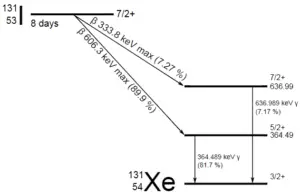
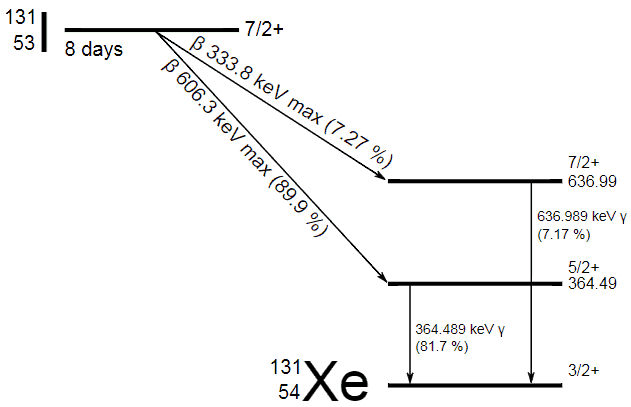
  • Iodine 131 - decay schemeRadioiodine. Radioiodine, iodine-131, is an important radioisotope of iodine. Radioiodine plays a major role as a radioactive isotope present in nuclear fission products, and it is a major contributor to the health hazards when released into the atmosphere during an accident. Iodine-131 has a half-life of 8.02 days. The target tissue for radioiodine exposure is the thyroid gland. The external beta and gamma dose from radioiodine present in the air is quite negligible when compared to the committed dose to the thyroid that would result from breathing this air. The biological half-life for iodine inside the human body is about 80 days (according to ICRP). Iodine in food is absorbed by the body and preferentially concentrated in the thyroid where it is needed for the functioning of that gland. When 131I is present in high levels in the environment from radioactive fallout, it can be absorbed through contaminated food, and will also accumulate in the thyroid. 131I decays with a half-life of 8.02 days with beta particle and gamma emissions. As it decays, it may cause damage to the thyroid. The primary risk from exposure to high levels of 131I is the chance occurrence of radiogenic thyroid cancer in later life. For 131I, ICRP has calculated that if you inhale 1 x 10⁶ Bq, you will receive a thyroid dose of HT = 400 mSv (and weighted whole-body dose of 20 mSv).
  • Tritium. Tritium is a byproduct in nuclear reactors. Most important source (due to releases of tritiated water) of tritium in nuclear power plants stems from the boric acid, which is commonly used as a chemical shim to compensate an excess of initial reactivity. Note that, tritium emits low-energy beta particles with a short range in body tissues and, therefore, poses a risk to health as a result of internal exposure only following ingestion in drinking water or food, or inhalation or absorption through the skin. The tritium taken into the body is uniformly distributed among all soft tissues. According to the ICRP, a biological half-time of tritium is 10 days for HTO and 40 days for OBT (organically bound tritium) formed from HTO in the body of adults. As a result, for an intake of 1 x 10⁹ Bq of tritium (HTO), an individual will get a whole-body dose of 20 mSv (equal to the intake of 1 x 10⁶ Bq of 131I). While for PWRs tritium poses a minor risk to health, for heavy water reactors, it contributes significantly to collective dose of plant workers. Note that, “Air that is saturated with moderator water at 35°C can give 3 000 mSv/h of tritium to an unprotected worker (See also: J.U.Burnham. Radiation Protection). The best protection from tritium can be achieved using an air-supplied respirator. Tritium cartridge respirators protects workers only by a factor of 3. The only way to reduce the skin absorption is by wearing plastics. In PHWR power plants, workers must wear plastics for work in atmospheres containing more than 500 μSv/h.
Respirators with suitable air filters, or completely self-contained suits with their own air supply can mitigate dangers from airborne contamination. Airborne contamination is usually measured by special radiological instruments that continuously pump the sampled air through a filter. Instruments that do this are called Continuous Air Monitors (CAM). Radioactive particulates in the air collect on the filter, where the activity is measured by a detector placed close to the filter.

References:

Radiation Protection:

  1. Knoll, Glenn F., Radiation Detection and Measurement 4th Edition, Wiley, 8/2010. ISBN-13: 978-0470131480.
  2. Stabin, Michael G., Radiation Protection and Dosimetry: An Introduction to Health Physics, Springer, 10/2010. ISBN-13: 978-1441923912.
  3. Martin, James E., Physics for Radiation Protection 3rd Edition, Wiley-VCH, 4/2013. ISBN-13: 978-3527411764.
  4. U.S.NRC, NUCLEAR REACTOR CONCEPTS
  5. U.S. Department of Energy, Nuclear Physics and Reactor Theory. DOE Fundamentals Handbook, Volume 1 and 2. January 1993.

Nuclear and Reactor Physics:

  1. J. R. Lamarsh, Introduction to Nuclear Reactor Theory, 2nd ed., Addison-Wesley, Reading, MA (1983).
  2. J. R. Lamarsh, A. J. Baratta, Introduction to Nuclear Engineering, 3d ed., Prentice-Hall, 2001, ISBN: 0-201-82498-1.
  3. W. M. Stacey, Nuclear Reactor Physics, John Wiley & Sons, 2001, ISBN: 0- 471-39127-1.
  4. Glasstone, Sesonske. Nuclear Reactor Engineering: Reactor Systems Engineering, Springer; 4th edition, 1994, ISBN: 978-0412985317
  5. W.S.C. Williams. Nuclear and Particle Physics. Clarendon Press; 1 edition, 1991, ISBN: 978-0198520467
  6. G.R.Keepin. Physics of Nuclear Kinetics. Addison-Wesley Pub. Co; 1st edition, 1965
  7. Robert Reed Burn, Introduction to Nuclear Reactor Operation, 1988.
  8. U.S. Department of Energy, Nuclear Physics and Reactor Theory. DOE Fundamentals Handbook, Volume 1 and 2. January 1993.
  9. Paul Reuss, Neutron Physics. EDP Sciences, 2008. ISBN: 978-2759800414.

See also:

Contamination

We hope, this article, Airborne Contamination – Particulates – Noble gases – Radioiodine, helps you. If so, give us a like in the sidebar. Main purpose of this website is to help the public to learn some interesting and important information about radiation and dosimeters.
What is Decontamination – Radiation Protection – Definition

Decontamination is a process used to reduce, or remove radioactive contamination to reduce the risk of radiation exposure. Decontamination in Radiation Protection
radioactive contamination
Radioactive contamination consist of radioactive material, that generate ionizing radiation. It is the source of radiation, not radiation itself.

Radioactive contamination is referred to as the presence of an unwanted radioactive substances on surfaces, or within solids (including the human body), liquids or gases, where their presence is unintended or undesirable. Radioactive contamination consist of radioactive atoms (material) that have escaped the system or structure that would normally contain them. Since radioactive contamination is radioactive material, ionizing radiation is emitted by the contamination. It is very important, which material (which radioisotope) is the radioactive contaminant. It is also very important to distinguish between radioactive contamination and radiation itself.

Decontamination

Decontamination is a process used to reduce, or remove radioactive contamination to reduce the risk of radiation exposure. The removal of contamination from occupied areas, equipment and personnel is important to maintain an ionizing radiation dose as low as reasonably achievable (ALARA). Decontamination also reduces background radiation levels, radioactive material inventory, and the spread of contamination to uncontrolled areas, equipment and personnel.

Decontamination may be accomplished by cleaning or treating surfaces to reduce or remove the contamination. It may be also accomplished by filtering contaminated air or water or by covering the contamination to shield or absorb the radiation. The process can also simply allow adequate time for natural radioactive decay to decrease the radioactivity.

In nuclear power plants, it is inevitable that many items of equipment, and also tools, clothing, work areas, and even people will become contaminated. This is quite common, that some of radioactive material becomes attached to surfaces (e.g. the sole of a shoe). In this case, workers are continuously monitored and in this case, surface contamination must be removed. We can rid of contamination by many mechanical, chemical (decontaminate surfaces). Biological processes (biological half-life) always work in case of internal contamination. A person becomes ‘radioactive’ if dust particles containing various radioisotopes land on the person’s skin or garments. Once a person has been decontaminated by clothes removal and dermal scrubbing, all of the particulate radioactivity sources are eliminated, and the individual is no longer contaminated.

Decontamination Techniques

In general, there are many techniques and equipment used for decontamination surfaces and persons. In any case, type of contamination and contaminated material matters. For example, it is very difficult to decontaminate porous materials. As a general orientation to the reader, these decontamination techniques and their main applications are highlighted in:

Special Reference: State of the Art Technology for Decontamination and Dismantling of Nuclear Facilities, IAEA. IAEA Vienna, 1999. ISBN 92–0–102499–1.

  • Chemical Decontamination. Chemical decontamination is one of the best method for most decontamination operations is to clean with water to which one or more suitable chemical cleaning agents have been added. These methods include decontamination using chemical solutions, chemical gels, foam decontamination etc. Removing contamination from personnel must be done carefully to ensure the skin is not damaged, and to prevent contamination from entering the body or a wound.
  • Mechanical Decontamination. Mechanical decontamination can be used especially for industrial decontamination. There are decontamination methods in which the outer layer of the contaminated surface is removed by physical force. Such methods are effective, but they are somewhat crude and destructive, and it may not be possible to use them on delicate objects. These methods include decontamination using steam cleaning, abrasive cleaning, sandblasting, vacuum cleaning, ultrasonic cleaning etc.
References:

Radiation Protection:

  1. Knoll, Glenn F., Radiation Detection and Measurement 4th Edition, Wiley, 8/2010. ISBN-13: 978-0470131480.
  2. Stabin, Michael G., Radiation Protection and Dosimetry: An Introduction to Health Physics, Springer, 10/2010. ISBN-13: 978-1441923912.
  3. Martin, James E., Physics for Radiation Protection 3rd Edition, Wiley-VCH, 4/2013. ISBN-13: 978-3527411764.
  4. U.S.NRC, NUCLEAR REACTOR CONCEPTS
  5. U.S. Department of Energy, Nuclear Physics and Reactor Theory. DOE Fundamentals Handbook, Volume 1 and 2. January 1993.

Nuclear and Reactor Physics:

  1. J. R. Lamarsh, Introduction to Nuclear Reactor Theory, 2nd ed., Addison-Wesley, Reading, MA (1983).
  2. J. R. Lamarsh, A. J. Baratta, Introduction to Nuclear Engineering, 3d ed., Prentice-Hall, 2001, ISBN: 0-201-82498-1.
  3. W. M. Stacey, Nuclear Reactor Physics, John Wiley & Sons, 2001, ISBN: 0- 471-39127-1.
  4. Glasstone, Sesonske. Nuclear Reactor Engineering: Reactor Systems Engineering, Springer; 4th edition, 1994, ISBN: 978-0412985317
  5. W.S.C. Williams. Nuclear and Particle Physics. Clarendon Press; 1 edition, 1991, ISBN: 978-0198520467
  6. G.R.Keepin. Physics of Nuclear Kinetics. Addison-Wesley Pub. Co; 1st edition, 1965
  7. Robert Reed Burn, Introduction to Nuclear Reactor Operation, 1988.
  8. U.S. Department of Energy, Nuclear Physics and Reactor Theory. DOE Fundamentals Handbook, Volume 1 and 2. January 1993.
  9. Paul Reuss, Neutron Physics. EDP Sciences, 2008. ISBN: 978-2759800414.

See also:

Contamination

We hope, this article, Decontamination – Radiation Protection, helps you. If so, give us a like in the sidebar. Main purpose of this website is to help the public to learn some interesting and important information about radiation and dosimeters.
What is Decontamination Technique and Method – Definition

In general, there are many techniques and equipment used for decontamination surfaces and persons. In any case, type of contamination and contaminated material matters. Radiation Dosimetry
radioactive contamination
Radioactive contamination consist of radioactive material, that generate ionizing radiation. It is the source of radiation, not radiation itself.

Decontamination Techniques

In general, there are many techniques and equipment used for decontamination surfaces and persons. In any case, type of contamination and contaminated material matters. For example, it is very difficult to decontaminate porous materials. As a general orientation to the reader, these decontamination techniques and their main applications are highlighted in:

Special Reference: State of the Art Technology for Decontamination and Dismantling of Nuclear Facilities, IAEA. IAEA Vienna, 1999. ISBN 92–0–102499–1.

  • Chemical Decontamination. Chemical decontamination is one of the best method for most decontamination operations is to clean with water to which one or more suitable chemical cleaning agents have been added. These methods include decontamination using chemical solutions, chemical gels, foam decontamination etc. Removing contamination from personnel must be done carefully to ensure the skin is not damaged, and to prevent contamination from entering the body or a wound.
  • Mechanical Decontamination. Mechanical decontamination can be used especially for industrial decontamination. There are decontamination methods in which the outer layer of the contaminated surface is removed by physical force. Such methods are effective, but they are somewhat crude and destructive, and it may not be possible to use them on delicate objects. These methods include decontamination using steam cleaning, abrasive cleaning, sandblasting, vacuum cleaning, ultrasonic cleaning etc.
References:

Radiation Protection:

  1. Knoll, Glenn F., Radiation Detection and Measurement 4th Edition, Wiley, 8/2010. ISBN-13: 978-0470131480.
  2. Stabin, Michael G., Radiation Protection and Dosimetry: An Introduction to Health Physics, Springer, 10/2010. ISBN-13: 978-1441923912.
  3. Martin, James E., Physics for Radiation Protection 3rd Edition, Wiley-VCH, 4/2013. ISBN-13: 978-3527411764.
  4. U.S.NRC, NUCLEAR REACTOR CONCEPTS
  5. U.S. Department of Energy, Nuclear Physics and Reactor Theory. DOE Fundamentals Handbook, Volume 1 and 2. January 1993.

Nuclear and Reactor Physics:

  1. J. R. Lamarsh, Introduction to Nuclear Reactor Theory, 2nd ed., Addison-Wesley, Reading, MA (1983).
  2. J. R. Lamarsh, A. J. Baratta, Introduction to Nuclear Engineering, 3d ed., Prentice-Hall, 2001, ISBN: 0-201-82498-1.
  3. W. M. Stacey, Nuclear Reactor Physics, John Wiley & Sons, 2001, ISBN: 0- 471-39127-1.
  4. Glasstone, Sesonske. Nuclear Reactor Engineering: Reactor Systems Engineering, Springer; 4th edition, 1994, ISBN: 978-0412985317
  5. W.S.C. Williams. Nuclear and Particle Physics. Clarendon Press; 1 edition, 1991, ISBN: 978-0198520467
  6. G.R.Keepin. Physics of Nuclear Kinetics. Addison-Wesley Pub. Co; 1st edition, 1965
  7. Robert Reed Burn, Introduction to Nuclear Reactor Operation, 1988.
  8. U.S. Department of Energy, Nuclear Physics and Reactor Theory. DOE Fundamentals Handbook, Volume 1 and 2. January 1993.
  9. Paul Reuss, Neutron Physics. EDP Sciences, 2008. ISBN: 978-2759800414.

See also:

Contamination

We hope, this article, Decontamination Technique and Method, helps you. If so, give us a like in the sidebar. Main purpose of this website is to help the public to learn some interesting and important information about radiation and dosimeters.
What is Chemical and Mechanical Decontamination – Definition

Chemical decontamination is one of the best method for most decontamination operations is to clean with water to which one or more suitable chemical cleaning agents have been added. Mechanical decontamination can be used especially for industrial decontamination. Radiation Dosimetry
radioactive contamination
Radioactive contamination consist of radioactive material, that generate ionizing radiation. It is the source of radiation, not radiation itself.

Decontamination Techniques

In general, there are many techniques and equipment used for decontamination surfaces and persons. In any case, type of contamination and contaminated material matters. For example, it is very difficult to decontaminate porous materials. As a general orientation to the reader, these decontamination techniques and their main applications are highlighted in:

Special Reference: State of the Art Technology for Decontamination and Dismantling of Nuclear Facilities, IAEA. IAEA Vienna, 1999. ISBN 92–0–102499–1.

  • Chemical Decontamination. Chemical decontamination is one of the best method for most decontamination operations is to clean with water to which one or more suitable chemical cleaning agents have been added. These methods include decontamination using chemical solutions, chemical gels, foam decontamination etc. Removing contamination from personnel must be done carefully to ensure the skin is not damaged, and to prevent contamination from entering the body or a wound.
  • Mechanical Decontamination. Mechanical decontamination can be used especially for industrial decontamination. There are decontamination methods in which the outer layer of the contaminated surface is removed by physical force. Such methods are effective, but they are somewhat crude and destructive, and it may not be possible to use them on delicate objects. These methods include decontamination using steam cleaning, abrasive cleaning, sandblasting, vacuum cleaning, ultrasonic cleaning etc.

Surface Contamination

Surface contamination means that radioactive material has been deposited on surfaces (such as walls, floors). It may be loosely deposited, much like ordinary dust, or it may be quite firmly fixed by chemical reaction. This distinction is important, and we classify surface contamination on the basis of how easily it can be removed:

  • Free Contamination. In the case of free contamination (or loose contamination), the radioactive material can be spread. This is surface contamination that can easily be removed with simple decontamination methods. For example, if dust particles containing various radioisotopes land on the person’s skin or garments, we can clean it up or remove clothes. Once a person has been decontaminated, all of the particulate radioactivity sources are eliminated, and the individual is no longer contaminated. Free contamination is also a more serious hazard than fixed contamination, because dust particles can become airborne and they can be easily ingested. This leads to an internal exposure by radioactive contaminants. Although almost all contaminants are beta radioactive with accompanying gamma emission, but there is also the possibility of alpha contamination in any nuclear fuel handling areas.
  • Fixed Contamination. In the case of fixed contamination, the radioactive material cannot be spread, since it is chemically or mechanically bound to structures. It cannot be removed by normal cleaning methods. Fixed contamination is a less serious hazard than free contamination, it cannot be re-suspended or transferred to skin. Therefore the hazard is usually an external one only. On the other hand, it depends on the level of contamination. Although almost all contaminants are beta radioactive with accompanying gamma emission, but there is also the possibility of alpha contamination in any nuclear fuel handling areas. Unless the level of contamination is very severe, the gamma radiation dose rate will be small and external exposure will be significant only in contact with, or very close to, the contaminated surfaces. Since beta particles are less penetrating than gamma rays, the beta dose rate can be high only at contact. A value of 1 mSv/h at contact for a contamination level of 400 – 500 Bq/cm2 is fairly representative.
References:

Radiation Protection:

  1. Knoll, Glenn F., Radiation Detection and Measurement 4th Edition, Wiley, 8/2010. ISBN-13: 978-0470131480.
  2. Stabin, Michael G., Radiation Protection and Dosimetry: An Introduction to Health Physics, Springer, 10/2010. ISBN-13: 978-1441923912.
  3. Martin, James E., Physics for Radiation Protection 3rd Edition, Wiley-VCH, 4/2013. ISBN-13: 978-3527411764.
  4. U.S.NRC, NUCLEAR REACTOR CONCEPTS
  5. U.S. Department of Energy, Nuclear Physics and Reactor Theory. DOE Fundamentals Handbook, Volume 1 and 2. January 1993.

Nuclear and Reactor Physics:

  1. J. R. Lamarsh, Introduction to Nuclear Reactor Theory, 2nd ed., Addison-Wesley, Reading, MA (1983).
  2. J. R. Lamarsh, A. J. Baratta, Introduction to Nuclear Engineering, 3d ed., Prentice-Hall, 2001, ISBN: 0-201-82498-1.
  3. W. M. Stacey, Nuclear Reactor Physics, John Wiley & Sons, 2001, ISBN: 0- 471-39127-1.
  4. Glasstone, Sesonske. Nuclear Reactor Engineering: Reactor Systems Engineering, Springer; 4th edition, 1994, ISBN: 978-0412985317
  5. W.S.C. Williams. Nuclear and Particle Physics. Clarendon Press; 1 edition, 1991, ISBN: 978-0198520467
  6. G.R.Keepin. Physics of Nuclear Kinetics. Addison-Wesley Pub. Co; 1st edition, 1965
  7. Robert Reed Burn, Introduction to Nuclear Reactor Operation, 1988.
  8. U.S. Department of Energy, Nuclear Physics and Reactor Theory. DOE Fundamentals Handbook, Volume 1 and 2. January 1993.
  9. Paul Reuss, Neutron Physics. EDP Sciences, 2008. ISBN: 978-2759800414.

See also:

Contamination

We hope, this article, Chemical and Mechanical Decontamination, helps you. If so, give us a like in the sidebar. Main purpose of this website is to help the public to learn some interesting and important information about radiation and dosimeters.
What is Annual Limit on Intake – ALI – Definition

Annual Limit on Intake, ALI, is defined as the activity intake (Bq) of a radionuclide which would lead to an effective dose corresponding to the annual limit Elimit;w. Radiation Dosimetry

In the assessment of committed effective doses for workers, intakes of radioactive material are controlled by the Annual Limit on Intake (ALI) defined by the ICRP, and expressed in units of activity (becquerels or curies).

The ALI was defined in by the ICRP in Publication 60 (ICRP, 1991b, paragraph S30) as:

“the activity intake (Bq) of a radionuclide which would lead to an effective dose corresponding to the annual limit Elimit;w, under the expectation that the worker is exposed to only this radionuclide.”

The ALI of radionuclide j is then:

Annual Limit on Intake - ALI

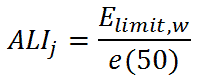
where e(50) is the corresponding reference committed effective dose coefficient in (Sv/Bq). This dose coefficient, e(T), is determined by the radiotoxicity of a nuclide, and it accounts for radiation and tissue weighting factors, metabolic and biokinetic information.

See also: ICRP, 1994. Dose Coefficients for Intakes of Radionuclides by Workers. ICRP Publication 68. Ann. ICRP 24 (4).

Annual Limit on Intake - ALI
Annual Limits on Intake (ALI) for workers, which results in a dose of 0.020 Sv.

The Commission recommended in Publication 60 that the ALI should be based on the dose limit of Elimit;w = 0.020 Sv in a year, with no time averaging. For members of the public Elimit;w = 0.001 Sv is the recommended value.

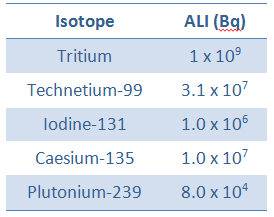
As an example, let assume an intake of radioactive tritium. For tritium, the annual limit intake (ALI) is 1 x 10⁹ Bq. If you take in 1 x 10⁹ Bq of tritium, you will receive a whole-body dose of 20 mSv. Note that, the biological half-life about 10 days, while the radioactive half-life is about 12 years. Instead of years, it takes a couple of months until the tritium has been pretty well eliminated. The committed effective dose, E(t), is therefore 20 mSv. It does not depend whether a person intakes this amount of activity in a short time or in a long time. In every case, this person gets the same whole-body dose of 20 mSv.

For 131I, ICRP has calculated that if you inhale 1 x 10⁶ Bq (ALI for 131I), you will receive a thyroid dose of HT = 400 mSv (and weighted whole-body dose of 20 mSv).

Derived Air Concentration – DAC

Concentrations of radioactive materials in air are limited by the Derived Air Concentration (DAC), which are derived from the ALI. The DAC is the activity concentration in air in units of Bq/m3 of the radionuclide considered, which would lead to an intake of an ALI (Bq) assuming a gender-averaged breathing rate of 1.1 m3/h and an annual working time of 2000 h (an annual air intake of 2200 m3).

The DAC was defined in by the ICRP in Publication 60 (ICRP, 1991b, paragraph S30) as:

“Derived air concentration equals to the annual limit on intake, ALI, (of a radionuclide) divided by the volume of air inhaled by a Reference Person in a working year (i.e., 2.2×10³ m3). The unit of DAC is Bq/m3.”

Special Reference: ICRP, 2007. The 2007 Recommendations of the International Commission on Radiological Protection. ICRP Publication 103. Ann. ICRP 37 (2-4).

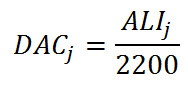
Therefore, if we divide the ALI by 2200 m3, we will get the DAC in Bq/m3. For example, the ALI of iodine-131 is 1 x 10⁶ Bq. The corresponding DAC will be 1 000 000/2400 = 417 Bq/m3.

The DAC of radionuclide j is given by:

Derived Air Concentration - DAC - definition

If a worker breathes air containing radioactive material at a concentration of 1 DAC for one hour, then the worker has been exposed to 1 DAC.hr.

See also: Airborne Contamination

Occupational Exposure – Effective Dose

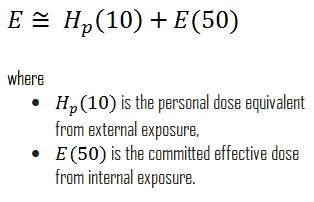
In most situations of occupational exposure the effective dose, E, can be derived from operational quantities using the following formula:

Occupational Exposure - External and Internal.

The committed dose is a dose quantity that measures the stochastic health risk due to an intake of radioactive material into the human body. Since the operational dose limit of 20 mSv applies to the sum of the internal and external exposures, if a worker has some external dose, the ALI must be modified or offset to account for the external dose. For example, assume the worker has 10 mSv from external sources of radiation. Only 10 more mSv are allowed from internal radiation before the worker reaches the occupational whole body limit.

See also: Dose Limits

References:

Radiation Protection:

  1. Knoll, Glenn F., Radiation Detection and Measurement 4th Edition, Wiley, 8/2010. ISBN-13: 978-0470131480.
  2. Stabin, Michael G., Radiation Protection and Dosimetry: An Introduction to Health Physics, Springer, 10/2010. ISBN-13: 978-1441923912.
  3. Martin, James E., Physics for Radiation Protection 3rd Edition, Wiley-VCH, 4/2013. ISBN-13: 978-3527411764.
  4. U.S.NRC, NUCLEAR REACTOR CONCEPTS
  5. U.S. Department of Energy, Nuclear Physics and Reactor Theory. DOE Fundamentals Handbook, Volume 1 and 2. January 1993.

Nuclear and Reactor Physics:

  1. J. R. Lamarsh, Introduction to Nuclear Reactor Theory, 2nd ed., Addison-Wesley, Reading, MA (1983).
  2. J. R. Lamarsh, A. J. Baratta, Introduction to Nuclear Engineering, 3d ed., Prentice-Hall, 2001, ISBN: 0-201-82498-1.
  3. W. M. Stacey, Nuclear Reactor Physics, John Wiley & Sons, 2001, ISBN: 0- 471-39127-1.
  4. Glasstone, Sesonske. Nuclear Reactor Engineering: Reactor Systems Engineering, Springer; 4th edition, 1994, ISBN: 978-0412985317
  5. W.S.C. Williams. Nuclear and Particle Physics. Clarendon Press; 1 edition, 1991, ISBN: 978-0198520467
  6. G.R.Keepin. Physics of Nuclear Kinetics. Addison-Wesley Pub. Co; 1st edition, 1965
  7. Robert Reed Burn, Introduction to Nuclear Reactor Operation, 1988.
  8. U.S. Department of Energy, Nuclear Physics and Reactor Theory. DOE Fundamentals Handbook, Volume 1 and 2. January 1993.
  9. Paul Reuss, Neutron Physics. EDP Sciences, 2008. ISBN: 978-2759800414.

See also:

Internal Dose

We hope, this article, Annual Limit on Intake – ALI, helps you. If so, give us a like in the sidebar. Main purpose of this website is to help the public to learn some interesting and important information about radiation and dosimeters.
What is Derived Air Concentration – DAC – Definition

Concentrations of radioactive materials in air are limited by the Derived Air Concentration (DAC), which are derived from the ALI. The DAC is the activity concentration in air in units of Bq/m3. Radiation Dosimetry

Concentrations of radioactive materials in air are limited by the Derived Air Concentration (DAC), which are derived from the ALI. The DAC is the activity concentration in air in units of Bq/m3 of the radionuclide considered, which would lead to an intake of an ALI (Bq) assuming a gender-averaged breathing rate of 1.1 m3/h and an annual working time of 2000 h (an annual air intake of 2200 m3).

The DAC was defined in by the ICRP in Publication 60 (ICRP, 1991b, paragraph S30) as:

“Derived air concentration equals to the annual limit on intake, ALI, (of a radionuclide) divided by the volume of air inhaled by a Reference Person in a working year (i.e., 2.2×10³ m3). The unit of DAC is Bq/m3.”

Special Reference: ICRP, 2007. The 2007 Recommendations of the International Commission on Radiological Protection. ICRP Publication 103. Ann. ICRP 37 (2-4).

Therefore, if we divide the ALI by 2200 m3, we will get the DAC in Bq/m3. For example, the ALI of iodine-131 is 1 x 10⁶ Bq. The corresponding DAC will be 1 000 000/2400 = 417 Bq/m3.

The DAC of radionuclide j is given by:

Derived Air Concentration - DAC - definition

If a worker breathes air containing radioactive material at a concentration of 1 DAC for one hour, then the worker has been exposed to 1 DAC.hr.

See also: Airborne Contamination

Annual Limit on Intake – ALI

In the assessment of committed effective doses for workers, intakes of radioactive material are controlled by the Annual Limit on Intake (ALI) defined by the ICRP, and expressed in units of activity (becquerels or curies).

The ALI was defined in by the ICRP in Publication 60 (ICRP, 1991b, paragraph S30) as:

“the activity intake (Bq) of a radionuclide which would lead to an effective dose corresponding to the annual limit Elimit;w, under the expectation that the worker is exposed to only this radionuclide.”

The ALI of radionuclide j is then:

Annual Limit on Intake - ALI

where e(50) is the corresponding reference committed effective dose coefficient in (Sv/Bq). This dose coefficient, e(T), is determined by the radiotoxicity of a nuclide, and it accounts for radiation and tissue weighting factors, metabolic and biokinetic information.

See also: ICRP, 1994. Dose Coefficients for Intakes of Radionuclides by Workers. ICRP Publication 68. Ann. ICRP 24 (4).

Annual Limit on Intake - ALI
Annual Limits on Intake (ALI) for workers, which results in a dose of 0.020 Sv.

The Commission recommended in Publication 60 that the ALI should be based on the dose limit of Elimit;w = 0.020 Sv in a year, with no time averaging. For members of the public Elimit;w = 0.001 Sv is the recommended value.

As an example, let assume an intake of radioactive tritium. For tritium, the annual limit intake (ALI) is 1 x 10⁹ Bq. If you take in 1 x 10⁹ Bq of tritium, you will receive a whole-body dose of 20 mSv. Note that, the biological half-life about 10 days, while the radioactive half-life is about 12 years. Instead of years, it takes a couple of months until the tritium has been pretty well eliminated. The committed effective dose, E(t), is therefore 20 mSv. It does not depend whether a person intakes this amount of activity in a short time or in a long time. In every case, this person gets the same whole-body dose of 20 mSv.

For 131I, ICRP has calculated that if you inhale 1 x 10⁶ Bq (ALI for 131I), you will receive a thyroid dose of HT = 400 mSv (and weighted whole-body dose of 20 mSv).

Occupational Exposure – Effective Dose

In most situations of occupational exposure the effective dose, E, can be derived from operational quantities using the following formula:

Occupational Exposure - External and Internal.

The committed dose is a dose quantity that measures the stochastic health risk due to an intake of radioactive material into the human body. Since the operational dose limit of 20 mSv applies to the sum of the internal and external exposures, if a worker has some external dose, the ALI must be modified or offset to account for the external dose. For example, assume the worker has 10 mSv from external sources of radiation. Only 10 more mSv are allowed from internal radiation before the worker reaches the occupational whole body limit.

See also: Dose Limits

References:

Radiation Protection:

  1. Knoll, Glenn F., Radiation Detection and Measurement 4th Edition, Wiley, 8/2010. ISBN-13: 978-0470131480.
  2. Stabin, Michael G., Radiation Protection and Dosimetry: An Introduction to Health Physics, Springer, 10/2010. ISBN-13: 978-1441923912.
  3. Martin, James E., Physics for Radiation Protection 3rd Edition, Wiley-VCH, 4/2013. ISBN-13: 978-3527411764.
  4. U.S.NRC, NUCLEAR REACTOR CONCEPTS
  5. U.S. Department of Energy, Nuclear Physics and Reactor Theory. DOE Fundamentals Handbook, Volume 1 and 2. January 1993.

Nuclear and Reactor Physics:

  1. J. R. Lamarsh, Introduction to Nuclear Reactor Theory, 2nd ed., Addison-Wesley, Reading, MA (1983).
  2. J. R. Lamarsh, A. J. Baratta, Introduction to Nuclear Engineering, 3d ed., Prentice-Hall, 2001, ISBN: 0-201-82498-1.
  3. W. M. Stacey, Nuclear Reactor Physics, John Wiley & Sons, 2001, ISBN: 0- 471-39127-1.
  4. Glasstone, Sesonske. Nuclear Reactor Engineering: Reactor Systems Engineering, Springer; 4th edition, 1994, ISBN: 978-0412985317
  5. W.S.C. Williams. Nuclear and Particle Physics. Clarendon Press; 1 edition, 1991, ISBN: 978-0198520467
  6. G.R.Keepin. Physics of Nuclear Kinetics. Addison-Wesley Pub. Co; 1st edition, 1965
  7. Robert Reed Burn, Introduction to Nuclear Reactor Operation, 1988.
  8. U.S. Department of Energy, Nuclear Physics and Reactor Theory. DOE Fundamentals Handbook, Volume 1 and 2. January 1993.
  9. Paul Reuss, Neutron Physics. EDP Sciences, 2008. ISBN: 978-2759800414.

See also:

Internal Dose

We hope, this article, Derived Air Concentration – DAC, helps you. If so, give us a like in the sidebar. Main purpose of this website is to help the public to learn some interesting and important information about radiation and dosimeters.
What is ALARA and Radiation Shielding – Definition

What is the optimal thickness of radiation shield? Since zero dose is not attainable, we can only minimize effects of radiation As Low As is Reasonable Achievable (the ALARA – principle). Radiation Dosimetry

One of radiation protection principles is optimisation of protection, which requires, that:

“doses should all be kept as low as reasonably achievable”.

radiation protection pronciples - time, distance, shielding
Principles of Radiation Protection – Time, Distance, Shielding

This statement is known as the ALARA principle. ALARA is an acronym for “as low as is reasonably achievable”. The ALARA principle means that we should make all reasonable efforts to maintain exposures to radiation as far below the dose limits in this part as is practical consistent with the purpose for which the licensed activity is undertaken, while at the same time not wasting a lot of money, time and effort to do so. The ALARA principle arises from the fact that infinite time, effort and money could be spent in the attempt of reducing a risk to zero.

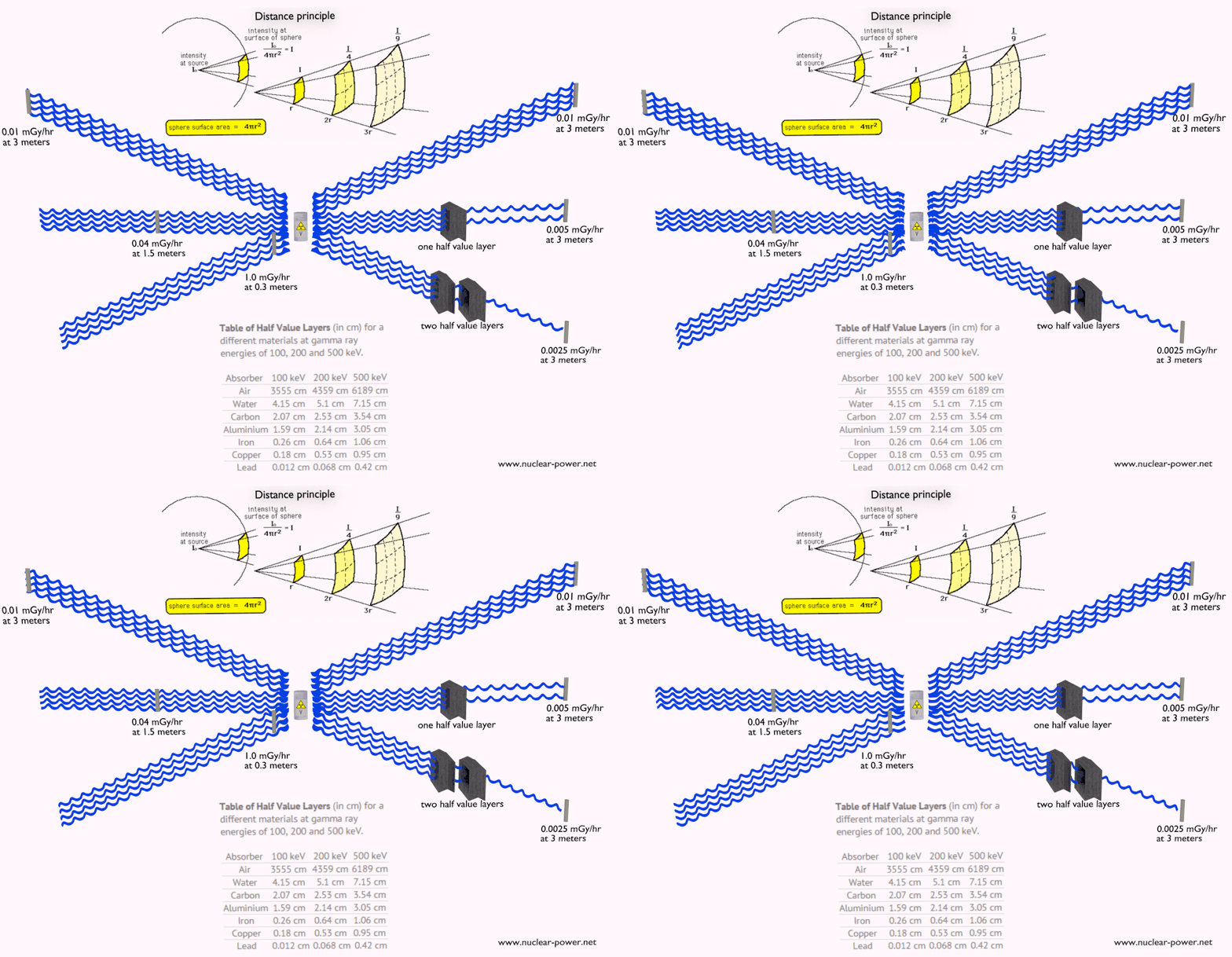
If the source of radiation is too intensive and time or distance do not provide sufficient radiation protection, the shielding must be used. Radiation shielding usually consist of barriers of lead, concrete or water. There are many many materials, which can be used for radiation shielding, but there are also many situations in radiation protection. It highly depends on the type of radiation to be shielded, its energy, and many other parametres.


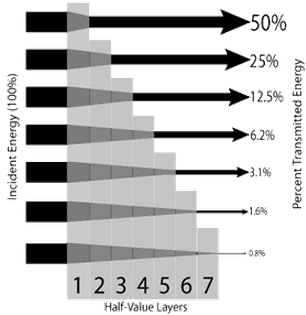
Generally, shielding of gamma rays is based on attenuation theory, which uses the concept of half-value layers. The half value layer expresses the thickness of absorbing material needed for reduction of the incident radiation intensity by a factor of two. As a result, according to attenuation theory, it is impossible to shield radiation completely, because attenuation is exponential. Almost every time some radiation, however small, travels through radiation shield.

half value layerRecall, today the protection system is based on the LNT-hypothesis, assuming that all radiation is bad and that the deleterious effect (essentially the cancer risk) increases linearly with dose with no threshold (start at zero dose). But we cannot shield radiation completely, becauses it would require radiation shields of infinite thickness. So what is the optimal thickness of radiation shield? Since zero dose is not attainable, we can only minimize effects of radiation As Low As is Reasonable Achievable (the ALARA – principle). The ALARA principle is also reflected in dose limits. In general, these limits are set to limit stochastic effects to an acceptable level, and to prevent deterministic effects completely.

References:

Radiation Protection:

  1. Knoll, Glenn F., Radiation Detection and Measurement 4th Edition, Wiley, 8/2010. ISBN-13: 978-0470131480.
  2. Stabin, Michael G., Radiation Protection and Dosimetry: An Introduction to Health Physics, Springer, 10/2010. ISBN-13: 978-1441923912.
  3. Martin, James E., Physics for Radiation Protection 3rd Edition, Wiley-VCH, 4/2013. ISBN-13: 978-3527411764.
  4. U.S.NRC, NUCLEAR REACTOR CONCEPTS
  5. U.S. Department of Energy, Nuclear Physics and Reactor Theory. DOE Fundamentals Handbook, Volume 1 and 2. January 1993.

Nuclear and Reactor Physics:

  1. J. R. Lamarsh, Introduction to Nuclear Reactor Theory, 2nd ed., Addison-Wesley, Reading, MA (1983).
  2. J. R. Lamarsh, A. J. Baratta, Introduction to Nuclear Engineering, 3d ed., Prentice-Hall, 2001, ISBN: 0-201-82498-1.
  3. W. M. Stacey, Nuclear Reactor Physics, John Wiley & Sons, 2001, ISBN: 0- 471-39127-1.
  4. Glasstone, Sesonske. Nuclear Reactor Engineering: Reactor Systems Engineering, Springer; 4th edition, 1994, ISBN: 978-0412985317
  5. W.S.C. Williams. Nuclear and Particle Physics. Clarendon Press; 1 edition, 1991, ISBN: 978-0198520467
  6. G.R.Keepin. Physics of Nuclear Kinetics. Addison-Wesley Pub. Co; 1st edition, 1965
  7. Robert Reed Burn, Introduction to Nuclear Reactor Operation, 1988.
  8. U.S. Department of Energy, Nuclear Physics and Reactor Theory. DOE Fundamentals Handbook, Volume 1 and 2. January 1993.
  9. Paul Reuss, Neutron Physics. EDP Sciences, 2008. ISBN: 978-2759800414.

See also:

ALARA

We hope, this article, ALARA and Radiation Shielding, helps you. If so, give us a like in the sidebar. Main purpose of this website is to help the public to learn some interesting and important information about radiation and dosimeters.
What is ALARA and ALARP Principle – Definition

The term “as low as reasonably achievable” (ALARA) used in the optimisation principle is synonymous with ALARP, and is the term used to describe the risk reduction process outside the UK. Radiation Dosimetry

The term ALARP arises from UK legislation, particularly the Health and Safety at Work etc. Act 1974, which requires “Provision and maintenance of plant and systems of work that are, so far as is reasonably practicable, safe and without risks to health”. The phrase So Far As is Reasonably Practicable (SFARP) in this and similar clauses is interpreted as leading to a requirement that risks must be reduced to a level that is As Low As is Reasonably Practicable (ALARP). ALARP, used especially in the UK, is much more broad term than ALARA, since it is applicable in various fields of the regulation and management of safety-critical and safety-involved systems.

The term “as low as reasonably achievable” (ALARA) used in the optimisation principle is synonymous with ALARP, and is the term used to describe the risk reduction process outside the UK. The term ALARA, or “as low as reasonably achievable” is used interchangeably in the United States of America, almost exclusively in the field of radiation protection. ALARA and ALARP are considered to be equivalent in meaning and purpose.

References:

Radiation Protection:

  1. Knoll, Glenn F., Radiation Detection and Measurement 4th Edition, Wiley, 8/2010. ISBN-13: 978-0470131480.
  2. Stabin, Michael G., Radiation Protection and Dosimetry: An Introduction to Health Physics, Springer, 10/2010. ISBN-13: 978-1441923912.
  3. Martin, James E., Physics for Radiation Protection 3rd Edition, Wiley-VCH, 4/2013. ISBN-13: 978-3527411764.
  4. U.S.NRC, NUCLEAR REACTOR CONCEPTS
  5. U.S. Department of Energy, Nuclear Physics and Reactor Theory. DOE Fundamentals Handbook, Volume 1 and 2. January 1993.

Nuclear and Reactor Physics:

  1. J. R. Lamarsh, Introduction to Nuclear Reactor Theory, 2nd ed., Addison-Wesley, Reading, MA (1983).
  2. J. R. Lamarsh, A. J. Baratta, Introduction to Nuclear Engineering, 3d ed., Prentice-Hall, 2001, ISBN: 0-201-82498-1.
  3. W. M. Stacey, Nuclear Reactor Physics, John Wiley & Sons, 2001, ISBN: 0- 471-39127-1.
  4. Glasstone, Sesonske. Nuclear Reactor Engineering: Reactor Systems Engineering, Springer; 4th edition, 1994, ISBN: 978-0412985317
  5. W.S.C. Williams. Nuclear and Particle Physics. Clarendon Press; 1 edition, 1991, ISBN: 978-0198520467
  6. G.R.Keepin. Physics of Nuclear Kinetics. Addison-Wesley Pub. Co; 1st edition, 1965
  7. Robert Reed Burn, Introduction to Nuclear Reactor Operation, 1988.
  8. U.S. Department of Energy, Nuclear Physics and Reactor Theory. DOE Fundamentals Handbook, Volume 1 and 2. January 1993.
  9. Paul Reuss, Neutron Physics. EDP Sciences, 2008. ISBN: 978-2759800414.

See also:

ALARA

We hope, this article, ALARA and ALARP Principle, helps you. If so, give us a like in the sidebar. Main purpose of this website is to help the public to learn some interesting and important information about radiation and dosimeters.
What is Carbon-14 – Production – Properties – Decay – Definition

Carbon-14 is a naturally occurring isotope. Radioactive carbon-14 has a half-life of 5730 years and undergoes β− decay. Carbon-14 is continuously formed in the upper atmosphere

Carbon-14

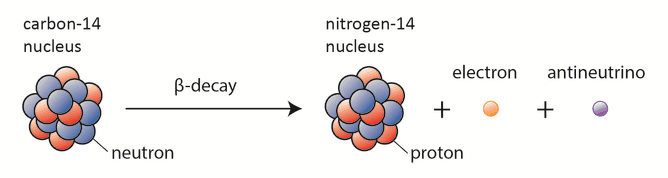
The only cosmogenic radionuclide to make a significant contribution to internal exposure of human is carbon-14. Radioactive carbon-14 has a half-life of 5730 years and undergoes β− decay, where the neutron is converted into a proton, an electron, and an electron antineutrino:

beta decay
Beta decay of C-14 nucleus.

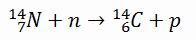
In spite of this short half-life compared to the age of the earth, carbon-14 is a naturally occurring isotope. Its presence can be explained by the following simple observation. Our atmosphere contains many gases, including nitrogen-14. Besides, the atmosphere is constantly bombarded with high energy cosmic rays, consisting of protons, heavier nuclei, or gamma rays. These cosmic rays interact with nuclei in the atmosphere, and produce also high-energy neutrons. These neutrons produced in these collisions can be absorbed by nitrogen-14 to produce an isotope of carbon-14:

carbon-14 dating - formation

Carbon-14 can also be produced in the atmosphere by other neutron reactions, including in particular 13C(n,γ)14C and 17O(n,α)14C. As a result, carbon-14 is continuously formed in the upper atmosphere by the interaction of cosmic rays with atmospheric nitrogen. On average just one out of every 1.3 x 10¹² carbon atoms in the atmosphere is a radioactive carbon-14 atom. As a result, all living biological substances contain the same amount of C-14 per gram of carbon, that is 0.3 Bq of carbon-14 activity per gram of carbon. Carbon-14 is present in the human body (13kg of carbon in 70kg human) at a level of about 3700 Bq (0.1 μCi) with a biological half-life of 40 days. Note that, biological half-life is the time taken for the amount of a particular element in the body to decrease to half of its initial value due to elimination by biological processes alone. However, a carbon atom is in the genetic information of about half the cells, while potassium is not a component of DNA. The decay of a carbon-14 atom inside DNA in one person happens about 50 times per second, changing a carbon atom to one of nitrogen.

The annual dose from carbon-14 is estimated to be about 12 μSv/year.

As long as the biological system is alive the level is constant due to constant intake of all isotopes of carbon. When the biological system dies, it stops exchanging carbon with its environment, and from that point onwards the amount of carbon-14 it contains begins to decrease as the carbon-14 undergoes radioactive decay.

See also: Carbon-14 Dating

References:

Radiation Protection:

  1. Knoll, Glenn F., Radiation Detection and Measurement 4th Edition, Wiley, 8/2010. ISBN-13: 978-0470131480.
  2. Stabin, Michael G., Radiation Protection and Dosimetry: An Introduction to Health Physics, Springer, 10/2010. ISBN-13: 978-1441923912.
  3. Martin, James E., Physics for Radiation Protection 3rd Edition, Wiley-VCH, 4/2013. ISBN-13: 978-3527411764.
  4. U.S.NRC, NUCLEAR REACTOR CONCEPTS
  5. U.S. Department of Energy, Nuclear Physics and Reactor Theory. DOE Fundamentals Handbook, Volume 1 and 2. January 1993.

Nuclear and Reactor Physics:

  1. J. R. Lamarsh, Introduction to Nuclear Reactor Theory, 2nd ed., Addison-Wesley, Reading, MA (1983).
  2. J. R. Lamarsh, A. J. Baratta, Introduction to Nuclear Engineering, 3d ed., Prentice-Hall, 2001, ISBN: 0-201-82498-1.
  3. W. M. Stacey, Nuclear Reactor Physics, John Wiley & Sons, 2001, ISBN: 0- 471-39127-1.
  4. Glasstone, Sesonske. Nuclear Reactor Engineering: Reactor Systems Engineering, Springer; 4th edition, 1994, ISBN: 978-0412985317
  5. W.S.C. Williams. Nuclear and Particle Physics. Clarendon Press; 1 edition, 1991, ISBN: 978-0198520467
  6. G.R.Keepin. Physics of Nuclear Kinetics. Addison-Wesley Pub. Co; 1st edition, 1965
  7. Robert Reed Burn, Introduction to Nuclear Reactor Operation, 1988.
  8. U.S. Department of Energy, Nuclear Physics and Reactor Theory. DOE Fundamentals Handbook, Volume 1 and 2. January 1993.
  9. Paul Reuss, Neutron Physics. EDP Sciences, 2008. ISBN: 978-2759800414.

See also:

Cosmogenic Radionuclides


We hope, this article, Carbon-14 – Production – Properties – Decay, helps you. If so, give us a like in the sidebar. Main purpose of this website is to help the public to learn some interesting and important information about radiation and dosimeters.
What is Tritium in Nature – Decay – Dose – Definition

Tritium is the only naturally-occurring radioisotope of hydrogen. An average annual dose from natural tritium intake is 0.01 μSv. Tritium in Nature – Decay – Dose

Tritium is the only naturally-occurring radioisotope of hydrogen. Its atomic number is naturally 1 which means there is 1 proton and 1 electron in the atomic structure. Unlike the hydrogen nucleus and deuterium nucleus, tritium has 2 neutrons in the nucleus. Tritium is naturally-occurring, but it is extremely rare.

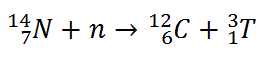
Tritium is produced in the atmosphere when cosmic rays collide with air molecules. In the most important reaction for natural production, a fast neutron (which must have energy greater than 4.0 MeV) interacts with atmospheric nitrogen:

Worldwide, the production of tritium from natural sources is 148 petabecquerels per year. In result, the tritiated water produced participates in the water cycle.

  • about 400 Bq/m3 in continental water
  • about 100 Bq/m3 in oceans

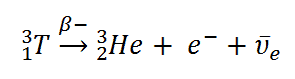
Tritium is a radioactive isotope, but it emits a very weak form of radiation, a low-energy beta particle that is similar to an electron. It is a pure beta emitter (i.e. beta emitter without an accompanying gamma radiation). The electron’s kinetic energy varies, with an average of 5.7 keV, while the remaining energy is carried off by the nearly undetectable electron antineutrino. Such a very low energy of electron causes, that the electron cannot penetrate the skin or even does not travel very far in air. Beta particles from tritium can penetrate only about 6.0 mm of air. Tritium decays via negative beta decay into helium-3 with half-life of 12.3 years.

Decay of TritiumTherefore, tritium poses a risk to health as a result of internal exposure only following ingestion in drinking water or food, or inhalation or absorption through the skin. The tritium taken into the body is uniformly distributed among all soft tissues. An average annual dose from natural tritium intake is 0.01 μSv.

In case of artificial tritium ingestion or inhalation, a biological half-time of tritium is 10 days for HTO and 40 days for OBT (organically bound tritium) formed from HTO in the body of adults. It was also shown that the biological half-time of HTO depends strongly on many variables and varies from about 4 to 18 days. During the warmer months, the average half-life is lower, which is attributed to increased water intake. As well as, drinking larger amounts of alcohol will reduce the biological half-life of water in the body.

References:

Radiation Protection:

  1. Knoll, Glenn F., Radiation Detection and Measurement 4th Edition, Wiley, 8/2010. ISBN-13: 978-0470131480.
  2. Stabin, Michael G., Radiation Protection and Dosimetry: An Introduction to Health Physics, Springer, 10/2010. ISBN-13: 978-1441923912.
  3. Martin, James E., Physics for Radiation Protection 3rd Edition, Wiley-VCH, 4/2013. ISBN-13: 978-3527411764.
  4. U.S.NRC, NUCLEAR REACTOR CONCEPTS
  5. U.S. Department of Energy, Nuclear Physics and Reactor Theory. DOE Fundamentals Handbook, Volume 1 and 2. January 1993.

Nuclear and Reactor Physics:

  1. J. R. Lamarsh, Introduction to Nuclear Reactor Theory, 2nd ed., Addison-Wesley, Reading, MA (1983).
  2. J. R. Lamarsh, A. J. Baratta, Introduction to Nuclear Engineering, 3d ed., Prentice-Hall, 2001, ISBN: 0-201-82498-1.
  3. W. M. Stacey, Nuclear Reactor Physics, John Wiley & Sons, 2001, ISBN: 0- 471-39127-1.
  4. Glasstone, Sesonske. Nuclear Reactor Engineering: Reactor Systems Engineering, Springer; 4th edition, 1994, ISBN: 978-0412985317
  5. W.S.C. Williams. Nuclear and Particle Physics. Clarendon Press; 1 edition, 1991, ISBN: 978-0198520467
  6. G.R.Keepin. Physics of Nuclear Kinetics. Addison-Wesley Pub. Co; 1st edition, 1965
  7. Robert Reed Burn, Introduction to Nuclear Reactor Operation, 1988.
  8. U.S. Department of Energy, Nuclear Physics and Reactor Theory. DOE Fundamentals Handbook, Volume 1 and 2. January 1993.
  9. Paul Reuss, Neutron Physics. EDP Sciences, 2008. ISBN: 978-2759800414.

See also:

Cosmogenic Radionuclides


We hope, this article, Tritium in Nature – Decay – Dose, helps you. If so, give us a like in the sidebar. Main purpose of this website is to help the public to learn some interesting and important information about radiation and dosimeters.