The dead-time is the period during which the detector is busy and cannot accept and process pulses. This phenomenon is very important, for example, for Geiger counters.. Dead Time of Detectors
Detector of Ionizing Radiation – Geiger Tube
For radiation detection systems that record pulses (discrete events), the dead time is the time after each event during which the system is not able to record another event. This phenomenon is very important, for example, for Geiger counters. Because of the large avalanche induced by any ionization, a Geiger counter takes a long time (about 1 ms) to recover between successive pulses. Therefore, Geiger counters are not able to measure high radiation rates due to the “dead time” of the tube.
In other words, dead-time is the period during which the detector is busy and cannot accept and process pulses. In case of detectors of ionizing radiation, this phenomenon can have serious consequences, since dead-time distorts outputs at high activities or high dose rates. The total dead time of a detection system is usually due to the contributions of the intrinsic dead time of the detector, of the analog front end and of the data acquisition.
Paralyzable and Non-paralyzable Detector
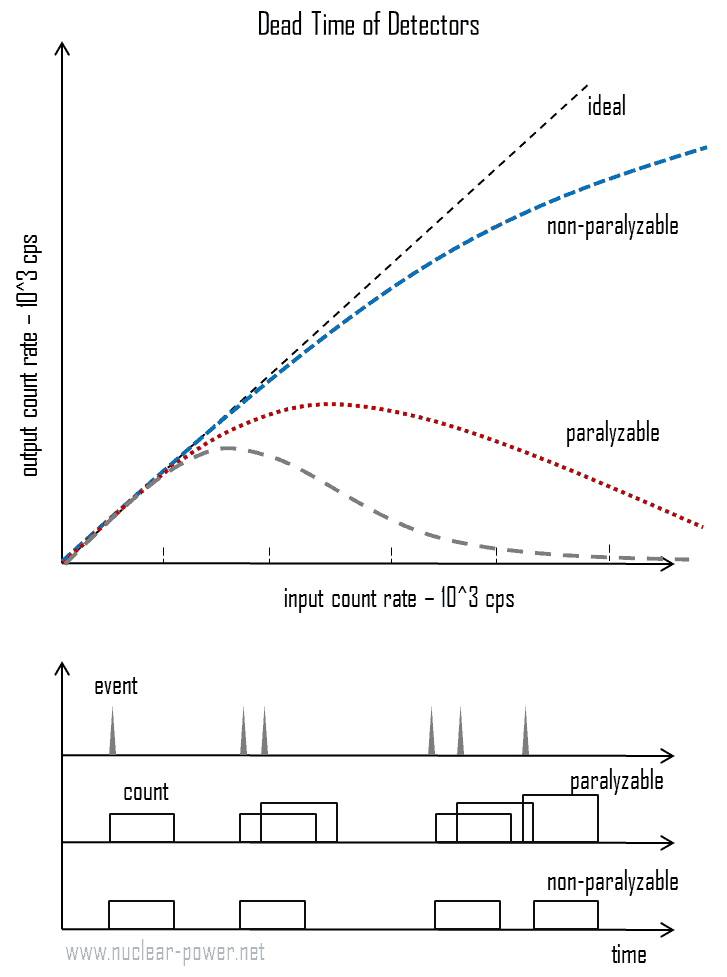
Because of the random nature of radioactive decay, there is always some probability, that a true event will be lost, because another event is just recorded and the detector cannot accept and process more than one pulse.
There are two main dead-time characteristics of each detecting system:
Paralyzable. In a paralyzable detector, an event happening during the dead time will not just be missed, but will restart the dead time, so that with increasing rate the detector will reach a saturation point where it will be incapable of recording any event at all.
Non-paralyzable. In a non-paralyzable detector, an event happening during the dead time is simply lost, so that with an increasing event rate the detector will reach a saturation rate equal to the inverse of the dead time.
Quenching – Dead Time – Geiger Counters
Dead time phenomenon is very important also for Geiger counters. Typically it has a value of about 100 μs (for proportional counters it is much less), and so after each ionising event a Geiger tube is basically switched off for 100 μs.
In a Geiger counter the fill gas of the chamber is an inert gas which is ionized by incident radiation, and a quench gas of 5–10% of an organic vapor or a halogen gas to prevent spurious pulsing by quenching the electron avalanches. The Geiger counter should not give spurious pulses, and should recover quickly to the passive state, ready for the next radiation event. Argon and helium are the most frequently used fill gases and allow for the detection of alpha, beta, and gamma radiation. For neutron detection He-3 and BF3 (Boron Trifluoride) are the most commonly employed gases.
However, for each electron collected in the chamber, there is a positively charged gas ion left over. These gas ions are heavy compared to an electron and move much more slowly. Free electrons are much lighter than the positive ions, thus, they are drawn toward the positive central electrode much faster than the positive ions are drawn to the chamber wall. The resulting cloud of positive ions near the electrode leads to distortions in gas multiplication. Eventually the positive ions move away from the positively charged central wire to the negatively charged wall and are neutralized by gaining an electron. These atoms then return to their ground state by emitting photons which in turn produce further ionisation and thereby spurious secondary discharges. The electrons produced by this ionization move toward the central wire and are multiplied en route. This pulse of charge is unrelated to the radiation to be detected and can set off a series of pulses. In practice the termination of the avalanche is improved by the use of “quenching” techniques.
The quenching gas molecules have a weaker affinity for electrons than the chamber gas does; therefore, the ionized atoms of the chamber gas readily take electrons from the quenching gas molecules. Thus, the ionized molecules of quenching gas reach the chamber wall instead of the chamber gas. The ionized molecules of the quenching gas are neutralized by gaining an electron, and the energy liberated does not cause further ionization, but causes dissociation of the molecule. This type of quenching is known as self-quenching or internal-quenching, since tubes stop the discharge without external assistance.
For Geiger counters, external quenching, sometimes called “active quenching” or “electronic quenching“, is also a possibility. Electronic quenching uses simplistic high speed control electronics to rapidly remove and re-apply the high voltage between the electrodes for a fixed time after each discharge peak in order to increase the maximum count rate and lifetime of the tube.
Robert Reed Burn, Introduction to Nuclear Reactor Operation, 1988.
U.S. Department of Energy, Nuclear Physics and Reactor Theory. DOE Fundamentals Handbook, Volume 1 and 2. January 1993.
Paul Reuss, Neutron Physics. EDP Sciences, 2008. ISBN: 978-2759800414.
See also:
Detectors
We hope, this article, Dead Time of Detectors, helps you. If so, give us a like in the sidebar. Main purpose of this website is to help the public to learn some interesting and important information about radiation and dosimeters.
There are two main dead-time characteristics of each detecting system: Paralyzable and Non-paralyzable detector. There is always some probability, that a true event will be lost, because another event is just recorded and the detector cannot accept and process more than one pulse. Radiation Dosimetry
For radiation detection systems that record pulses (discrete events), the dead time is the time after each event during which the system is not able to record another event. This phenomenon is very important, for example, for Geiger counters. Because of the large avalanche induced by any ionization, a Geiger counter takes a long time (about 1 ms) to recover between successive pulses. Therefore, Geiger counters are not able to measure high radiation rates due to the “dead time” of the tube.
In other words, dead-time is the period during which the detector is busy and cannot accept and process pulses. In case of detectors of ionizing radiation, this phenomenon can have serious consequences, since dead-time distorts outputs at high activities or high dose rates. The total dead time of a detection system is usually due to the contributions of the intrinsic dead time of the detector, of the analog front end and of the data acquisition.
Paralyzable and Non-paralyzable Detector
Because of the random nature of radioactive decay, there is always some probability, that a true event will be lost, because another event is just recorded and the detector cannot accept and process more than one pulse.
There are two main dead-time characteristics of each detecting system:
Paralyzable. In a paralyzable detector, an event happening during the dead time will not just be missed, but will restart the dead time, so that with increasing rate the detector will reach a saturation point where it will be incapable of recording any event at all.
Non-paralyzable. In a non-paralyzable detector, an event happening during the dead time is simply lost, so that with an increasing event rate the detector will reach a saturation rate equal to the inverse of the dead time.
Robert Reed Burn, Introduction to Nuclear Reactor Operation, 1988.
U.S. Department of Energy, Nuclear Physics and Reactor Theory. DOE Fundamentals Handbook, Volume 1 and 2. January 1993.
Paul Reuss, Neutron Physics. EDP Sciences, 2008. ISBN: 978-2759800414.
See also:
Dead Time
We hope, this article, Paralyzable and Non-paralyzable detector, helps you. If so, give us a like in the sidebar. Main purpose of this website is to help the public to learn some interesting and important information about radiation and dosimeters.
A Geiger-Müller tube is a key part of Geiger counter. The Geiger-Müller tube is the sensing element which detects radiation. There are two main types of Geiger tube construction. Radiation Dosimetry
Detector of Ionizing Radiation – Geiger Tube
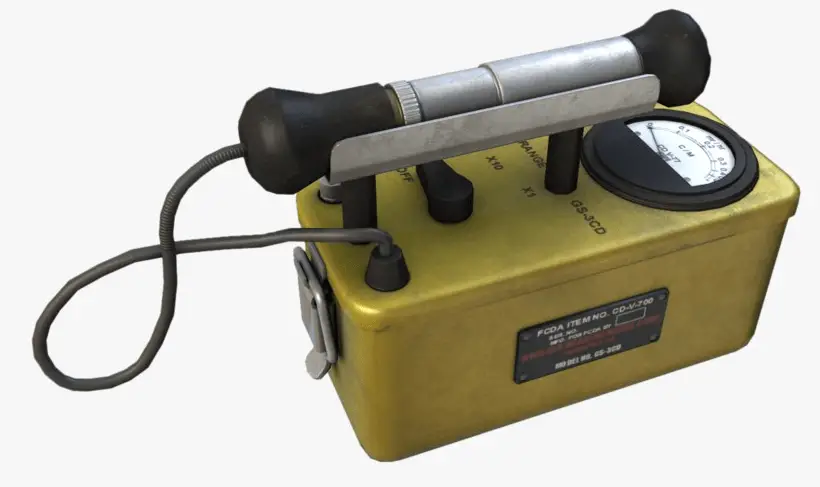
A Geiger counter consists of a Geiger-Müller tube (the sensing element which detects the radiation) and the processing electronics, which displays the result.
Geiger counter can detect ionizing radiation such as alpha and beta particles, neutrons, and gamma rays using the ionization effect produced in a Geiger–Müller tube, which gives its name to the instrument. The voltage of detector is adjusted so that the conditions correspond to the Geiger-Mueller region.
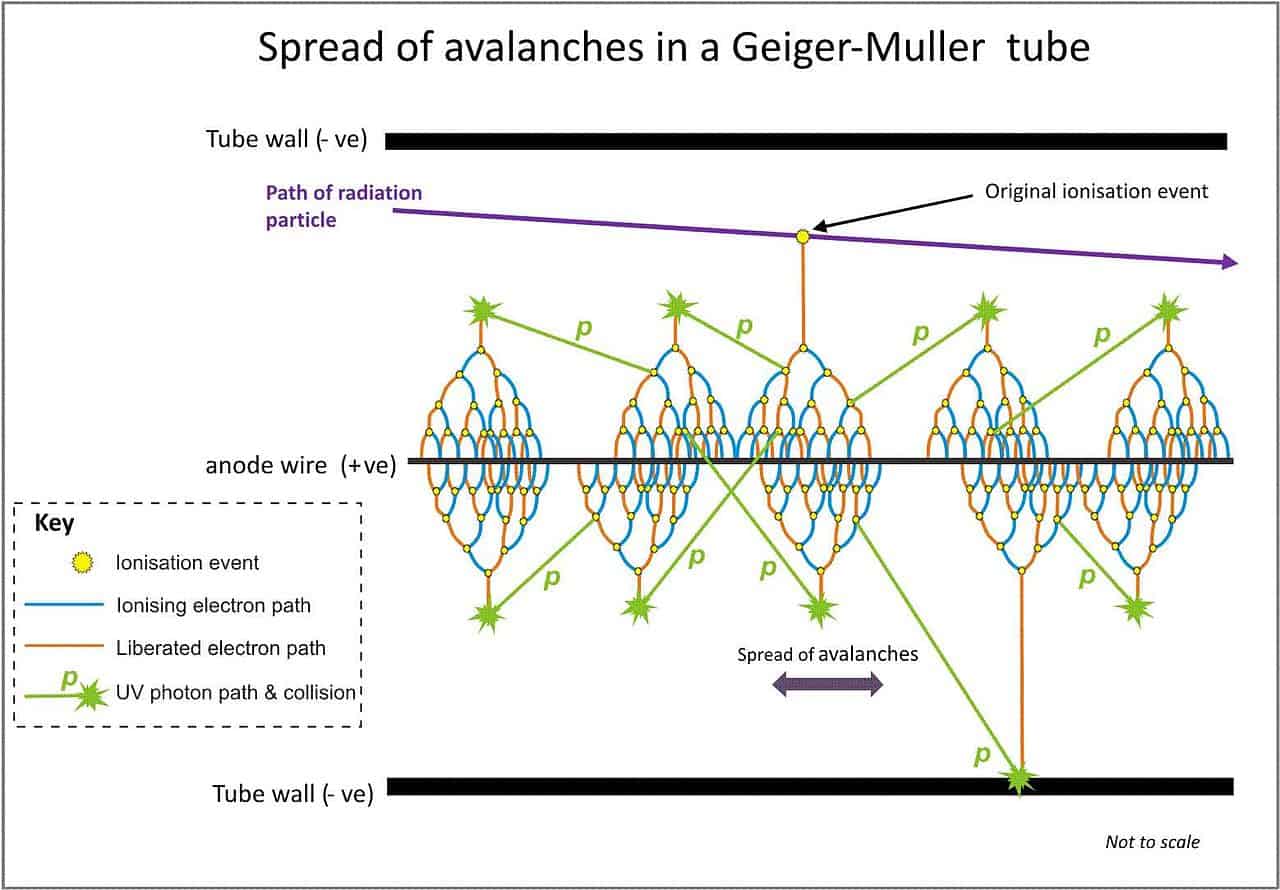
Visualisation of the spread of Townsend avalanches by means of UV photons. Source: wikpedia.org License: CC BY-SA 3.0
In this region, the voltage is high enough to provide the primary electrons with sufficient acceleration and energy so that they can ionize additional atoms of the medium. These secondary ions (gas amplification) formed are also accelerated causing an effect known as Townsend avalanches. These avalanches can be triggered and propagated by photons emitted by atoms excited in the original avalanche. Since these photons are not affected by the electric field, they may interact far (e.g. laterally to the axis) from the primary avalanche, the entire Geiger tube is participating in the process.
A strong signal (the amplification factor can reach about 1010) is produced by these avalanches with shape and height independently of the primary ionization and the energy of the detected photon. The voltage pulse in this case would be a large and easily detectable ≈ 1.6 V. The technical advantage of a Geiger counter is its simplicity of construction and its insensitivity to small voltage fluctuations. It is very useful for general measurement of nuclear radiation, but it has two important disadvantages.
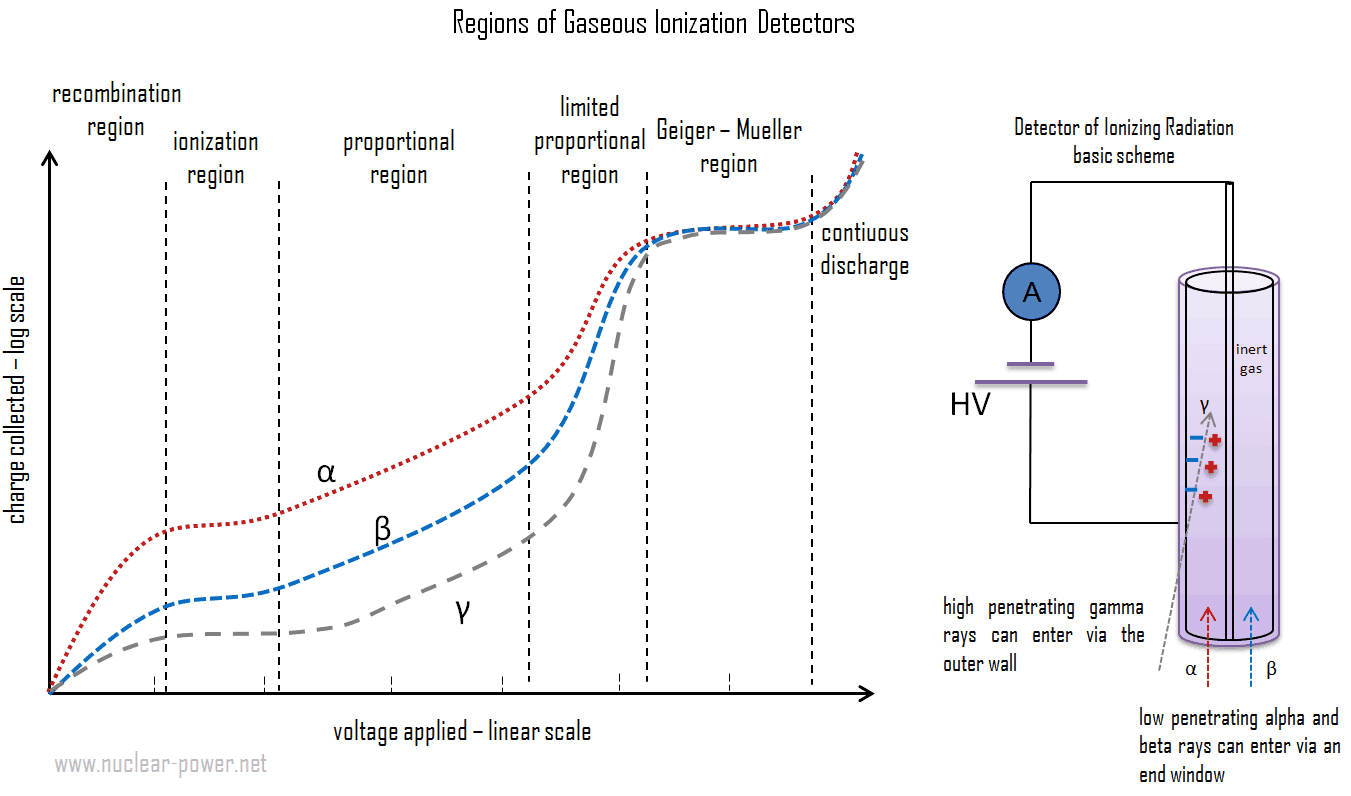
This diagram shows the number of ion pairs generated in the gas-filled detector, which varies according to the applied voltage for constant incident radiation. The voltages can vary widely depending upon the detector geometry and the gas type and pressure. This figure schematically indicates the different voltage regions for alpha, beta and gamma rays. There are six main practical operating regions, where three (ionization, proportional and Geiger-Mueller region) are useful to detect ionizing radiation. Alpha particles are more ionising than beta particles and than gamma rays, so more current is produced in the ion chamber region by alpha than beta and gamma, but the particles cannot be differentiated. More current is produced in the proportional counting region by alpha particles than beta, but by the nature of proportional counting it is possible to differentiate alpha, beta and gamma pulses. In the Geiger region, there is no differentiation of alpha and beta as any single ionisation event in the gas results in the same current output.
Since the pulse height is independent of the type and energy of radiation, discrimination is not possible. There is no information whatsoever on the nature of the ionization that caused the pulse.
Because of the large avalanche induced by any ionization, a Geiger counter takes a long time (about 1 ms) to recover between successive pulses. Therefore, Geiger counters are not able to measure high radiation rates due to the “dead time” of the tube.
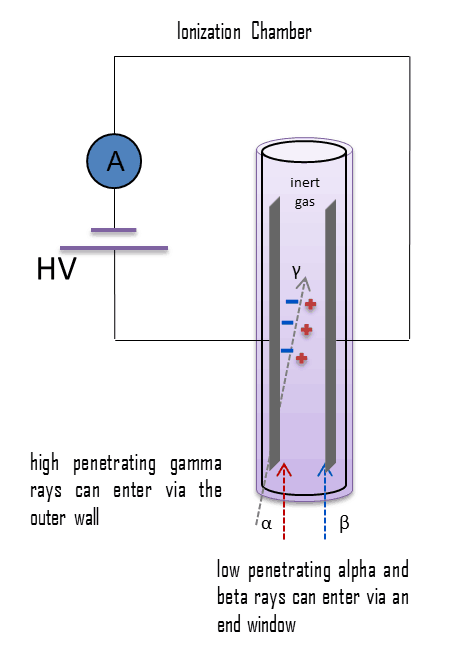
There is a subtle, but important difference between ionization chambers and Geiger counters. An ionization chamber will produce a current that is proportional to the number of electrons collected each second (no amplification occurs). This current is averaged and is used to drive a display reading in Bq, or μSv/h. Proportional and Geiger counters do not work in this way. Instead, they amplify each of the individual bursts of ionisation so that each ionising event is detected separately. They therefore measure the number of ionising events (which is why they are called counters). While ionization chambers can be operated in current or pulse mode, proportional counters or Geiger counters are almost always used in pulse mode. In contrast to proportional counters, the G-M counters are mainly used for portable instrumentation due to its sensitivity, simple counting circuit, and ability to detect low-level radiation.
Geiger-Mueller Region
Visualisation of the spread of Townsend avalanches by means of UV photons. Source: wikpedia.org License: CC BY-SA 3.0
In the Geiger-Mueller region, the voltage and thus the electric field is so strong that secondary avalanches can occur. These avalanches can be triggered and propagated by photons emitted by atoms excited in the original avalanche. Since these photons are not affected by the electric field, they may interact far (e.g. laterally to the axis) from the primary avalanche, the entire Geiger tube is participating in the process. A strong signal (the amplification factor can reach about 1010) is produced by these avalanches with shape and height independently of the primary ionization and the energy of the detected photon. Detectors, which are operated in the Geiger-Mueller region, are capable of detection of gamma rays, and also of all types of charged particles, that can enter the detector. These detectors are known as Geiger counters. Main advantage of these instruments is that they usually do not require any signal amplifiers. Since the positive ions do not move far from the avalanche region, a positively charged ion cloud disturbs the electric field and terminates the avalanche process. In practice the termination of the avalanche is improved by the use of “quenching” techniques. In contrast to proportional counters the energy or even incident radiation particle cannot not be distinguished by Geiger counters, since the output signal is independent of the amount and type of original ionization.
Basic Principle of Geiger Counters
Detectors of ionizing radiation consist of two parts that are usually connected. The first part consists of a sensitive material, consisting of a compound that experiences changes when exposed to radiation. The other component is a device that converts these changes into measurable signals.
The Geiger counter has a cathode and an anode that are held at high voltage, and the device is characterized by a capacitance that is determined by the geometry of the electrodes. In a Geiger counter the fill gas of the chamber is an inert gas which is ionized by incident radiation, and a quench gas of 5–10% of an organic vapor or a halogen gas to prevent spurious pulsing by quenching the electron avalanches.
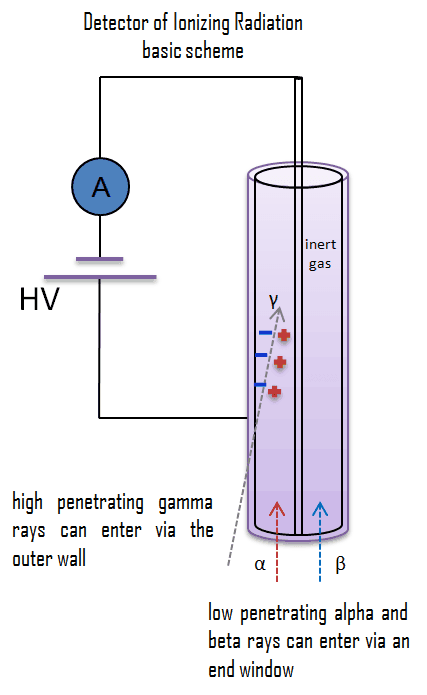
As ionizing radiation enters the gas between the electrodes, a finite number of ion-pairs are formed. In air, the average energy needed to produce an ion is about 34 eV, therefore a 1 MeV radiation completely absorbed in the detector produces about 3 x 10⁴ pair of ions. The behavior of the resultant ion-pairs is affected by the potential gradient of the electric field within the gas and the type and pressure of the fill gas. Under the influence of the electric field, the positive ions will move toward the negatively charged electrode (outer cylinder), and the negative ions (electrons) will migrate toward the positive electrode (central wire). The electric field in this region keeps the ions from recombining with the electrons. In the immediate vicinity of the anode wire, the field strength becomes large enough to produce Townsend avalanches. These avalanches can be triggered and propagated by photons emitted by atoms excited in the original avalanche. Since these photons are not affected by the electric field, they may interact far (e.g. laterally to the axis) from the primary avalanche, the entire Geiger tube is participating in the process. A strong signal (the amplification factor can reach about 1010) is produced by these avalanches with shape and height independently of the primary ionization and the energy of the detected photon. The high amplification factor of the Geiger counter is the major advantage over the ionization chamber. Geiger counter is therefore a much more sensitive device than other chambers. It is often used in the detection of low-level gamma rays and beta particles for this reason.
Since the positive ions do not move far from the avalanche region, a positively charged ion cloud disturbs the electric field and terminates the avalanche process. In practice the termination of the avalanche is improved by the use of “quenching” techniques.
The collection of all these electrons will produce a charge on the electrodes and an electrical pulse across the detection circuit. Each pulse corresponds to one gamma ray or neutron interaction. The pulse height is not proportional to the number of original electrons produced. Therefore, Geiger counters are not capable of particle identification and energy measurement (spectroscopy). Since the process of charge amplification greatly improves the signal-to-noise ratio of the detector, the subsequent electronic amplification is usually not required.
Quenching – Dead Time – Geiger Counters
In a Geiger counter the fill gas of the chamber is an inert gas which is ionized by incident radiation, and a quench gas of 5–10% of an organic vapor or a halogen gas to prevent spurious pulsing by quenching the electron avalanches. The Geiger counter should not give spurious pulses, and should recover quickly to the passive state, ready for the next radiation event. Argon and helium are the most frequently used fill gases and allow for the detection of alpha, beta, and gamma radiation. For neutron detection He-3 and BF3 (Boron Trifluoride) are the most commonly employed gases.
However, for each electron collected in the chamber, there is a positively charged gas ion left over. These gas ions are heavy compared to an electron and move much more slowly. Free electrons are much lighter than the positive ions, thus, they are drawn toward the positive central electrode much faster than the positive ions are drawn to the chamber wall. The resulting cloud of positive ions near the electrode leads to distortions in gas multiplication. Eventually the positive ions move away from the positively charged central wire to the negatively charged wall and are neutralized by gaining an electron. These atoms then return to their ground state by emitting photons which in turn produce further ionisation and thereby spurious secondary discharges. The electrons produced by this ionization move toward the central wire and are multiplied en route. This pulse of charge is unrelated to the radiation to be detected and can set off a series of pulses. In practice the termination of the avalanche is improved by the use of “quenching” techniques.
The quenching gas molecules have a weaker affinity for electrons than the chamber gas does; therefore, the ionized atoms of the chamber gas readily take electrons from the quenching gas molecules. Thus, the ionized molecules of quenching gas reach the chamber wall instead of the chamber gas. The ionized molecules of the quenching gas are neutralized by gaining an electron, and the energy liberated does not cause further ionization, but causes dissociation of the molecule. This type of quenching is known as self-quenching or internal-quenching, since tubes stop the discharge without external assistance.
For Geiger counters, external quenching, sometimes called “active quenching” or “electronic quenching“, is also a possibility. Electronic quenching uses simplistic high speed control electronics to rapidly remove and re-apply the high voltage between the electrodes for a fixed time after each discharge peak in order to increase the maximum count rate and lifetime of the tube.
Special Reference: U.S. Department of Energy, Instrumantation and Control. DOE Fundamentals Handbook, Volume 2 of 2. June 1992.
Types of Geiger-Mueller Tubes
Geiger counters are mainly used for portable instrumentation due to its sensitivity, simple counting circuit, and ability to detect low-level radiation. Although the major use of Geiger counters is probably in individual particle detection, they are also found in gamma survey meters. They are able to detect almost all types of radiation, but there are slight differences in the Geiger-Mueller tube. However, the Geiger-Müller tube produces a pulse output which is the same magnitude for all detected radiation, so a Geiger counter with an end window tube cannot distinguish between alpha and beta particles.
There are two main types of Geiger tube construction:
End-Window type. For alpha and beta particles to be detected by Geiger counters, they must be provided with a thin window. This “end-window” must be thin enough for the alpha and beta particles to penetrate. However, a window of almost any thickness will prevent an alpha particle from entering the chamber. The window is usually made of mica with a density of about 1.5 – 2.0 mg/cm2 to allow low-energy beta particles (e.g. from carbon-14) to enter the detector. The efficiency reduction for alpha is due to the attenuation effect of the end window, though distance from the surface being checked also has a significant effect, and ideally a source of alpha radiation should be less than 10mm from the detector due to attenuation in air.
Windowless type. Gamma rays have very little trouble in penetrating the metal walls of the chamber. Therefore, Geiger counters may be used to detect gamma radiation and X-rays (thin-walled tubes) collectively known as photons, and for this the windowless tube is used.
A thick walled tube is used for gamma radiation detection above energies of about 25 KeV, this type generally has an overall wall thickness of about 1-2 mm of chrome steel.
A thin walled tube is used for low energy photons (X-rays or gamma rays) and high energy beta particles. The transition from thin walled to thick walled design takes place at the 300–400 keV energy levels. Above these levels thick walled designs are used, and beneath these levels the direct gas ionisation effect is predominant.
Sometimes, a “pancake” design of the Geiger-Mueller tube is prefered. This detector is a flat Geiger tube with a thin mica window of larger area. Flat Geiger tubes like this are known as “pancake” tubes. Such tubes are fitted with a wire screen to protect them. This design provides larger detecting area and thus higher efficiency to make checking quicker. However, the pressure of the atmosphere against the low pressure of the fill gas limits the window size due to the limited strength of the window membrane.
Detection of Neutrons using Geiger Counter
Since the neutrons are electrically neutral particles, they are mainly subject to strong nuclear forces but not to electric forces. Therefore neutrons are not directly ionizing and they have usually to be converted into charged particles before they can be detected. Generally every type of neutron detector must be equipped with converter (to convert neutron radiation to common detectable radiation) and one of the conventional radiation detectors (scintillation detector, gaseous detector, semiconductor detector, etc.).
It is not common, but Geiger counters may be also used for neutron detection. In this case, Geiger-Mueller tube must have the inside of the tube coated with boron, or the tube must contain boron trifluoride (BF3) or helium-3 as the fill gas.
Robert Reed Burn, Introduction to Nuclear Reactor Operation, 1988.
U.S. Department of Energy, Nuclear Physics and Reactor Theory. DOE Fundamentals Handbook, Volume 1 and 2. January 1993.
Paul Reuss, Neutron Physics. EDP Sciences, 2008. ISBN: 978-2759800414.
See also:
Geiger Counter
We hope, this article, Geiger-Müller tube – Geiger Chamber, helps you. If so, give us a like in the sidebar. Main purpose of this website is to help the public to learn some interesting and important information about radiation and dosimeters.
The Geiger counter has a cathode and an anode that are held at high voltage, and the device is characterized by a capacitance that is determined by the geometry of the electrodes. Principle of Geiger Counters
Detector of Ionizing Radiation – Geiger Tube
The Geiger counter, also known as the Geiger-Mueller counter, is electrical device that detects various types of ionizing radiation. This device is named after the two physicists who invented the counter in 1928. Mueller was a student of Hans Geiger. Geiger counter is widely used in applications such as radiation dosimetry, radiological protection, experimental physics, and the nuclear industry. A Geiger counter consists of a Geiger-Müller tube (the sensing element which detects the radiation) and the processing electronics, which displays the result.
Geiger counter can detect ionizing radiation such as alpha and beta particles, neutrons, and gamma rays using the ionization effect produced in a Geiger–Müller tube, which gives its name to the instrument. The voltage of detector is adjusted so that the conditions correspond to the Geiger-Mueller region.
Basic Principle of Geiger Counters
Detectors of ionizing radiation consist of two parts that are usually connected. The first part consists of a sensitive material, consisting of a compound that experiences changes when exposed to radiation. The other component is a device that converts these changes into measurable signals.
The Geiger counter has a cathode and an anode that are held at high voltage, and the device is characterized by a capacitance that is determined by the geometry of the electrodes. In a Geiger counter the fill gas of the chamber is an inert gas which is ionized by incident radiation, and a quench gas of 5–10% of an organic vapor or a halogen gas to prevent spurious pulsing by quenching the electron avalanches.
As ionizing radiation enters the gas between the electrodes, a finite number of ion-pairs are formed. In air, the average energy needed to produce an ion is about 34 eV, therefore a 1 MeV radiation completely absorbed in the detector produces about 3 x 10⁴ pair of ions. The behavior of the resultant ion-pairs is affected by the potential gradient of the electric field within the gas and the type and pressure of the fill gas. Under the influence of the electric field, the positive ions will move toward the negatively charged electrode (outer cylinder), and the negative ions (electrons) will migrate toward the positive electrode (central wire). The electric field in this region keeps the ions from recombining with the electrons. In the immediate vicinity of the anode wire, the field strength becomes large enough to produce Townsend avalanches. These avalanches can be triggered and propagated by photons emitted by atoms excited in the original avalanche. Since these photons are not affected by the electric field, they may interact far (e.g. laterally to the axis) from the primary avalanche, the entire Geiger tube is participating in the process. A strong signal (the amplification factor can reach about 1010) is produced by these avalanches with shape and height independently of the primary ionization and the energy of the detected photon. The high amplification factor of the Geiger counter is the major advantage over the ionization chamber. Geiger counter is therefore a much more sensitive device than other chambers. It is often used in the detection of low-level gamma rays and beta particles for this reason.
Since the positive ions do not move far from the avalanche region, a positively charged ion cloud disturbs the electric field and terminates the avalanche process. In practice the termination of the avalanche is improved by the use of “quenching” techniques.
The collection of all these electrons will produce a charge on the electrodes and an electrical pulse across the detection circuit. Each pulse corresponds to one gamma ray or neutron interaction. The pulse height is not proportional to the number of original electrons produced. Therefore, Geiger counters are not capable of particle identification and energy measurement (spectroscopy). Since the process of charge amplification greatly improves the signal-to-noise ratio of the detector, the subsequent electronic amplification is usually not required.
Robert Reed Burn, Introduction to Nuclear Reactor Operation, 1988.
U.S. Department of Energy, Nuclear Physics and Reactor Theory. DOE Fundamentals Handbook, Volume 1 and 2. January 1993.
Paul Reuss, Neutron Physics. EDP Sciences, 2008. ISBN: 978-2759800414.
See also:
Geiger Counter
We hope, this article, Basic Principle of Geiger Counters – Description, helps you. If so, give us a like in the sidebar. Main purpose of this website is to help the public to learn some interesting and important information about radiation and dosimeters.
For Geiger counters, external quenching, sometimes called “active quenching” or “electronic quenching“, is also a possibility. Geiger counters are not able to measure high radiation rates due to the “dead time” of the tube.
Because of the large avalanche induced by any ionization, a Geiger counter takes a long time (about 1 ms) to recover between successive pulses. Therefore, Geiger counters are not able to measure high radiation rates due to the “dead time” of the tube. The dead time is the time after each event during which the system is not able to record another event.
In a Geiger counter the fill gas of the chamber is an inert gas which is ionized by incident radiation, and a quench gas of 5–10% of an organic vapor or a halogen gas to prevent spurious pulsing by quenching the electron avalanches. The Geiger counter should not give spurious pulses, and should recover quickly to the passive state, ready for the next radiation event. Argon and helium are the most frequently used fill gases and allow for the detection of alpha, beta, and gamma radiation. For neutron detection He-3 and BF3 (Boron Trifluoride) are the most commonly employed gases.
However, for each electron collected in the chamber, there is a positively charged gas ion left over. These gas ions are heavy compared to an electron and move much more slowly. Free electrons are much lighter than the positive ions, thus, they are drawn toward the positive central electrode much faster than the positive ions are drawn to the chamber wall. The resulting cloud of positive ions near the electrode leads to distortions in gas multiplication. Eventually the positive ions move away from the positively charged central wire to the negatively charged wall and are neutralized by gaining an electron. These atoms then return to their ground state by emitting photons which in turn produce further ionisation and thereby spurious secondary discharges. The electrons produced by this ionization move toward the central wire and are multiplied en route. This pulse of charge is unrelated to the radiation to be detected and can set off a series of pulses. In practice the termination of the avalanche is improved by the use of “quenching” techniques.
The quenching gas molecules have a weaker affinity for electrons than the chamber gas does; therefore, the ionized atoms of the chamber gas readily take electrons from the quenching gas molecules. Thus, the ionized molecules of quenching gas reach the chamber wall instead of the chamber gas. The ionized molecules of the quenching gas are neutralized by gaining an electron, and the energy liberated does not cause further ionization, but causes dissociation of the molecule. This type of quenching is known as self-quenching or internal-quenching, since tubes stop the discharge without external assistance.
For Geiger counters, external quenching, sometimes called “active quenching” or “electronic quenching“, is also a possibility. Electronic quenching uses simplistic high speed control electronics to rapidly remove and re-apply the high voltage between the electrodes for a fixed time after each discharge peak in order to increase the maximum count rate and lifetime of the tube.
Special Reference: U.S. Department of Energy, Instrumantation and Control. DOE Fundamentals Handbook, Volume 2 of 2. June 1992.
Robert Reed Burn, Introduction to Nuclear Reactor Operation, 1988.
U.S. Department of Energy, Nuclear Physics and Reactor Theory. DOE Fundamentals Handbook, Volume 1 and 2. January 1993.
Paul Reuss, Neutron Physics. EDP Sciences, 2008. ISBN: 978-2759800414.
See also:
Geiger Counter
We hope, this article, Quenching – Dead Time – Geiger Counters, helps you. If so, give us a like in the sidebar. Main purpose of this website is to help the public to learn some interesting and important information about radiation and dosimeters.
Geiger counter can detect ionizing radiation such as alpha and beta particles, neutrons, and gamma rays using the ionization effect produced in a Geiger–Müller tube, which gives its name to the instrument. Detection of Alpha, Beta and Gamma Radiation using Geiger-Mueller Counter
Detector of Ionizing Radiation – Geiger Tube
The Geiger counter, also known as the Geiger-Mueller counter, is electrical device that detects various types of ionizing radiation. This device is named after the two physicists who invented the counter in 1928. Mueller was a student of Hans Geiger. Geiger counter is widely used in applications such as radiation dosimetry, radiological protection, experimental physics, and the nuclear industry. A Geiger counter consists of a Geiger-Müller tube (the sensing element which detects the radiation) and the processing electronics, which displays the result.
Geiger counter can detect ionizing radiation such as alpha and beta particles, neutrons, and gamma rays using the ionization effect produced in a Geiger–Müller tube, which gives its name to the instrument. The voltage of detector is adjusted so that the conditions correspond to the Geiger-Mueller region.
Visualisation of the spread of Townsend avalanches by means of UV photons. Source: wikpedia.org License: CC BY-SA 3.0
Detection of Alpha, Beta and Gamma Radiation using Geiger-Mueller Counter
Geiger counters are mainly used for portable instrumentation due to its sensitivity, simple counting circuit, and ability to detect low-level radiation. Although the major use of Geiger counters is probably in individual particle detection, they are also found in gamma survey meters. They are able to detect almost all types of radiation, but there are slight differences in the Geiger-Mueller tube. However, the Geiger-Müller tube produces a pulse output which is the same magnitude for all detected radiation, so a Geiger counter with an end window tube cannot distinguish between alpha and beta particles.
There are two main types of Geiger tube construction:
End-Window type. For alpha and beta particles to be detected by Geiger counters, they must be provided with a thin window. This “end-window” must be thin enough for the alpha and beta particles to penetrate. However, a window of almost any thickness will prevent an alpha particle from entering the chamber. The window is usually made of mica with a density of about 1.5 – 2.0 mg/cm2 to allow low-energy beta particles (e.g. from carbon-14) to enter the detector. The efficiency reduction for alpha is due to the attenuation effect of the end window, though distance from the surface being checked also has a significant effect, and ideally a source of alpha radiation should be less than 10mm from the detector due to attenuation in air.
Windowless type. Gamma rays have very little trouble in penetrating the metal walls of the chamber. Therefore, Geiger counters may be used to detect gamma radiation and X-rays (thin-walled tubes) collectively known as photons, and for this the windowless tube is used.
A thick walled tube is used for gamma radiation detection above energies of about 25 KeV, this type generally has an overall wall thickness of about 1-2 mm of chrome steel.
A thin walled tube is used for low energy photons (X-rays or gamma rays) and high energy beta particles. The transition from thin walled to thick walled design takes place at the 300–400 keV energy levels. Above these levels thick walled designs are used, and beneath these levels the direct gas ionisation effect is predominant.
Sometimes, a “pancake” design of the Geiger-Mueller tube is prefered. This detector is a flat Geiger tube with a thin mica window of larger area. Flat Geiger tubes like this are known as “pancake” tubes. Such tubes are fitted with a wire screen to protect them. This design provides larger detecting area and thus higher efficiency to make checking quicker. However, the pressure of the atmosphere against the low pressure of the fill gas limits the window size due to the limited strength of the window membrane.
Robert Reed Burn, Introduction to Nuclear Reactor Operation, 1988.
U.S. Department of Energy, Nuclear Physics and Reactor Theory. DOE Fundamentals Handbook, Volume 1 and 2. January 1993.
Paul Reuss, Neutron Physics. EDP Sciences, 2008. ISBN: 978-2759800414.
See also:
Geiger Counter
We hope, this article, Detection of Alpha, Beta and Gamma Radiation using Geiger-Mueller Counter, helps you. If so, give us a like in the sidebar. Main purpose of this website is to help the public to learn some interesting and important information about radiation and dosimeters.
Geiger counters are mainly used for portable instrumentation. There are two main types of Geiger tube construction: End-Window tube and Windowless tube. Radiation Dosimetry
Detector of Ionizing Radiation – Geiger Tube
The Geiger counter, also known as the Geiger-Mueller counter, is electrical device that detects various types of ionizing radiation. This device is named after the two physicists who invented the counter in 1928. Mueller was a student of Hans Geiger. Geiger counter is widely used in applications such as radiation dosimetry, radiological protection, experimental physics, and the nuclear industry. A Geiger counter consists of a Geiger-Müller tube (the sensing element which detects the radiation) and the processing electronics, which displays the result.
Geiger counter can detect ionizing radiation such as alpha and beta particles, neutrons, and gamma rays using the ionization effect produced in a Geiger–Müller tube, which gives its name to the instrument. The voltage of detector is adjusted so that the conditions correspond to the Geiger-Mueller region.
End-Window and Windowless type of Geiger Counter
Detectors of ionizing radiation consist of two parts that are usually connected. The first part consists of a sensitive material, consisting of a compound that experiences changes when exposed to radiation. The other component is a device that converts these changes into measurable signals.
Geiger counters are mainly used for portable instrumentation due to its sensitivity, simple counting circuit, and ability to detect low-level radiation. Although the major use of Geiger counters is probably in individual particle detection, they are also found in gamma survey meters. They are able to detect almost all types of radiation, but there are slight differences in the Geiger-Mueller tube. However, the Geiger-Müller tube produces a pulse output which is the same magnitude for all detected radiation, so a Geiger counter with an end window tube cannot distinguish between alpha and beta particles.
There are two main types of Geiger tube construction:
End-Window type. For alpha and beta particles to be detected by Geiger counters, they must be provided with a thin window. This “end-window” must be thin enough for the alpha and beta particles to penetrate. However, a window of almost any thickness will prevent an alpha particle from entering the chamber. The window is usually made of mica with a density of about 1.5 – 2.0 mg/cm2 to allow low-energy beta particles (e.g. from carbon-14) to enter the detector. The efficiency reduction for alpha is due to the attenuation effect of the end window, though distance from the surface being checked also has a significant effect, and ideally a source of alpha radiation should be less than 10mm from the detector due to attenuation in air.
Windowless type. Gamma rays have very little trouble in penetrating the metal walls of the chamber. Therefore, Geiger counters may be used to detect gamma radiation and X-rays (thin-walled tubes) collectively known as photons, and for this the windowless tube is used.
A thick walled tube is used for gamma radiation detection above energies of about 25 KeV, this type generally has an overall wall thickness of about 1-2 mm of chrome steel.
A thin walled tube is used for low energy photons (X-rays or gamma rays) and high energy beta particles. The transition from thin walled to thick walled design takes place at the 300–400 keV energy levels. Above these levels thick walled designs are used, and beneath these levels the direct gas ionisation effect is predominant.
Sometimes, a “pancake” design of the Geiger-Mueller tube is prefered. This detector is a flat Geiger tube with a thin mica window of larger area. Flat Geiger tubes like this are known as “pancake” tubes. Such tubes are fitted with a wire screen to protect them. This design provides larger detecting area and thus higher efficiency to make checking quicker. However, the pressure of the atmosphere against the low pressure of the fill gas limits the window size due to the limited strength of the window membrane.
Robert Reed Burn, Introduction to Nuclear Reactor Operation, 1988.
U.S. Department of Energy, Nuclear Physics and Reactor Theory. DOE Fundamentals Handbook, Volume 1 and 2. January 1993.
Paul Reuss, Neutron Physics. EDP Sciences, 2008. ISBN: 978-2759800414.
See also:
Geiger Counter
We hope, this article, End-Window and Windowless type of Geiger Counter, helps you. If so, give us a like in the sidebar. Main purpose of this website is to help the public to learn some interesting and important information about radiation and dosimeters.
A thick walled tube is used for gamma radiation detection above energies of about 25 keV. A thin walled tube is used for low energy photons (X-rays or gamma rays) and high energy beta particles. Radiation Dosimetry
Detector of Ionizing Radiation – Geiger Tube
The Geiger counter, also known as the Geiger-Mueller counter, is electrical device that detects various types of ionizing radiation. This device is named after the two physicists who invented the counter in 1928. Mueller was a student of Hans Geiger. Geiger counter is widely used in applications such as radiation dosimetry, radiological protection, experimental physics, and the nuclear industry. A Geiger counter consists of a Geiger-Müller tube (the sensing element which detects the radiation) and the processing electronics, which displays the result.
Geiger counter can detect ionizing radiation such as alpha and beta particles, neutrons, and gamma rays using the ionization effect produced in a Geiger–Müller tube, which gives its name to the instrument. The voltage of detector is adjusted so that the conditions correspond to the Geiger-Mueller region.
Thick-Walled and Thin-Walled Geiger Tube
Windowless type. Gamma rays have very little trouble in penetrating the metal walls of the chamber. Therefore, Geiger counters may be used to detect gamma radiation and X-rays (thin-walled tubes) collectively known as photons, and for this the windowless tube is used.
A thick walled tube is used for gamma radiation detection above energies of about 25 keV, this type generally has an overall wall thickness of about 1-2 mm of chrome steel.
A thin walled tube is used for low energy photons (X-rays or gamma rays) and high energy beta particles. The transition from thin walled to thick walled design takes place at the 300–400 keV energy levels. Above these levels thick walled designs are used, and beneath these levels the direct gas ionisation effect is predominant.
Sometimes, a “pancake” design of the Geiger-Mueller tube is prefered. This detector is a flat Geiger tube with a thin mica window of larger area. Flat Geiger tubes like this are known as “pancake” tubes. Such tubes are fitted with a wire screen to protect them. This design provides larger detecting area and thus higher efficiency to make checking quicker. However, the pressure of the atmosphere against the low pressure of the fill gas limits the window size due to the limited strength of the window membrane.
Robert Reed Burn, Introduction to Nuclear Reactor Operation, 1988.
U.S. Department of Energy, Nuclear Physics and Reactor Theory. DOE Fundamentals Handbook, Volume 1 and 2. January 1993.
Paul Reuss, Neutron Physics. EDP Sciences, 2008. ISBN: 978-2759800414.
See also:
Geiger Counter
We hope, this article, Thick-Walled and Thin-Walled Geiger Tube, helps you. If so, give us a like in the sidebar. Main purpose of this website is to help the public to learn some interesting and important information about radiation and dosimeters.
It is not common, but Geiger counters may be also used for neutron detection. In this case, Geiger-Mueller tube must have the inside of the tube coated with boron, or the tube must contain boron trifluoride (BF3) or helium-3 as the fill gas. Radiation Dosimetry
Detector of Ionizing Radiation – Geiger Tube
The Geiger counter, also known as the Geiger-Mueller counter, is electrical device that detects various types of ionizing radiation. This device is named after the two physicists who invented the counter in 1928. Mueller was a student of Hans Geiger. Geiger counter is widely used in applications such as radiation dosimetry, radiological protection, experimental physics, and the nuclear industry. A Geiger counter consists of a Geiger-Müller tube (the sensing element which detects the radiation) and the processing electronics, which displays the result.
Geiger counter can detect ionizing radiation such as alpha and beta particles, neutrons, and gamma rays using the ionization effect produced in a Geiger–Müller tube, which gives its name to the instrument. The voltage of detector is adjusted so that the conditions correspond to the Geiger-Mueller region.
Detection of Neutrons using Geiger Counter
Since the neutrons are electrically neutral particles, they are mainly subject to strong nuclear forces but not to electric forces. Therefore neutrons are not directly ionizing and they have usually to be converted into charged particles before they can be detected. Generally every type of neutron detector must be equipped with converter (to convert neutron radiation to common detectable radiation) and one of the conventional radiation detectors (scintillation detector, gaseous detector, semiconductor detector, etc.).
It is not common, but Geiger counters may be also used for neutron detection. In this case, Geiger-Mueller tube must have the inside of the tube coated with boron, or the tube must contain boron trifluoride (BF3) or helium-3 as the fill gas.
The incoming neutrons produce alpha particles when they react with the boron atoms in the detector gas. Most of (n,alpha) reactions of thermal neutrons are 10B(n,alpha)7Li reactions accompanied by 0.48 MeV gamma emission.
Moreover, isotope boron-10 has high (n,alpha) reaction cross-section along the entire neutron energy spectrum. The alpha particle causes ionization within the chamber, and ejected electrons cause further secondary ionizations.
Robert Reed Burn, Introduction to Nuclear Reactor Operation, 1988.
U.S. Department of Energy, Nuclear Physics and Reactor Theory. DOE Fundamentals Handbook, Volume 1 and 2. January 1993.
Paul Reuss, Neutron Physics. EDP Sciences, 2008. ISBN: 978-2759800414.
See also:
Geiger Counter
We hope, this article, Detection of Neutrons using Geiger Counter, helps you. If so, give us a like in the sidebar. Main purpose of this website is to help the public to learn some interesting and important information about radiation and dosimeters.
Applications of Geiger Counters. Geiger counter can detect ionizing radiation such as alpha and beta particles, neutrons, and gamma rays using the ionization effect produced in a Geiger–Müller tube. Radiation Dosimetry
Detector of Ionizing Radiation – Geiger Tube
The Geiger counter, also known as the Geiger-Mueller counter, is electrical device that detects various types of ionizing radiation. This device is named after the two physicists who invented the counter in 1928. Mueller was a student of Hans Geiger. Geiger counter is widely used in applications such as radiation dosimetry, radiological protection, experimental physics, and the nuclear industry. A Geiger counter consists of a Geiger-Müller tube (the sensing element which detects the radiation) and the processing electronics, which displays the result.
Geiger counter can detect ionizing radiation such as alpha and beta particles, neutrons, and gamma rays using the ionization effect produced in a Geiger–Müller tube, which gives its name to the instrument. The voltage of detector is adjusted so that the conditions correspond to the Geiger-Mueller region.
Applications – Detection of Alpha, Beta and Gamma Radiation
Detectors of ionizing radiation consist of two parts that are usually connected. The first part consists of a sensitive material, consisting of a compound that experiences changes when exposed to radiation. The other component is a device that converts these changes into measurable signals.
Geiger counters are mainly used for portable instrumentation due to its sensitivity, simple counting circuit, and ability to detect low-level radiation. Although the major use of Geiger counters is probably in individual particle detection, they are also found in gamma survey meters. They are able to detect almost all types of radiation, but there are slight differences in the Geiger-Mueller tube. However, the Geiger-Müller tube produces a pulse output which is the same magnitude for all detected radiation, so a Geiger counter with an end window tube cannot distinguish between alpha and beta particles.
There are two main types of Geiger tube construction:
End-Window type. For alpha and beta particles to be detected by Geiger counters, they must be provided with a thin window. This “end-window” must be thin enough for the alpha and beta particles to penetrate. However, a window of almost any thickness will prevent an alpha particle from entering the chamber. The window is usually made of mica with a density of about 1.5 – 2.0 mg/cm2 to allow low-energy beta particles (e.g. from carbon-14) to enter the detector. The efficiency reduction for alpha is due to the attenuation effect of the end window, though distance from the surface being checked also has a significant effect, and ideally a source of alpha radiation should be less than 10mm from the detector due to attenuation in air.
Windowless type. Gamma rays have very little trouble in penetrating the metal walls of the chamber. Therefore, Geiger counters may be used to detect gamma radiation and X-rays (thin-walled tubes) collectively known as photons, and for this the windowless tube is used.
A thick walled tube is used for gamma radiation detection above energies of about 25 KeV, this type generally has an overall wall thickness of about 1-2 mm of chrome steel.
A thin walled tube is used for low energy photons (X-rays or gamma rays) and high energy beta particles. The transition from thin walled to thick walled design takes place at the 300–400 keV energy levels. Above these levels thick walled designs are used, and beneath these levels the direct gas ionisation effect is predominant.
Sometimes, a “pancake” design of the Geiger-Mueller tube is prefered. This detector is a flat Geiger tube with a thin mica window of larger area. Flat Geiger tubes like this are known as “pancake” tubes. Such tubes are fitted with a wire screen to protect them. This design provides larger detecting area and thus higher efficiency to make checking quicker. However, the pressure of the atmosphere against the low pressure of the fill gas limits the window size due to the limited strength of the window membrane.
Applications – Detection of Neutrons
Since the neutrons are electrically neutral particles, they are mainly subject to strong nuclear forces but not to electric forces. Therefore neutrons are not directly ionizing and they have usually to be converted into charged particles before they can be detected. Generally every type of neutron detector must be equipped with converter (to convert neutron radiation to common detectable radiation) and one of the conventional radiation detectors (scintillation detector, gaseous detector, semiconductor detector, etc.).
It is not common, but Geiger counters may be also used for neutron detection. In this case, Geiger-Mueller tube must have the inside of the tube coated with boron, or the tube must contain boron trifluoride (BF3) or helium-3 as the fill gas.
The incoming neutrons produce alpha particles when they react with the boron atoms in the detector gas. Most of (n,alpha) reactions of thermal neutrons are 10B(n,alpha)7Li reactions accompanied by 0.48 MeV gamma emission.
Moreover, isotope boron-10 has high (n,alpha) reaction cross-section along the entire neutron energy spectrum. The alpha particle causes ionization within the chamber, and ejected electrons cause further secondary ionizations.
Robert Reed Burn, Introduction to Nuclear Reactor Operation, 1988.
U.S. Department of Energy, Nuclear Physics and Reactor Theory. DOE Fundamentals Handbook, Volume 1 and 2. January 1993.
Paul Reuss, Neutron Physics. EDP Sciences, 2008. ISBN: 978-2759800414.
See also:
Geiger Counter
We hope, this article, Application of Geiger Counters, helps you. If so, give us a like in the sidebar. Main purpose of this website is to help the public to learn some interesting and important information about radiation and dosimeters.
 Because of the random nature of radioactive decay, there is always some probability, that a true event will be lost, because another event is just recorded and the detector cannot accept and process more than one pulse.