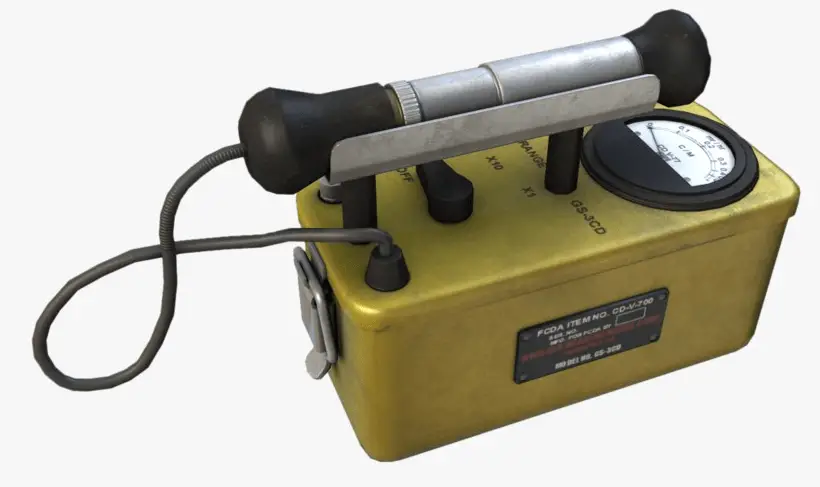
The Geiger counter, also known as the Geiger-Mueller counter, is electrical device that detects various types of ionizing radiation. This device is named after the two physicists who invented the counter in 1928. Mueller was a student of Hans Geiger. Geiger counter is widely used in applications such as radiation dosimetry, radiological protection, experimental physics, and the nuclear industry. A Geiger counter consists of a Geiger-Müller tube (the sensing element which detects the radiation) and the processing electronics, which displays the result.
Geiger counter can detect ionizing radiation such as alpha and beta particles, neutrons, and gamma rays using the ionization effect produced in a Geiger–Müller tube, which gives its name to the instrument. The voltage of detector is adjusted so that the conditions correspond to the Geiger-Mueller region.
Thick-Walled and Thin-Walled Geiger Tube
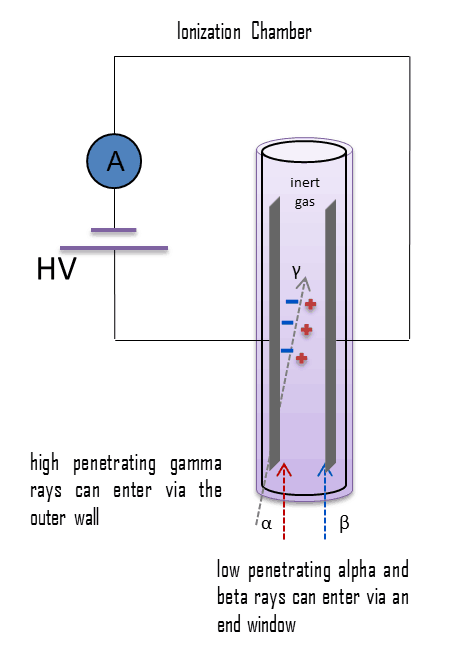 Windowless type. Gamma rays have very little trouble in penetrating the metal walls of the chamber. Therefore, Geiger counters may be used to detect gamma radiation and X-rays (thin-walled tubes) collectively known as photons, and for this the windowless tube is used.
- A thick walled tube is used for gamma radiation detection above energies of about 25 keV, this type generally has an overall wall thickness of about 1-2 mm of chrome steel.
- A thin walled tube is used for low energy photons (X-rays or gamma rays) and high energy beta particles. The transition from thin walled to thick walled design takes place at the 300–400 keV energy levels. Above these levels thick walled designs are used, and beneath these levels the direct gas ionisation effect is predominant.
Sometimes, a “pancake” design of the Geiger-Mueller tube is prefered. This detector is a flat Geiger tube with a thin mica window of larger area. Flat Geiger tubes like this are known as “pancake” tubes. Such tubes are fitted with a wire screen to protect them. This design provides larger detecting area and thus higher efficiency to make checking quicker. However, the pressure of the atmosphere against the low pressure of the fill gas limits the window size due to the limited strength of the window membrane.
We hope, this article, Thick-Walled and Thin-Walled Geiger Tube, helps you. If so, give us a like in the sidebar. Main purpose of this website is to help the public to learn some interesting and important information about radiation and dosimeters.