Direct reading dosimeters, DRDs, are active dosimeters, since they display doses and dose rates while they are being used. Direct reading dosimeters are especially useful in high dose areas. Radiation Dosimetry
Direct reading dosimeters, DRDs, are active dosimeters, since they display doses and dose rates while they are being used. Direct reading dosimeters are especially useful in high dose areas where residence time of the wearer is limited due to dose constraints. DRDs can warn the person wearing it when a specified dose rate or a cumulative dose is exceeded. For many years, DRDs have been used as dose control devices, particularly in the nuclear power industry.
EPD – Electronic Personal Dosimeter
An electronic personal dosimeter is modern dosimeter, which can give a continuous readout of cumulative dose and current dose rate, and can warn the person wearing it when a specified dose rate or a cumulative dose is exceeded. EPDs are especially useful in high dose areas where residence time of the wearer is limited due to dose constraints.
Characteristics of EPDs
The electronic personal dosimeter, EPD, is able to display a direct reading of the detected dose or dose rate in real time. Electronic dosimeters may be used as a supplemental dosimeter as well a primary dosimeter. The passive dosimeters and the electronic personal dosimeters are often used together to complement each other. To estimate effective doses, dosimeters must be worn on a position of the body representative of its exposure, typically between the waist and the neck, on the front of the torso, facing the radioactive source. Dosimeters are usually worn on the outside of clothing, around the chest or torso to represent dose to the “whole body”. Dosimeters may also be worn on the extremities or near the eye to measure equivalent dose to these tissues.
The dosimeter can be reset, usually after taking a reading for record purposes, and thereby re-used multiple times. The EPDs have a top mounted display to make them easy to read when they are clipped to your breast pocket. The digital display gives both dose and dose rate information usually in mSv and mSv/h. The EPD has a dose rate alarm, and a dose alarm. These alarms are programmable. Different alarms can be set for different activities.
For example:
dose rate alarm at 100 μSv/h,
dose alarm: 100 μSv.
If an alarm set point is reached, the relevant display flashes along with a red light, and quite a piercing noise is generated. You can clear the dose rate alarm by retreating to a lower radiation field, but you cannot clear the dose alarm until you get to a EPD reader. EPDs can also give a bleep for every 1 or 10 μSv they register. This gives you an audible indication of the radiation fields. Some EPDs have wireless communication capabilities. EPDs are capable of measuring a wide radiation dose range from routine (μSv) levels to emergency levels (hundreds mSv or units of Sieverts) with high precision, and may display the exposure rate as well as accumulated exposure values. Of the dosimeter technologies, electronic personal dosimeters are generally the most expensive, largest in size, and the most versatile.
Robert Reed Burn, Introduction to Nuclear Reactor Operation, 1988.
U.S. Department of Energy, Nuclear Physics and Reactor Theory. DOE Fundamentals Handbook, Volume 1 and 2. January 1993.
Paul Reuss, Neutron Physics. EDP Sciences, 2008. ISBN: 978-2759800414.
See also:
EPD
We hope, this article, Direct Reading Dosimeter, helps you. If so, give us a like in the sidebar. Main purpose of this website is to help the public to learn some interesting and important information about radiation and dosimeters.
PIN dosimeters are based on semiconductor chip. This chip has a p-i-n structure in which the intrinsic (i) region is sensitive to ionizing radiation, particularly X rays and gamma rays. Radiation Dosimetry
A PIN dosimeter is modern dosimeter, which can give a continuous readout of cumulative dose and current dose rate, and can warn the person wearing it when a specified dose rate or a cumulative dose is exceeded. PIN dosimeters are based on semiconductor chip. Semiconductor detectors are based on ionization in a solid (e.g. silicon) and include different types of solid-state devices with two terminals called diodes. For example a silicon diode, which has a p-i-n structure in which the intrinsic (i) region is sensitive to ionizing radiation, particularly X rays and gamma rays. Under reverse bias, an electric field extends across the intrinsic or depleted region. In this case, negative voltage is applied to the p-side and positive to the second one. Holes in the p-region are attracted from the junction towards the p contact and similarly for electrons and the n contact.
Robert Reed Burn, Introduction to Nuclear Reactor Operation, 1988.
U.S. Department of Energy, Nuclear Physics and Reactor Theory. DOE Fundamentals Handbook, Volume 1 and 2. January 1993.
Paul Reuss, Neutron Physics. EDP Sciences, 2008. ISBN: 978-2759800414.
See also:
EPD
We hope, this article, PIN Dosimeter, helps you. If so, give us a like in the sidebar. Main purpose of this website is to help the public to learn some interesting and important information about radiation and dosimeters.
An electronic personal dosimeter, EPD, is modern dosimeter, which can give a continuous readout of cumulative dose and current dose rate, and can warn the person wearing it. Radiation Dosimetry
An electronic personal dosimeter is modern dosimeter, which can give a continuous readout of cumulative dose and current dose rate, and can warn the person wearing it when a specified dose rate or a cumulative dose is exceeded. EPDs are especially useful in high dose areas where residence time of the wearer is limited due to dose constraints.
Types of EPDs
EPD – Electronic Personal Dosimeters with Si chip
EPDs are battery powered and most use either a small Geiger-Mueller (GM) tube or a semiconductor (Si chip) in which ionizing radiation releases charges resulting in measurable electric current.
G-M counter. A Geiger counter consists of a Geiger-Müller tube (the sensing element which detects the radiation) and the processing electronics, which displays the result. G-M counters are mainly used for portable instrumentation due to its sensitivity, simple counting circuit, and ability to detect low-level radiation. Because of the large avalanche induced by any ionization, a Geiger counter takes a long time (about 1 ms) to recover between successive pulses. Therefore, Geiger counters are not able to measure high radiation rates due to the “dead time” of the tube.
Semiconductor Detector. Semiconductor detectors are based on ionization in a solid (e.g. silicon) and include different types of solid-state devices with two terminals called diodes. For example a silicon diode, which has a p-i-n structure in which the intrinsic (i) region is sensitive to ionizing radiation, particularly X rays and gamma rays. Under reverse bias, an electric field extends across the intrinsic or depleted region. In this case, negative voltage is applied to the p-side and positive to the second one. Holes in the p-region are attracted from the junction towards the p contact and similarly for electrons and the n contact.
Scintillation Detector. Some EPDs use a scintillating crystal such as sodium iodide (NaI) or cesium iodide (CsI) with a photodiode or photomultiplier tube to measure photons released by radiation.
Characteristics of EPDs
The electronic personal dosimeter, EPD, is able to display a direct reading of the detected dose or dose rate in real time. Electronic dosimeters may be used as a supplemental dosimeter as well a primary dosimeter. The passive dosimeters and the electronic personal dosimeters are often used together to complement each other. To estimate effective doses, dosimeters must be worn on a position of the body representative of its exposure, typically between the waist and the neck, on the front of the torso, facing the radioactive source. Dosimeters are usually worn on the outside of clothing, around the chest or torso to represent dose to the “whole body”. Dosimeters may also be worn on the extremities or near the eye to measure equivalent dose to these tissues.
The dosimeter can be reset, usually after taking a reading for record purposes, and thereby re-used multiple times. The EPDs have a top mounted display to make them easy to read when they are clipped to your breast pocket. The digital display gives both dose and dose rate information usually in mSv and mSv/h. The EPD has a dose rate alarm, and a dose alarm. These alarms are programmable. Different alarms can be set for different activities.
For example:
dose rate alarm at 100 μSv/h,
dose alarm: 100 μSv.
If an alarm set point is reached, the relevant display flashes along with a red light, and quite a piercing noise is generated. You can clear the dose rate alarm by retreating to a lower radiation field, but you cannot clear the dose alarm until you get to a EPD reader. EPDs can also give a bleep for every 1 or 10 μSv they register. This gives you an audible indication of the radiation fields. Some EPDs have wireless communication capabilities. EPDs are capable of measuring a wide radiation dose range from routine (μSv) levels to emergency levels (hundreds mSv or units of Sieverts) with high precision, and may display the exposure rate as well as accumulated exposure values. Of the dosimeter technologies, electronic personal dosimeters are generally the most expensive, largest in size, and the most versatile.
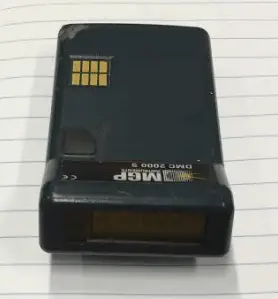
DMC 3000 – Mirion Technologies Inc.
The DMC 3000 is an electronic radiation dosimeter, EPD, that provides dose and ambient dose rate readings for deep dose equivalent Hp(10). It is one of the most used EPDs on the market. It uses a Si chipdetector with gamma sensitivity of 180 cps/R/h. This electronic personal dosimeter has the following characteristics:
Energy response (X-ray and gamma) from 15 keV to 7 Mev.
Dose measurement display range: between 1 μSv and 10 Sv.
Rate measurement display range: between 10 μSv/hr and 10 Sv/h.
The device measures 3.3 x 1.9 x 0.7 inches and has options for being clipped to a pocket, belt, or lanyard. It is powered with rechargeable or AAA batteries with a battery life of up to 2,500 hours of continuous use. Audible and visual indicators signal a low battery condition. The device has a backlit, eight-digit LCD display; two-button navigation; and visual LED, audible, and vibrating alarm indicators. Calibration is expected to last 9 months under routine use and 2 years in storage. Data is stored in nonvolatile memory. The operating range for the dosimeter is from 14°F to 122°F and up to 90 percent relative humidity. It is drop tested to 1.5 meters. The DMC 3000 has optional external modules that expand the device’s detection and communication capabilities. These include a beta module that provides Hp(0,07) for beta radiation measurement; a neutron module that provides Hp(10) neutron radiation measurement; and a telemetry module that allows transmission of data to an external station.
See also: The Radiation Dosimeters for Response and Recovery Market Survey Report. National Urban Security Technology Laboratory. SAVER-T-MSR-4. <available from: https://www.dhs.gov/sites/default/files/publications/Radiation-Dosimeters-Response-Recovery-MSR_0616-508_0.pdf>.
Advantages and Disadvantages of Electronic Personal Dosimeters
Advantages of Electronic Personal Dosimeters
EPDs are able to display a direct reading of the detected dose and dose rate in real time.
EPDs have a dose rate alarm, and a dose alarm, which can warn the person wearing it when a specified dose rate or a cumulative dose is exceeded.
The dosimeter can be reset, usually after taking a reading for record purposes, and thereby re-used multiple times.
EPDs are capable of measuring a wide radiation dose range from routine (μSv) levels to emergency levels (hundreds mSv or units of Sieverts) with high precision
Disadvantages of Electronic Personal Dosimeters
EPDs are generally the most expensive dosimeters.
EPDs are generally large in size.
EPDs are used to measure and record radiation exposure due to gamma rays, X-rays, sometimes beta particles. For neutrons, TLDs are more capable.
Radiation Dose Measuring and Monitoring
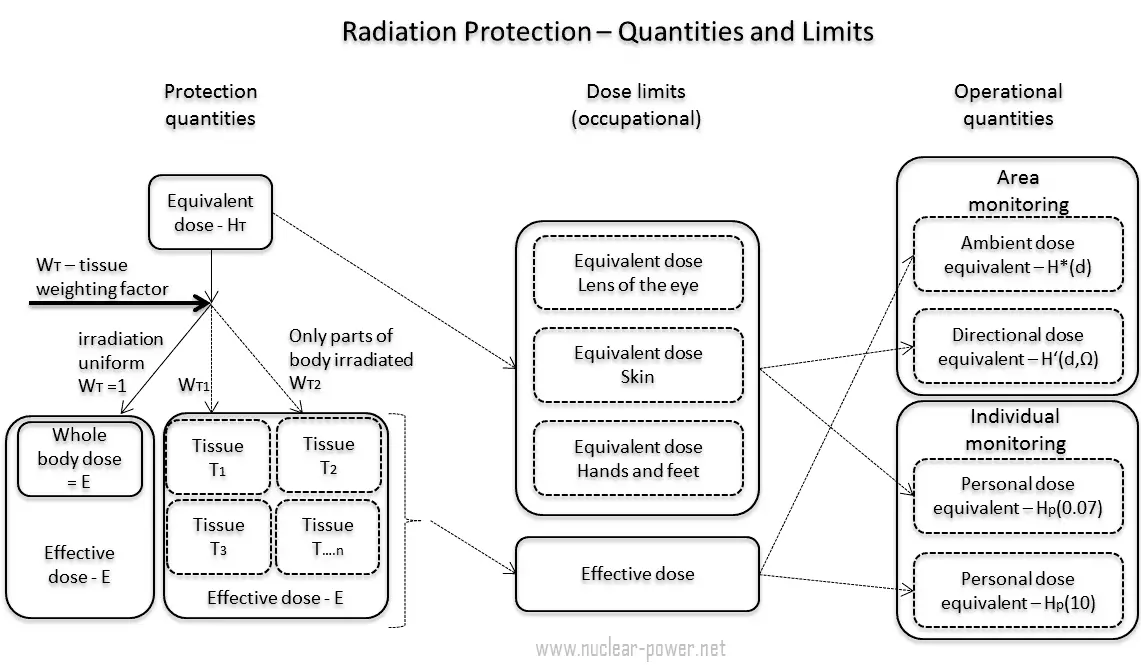
In previous chapters, we described the equivalent dose and the effective dose. But these doses are not directly measurable. For this purpose, the ICRP has introduced and defined a set of operational quantities, which can be measured and which are intended to provide a reasonable estimate for the protection quantities. These quantities aim to provide a conservative estimate for the value of the protection quantities related to an exposure avoiding both underestimation and too much overestimation.
Numerical links between these quantities is represented by conversion coefficients, which are defined for a reference person. It is very important that an internationally agreed set of conversion coefficients is available for general use in radiological protection practice for occupational exposures and exposures of the public. For the calculation of conversion coefficients for external exposure, computational phantoms are used for dose assessment in various radiation fields. For the calculation of dose coefficients from intakes of radionuclides, biokinetic models for radionuclides, reference physiological data, and computational phantoms are used.
A set of evaluated data of conversion coefficients for protection, and operational quantities for external exposure to mono-energetic photon, neutron, and electron radiation under specific irradiation conditions is published in reports (ICRP, 1996b, ICRU, 1997).
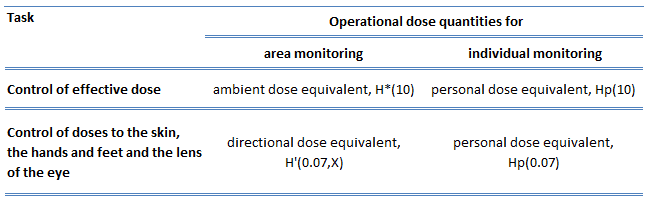
In general, the ICRP defines operational quantities for area and individual monitoring of external exposures. The operational quantities for area monitoring are:
Ambient dose equivalent, H*(10). The ambient dose equivalent is an operational quantity for area monitoring of strongly penetrating radiation.
Directional dose equivalent, H’ (d,Ω). The directional dose equivalent is an operational quantity for area monitoring of weakly penetrating radiation.
Personal dose equivalent, Hp(0.07). The Hp(0.07) dose equivalent is an operational quantity for individual monitoring for the assessment of the dose to the skin and to the hands and feet.
Personal dose equivalent, Hp(10). The Hp(10) dose equivalent is an operational quantity for individual monitoring for the assessment of effective dose.
Special Reference: ICRP, 2007. The 2007 Recommendations of the International Commission on Radiological Protection. ICRP Publication 103. Ann. ICRP 37 (2-4).
Dose limits are split into two groups, the public, and occupationally exposed workers. According to ICRP, occupational exposure refers to all exposure incurred by workers in the course of their work, with the exception of
excluded exposures and exposures from exempt activities involving radiation or exempt sources
any medical exposure
the normal local natural background radiation.
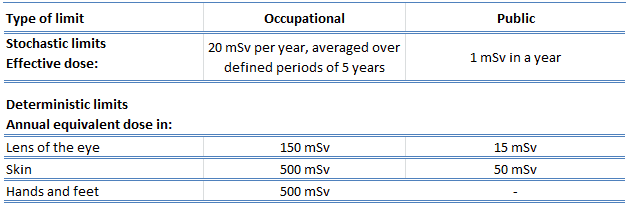
The following table summarizes dose limits for occupationally exposed workers and for the public:
Table of dose limits for occupationally exposed workers and for the public. Source of data: ICRP, 2007. The 2007 Recommendations of the International Commission on Radiological Protection. ICRP Publication 103. Ann. ICRP 37 (2-4).
According to the recommendation of the ICRP in its statement on tissue reactions of 21. April 2011, the equivalent dose limit for the lens of the eye for occupational exposure in planned exposure situations was reduced from 150 mSv/year to 20 mSv/year, averaged over defined periods of 5 years, with no annual dose in a single year exceeding 50 mSv.
Limits on effective dose are for the sum of the relevant effective doses from external exposure in the specified time period and the committed effective dose from intakes of radionuclides in the same period. For adults, the committed effective dose is computed for a 50-year period after intake, whereas for children it is computed for the period up to age 70 years. The effective whole-body dose limit of 20 mSv is an average value over five years. The real limit is 100 mSv in 5 years, with not more than 50 mSv in any one year.
Sievert – Unit of Equivalent Dose
In radiation protection, the sievert is a derived unit of equivalent dose and effective dose. The sievert represents the equivalent biological effect of the deposit of a joule of gamma rays energy in a kilogram of human tissue. Unit of sievert is of importance in radiation protection and was named after the Swedish scientist Rolf Sievert, who did a lot of the early work on radiation dosimetry in radiation therapy.
As was written, the sievert is used for radiation dose quantities such as equivalent dose and effective dose. Equivalent dose (symbol HT) is a dose quantity calculated for individual organs (index T – tissue). Equivalent dose is based on the absorbed dose to an organ, adjusted to account for the effectiveness of the type of radiation. Equivalent dose is given the symbol HT. The SI unit of HT is the sievert (Sv) or but rem (roentgen equivalent man) is still commonly used (1 Sv = 100 rem).
Examples of Doses in Sieverts
We must note that radiation is all around us. In, around, and above the world we live in. It is a natural energy force that surrounds us. It is a part of our natural world that has been here since the birth of our planet. In the following points we try to express enormous ranges of radiation exposure, which can be obtained from various sources.
0.05 µSv – Sleeping next to someone
0.09 µSv – Living within 30 miles of a nuclear power plant for a year
0.1 µSv – Eating one banana
0.3 µSv – Living within 50 miles of a coal power plant for a year
10 µSv – Average daily dose received from natural background
20 µSv – Chest X-ray
40 µSv – A 5-hour airplane flight
600 µSv – mammogram
1 000 µSv – Dose limit for individual members of the public, total effective dose per annum
3 650 µSv – Average yearly dose received from natural background
5 800 µSv – Chest CT scan
10 000 µSv – Average yearly dose received from natural background in Ramsar, Iran
20 000 µSv – single full-body CT scan
175 000 µSv – Annual dose from natural radiation on a monazite beach near Guarapari, Brazil.
5 000 000 µSv – Dose that kills a human with a 50% risk within 30 days (LD50/30), if the dose is received over a very short duration.
Robert Reed Burn, Introduction to Nuclear Reactor Operation, 1988.
U.S. Department of Energy, Nuclear Physics and Reactor Theory. DOE Fundamentals Handbook, Volume 1 and 2. January 1993.
Paul Reuss, Neutron Physics. EDP Sciences, 2008. ISBN: 978-2759800414.
See also:
Radiation Dosimeter
We hope, this article, EPD – Electronic Personal Dosimeter, helps you. If so, give us a like in the sidebar. Main purpose of this website is to help the public to learn some interesting and important information about radiation and dosimeters.
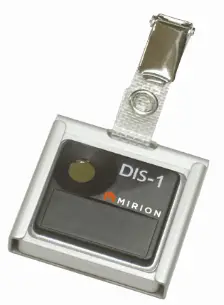
The DIS dosimeter, direct-ion storage dosimeter, is based on the combination of an ion chamber and a non-volatile electronic charge storage element. Radiation Dosimetry
Direct-ion storage dosimeter, DIS, is an electronic dosimeter, from which the dose information for both Hp(10) and Hp(0.07) can be obtained instantly at the workplace by using an electronic reader unit. The DIS dosimeter is based on the combination of an ion chamber and a non-volatile electronic charge storage element.
DIS dosimeter use an analog memory cell inside a small, gas-filled, ionization chamber. Incident radiation causes ionizations in the chamber wall and in the gas, and the charge is stored for subsequent readout. The DIS dosimeter is read at the user’s site through connection to an electronic reader unit. The DIS dosimeter is designed to clip to a breast pocket. The DIS series of personal electronic radiation dosimeters can operate at high dose rates and inside pulsed fields. It’s lightweight, but rugged. The DIS dosimeter represents a potential alternative for replacing the existing film and thermoluminescence dosimeters (TLDs) used in occupational monitoring due to its ease of use and low operating costs.
Robert Reed Burn, Introduction to Nuclear Reactor Operation, 1988.
U.S. Department of Energy, Nuclear Physics and Reactor Theory. DOE Fundamentals Handbook, Volume 1 and 2. January 1993.
Paul Reuss, Neutron Physics. EDP Sciences, 2008. ISBN: 978-2759800414.
See also:
Radiation Dosimeter
We hope, this article, DIS Dosimeter – Direct-ion Storage Dosimeter, helps you. If so, give us a like in the sidebar. Main purpose of this website is to help the public to learn some interesting and important information about radiation and dosimeters.
OSL dosimeters, (Optically Stimulated Luminescence) are designed to provide X, gamma, beta and neutron radiation monitoring using OSL technology. Radiation Dosimetry
The OSL dosimetry (Optically Stimulated Luminescence) is a method that has established itself in the whole-body dosimetry. As can be deduced, this method is based on optically stimulated luminescence. The OSL dosimeter provides a very high degree of sensitivity by giving an accurate reading as low as 1 mrem for x-ray and gamma ray photons with energies ranging from 5 keV to greater than 40 MeV. OSL dosimeters are designed to provide X, gamma, beta and neutron radiation monitoring using OSL technology. OSL dosimeters are applicable to situations where real-time information is not needed, but precise accumulated dose monitoring records are desired for comparison to field measurements or for assessing the potential for long term health effects. In diagnostic imaging the increased sensitivity of the OSL dosimeter makes it ideal for monitoring employees working in low-radiation environments and for pregnant workers. OSL dosimeters offer advantages that include the ability to be re-read and a high sensitivity (low minimum measurable dose), and they have become popular because of these favourable properties.
OSL materials (e.g. beryllium oxide ceramic) contain defects in their crystal structure that trap electrons released by exposure to radiation. In TLDs, the trapped electrons are subsequently freed by stimulation with heat, while OSL uses stimulation with light. After stimulation by light, the detector releases the stored energy in the form of light, i.e., it is stimulated to emit light. The light output measured with photomultipliers is a measure unit for the dose. In comparison with TLDs, their major difference is that luminescence is produced by a light beam, rather than by heat.
The OSL dosimeter must be worn on a position of the body representative of its exposure, typically between the waist and the neck, on the front of the torso, facing the radioactive source. Dosimeters are usually worn on the outside of clothing, around the chest or torso to represent dose to the “whole body”. If a person uses a lead apron, the dosimeter must be worn under the lead apron. Specialized equipment (OSL Reader) is used for this readout, either by the user with field-portable or lab-based equipment, or by a dosimetry processing laboratory. A commercial dosimetry service can be contracted to supply dosimeters on a regular basis, read out returned dosimeters, and provide dose tracking and record keeping. TLDs and OSL dosimeters are offered in either a clip-on brooch format or identification card style.
Robert Reed Burn, Introduction to Nuclear Reactor Operation, 1988.
U.S. Department of Energy, Nuclear Physics and Reactor Theory. DOE Fundamentals Handbook, Volume 1 and 2. January 1993.
Paul Reuss, Neutron Physics. EDP Sciences, 2008. ISBN: 978-2759800414.
See also:
Radiation Dosimeter
We hope, this article, OSL Dosimetry – Optically Stimulated Luminescence Dosimeter, helps you. If so, give us a like in the sidebar. Main purpose of this website is to help the public to learn some interesting and important information about radiation and dosimeters.
Thermoluminiscent Albedo Neutron Dosimeter. Albedo neutron dosimetry is based on the effect of moderation and backscattering of neutrons by the human body. Radiation Dosimetry
A thermoluminescent dosimeter, abbreviated as TLD, is a passive radiation dosimeter, that measures ionizing radiation exposure by measuring the intensity of visible light emitted from a sensitive crystal in the detector when the crystal is heated. The intensity of light emitted is measure by TLD reader and it is dependent upon the radiation exposure. Thermoluminescent dosimeters was invented in 1954 by Professor Farrington Daniels of the University of Wisconsin-Madison. TLD dosimeters are applicable to situations where real-time information is not needed, but precise accumulated dose monitoring records are desired for comparison to field measurements or for assessing the potential for long term health effects. In dosimetry, both the quartz fiber and film badge types are being superseded by TLDs and EPDs (Electronic Personal Dosimeter).
Thermoluminiscent Albedo Neutron Dosimeter
Albedo neutron dosimetry is based on the effect of moderation and backscattering of neutrons by the human body. Albedo, the latin word for “whiteness”, was defined by Lambert as the fraction of the incident light reflected diffusely by a surface. Moderation and backscattering of neutrons by the human body creates a neutron flux at the body surface in the thermal and intermediate energy range. These backscattered neutrons called albedo neutrons, can be detected by a dosimeter (usually a LiF TLD chip), placed on the body which is designed to detect thermal neutrons. Albedo dosimeters have been found to be the only dosimeters which can measure doses due to neutrons over the whole range of energies. Usually, two types of lithium fluoride are used to separate doses contributed by gamma-rays and neutrons. LiF chip enriched in lithium-6, which is very sensitive to thermal neutrons and LiF chip containing very little of lithium-6, which has a negligible neutron response.
Robert Reed Burn, Introduction to Nuclear Reactor Operation, 1988.
U.S. Department of Energy, Nuclear Physics and Reactor Theory. DOE Fundamentals Handbook, Volume 1 and 2. January 1993.
Paul Reuss, Neutron Physics. EDP Sciences, 2008. ISBN: 978-2759800414.
See also:
TLD
We hope, this article, Thermoluminescent Albedo Neutron Dosimeter, helps you. If so, give us a like in the sidebar. Main purpose of this website is to help the public to learn some interesting and important information about radiation and dosimeters.
Neutron Thermoluminescent Dosimeter – Neutron TLD. The most commonly used personnel neutron dosimeters for radiation protection purposes are thermoluminescent dosimeters and albedo dosimeters. Both are based on this phenomenon – thermoluminescence. Radiation Dosimetry
A thermoluminescent dosimeter, abbreviated as TLD, is a passive radiation dosimeter, that measures ionizing radiation exposure by measuring the intensity of visible light emitted from a sensitive crystal in the detector when the crystal is heated. The intensity of light emitted is measure by TLD reader and it is dependent upon the radiation exposure. Thermoluminescent dosimeters was invented in 1954 by Professor Farrington Daniels of the University of Wisconsin-Madison. TLD dosimeters are applicable to situations where real-time information is not needed, but precise accumulated dose monitoring records are desired for comparison to field measurements or for assessing the potential for long term health effects. In dosimetry, both the quartz fiber and film badge types are being superseded by TLDs and EPDs (Electronic Personal Dosimeter).
Neutron Thermoluminescent Dosimeter – Neutron TLD
The personnel neutron dosimetry continues to be one of the problems in the field of radiation protection, as no single method provides the combination of energy response, sensitivity, orientation dependence characteristics and accuracy necessary to meet the needs of a personnel dosimeter.
The most commonly used personnel neutron dosimeters for radiation protection purposes are thermoluminescent dosimeters and albedo dosimeters. Both are based on this phenomenon – thermoluminescence. For this purpose, lithium fluoride (LiF) as sensitive material (chip) is widely used. Lithium fluoride TLD is used for gamma and neutron exposure (indirectly, using the Li-6 (n,alpha)) nuclear reaction. Small crystals of LiF (lithium fluoride) are the most common TLD dosimeters since they have the same absorption properties as soft tissue. Lithium has two stable isotopes, lithium-6 (7.4 %) and lithium-7 (92.6 %). Li-6 is the isotope sensitive to neutrons. In order to record neutrons, LiF crystal dosimeters may be enriched in lithium-6 to enhance the lithium-6 (n,alpha) nuclear reaction. The efficiency of the detector depends on the energy of the neutrons. Because the interaction of neutrons with any element is highly dependent on energy, making a dosimeter independent of the energy of neutrons is very difficult. In order to separate thermal neutrons and photons, LiF dosimeters are mostly utilized, containing different percentage of lithium-6. LiF chip enriched in lithium-6, which is very sensitive to thermal neutrons and LiF chip containing very little of lithium-6, which has a negligible neutron response.
The principle of neutron TLDs is then similar as for gamma radiation TLDs. In the LiF chip, there are impurities (e.g. manganese or magnesium), which produce trap states for energetic electrons. The impurity causes traps in the crystalline lattice where, following irradiation (to alpha radiation), electrons are held. When the crystal is warmed, the trapped electrons are released and light is emitted. The amount of light is related to the dose of radiation received by the crystal.
Thermoluminiscent Albedo Neutron Dosimeter
Albedo neutron dosimetry is based on the effect of moderation and backscattering of neutrons by the human body. Albedo, the latin word for “whiteness”, was defined by Lambert as the fraction of the incident light reflected diffusely by a surface. Moderation and backscattering of neutrons by the human body creates a neutron flux at the body surface in the thermal and intermediate energy range. These backscattered neutrons called albedo neutrons, can be detected by a dosimeter (usually a LiF TLD chip), placed on the body which is designed to detect thermal neutrons. Albedo dosimeters have been found to be the only dosimeters which can measure doses due to neutrons over the whole range of energies. Usually, two types of lithium fluoride are used to separate doses contributed by gamma-rays and neutrons. LiF chip enriched in lithium-6, which is very sensitive to thermal neutrons and LiF chip containing very little of lithium-6, which has a negligible neutron response.
TLD – Principle of Operation
The following basic overview explains how a TLD works:
When ionizing radiation passes through the detector (chip), the chip absorbs the radiation and its structure changes slightly.
In thermoluminescent materials, electrons may reach the conduction band, when they are excited, for example, by ionizing radiation (i.e. they must obtain energy higher than Egap). But in this case, defects in the material exist or impurities are added to trap electrons in the band gap and hold them there.
These trapped electrons represent stored energy for the time that the electrons are held and the amount of this energy is dependent upon the radiation exposure.
In order to obtain the dose received, the TLD chip must be heated in this TLD reader. The trapped electrons return to the ground state and emit photons of visible light. The amount of light emitted relative to the temperature is called the glow curve.
After the readout is complete, the TLD is annealed at a high temperature. This process essentially zeroes the TL material by releasing all trapped electrons. The TLD is then ready for reuse.
TLD Reader
As was written, previously absorbed energy from electromagnetic radiation or other ionizing radiation in these materials is re-emitted as light upon heating of the material. The intensity of light emitted is measure by TLD reader and it is dependent upon the radiation exposure. A typical basic TLD reader contains the following components:
Heater. Heater raises the temperature of the TL material
Photomultiplier tube. PMT amplifies and measures the light output.
Meter/Recorder. Recorder is able to display and record data.
Glow Curve Source: Dosimetry. Study Guide for Radiological control Technician. DOE-HDBK-1122-99. Department of Energy
In order to obtain the dose received, the TLD chip must be heated in this TLD reader. The trapped electrons return to the ground state and emit photons of visible light. The amount of light emitted relative to the temperature is called the glow curve. This curve is analyzed to determine the dose. After the readout is complete, the TLD is annealed at a high temperature. This process essentially zeroes the TL material by releasing all trapped electrons. The TLD is then ready for reuse. There are two types of readers. Automatic, and manual readers. The automatic TLD reader is a lot more complicated than it might expected.
Robert Reed Burn, Introduction to Nuclear Reactor Operation, 1988.
U.S. Department of Energy, Nuclear Physics and Reactor Theory. DOE Fundamentals Handbook, Volume 1 and 2. January 1993.
Paul Reuss, Neutron Physics. EDP Sciences, 2008. ISBN: 978-2759800414.
See also:
TLD
We hope, this article, Neutron Thermoluminescent Dosimeter – Neutron TLD, helps you. If so, give us a like in the sidebar. Main purpose of this website is to help the public to learn some interesting and important information about radiation and dosimeters.
Advantages and Disadvantages of TLDs. TLDs are able to measure a greater range of doses in comparison with film badges. The readout process effectively “zeroes” the TLD.
A thermoluminescent dosimeter, abbreviated as TLD, is a passive radiation dosimeter, that measures ionizing radiation exposure by measuring the intensity of visible light emitted from a sensitive crystal in the detector when the crystal is heated. The intensity of light emitted is measure by TLD reader and it is dependent upon the radiation exposure. Thermoluminescent dosimeters was invented in 1954 by Professor Farrington Daniels of the University of Wisconsin-Madison. TLD dosimeters are applicable to situations where real-time information is not needed, but precise accumulated dose monitoring records are desired for comparison to field measurements or for assessing the potential for long term health effects. In dosimetry, both the quartz fiber and film badge types are being superseded by TLDs and EPDs (Electronic Personal Dosimeter).
Advantages and Disadvantages of TLDs
Advantages of TLDs
TLDs are able to measure a greater range of doses in comparison with film badges.
Doses from TLDs may be easily obtained.
TLDs can be read on site instead of being sent away for developing.
Robert Reed Burn, Introduction to Nuclear Reactor Operation, 1988.
U.S. Department of Energy, Nuclear Physics and Reactor Theory. DOE Fundamentals Handbook, Volume 1 and 2. January 1993.
Paul Reuss, Neutron Physics. EDP Sciences, 2008. ISBN: 978-2759800414.
See also:
TLD
We hope, this article, Advantage and Disadvantage of Thermoluminescent Dosimeter, helps you. If so, give us a like in the sidebar. Main purpose of this website is to help the public to learn some interesting and important information about radiation and dosimeters.
The intensity of light emitted is measure by TLD reader and it is dependent upon the radiation exposure. The amount of light emitted relative to the temperature is called the glow curve. Radiation Dosimetry
As was written, previously absorbed energy from electromagnetic radiation or other ionizing radiation in these materials is re-emitted as light upon heating of the material. The intensity of light emitted is measure by TLD reader and it is dependent upon the radiation exposure. A typical basic TLD reader contains the following components:
Heater. Heater raises the temperature of the TL material
Photomultiplier tube. PMT amplifies and measures the light output.
Meter/Recorder. Recorder is able to display and record data.
Glow Curve Source: Dosimetry. Study Guide for Radiological control Technician. DOE-HDBK-1122-99. Department of Energy
In order to obtain the dose received, the TLD chip must be heated in this TLD reader. The trapped electrons return to the ground state and emit photons of visible light. The amount of light emitted relative to the temperature is called the glow curve. This curve is analyzed to determine the dose. After the readout is complete, the TLD is annealed at a high temperature. This process essentially zeroes the TL material by releasing all trapped electrons. The TLD is then ready for reuse. There are two types of readers. Automatic, and manual readers. The automatic TLD reader is a lot more complicated than it might expected.
Robert Reed Burn, Introduction to Nuclear Reactor Operation, 1988.
U.S. Department of Energy, Nuclear Physics and Reactor Theory. DOE Fundamentals Handbook, Volume 1 and 2. January 1993.
Paul Reuss, Neutron Physics. EDP Sciences, 2008. ISBN: 978-2759800414.
See also:
TLD
We hope, this article, TLD Reader – Glow Curve, helps you. If so, give us a like in the sidebar. Main purpose of this website is to help the public to learn some interesting and important information about radiation and dosimeters.
TLD – Principle of Operation The following basic overview explains how a thermoluminescent dosimeter works: When ionizing radiation passes through the detector (chip), the chip absorbs the radiation and its structure changes slightly. Radiation Dosimetry
A thermoluminescent dosimeter, abbreviated as TLD, is a passive radiation dosimeter, that measures ionizing radiation exposure by measuring the intensity of visible light emitted from a sensitive crystal in the detector when the crystal is heated. The intensity of light emitted is measure by TLD reader and it is dependent upon the radiation exposure. Thermoluminescent dosimeters was invented in 1954 by Professor Farrington Daniels of the University of Wisconsin-Madison. TLD dosimeters are applicable to situations where real-time information is not needed, but precise accumulated dose monitoring records are desired for comparison to field measurements or for assessing the potential for long term health effects. In dosimetry, both the quartz fiber and film badge types are being superseded by TLDs and EPDs (Electronic Personal Dosimeter).
TLD – Principle of Operation
The following basic overview explains how a TLD works:
When ionizing radiation passes through the detector (chip), the chip absorbs the radiation and its structure changes slightly.
In thermoluminescent materials, electrons may reach the conduction band, when they are excited, for example, by ionizing radiation (i.e. they must obtain energy higher than Egap). But in this case, defects in the material exist or impurities are added to trap electrons in the band gap and hold them there.
These trapped electrons represent stored energy for the time that the electrons are held and the amount of this energy is dependent upon the radiation exposure.
In order to obtain the dose received, the TLD chip must be heated in this TLD reader. The trapped electrons return to the ground state and emit photons of visible light. The amount of light emitted relative to the temperature is called the glow curve.
After the readout is complete, the TLD is annealed at a high temperature. This process essentially zeroes the TL material by releasing all trapped electrons. The TLD is then ready for reuse.
TLD Reader
As was written, previously absorbed energy from electromagnetic radiation or other ionizing radiation in these materials is re-emitted as light upon heating of the material. The intensity of light emitted is measure by TLD reader and it is dependent upon the radiation exposure. A typical basic TLD reader contains the following components:
Heater. Heater raises the temperature of the TL material
Photomultiplier tube. PMT amplifies and measures the light output.
Meter/Recorder. Recorder is able to display and record data.
Glow Curve Source: Dosimetry. Study Guide for Radiological control Technician. DOE-HDBK-1122-99. Department of Energy
In order to obtain the dose received, the TLD chip must be heated in this TLD reader. The trapped electrons return to the ground state and emit photons of visible light. The amount of light emitted relative to the temperature is called the glow curve. This curve is analyzed to determine the dose. After the readout is complete, the TLD is annealed at a high temperature. This process essentially zeroes the TL material by releasing all trapped electrons. The TLD is then ready for reuse. There are two types of readers. Automatic, and manual readers. The automatic TLD reader is a lot more complicated than it might expected.
Robert Reed Burn, Introduction to Nuclear Reactor Operation, 1988.
U.S. Department of Energy, Nuclear Physics and Reactor Theory. DOE Fundamentals Handbook, Volume 1 and 2. January 1993.
Paul Reuss, Neutron Physics. EDP Sciences, 2008. ISBN: 978-2759800414.
See also:
TLD
We hope, this article, TLD – Principle of Operation, helps you. If so, give us a like in the sidebar. Main purpose of this website is to help the public to learn some interesting and important information about radiation and dosimeters.