Facebook Instagram Youtube Twitter

What is Compton Scattering of X-rays – Definition

Compton scattering of X-rays is the process in which the X-ray bounces off electron, giving up some of its initial energy (given by Planck’s formula E=hf). Radiation Dosimetry

Compton Scattering of X-rays

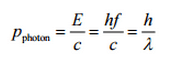
compton scatteringThe Compton formula was published in 1923 in the Physical Review. Compton explained that the X-ray shift is caused by particle-like momentum of photons. Compton scattering formula is the mathematical relationship between the shift in wavelength and the scattering angle of the X-rays. In the case of Compton scattering the photon of frequency f collides with an electron at rest. Upon collision, the photon bounces off electron, giving up some of its initial energy (given by Planck’s formula E=hf). While the electron gains momentum (mass x velocity), the photon cannot lower its velocity. As a result of momentum conservation law, the photon must lower its momentum given by:

As a result of momentum conservetion law, the photon must lower its momentum given by this formula.

Compton Scattering
In Compton scattering, the incident gamma-ray photon is deflected through an angle Θ with respect to its original direction. This deflection results in a decrease in energy (decrease in photon’s frequency) of the photon and is called the Compton effect.
Source: hyperphysics.phy-astr.gsu.edu

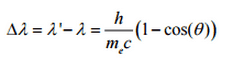
So the decrease in photon’s momentum must be translated into decrease in frequency (increase in wavelength Δλ = λ’ – λ). The shift of the wavelength increased with scattering angle according to the Compton formula:


The shift of the wavelength increased with scattering angle according to the Compton formula

where λ is the initial wavelength of photon λ’ is the wavelength after scattering, h is the Planck constant = 6.626 x 10⁻³⁴ J.s, me is the electron rest mass (0.511 MeV)c is the speed of light Θ is the scattering angle. The minimum change in wavelength (λ′ − λ) for the photon occurs when Θ = 0° (cos(Θ)=1) and is at least zero. The maximum change in wavelength (λ′ − λ) for the photon occurs when Θ = 180° (cos(Θ)=-1). In this case the photon transfers to the electron as much momentum as possible. The maximum change in wavelength can be derived from Compton formula:

The maximum change in wavelength can be derived from Compton formula. Compton length

The quantity h/mec is known as the Compton wavelength of the electron and is equal to 2.43×10⁻¹² m.

Interaction of X-rays with Matter

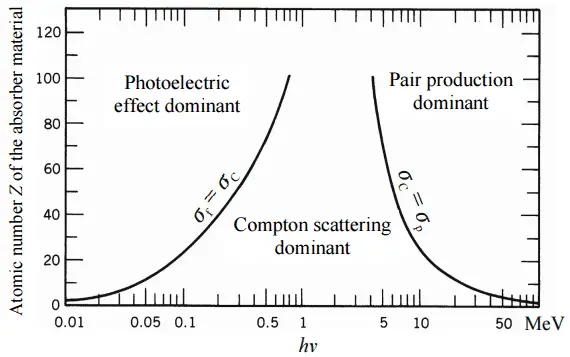
Although a large number of possible interactions are known, there are three key interaction mechanisms with matter. The strength of these interactions depends on the energy of the X-rays and the elemental composition of the material, but not much on chemical properties, since the X-ray photon energy is much higher than chemical binding energies. The photoelectric absorbtion dominates at low-energies of X-rays, while Compton scattering dominates at higher energies.

  • Photoelectric absorption
  • Compton scattering
  • Rayleigh scattering
References:

Radiation Protection:

  1. Knoll, Glenn F., Radiation Detection and Measurement 4th Edition, Wiley, 8/2010. ISBN-13: 978-0470131480.
  2. Stabin, Michael G., Radiation Protection and Dosimetry: An Introduction to Health Physics, Springer, 10/2010. ISBN-13: 978-1441923912.
  3. Martin, James E., Physics for Radiation Protection 3rd Edition, Wiley-VCH, 4/2013. ISBN-13: 978-3527411764.
  4. U.S.NRC, NUCLEAR REACTOR CONCEPTS
  5. U.S. Department of Energy, Nuclear Physics and Reactor Theory. DOE Fundamentals Handbook, Volume 1 and 2. January 1993.

Nuclear and Reactor Physics:

  1. J. R. Lamarsh, Introduction to Nuclear Reactor Theory, 2nd ed., Addison-Wesley, Reading, MA (1983).
  2. J. R. Lamarsh, A. J. Baratta, Introduction to Nuclear Engineering, 3d ed., Prentice-Hall, 2001, ISBN: 0-201-82498-1.
  3. W. M. Stacey, Nuclear Reactor Physics, John Wiley & Sons, 2001, ISBN: 0- 471-39127-1.
  4. Glasstone, Sesonske. Nuclear Reactor Engineering: Reactor Systems Engineering, Springer; 4th edition, 1994, ISBN: 978-0412985317
  5. W.S.C. Williams. Nuclear and Particle Physics. Clarendon Press; 1 edition, 1991, ISBN: 978-0198520467
  6. G.R.Keepin. Physics of Nuclear Kinetics. Addison-Wesley Pub. Co; 1st edition, 1965
  7. Robert Reed Burn, Introduction to Nuclear Reactor Operation, 1988.
  8. U.S. Department of Energy, Nuclear Physics and Reactor Theory. DOE Fundamentals Handbook, Volume 1 and 2. January 1993.
  9. Paul Reuss, Neutron Physics. EDP Sciences, 2008. ISBN: 978-2759800414.

See also:

X-rays

We hope, this article, Compton Scattering of X-rays, helps you. If so, give us a like in the sidebar. Main purpose of this website is to help the public to learn some interesting and important information about radiation and dosimeters.

What is Rayleigh Scattering – Thomson Scattering – Definition

Rayleigh scattering, also known as Thomson scattering is the low-energy limit of Compton scattering. The particle kinetic energy and photon frequency do not change as a result of the scattering. Radiation Dosimetry

Rayleigh Scattering – Thomson Scattering

Rayleigh scattering, also known as Thomson scattering is the low-energy limit of Compton scattering. The particle kinetic energy and photon frequency do not change as a result of the scattering. Rayleigh scattering occurs as a result of an interaction between an incoming photon and an electron, the binding energy of which is significantly greater than that of the incoming photon. The incident radiation is assumed to set the electron into forced resonant oscillation such that the electron re-emits radiation of the same frequency but in all directions. In this case, the electric field of the incident wave (photon) accelerates the charged particle, causing it, in turn, to emit radiation at the same frequency as the incident wave, and thus the wave is scattered. Rayleigh scattering is significant up to ≈ 20keV and like Thomson scattering, is elastic. The total scattering cross section becomes a combination of the Rayleigh and Compton bound scattering cross sections. Thomson scattering is an important phenomenon in plasma physics and was first explained by the physicist J. J. Thomson. This interaction has great significance in the area of X-ray crystallography.

Interaction of X-rays with Matter

Although a large number of possible interactions are known, there are three key interaction mechanisms with matter. The strength of these interactions depends on the energy of the X-rays and the elemental composition of the material, but not much on chemical properties, since the X-ray photon energy is much higher than chemical binding energies. The photoelectric absorbtion dominates at low-energies of X-rays, while Compton scattering dominates at higher energies.

  • Photoelectric absorption
  • Compton scattering
  • Rayleigh scattering
References:

Radiation Protection:

  1. Knoll, Glenn F., Radiation Detection and Measurement 4th Edition, Wiley, 8/2010. ISBN-13: 978-0470131480.
  2. Stabin, Michael G., Radiation Protection and Dosimetry: An Introduction to Health Physics, Springer, 10/2010. ISBN-13: 978-1441923912.
  3. Martin, James E., Physics for Radiation Protection 3rd Edition, Wiley-VCH, 4/2013. ISBN-13: 978-3527411764.
  4. U.S.NRC, NUCLEAR REACTOR CONCEPTS
  5. U.S. Department of Energy, Nuclear Physics and Reactor Theory. DOE Fundamentals Handbook, Volume 1 and 2. January 1993.

Nuclear and Reactor Physics:

  1. J. R. Lamarsh, Introduction to Nuclear Reactor Theory, 2nd ed., Addison-Wesley, Reading, MA (1983).
  2. J. R. Lamarsh, A. J. Baratta, Introduction to Nuclear Engineering, 3d ed., Prentice-Hall, 2001, ISBN: 0-201-82498-1.
  3. W. M. Stacey, Nuclear Reactor Physics, John Wiley & Sons, 2001, ISBN: 0- 471-39127-1.
  4. Glasstone, Sesonske. Nuclear Reactor Engineering: Reactor Systems Engineering, Springer; 4th edition, 1994, ISBN: 978-0412985317
  5. W.S.C. Williams. Nuclear and Particle Physics. Clarendon Press; 1 edition, 1991, ISBN: 978-0198520467
  6. G.R.Keepin. Physics of Nuclear Kinetics. Addison-Wesley Pub. Co; 1st edition, 1965
  7. Robert Reed Burn, Introduction to Nuclear Reactor Operation, 1988.
  8. U.S. Department of Energy, Nuclear Physics and Reactor Theory. DOE Fundamentals Handbook, Volume 1 and 2. January 1993.
  9. Paul Reuss, Neutron Physics. EDP Sciences, 2008. ISBN: 978-2759800414.

See also:

X-rays

We hope, this article, Rayleigh Scattering – Thomson Scattering, helps you. If so, give us a like in the sidebar. Main purpose of this website is to help the public to learn some interesting and important information about radiation and dosimeters.

What is X-ray Attenuation – Definition

X-ray attenuation theory describes how x-rays are attenuated by materials. The attenuation theory is valid for X-rays and gamma rays as well. Radiation Dosimetry

X-rays, also known as X-radiation, refers to electromagnetic radiation (no rest mass, no charge) of high energies. X-rays are high-energy photons with short wavelengths and thus very high frequency. The radiation frequency is key parameter of all photons, because it determines the energy of a photon. Photons are categorized according to the energies from low-energy radio waves and infrared radiation, through visible light, to high-energy X-rays and gamma rays.

Most X-rays have a wavelength ranging from 0.01 to 10 nanometers (3×10¹⁶ Hz to 3×10¹⁹ Hz), corresponding to energies in the range 100 eV to 100 keV. X-ray wavelengths are shorter than those of UV rays and typically longer than those of gamma rays. The distinction between X-rays and gamma rays is not so simple and has changed in recent decades.  According to the currently valid definition, X-rays are emitted by electrons outside the nucleus, while gamma rays are emitted by the nucleus.

X-ray Attenuation

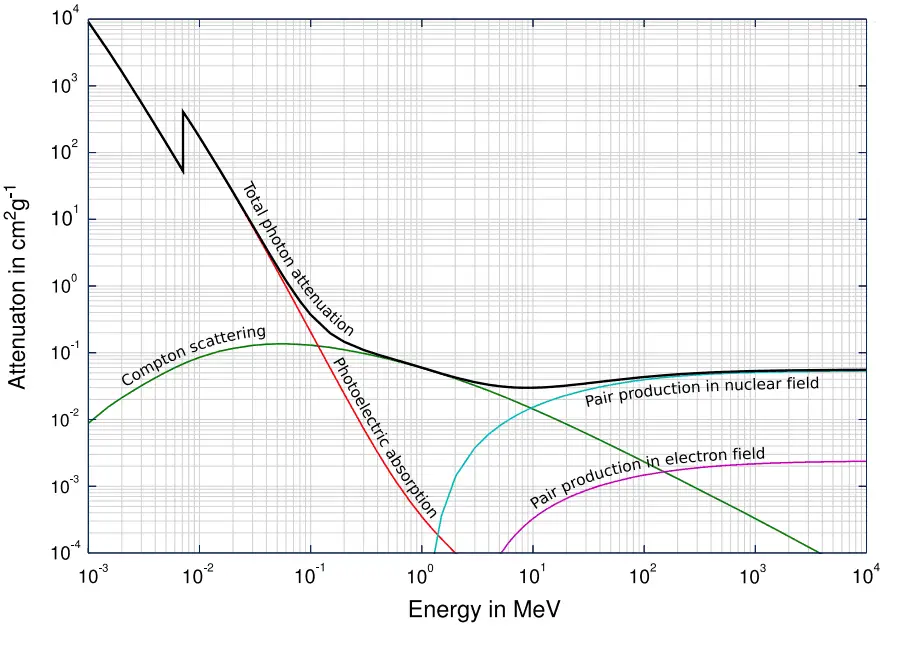
Attenuation coefficients.
Total photon cross sections.
Source: Wikimedia Commons

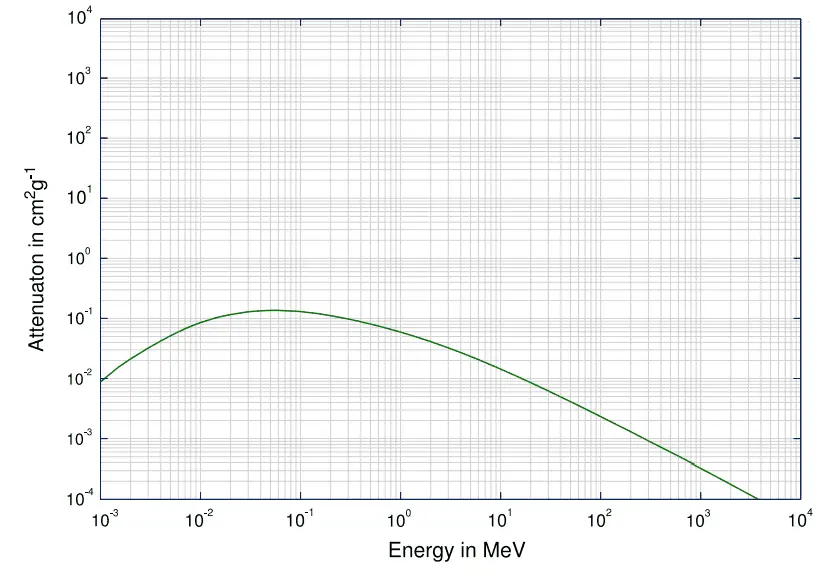
As the high-energy photons pass through material, their energy is decreasing. This is known as attenuation. The attenuation theory is valid for X-rays and gamma rays as well. It turns out that higher energy photons (hard X-rays) travel through tissue more easily than low-energy photons (i.e. the higher energy photons are less likely to interact with matter). Much of this effect is related to the photoelectric effect. The probability of photoelectric absorption is approximately proportional to (Z/E)3, where Z is the atomic number of the tissue atom and E is the photon energy. As E gets larger, the likelihood of interaction drops rapidly. For higher energies, Compton scattering becomes dominant. Compton scattering is about constant for different energies although it slowly decreases at higher energies.

Exponential Attenuation

Assume that monoenergetic X-rays are collimated into a narrow beam and the detector behind the material only detects the X-rays that passed through that material without any kind of interaction with this material, then the dependence should be simple exponential attenuation of X-rays. Each of these interactions removes the photon from the beam either by absorbtion or by scattering away from the detector direction. Therefore the interactions can be characterized by a fixed probability of occurance per unit path length in the absorber. The sum of these probabilities is called the linear attenuation coefficient:

μ = τ(photoelectric) +  σ(Compton)

Gamma rays attuenuation
The relative importance of various processes of gamma radiation interaction with matter.

Linear Attenuation Coefficient – X-rays

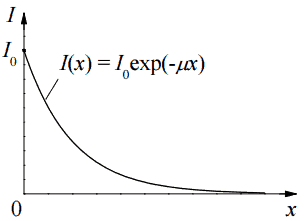
The attenuation of X-rays can be then described by the following equation.

I=I0.e-μx

, where I is intensity after attenuation,  Io is incident intensity,  μ is the linear attenuation coefficient (cm-1), and physical thickness of absorber (cm).

Attenuation
Dependence of gamma radiation intensity on absorber thickness

The materials listed in the table are air, water and a different elements from carbon (Z=6) through to lead (Z=82) and their linear attenuation coefficients are given for two X-ray energies. There are two main features of the linear attenuation coefficient:

  • The linear attenuation coefficient increases as the atomic number of the absorber increases.
  • The linear attenuation coefficient for all materials decreases with the energy of the X-rays.

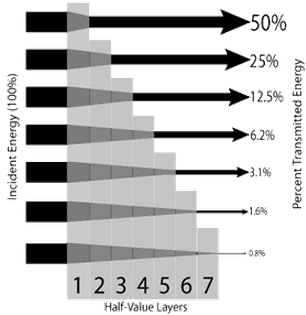
Half Value Layer

The half value layer expresses the thickness of absorbing material needed for reduction of the incident radiation intensity by a factor of two. There are two main features of the half value layer:

  • The half value layer decreases as the atomic number of the absorber increases. For example 35 m of air is needed to reduce the intensity of a 100 keV X-ray beam by a factor of two whereas just 0.12 mm of lead can do the same thing.
  • The half value layer for all materials increases with the energy of the X-rays. For example from 0.26 cm for iron at 100 keV to about 0.64 cm at 200 keV.

Mass Attenuation Coefficient

When characterizing an absorbing material, we can use sometimes the mass attenuation coefficient.  The mass attenuation coefficient is defined as the ratio of the linear attenuation coefficient and absorber density (μ/ρ). The attenuation of X-rays can be then described by the following equation:

I=I0.e-(μ/ρ).ρl

, where ρ is the material density, (μ/ρ) is the mass attenuation coefficient and ρ.l is the mass thickness. The measurement unit used for the mass attenuation coefficient cm2g-1. For intermediate energies the Compton scattering dominates and different absorbers have approximately equal mass attenuation coefficients. This is due to the fact that cross section of Compton scattering is proportional to the Z (atomic number) and therefore the coefficient is proportional to the material density ρ. At small values of X-ray energy, where the coefficient is proportional to higher powers of the atomic number Z (for photoelectric effect σf ~ Z3), the attenuation coefficient μ is not a constant.

See also calculator: Gamma activity to dose rate (with/without shield)

See also XCOM – photon cross-section DB: XCOM: Photon Cross Sections Database

Example:

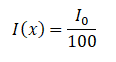
How much water schielding do you require, if you want to reduce the intensity of a 100 keV monoenergetic X-ray beam (narrow beam) to 1% of its incident intensity? The half value layer for 100 keV X-rays in water is 4.15 cm and the linear attenuation coefficient for 100 keV X-rays in water is 0.167 cm-1. The problem is quite simple and can be described by following equation:

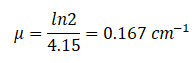
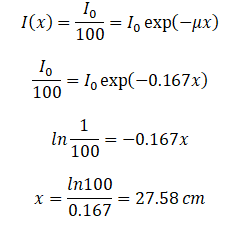
If the half value layer for water is 4.15 cm, the linear attenuation coefficient is:Now we can use the exponential attenuation equation:x-ray attenuation - problem with solution

So the required thickness of water is about 27.58 cm.  This is relatively large thickness and it is caused by small atomic numbers of hydrogen and oxygen. If we calculate the same problem for lead (Pb), we obtain the thickness x=0.077 cm.

Linear Attenuation Coefficients

Table of Linear Attenuation Coefficients (in cm-1) for a different materials at photon energies of 100, 200 and 500 keV.

Absorber 100 keV 200 keV 500 keV
Air   0.000195/cm   0.000159/cm   0.000112/cm
Water 0.167/cm 0.136/cm 0.097/cm
Carbon 0.335/cm 0.274/cm 0.196/cm
Aluminium 0.435/cm 0.324/cm 0.227/cm
Iron 2.72/cm 1.09/cm 0.655/cm
Copper 3.8/cm 1.309/cm 0.73/cm
Lead 59.7/cm 10.15/cm 1.64/cm

Read more

What is Linear and Mass Attenuation Coefficient – X-rays – Definition

Linear and Mass Attenuation Coefficient – X-rays. The linear attenuation coefficient increases as the atomic number of the absorber increases. The mass attenuation coefficient is defined as the ratio of the linear attenuation coefficient and absorber density (μ/ρ). Radiation Dosimetry

X-rays, also known as X-radiation, refers to electromagnetic radiation (no rest mass, no charge) of high energies. X-rays are high-energy photons with short wavelengths and thus very high frequency. The radiation frequency is key parameter of all photons, because it determines the energy of a photon. Photons are categorized according to the energies from low-energy radio waves and infrared radiation, through visible light, to high-energy X-rays and gamma rays.

Most X-rays have a wavelength ranging from 0.01 to 10 nanometers (3×10¹⁶ Hz to 3×10¹⁹ Hz), corresponding to energies in the range 100 eV to 100 keV. X-ray wavelengths are shorter than those of UV rays and typically longer than those of gamma rays. The distinction between X-rays and gamma rays is not so simple and has changed in recent decades.  According to the currently valid definition, X-rays are emitted by electrons outside the nucleus, while gamma rays are emitted by the nucleus.

Linear Attenuation Coefficient – X-rays

The attenuation of X-rays can be then described by the following equation.

I=I0.e-μx

, where I is intensity after attenuation,  Io is incident intensity,  μ is the linear attenuation coefficient (cm-1), and physical thickness of absorber (cm).

Attenuation
Dependence of gamma radiation intensity on absorber thickness

The materials listed in the table are air, water and a different elements from carbon (Z=6) through to lead (Z=82) and their linear attenuation coefficients are given for two X-ray energies. There are two main features of the linear attenuation coefficient:

  • The linear attenuation coefficient increases as the atomic number of the absorber increases.
  • The linear attenuation coefficient for all materials decreases with the energy of the X-rays.

Mass Attenuation Coefficient

When characterizing an absorbing material, we can use sometimes the mass attenuation coefficient.  The mass attenuation coefficient is defined as the ratio of the linear attenuation coefficient and absorber density (μ/ρ). The attenuation of X-rays can be then described by the following equation:

I=I0.e-(μ/ρ).ρl

, where ρ is the material density, (μ/ρ) is the mass attenuation coefficient and ρ.l is the mass thickness. The measurement unit used for the mass attenuation coefficient cm2g-1. For intermediate energies the Compton scattering dominates and different absorbers have approximately equal mass attenuation coefficients. This is due to the fact that cross section of Compton scattering is proportional to the Z (atomic number) and therefore the coefficient is proportional to the material density ρ. At small values of X-ray energy, where the coefficient is proportional to higher powers of the atomic number Z (for photoelectric effect σf ~ Z3), the attenuation coefficient μ is not a constant.

See also calculator: Gamma activity to dose rate (with/without shield)

See also XCOM – photon cross-section DB: XCOM: Photon Cross Sections Database

Example:

How much water schielding do you require, if you want to reduce the intensity of a 100 keV monoenergetic X-ray beam (narrow beam) to 1% of its incident intensity? The half value layer for 100 keV X-rays in water is 4.15 cm and the linear attenuation coefficient for 100 keV X-rays in water is 0.167 cm-1. The problem is quite simple and can be described by following equation:

If the half value layer for water is 4.15 cm, the linear attenuation coefficient is:Now we can use the exponential attenuation equation:x-ray attenuation - problem with solution

So the required thickness of water is about 27.58 cm.  This is relatively large thickness and it is caused by small atomic numbers of hydrogen and oxygen. If we calculate the same problem for lead (Pb), we obtain the thickness x=0.077 cm.

Linear Attenuation Coefficients

Table of Linear Attenuation Coefficients (in cm-1) for a different materials at photon energies of 100, 200 and 500 keV.

Absorber 100 keV 200 keV 500 keV
Air   0.000195/cm   0.000159/cm   0.000112/cm
Water 0.167/cm 0.136/cm 0.097/cm
Carbon 0.335/cm 0.274/cm 0.196/cm
Aluminium 0.435/cm 0.324/cm 0.227/cm
Iron 2.72/cm 1.09/cm 0.655/cm
Copper 3.8/cm 1.309/cm 0.73/cm
Lead 59.7/cm 10.15/cm 1.64/cm
References:

Radiation Protection:

  1. Knoll, Glenn F., Radiation Detection and Measurement 4th Edition, Wiley, 8/2010. ISBN-13: 978-0470131480.
  2. Stabin, Michael G., Radiation Protection and Dosimetry: An Introduction to Health Physics, Springer, 10/2010. ISBN-13: 978-1441923912.
  3. Martin, James E., Physics for Radiation Protection 3rd Edition, Wiley-VCH, 4/2013. ISBN-13: 978-3527411764.
  4. U.S.NRC, NUCLEAR REACTOR CONCEPTS
  5. U.S. Department of Energy, Nuclear Physics and Reactor Theory. DOE Fundamentals Handbook, Volume 1 and 2. January 1993.

Nuclear and Reactor Physics:

  1. J. R. Lamarsh, Introduction to Nuclear Reactor Theory, 2nd ed., Addison-Wesley, Reading, MA (1983).
  2. J. R. Lamarsh, A. J. Baratta, Introduction to Nuclear Engineering, 3d ed., Prentice-Hall, 2001, ISBN: 0-201-82498-1.
  3. W. M. Stacey, Nuclear Reactor Physics, John Wiley & Sons, 2001, ISBN: 0- 471-39127-1.
  4. Glasstone, Sesonske. Nuclear Reactor Engineering: Reactor Systems Engineering, Springer; 4th edition, 1994, ISBN: 978-0412985317
  5. W.S.C. Williams. Nuclear and Particle Physics. Clarendon Press; 1 edition, 1991, ISBN: 978-0198520467
  6. G.R.Keepin. Physics of Nuclear Kinetics. Addison-Wesley Pub. Co; 1st edition, 1965
  7. Robert Reed Burn, Introduction to Nuclear Reactor Operation, 1988.
  8. U.S. Department of Energy, Nuclear Physics and Reactor Theory. DOE Fundamentals Handbook, Volume 1 and 2. January 1993.
  9. Paul Reuss, Neutron Physics. EDP Sciences, 2008. ISBN: 978-2759800414.

See also:

X-rays

We hope, this article, Linear and Mass Attenuation Coefficient – X-rays, helps you. If so, give us a like in the sidebar. Main purpose of this website is to help the public to learn some interesting and important information about radiation and dosimeters.

What is Half Value Layer – X-rays – Definition

The half value layer expresses the thickness of absorbing material needed for reduction of the incident radiation intensity by a factor of two. Half Value Layer – X-rays

X-rays, also known as X-radiation, refers to electromagnetic radiation (no rest mass, no charge) of high energies. X-rays are high-energy photons with short wavelengths and thus very high frequency. The radiation frequency is key parameter of all photons, because it determines the energy of a photon. Photons are categorized according to the energies from low-energy radio waves and infrared radiation, through visible light, to high-energy X-rays and gamma rays.

Most X-rays have a wavelength ranging from 0.01 to 10 nanometers (3×10¹⁶ Hz to 3×10¹⁹ Hz), corresponding to energies in the range 100 eV to 100 keV. X-ray wavelengths are shorter than those of UV rays and typically longer than those of gamma rays. The distinction between X-rays and gamma rays is not so simple and has changed in recent decades.  According to the currently valid definition, X-rays are emitted by electrons outside the nucleus, while gamma rays are emitted by the nucleus.

Half Value Layer

half value layerThe half value layer expresses the thickness of absorbing material needed for reduction of the incident radiation intensity by a factor of two. There are two main features of the half value layer:

  • The half value layer decreases as the atomic number of the absorber increases. For example 35 m of air is needed to reduce the intensity of a 100 keV X-ray beam by a factor of two whereas just 0.12 mm of lead can do the same thing.
  • The half value layer for all materials increases with the energy of the X-rays. For example from 0.26 cm for iron at 100 keV to about 0.64 cm at 200 keV.

Half Value Layer – Example:

How much water schielding do you require, if you want to reduce the intensity of a 100 keV monoenergetic X-ray beam (narrow beam) to 1% of its incident intensity? The half value layer for 100 keV X-rays in water is 4.15 cm and the linear attenuation coefficient for 100 keV X-rays in water is 0.167 cm-1. The problem is quite simple and can be described by following equation:

If the half value layer for water is 4.15 cm, the linear attenuation coefficient is:Now we can use the exponential attenuation equation:x-ray attenuation - problem with solution

So the required thickness of water is about 27.58 cm.  This is relatively large thickness and it is caused by small atomic numbers of hydrogen and oxygen. If we calculate the same problem for lead (Pb), we obtain the thickness x=0.077 cm.


Read more

What is Shielding of X-rays – Definition

Effective shielding of X-rays is in most cases based on use of materials with two following material properties: High atomic number and density material. Shielding of X-rays

Shielding of Gamma and X-raysX-rays, also known as X-radiation, refers to electromagnetic radiation (no rest mass, no charge) of high energies. X-rays are high-energy photons with short wavelengths and thus very high frequency. The radiation frequency is key parameter of all photons, because it determines the energy of a photon. Photons are categorized according to the energies from low-energy radio waves and infrared radiation, through visible light, to high-energy X-rays and gamma rays.

Most X-rays have a wavelength ranging from 0.01 to 10 nanometers (3×10¹⁶ Hz to 3×10¹⁹ Hz), corresponding to energies in the range 100 eV to 100 keV. X-ray wavelengths are shorter than those of UV rays and typically longer than those of gamma rays. The distinction between X-rays and gamma rays is not so simple and has changed in recent decades.  According to the currently valid definition, X-rays are emitted by electrons outside the nucleus, while gamma rays are emitted by the nucleus.


Shielding of X-rays

See also: Shielding of Ionizing Radiation

X-ray Attenuation

Attenuation coefficients.
Total photon cross sections.
Source: Wikimedia Commons

As the high-energy photons pass through material, their energy is decreasing. This is known as attenuation. The attenuation theory is valid for X-rays and gamma rays as well. It turns out that higher energy photons (hard X-rays) travel through tissue more easily than low-energy photons (i.e. the higher energy photons are less likely to interact with matter). Much of this effect is related to the photoelectric effect. The probability of photoelectric absorption is approximately proportional to (Z/E)3, where Z is the atomic number of the tissue atom and E is the photon energy. As E gets larger, the likelihood of interaction drops rapidly. For higher energies, Compton scattering becomes dominant. Compton scattering is about constant for different energies although it slowly decreases at higher energies.

half value layer

As can be seen, effective shielding of X-rays is in most cases based on use of materials with two following material properties:

  • high-density of material.
  • high atomic number of material  (high Z materials)

However, low-density materials and low Z materials can be compensated with increased thickness, which is as significant as density and atomic number in shielding applications.

A lead is widely used as a X-rays shield.  Major advantage of lead shield is in its compactness due to its higher density. A lead is widely used as a gamma shield. On the other hand depleted uranium is much more effective due to its higher Z.  Depleted uranium is used for shielding in portable gamma ray sources.

In nuclear power plants shielding of a reactor core can be provided by materials of reactor pressure vessel, reactor internals (neutron reflector). Also heavy concrete is usually used to shield both neutrons and gamma radiation.

In general, the X-rays shielding is more complex and difficult than the alpha or beta radiation shielding. In order to understand comprehensively the way how a X-ray loses its initial energy, how can be attenuated and how can be shielded we must have detailed knowledge of the its interaction mechanisms.

See also more theory: Interaction of X-rays with Matter

See also calculator: Gamma activity to dose rate (with/without shield)

See also XCOM – photon cross-section DB: XCOM: Photon Cross Sections Database

Half Value Layer – X-rays

The half value layer expresses the thickness of absorbing material needed for reduction of the incident radiation intensity by a factor of two. There are two main features of the half value layer:

  • The half value layer decreases as the atomic number of the absorber increases. For example 35 m of air is needed to reduce the intensity of a 100 keV X-ray beam by a factor of two whereas just 0.12 mm of lead can do the same thing.
  • The half value layer for all materials increases with the energy of the X-rays. For example from 0.26 cm for iron at 100 keV to about 0.64 cm at 200 keV.

Example:

How much water schielding do you require, if you want to reduce the intensity of a 100 keV monoenergetic X-ray beam (narrow beam) to 1% of its incident intensity? The half value layer for 100 keV X-rays in water is 4.15 cm and the linear attenuation coefficient for 100 keV X-rays in water is 0.167 cm-1. The problem is quite simple and can be described by following equation:

If the half value layer for water is 4.15 cm, the linear attenuation coefficient is:Now we can use the exponential attenuation equation:x-ray attenuation - problem with solution

So the required thickness of water is about 27.58 cm.  This is relatively large thickness and it is caused by small atomic numbers of hydrogen and oxygen. If we calculate the same problem for lead (Pb), we obtain the thickness x=0.077 cm.

Table of Half Value Layers

Table of Half Value Layers (in cm) for a different materials at photon energies of 100, 200 and 500 keV.

Absorber 100 keV 200 keV 500 keV
Air 3555 cm 4359 cm 6189 cm
Water 4.15 cm 5.1 cm 7.15 cm
Carbon 2.07 cm 2.53 cm 3.54 cm
Aluminium 1.59 cm 2.14 cm 3.05 cm
Iron 0.26 cm 0.64 cm 1.06 cm
Copper 0.18 cm 0.53 cm 0.95 cm
Lead  0.012 cm  0.068 cm  0.42 cm
References:

Radiation Protection:

  1. Knoll, Glenn F., Radiation Detection and Measurement 4th Edition, Wiley, 8/2010. ISBN-13: 978-0470131480.
  2. Stabin, Michael G., Radiation Protection and Dosimetry: An Introduction to Health Physics, Springer, 10/2010. ISBN-13: 978-1441923912.
  3. Martin, James E., Physics for Radiation Protection 3rd Edition, Wiley-VCH, 4/2013. ISBN-13: 978-3527411764.
  4. U.S.NRC, NUCLEAR REACTOR CONCEPTS
  5. U.S. Department of Energy, Nuclear Physics and Reactor Theory. DOE Fundamentals Handbook, Volume 1 and 2. January 1993.

Nuclear and Reactor Physics:

  1. J. R. Lamarsh, Introduction to Nuclear Reactor Theory, 2nd ed., Addison-Wesley, Reading, MA (1983).
  2. J. R. Lamarsh, A. J. Baratta, Introduction to Nuclear Engineering, 3d ed., Prentice-Hall, 2001, ISBN: 0-201-82498-1.
  3. W. M. Stacey, Nuclear Reactor Physics, John Wiley & Sons, 2001, ISBN: 0- 471-39127-1.
  4. Glasstone, Sesonske. Nuclear Reactor Engineering: Reactor Systems Engineering, Springer; 4th edition, 1994, ISBN: 978-0412985317
  5. W.S.C. Williams. Nuclear and Particle Physics. Clarendon Press; 1 edition, 1991, ISBN: 978-0198520467
  6. G.R.Keepin. Physics of Nuclear Kinetics. Addison-Wesley Pub. Co; 1st edition, 1965
  7. Robert Reed Burn, Introduction to Nuclear Reactor Operation, 1988.
  8. U.S. Department of Energy, Nuclear Physics and Reactor Theory. DOE Fundamentals Handbook, Volume 1 and 2. January 1993.
  9. Paul Reuss, Neutron Physics. EDP Sciences, 2008. ISBN: 978-2759800414.

See also:

X-rays

We hope, this article, Shielding of X-rays, helps you. If so, give us a like in the sidebar. Main purpose of this website is to help the public to learn some interesting and important information about radiation and dosimeters.

What is Radioactive Decay Chain – Definition

In physics, a radioactive decay chain is a sequence of unstable atomic nuclei and their modes of decays, which leads to a stable nucleus. Sources of these unstable nuclei are different, but mostly engineers deal with naturally occurring radioactive decay chains. Radiation Dosimetry

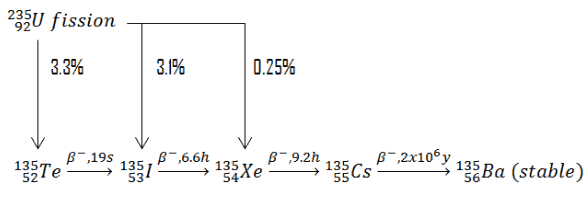
In physics, a radioactive decay chain is a sequence of unstable atomic nuclei and their modes of decays, which leads to a stable nucleus. Sources of these unstable nuclei are different, but mostly engineers deal with naturally occurring radioactive decay chains known as radioactive series. Note that, in nuclear reactors, there are many types of decay chains of fission fragments. Fission fragments are highly unstable (radioactive) and undergo further radioactive decays to stabilize itself. These “artificial” decay chains do not belong to the naturally occurring radioactive series.

Radioactive Series – Radioactive Cascade

Radioactive series (known also as a radioactive cascades) are three naturally occurring radioactive decay chains and one artificial radioactive decay chain of unstable heavy atomic nuclei that decay through a sequence of alpha and beta decays until a stable nucleus is achieved. Most radioisotopes do not decay directly to a stable state and all isotopes within the series decay in the same way. In physics of nuclear decays, the disintegrating nucleus is usually referred to as the parent nucleus and the nucleus remaining after the event as the daughter nucleus. Since alpha decay represents the disintegration of a parent nucleus to a daughter through the emission of the nucleus of a helium atom (which contains four nucleons), there are only four decay series. Within each series, therefore, the mass number of the members may be expressed as four times an appropriate integer (n) plus the constant for that series. As a result, the thorium series is known as the 4n series, the neptunium series as the 4n + 1 series, the uranium series as the 4n + 2 series and the actinium series as the 4n + 3 series.

Three of the sets are called natural or classical series. The fourth set, the neptunium series, is headed by neptunium-237. Its members are produced artificially by nuclear reactions and do not occur naturally.

The classical series are headed by primordial unstable nuclei. Primordial nuclides are nuclides found on the Earth that have existed in their current form since before Earth was formed. The previous four series consist of the radioisotopes, that are the descendants of four heavy nuclei with long and very long half-lives:

  • the thorium series with thorium-232 (with a half-life of 14.0 billion years),
  • the uranium series with uranium-238 (which lives for 4.47 billion years),
  • the actinium series with uranium-235 (with a half-life of 0.7 billion years).
  • the neptunium series with neptunium-237 (with a half-life of 2 million years).

The half-lives of all the daughter nuclei are all extremely variable, and it is difficult to represent a range of timescales going from individual seconds to billions of years. Since daughter radioisotopes have different half-lives then secular equilibrium is reached after some time. In the long decay chain for a naturally radioactive element, such as uranium-238, where all of the elements in the chain are in secular equilibrium, each of the descendants has built up to an equilibrium amount and all decay at the rate set by the original parent. If and when equilibrium is achieved, each successive daughter isotope is present in direct proportion to its half-life. Since its activity is inversely proportional to its half-life, each nuclide in the decay chain finally contributes as many individual transformations as the head of the chain.

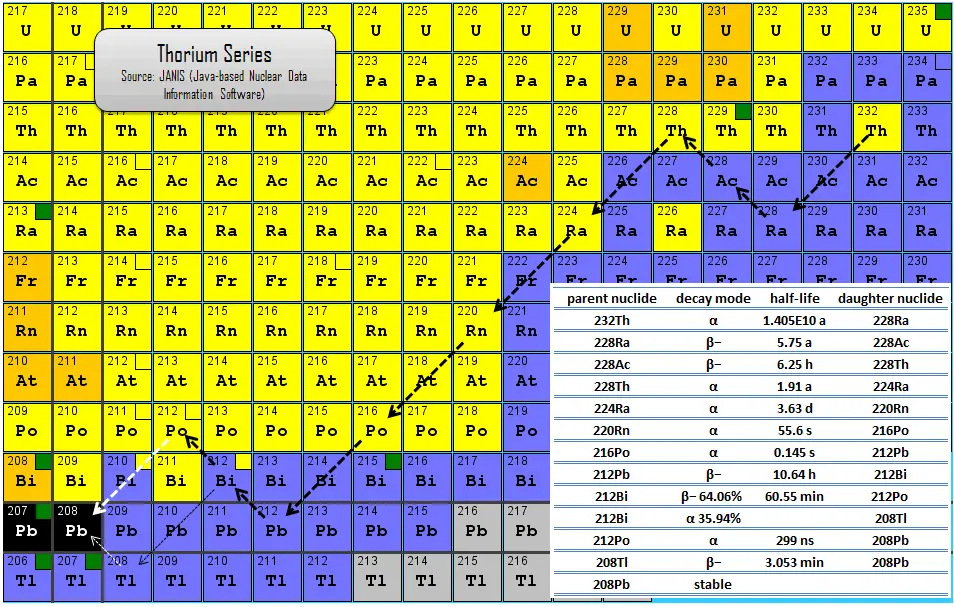
As can be seen from figures, branching occurs in all four of the radioactive series. That means the decay of a given species may occur in more than one way. For example, in the thorium series, bismuth-212 decays partially by negative beta emission to polonium-212 and partially by alpha emission to thallium-206.

Radioactive cascade significantly influences radioactivity (disintegrations per second) of natural samples and natural materials. All the descendants are present, at least transiently, in any natural sample, whether metal, compound, or mineral. For example, pure uranium-238 is weakly radioactive (proportional to its long half-life), but a uranium ore is about 13 times more radioactive than the pure uranium-238 metal because of its daughter isotopes (e.g. radon, radium etc.) it contains. Not only are unstable radium isotopes significant radioactivity emitters, but as the next stage in the decay chain they also generate radon, a heavy, inert, naturally occurring radioactive gas. Moreover the decay heat of uranium and its decay products (e.g. radon, radium etc.) contributes to heating of Earth’s core. Together with thorium and potassium-40 in the Earth’s mantle is thought that these elements are the main source of heat that keeps the Earth’s core liquid.

Types of Decay

Within each radioactive series, there are two main modes of radioactive decay:

  • Alpha decay. Alpha decay represents the disintegration of a parent nucleus to a daughter through the emission of the nucleus of a helium atom. Alpha particles consist of two protons and two neutrons bound together into a particle identical to a helium nucleus. Because of its very large mass (more than 7000 times the mass of the beta particle) and its charge, it heavy ionizes material and has a very short range.
  • Beta decay. Beta decay or β decay represents the disintegration of a parent nucleus to a daughter through the emission of the beta particle. Beta particles are high-energy, high-speed electrons or positrons emitted by certain types of radioactive nuclei such as potassium-40. The beta particles have greater range of penetration than alpha particles, but still much less than gamma rays.The beta particles emitted are a form of ionizing radiation also known as beta rays. The production of beta particles is termed beta decay.

Thorium Series
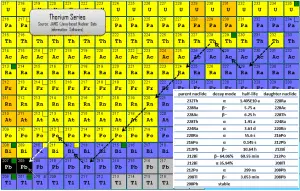
thorium series - decay chainThe thorium series is one of three classical radioactive series beginning with naturally occurring thorium-232. This radioactive decay chain consists of unstable heavy atomic nuclei that decay through a sequence of alpha and beta decays until a stable nucleus is achieved. In case of thorium series, the stable nucleus is lead-208.

Since alpha decay represents the disintegration of a parent nucleus to a daughter through the emission of the nucleus of a helium atom (which contains four nucleons), there are only four decay series. Within each series, therefore, the mass number of the members may be expressed as four times an appropriate integer (n) plus the constant for that series. As a result, the thorium series is known as the 4n series.

The total energy released from thorium-232 to lead-208, including the energy lost to neutrinos, is 42.6 MeV.

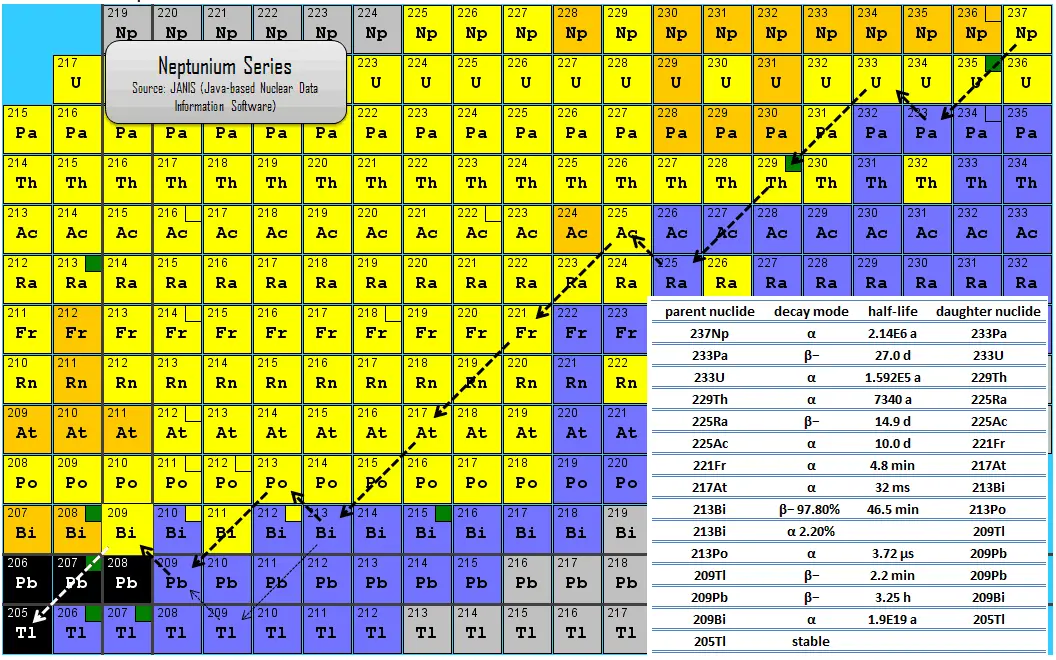
Neptunium Series
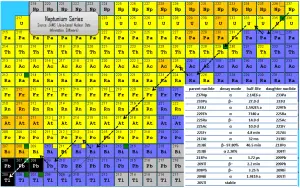
neptunium series - decay chainThe neptunium series is a radioactive series beginning with neptunium-237. Its members are produced artificially by nuclear reactions and do not occur naturally, because the half-life of the longest lived isotope in the series is short compared to the age of the earth. This radioactive decay chain consists of unstable heavy atomic nuclei that decay through a sequence of alpha and beta decays until a stable nucleus is achieved. In case of neptunium series, the stable nucleus is bismuth-209 (with half-life of 1.9E19 years) and thallium-205.

Since alpha decay represents the disintegration of a parent nucleus to a daughter through the emission of the nucleus of a helium atom (which contains four nucleons), there are only four decay series. Within each series, therefore, the mass number of the members may be expressed as four times an appropriate integer (n) plus the constant for that series. As a result, the neptunium series is known as the 4n+1 series.

The total energy released from neptunium-237 to thallium-205, including the energy lost to neutrinos, is 50.0 MeV.

In some kind of smoke detectors, you can meet radionuclides from this series. Ionization smoke detectors usually use a radioisotope, typically americium-241, to ionize air and to detect smoke. In this case americium-241 decays to neptunium-237 and is, in fact, a member of neptunium series.

Uranium Series
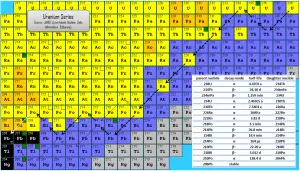
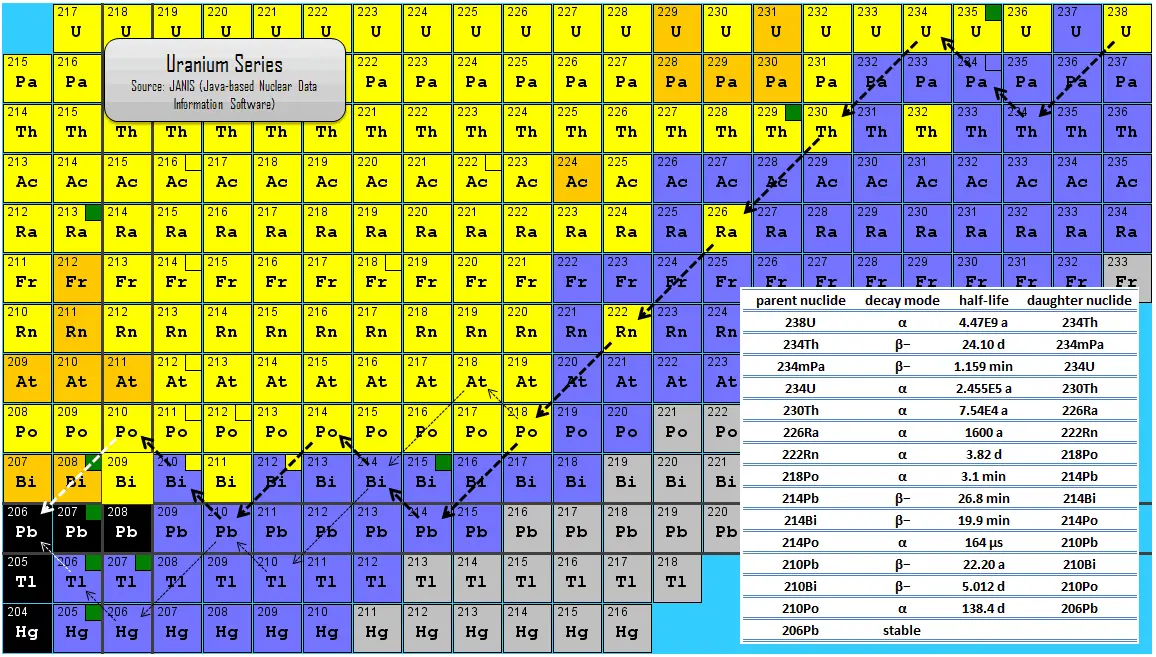
uranium series - decay chainThe uranium series, known also as radium series, is one of three classical radioactive series beginning with naturally occurring uranium-238. This radioactive decay chain consists of unstable heavy atomic nuclei that decay through a sequence of alpha and beta decays until a stable nucleus is achieved. In case of uranium series, the stable nucleus is lead-206.

Since alpha decay represents the disintegration of a parent nucleus to a daughter through the emission of the nucleus of a helium atom (which contains four nucleons), there are only four decay series. Within each series, therefore, the mass number of the members may be expressed as four times an appropriate integer (n) plus the constant for that series. As a result, the uranium series is known as the 4n+2 series.

The total energy released from uranium-238 to lead-206, including the energy lost to neutrinos, is 51.7 MeV.

Uranium Series and Uranium-234

Isotope of uranium-234 is a member of this series. This isotope has the half-life of only 2.46×10⁵ years and therefore it do not belong to primordial nuclides (unlike 235U and 238U). On the other hand, this isotope is still present in the Earth’s crust, but this is due to the fact 234U is an indirect decay product of 238U. 238U decays via alpha decay into 234U. 234U decays via alpha decay into 230Th, except very small fraction (on the order of ppm) of nuclei which decays by spontaneous fission.

In a natural sample of uranium, these nuclei are present in the unalterable proportions of the radioactive equilibrium of the 238U filiation at a ratio of one atom of 234U for about 18 500 nuclei of 238U. As a result of this equilibrium these two isotopes (238U and 234U) contribute equally to the radioactivity of natural uranium.

Actinium Series
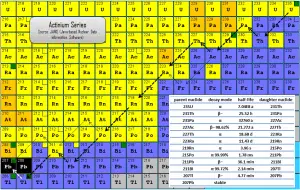
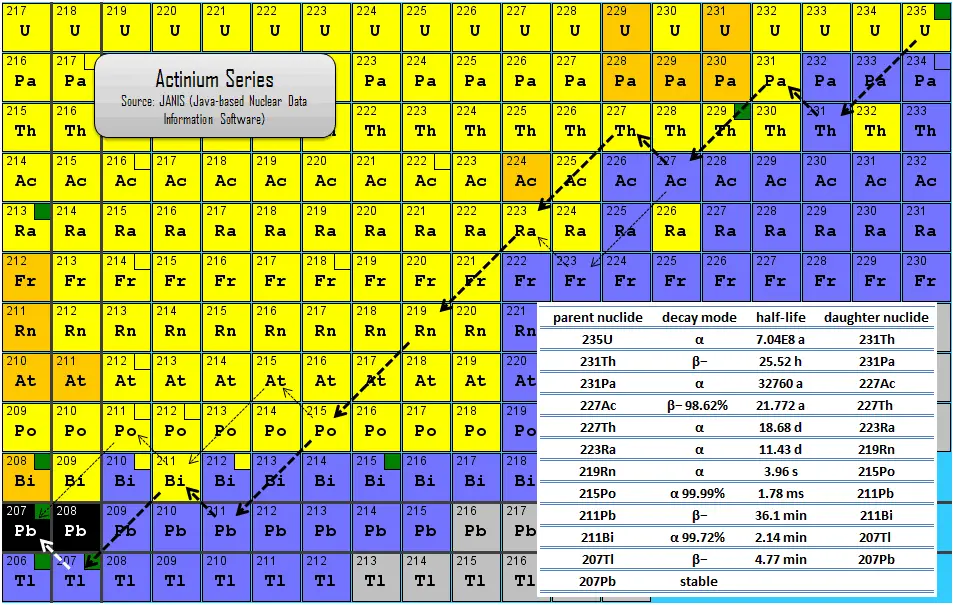
actinium series - decay chainThe actinium series is one of three classical radioactive series beginning with naturally occurring uranium-235. This radioactive decay chain consists of unstable heavy atomic nuclei that decay through a sequence of alpha and beta decays until a stable nucleus is achieved. In case of actinium series, the stable nucleus is lead-207.

Since alpha decay represents the disintegration of a parent nucleus to a daughter through the emission of the nucleus of a helium atom (which contains four nucleons), there are only four decay series. Within each series, therefore, the mass number of the members may be expressed as four times an appropriate integer (n) plus the constant for that series. As a result, the actinium series is known as the 4n+3 series.

The total energy released from uranium-235 to lead-207, including the energy lost to neutrinos, is 46.4 MeV.
References:

Radiation Protection:

  1. Knoll, Glenn F., Radiation Detection and Measurement 4th Edition, Wiley, 8/2010. ISBN-13: 978-0470131480.
  2. Stabin, Michael G., Radiation Protection and Dosimetry: An Introduction to Health Physics, Springer, 10/2010. ISBN-13: 978-1441923912.
  3. Martin, James E., Physics for Radiation Protection 3rd Edition, Wiley-VCH, 4/2013. ISBN-13: 978-3527411764.
  4. U.S.NRC, NUCLEAR REACTOR CONCEPTS
  5. U.S. Department of Energy, Nuclear Physics and Reactor Theory. DOE Fundamentals Handbook, Volume 1 and 2. January 1993.

Nuclear and Reactor Physics:

  1. J. R. Lamarsh, Introduction to Nuclear Reactor Theory, 2nd ed., Addison-Wesley, Reading, MA (1983).
  2. J. R. Lamarsh, A. J. Baratta, Introduction to Nuclear Engineering, 3d ed., Prentice-Hall, 2001, ISBN: 0-201-82498-1.
  3. W. M. Stacey, Nuclear Reactor Physics, John Wiley & Sons, 2001, ISBN: 0- 471-39127-1.
  4. Glasstone, Sesonske. Nuclear Reactor Engineering: Reactor Systems Engineering, Springer; 4th edition, 1994, ISBN: 978-0412985317
  5. W.S.C. Williams. Nuclear and Particle Physics. Clarendon Press; 1 edition, 1991, ISBN: 978-0198520467
  6. G.R.Keepin. Physics of Nuclear Kinetics. Addison-Wesley Pub. Co; 1st edition, 1965
  7. Robert Reed Burn, Introduction to Nuclear Reactor Operation, 1988.
  8. U.S. Department of Energy, Nuclear Physics and Reactor Theory. DOE Fundamentals Handbook, Volume 1 and 2. January 1993.
  9. Paul Reuss, Neutron Physics. EDP Sciences, 2008. ISBN: 978-2759800414.

See also:

Radioactive Decay

We hope, this article, Radioactive Decay Chain, helps you. If so, give us a like in the sidebar. Main purpose of this website is to help the public to learn some interesting and important information about radiation and dosimeters.

What is Radioactive Series – Radioactive Cascade – Definition

Radioactive series (known also as a radioactive cascades) are three naturally occurring radioactive decay chains and one artificial radioactive decay chain of unstable heavy atomic nuclei. Radiation Dosimetry

Radioactive series (known also as a radioactive cascades) are three naturally occurring radioactive decay chains and one artificial radioactive decay chain of unstable heavy atomic nuclei that decay through a sequence of alpha and beta decays until a stable nucleus is achieved. Most radioisotopes do not decay directly to a stable state and all isotopes within the series decay in the same way. In physics of nuclear decays, the disintegrating nucleus is usually referred to as the parent nucleus and the nucleus remaining after the event as the daughter nucleus. Since alpha decay represents the disintegration of a parent nucleus to a daughter through the emission of the nucleus of a helium atom (which contains four nucleons), there are only four decay series. Within each series, therefore, the mass number of the members may be expressed as four times an appropriate integer (n) plus the constant for that series. As a result, the thorium series is known as the 4n series, the neptunium series as the 4n + 1 series, the uranium series as the 4n + 2 series and the actinium series as the 4n + 3 series.

Three of the sets are called natural or classical series. The fourth set, the neptunium series, is headed by neptunium-237. Its members are produced artificially by nuclear reactions and do not occur naturally.

The classical series are headed by primordial unstable nuclei. Primordial nuclides are nuclides found on the Earth that have existed in their current form since before Earth was formed. The previous four series consist of the radioisotopes, that are the descendants of four heavy nuclei with long and very long half-lives:

  • the thorium series with thorium-232 (with a half-life of 14.0 billion years),
  • the uranium series with uranium-238 (which lives for 4.47 billion years),
  • the actinium series with uranium-235 (with a half-life of 0.7 billion years).
  • the neptunium series with neptunium-237 (with a half-life of 2 million years).

The half-lives of all the daughter nuclei are all extremely variable, and it is difficult to represent a range of timescales going from individual seconds to billions of years. Since daughter radioisotopes have different half-lives then secular equilibrium is reached after some time. In the long decay chain for a naturally radioactive element, such as uranium-238, where all of the elements in the chain are in secular equilibrium, each of the descendants has built up to an equilibrium amount and all decay at the rate set by the original parent. If and when equilibrium is achieved, each successive daughter isotope is present in direct proportion to its half-life. Since its activity is inversely proportional to its half-life, each nuclide in the decay chain finally contributes as many individual transformations as the head of the chain.

As can be seen from figures, branching occurs in all four of the radioactive series. That means the decay of a given species may occur in more than one way. For example, in the thorium series, bismuth-212 decays partially by negative beta emission to polonium-212 and partially by alpha emission to thallium-206.

Radioactive cascade significantly influences radioactivity (disintegrations per second) of natural samples and natural materials. All the descendants are present, at least transiently, in any natural sample, whether metal, compound, or mineral. For example, pure uranium-238 is weakly radioactive (proportional to its long half-life), but a uranium ore is about 13 times more radioactive than the pure uranium-238 metal because of its daughter isotopes (e.g. radon, radium etc.) it contains. Not only are unstable radium isotopes significant radioactivity emitters, but as the next stage in the decay chain they also generate radon, a heavy, inert, naturally occurring radioactive gas. Moreover the decay heat of uranium and its decay products (e.g. radon, radium etc.) contributes to heating of Earth’s core. Together with thorium and potassium-40 in the Earth’s mantle is thought that these elements are the main source of heat that keeps the Earth’s core liquid.

See also: Radioactive Equilibrium

Types of Decay

Within each radioactive series, there are two main modes of radioactive decay:

  • Alpha decay. Alpha decay represents the disintegration of a parent nucleus to a daughter through the emission of the nucleus of a helium atom. Alpha particles consist of two protons and two neutrons bound together into a particle identical to a helium nucleus. Because of its very large mass (more than 7000 times the mass of the beta particle) and its charge, it heavy ionizes material and has a very short range.
  • Beta decay. Beta decay or β decay represents the disintegration of a parent nucleus to a daughter through the emission of the beta particle. Beta particles are high-energy, high-speed electrons or positrons emitted by certain types of radioactive nuclei such as potassium-40. The beta particles have greater range of penetration than alpha particles, but still much less than gamma rays.The beta particles emitted are a form of ionizing radiation also known as beta rays. The production of beta particles is termed beta decay.

Thorium Series

thorium series - decay chainThe thorium series is one of three classical radioactive series beginning with naturally occurring thorium-232. This radioactive decay chain consists of unstable heavy atomic nuclei that decay through a sequence of alpha and beta decays until a stable nucleus is achieved. In case of thorium series, the stable nucleus is lead-208.

Since alpha decay represents the disintegration of a parent nucleus to a daughter through the emission of the nucleus of a helium atom (which contains four nucleons), there are only four decay series. Within each series, therefore, the mass number of the members may be expressed as four times an appropriate integer (n) plus the constant for that series. As a result, the thorium series is known as the 4n series.

The total energy released from thorium-232 to lead-208, including the energy lost to neutrinos, is 42.6 MeV.

Neptunium Series

neptunium series - decay chainThe neptunium series is a radioactive series beginning with neptunium-237. Its members are produced artificially by nuclear reactions and do not occur naturally, because the half-life of the longest lived isotope in the series is short compared to the age of the earth. This radioactive decay chain consists of unstable heavy atomic nuclei that decay through a sequence of alpha and beta decays until a stable nucleus is achieved. In case of neptunium series, the stable nucleus is bismuth-209 (with half-life of 1.9E19 years) and thallium-205.

Since alpha decay represents the disintegration of a parent nucleus to a daughter through the emission of the nucleus of a helium atom (which contains four nucleons), there are only four decay series. Within each series, therefore, the mass number of the members may be expressed as four times an appropriate integer (n) plus the constant for that series. As a result, the neptunium series is known as the 4n+1 series.

The total energy released from neptunium-237 to thallium-205, including the energy lost to neutrinos, is 50.0 MeV.

In some kind of smoke detectors, you can meet radionuclides from this series. Ionization smoke detectors usually use a radioisotope, typically americium-241, to ionize air and to detect smoke. In this case americium-241 decays to neptunium-237 and is, in fact, a member of neptunium series.

Uranium Series

uranium series - decay chainThe uranium series, known also as radium series, is one of three classical radioactive series beginning with naturally occurring uranium-238. This radioactive decay chain consists of unstable heavy atomic nuclei that decay through a sequence of alpha and beta decays until a stable nucleus is achieved. In case of uranium series, the stable nucleus is lead-206.

Since alpha decay represents the disintegration of a parent nucleus to a daughter through the emission of the nucleus of a helium atom (which contains four nucleons), there are only four decay series. Within each series, therefore, the mass number of the members may be expressed as four times an appropriate integer (n) plus the constant for that series. As a result, the uranium series is known as the 4n+2 series.

The total energy released from uranium-238 to lead-206, including the energy lost to neutrinos, is 51.7 MeV.

Uranium Series and Uranium-234

Isotope of uranium-234 is a member of this series. This isotope has the half-life of only 2.46×10⁵ years and therefore it do not belong to primordial nuclides (unlike 235U and 238U). On the other hand, this isotope is still present in the Earth’s crust, but this is due to the fact 234U is an indirect decay product of 238U. 238U decays via alpha decay into 234U. 234U decays via alpha decay into 230Th, except very small fraction (on the order of ppm) of nuclei which decays by spontaneous fission.

In a natural sample of uranium, these nuclei are present in the unalterable proportions of the radioactive equilibrium of the 238U filiation at a ratio of one atom of 234U for about 18 500 nuclei of 238U. As a result of this equilibrium these two isotopes (238U and 234U) contribute equally to the radioactivity of natural uranium.

Actinium Series

actinium series - decay chainThe actinium series is one of three classical radioactive series beginning with naturally occurring uranium-235. This radioactive decay chain consists of unstable heavy atomic nuclei that decay through a sequence of alpha and beta decays until a stable nucleus is achieved. In case of actinium series, the stable nucleus is lead-207.

Since alpha decay represents the disintegration of a parent nucleus to a daughter through the emission of the nucleus of a helium atom (which contains four nucleons), there are only four decay series. Within each series, therefore, the mass number of the members may be expressed as four times an appropriate integer (n) plus the constant for that series. As a result, the actinium series is known as the 4n+3 series.

The total energy released from uranium-235 to lead-207, including the energy lost to neutrinos, is 46.4 MeV.

References:

Radiation Protection:

  1. Knoll, Glenn F., Radiation Detection and Measurement 4th Edition, Wiley, 8/2010. ISBN-13: 978-0470131480.
  2. Stabin, Michael G., Radiation Protection and Dosimetry: An Introduction to Health Physics, Springer, 10/2010. ISBN-13: 978-1441923912.
  3. Martin, James E., Physics for Radiation Protection 3rd Edition, Wiley-VCH, 4/2013. ISBN-13: 978-3527411764.
  4. U.S.NRC, NUCLEAR REACTOR CONCEPTS
  5. U.S. Department of Energy, Nuclear Physics and Reactor Theory. DOE Fundamentals Handbook, Volume 1 and 2. January 1993.

Nuclear and Reactor Physics:

  1. J. R. Lamarsh, Introduction to Nuclear Reactor Theory, 2nd ed., Addison-Wesley, Reading, MA (1983).
  2. J. R. Lamarsh, A. J. Baratta, Introduction to Nuclear Engineering, 3d ed., Prentice-Hall, 2001, ISBN: 0-201-82498-1.
  3. W. M. Stacey, Nuclear Reactor Physics, John Wiley & Sons, 2001, ISBN: 0- 471-39127-1.
  4. Glasstone, Sesonske. Nuclear Reactor Engineering: Reactor Systems Engineering, Springer; 4th edition, 1994, ISBN: 978-0412985317
  5. W.S.C. Williams. Nuclear and Particle Physics. Clarendon Press; 1 edition, 1991, ISBN: 978-0198520467
  6. G.R.Keepin. Physics of Nuclear Kinetics. Addison-Wesley Pub. Co; 1st edition, 1965
  7. Robert Reed Burn, Introduction to Nuclear Reactor Operation, 1988.
  8. U.S. Department of Energy, Nuclear Physics and Reactor Theory. DOE Fundamentals Handbook, Volume 1 and 2. January 1993.
  9. Paul Reuss, Neutron Physics. EDP Sciences, 2008. ISBN: 978-2759800414.

See also:

Radioactive Decay

We hope, this article, Radioactive Series – Radioactive Cascade, helps you. If so, give us a like in the sidebar. Main purpose of this website is to help the public to learn some interesting and important information about radiation and dosimeters.

What is Thorium Series – Definition

The thorium series (or thorium cascade) is one of three classical radioactive series beginning with naturally occurring thorium-232. Thorium series significantly influences radioactivity natural materials. Radiation Dosimetry

thorium series - decay chainThe thorium series is one of three classical radioactive series beginning with naturally occurring thorium-232. This radioactive decay chain consists of unstable heavy atomic nuclei that decay through a sequence of alpha and beta decays until a stable nucleus is achieved. In case of thorium series, the stable nucleus is lead-208.

Since alpha decay represents the disintegration of a parent nucleus to a daughter through the emission of the nucleus of a helium atom (which contains four nucleons), there are only four decay series. Within each series, therefore, the mass number of the members may be expressed as four times an appropriate integer (n) plus the constant for that series. As a result, the thorium series is known as the 4n series.

The total energy released from thorium-232 to lead-208, including the energy lost to neutrinos, is 42.6 MeV.

Activity of Natural Samples – Thorium Series

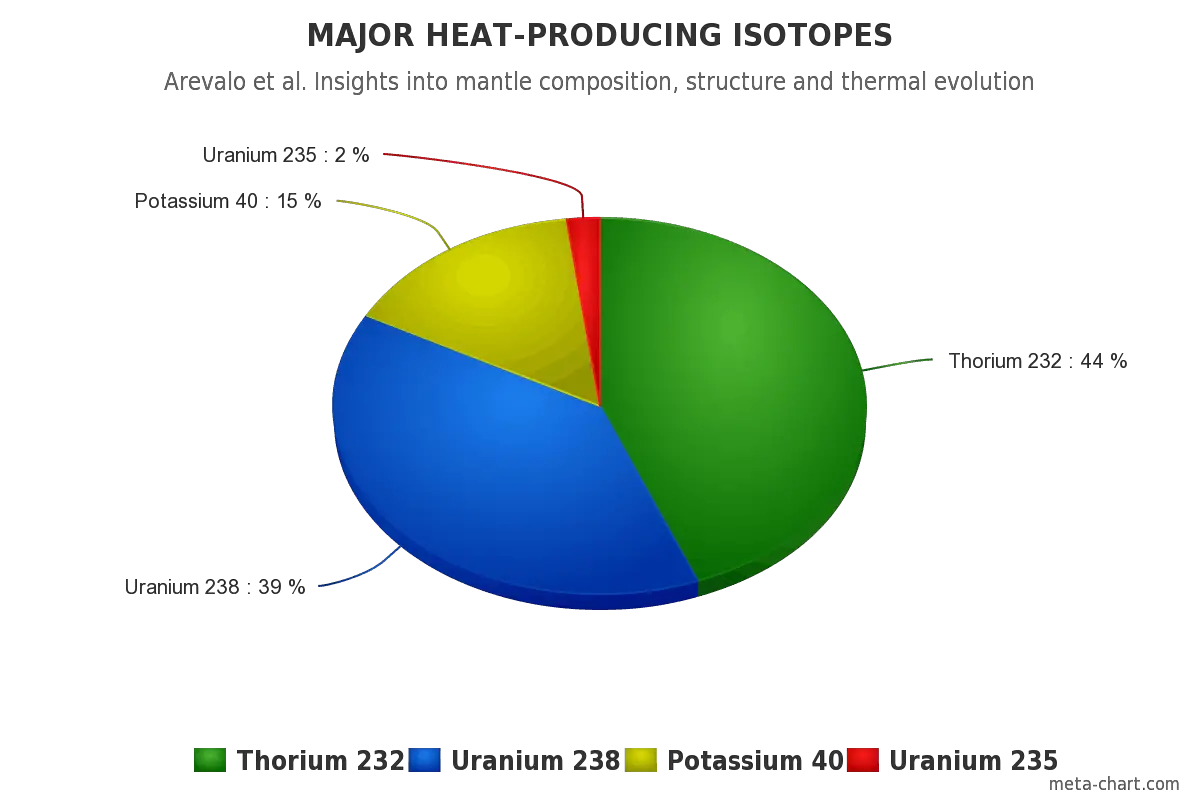
Major heat-producing isotopes.Thorium cascade significantly influences radioactivity (disintegrations per second) of natural samples and natural materials. All the descendants are present, at least transiently, in any natural thorium-containing sample, whether metal, compound, or mineral.  For example, pure thorium-232 is weakly radioactive (proportional to its long half-life), but a thorium ore is about 10 times more radioactive than the pure thorium-232 metal because of its daughter isotopes (e.g. radon, radium etc.) it contains. Not only are unstable radium isotopes significant radioactivity emitters, but as the next stage in the decay chain they also generate radon, a heavy, inert, naturally occurring radioactive gas. Moreover the decay heat of thorium and its decay products (e.g. radon, radium etc.) contributes to heating of Earth’s core. Together with uranium and potassium-40 in the Earth’s mantle is thought that these elements are the main source of heat that keeps the Earth’s core liquid.

Types of Decay in Thorium Series

Within each radioactive series, there are two main modes of radioactive decay:

  • Alpha decay. Alpha decay represents the disintegration of a parent nucleus to a daughter through the emission of the nucleus of a helium atom. Alpha particles consist of two protons and two neutrons bound together into a particle identical to a helium nucleus. Because of its very large mass (more than 7000 times the mass of the beta particle) and its charge, it heavy ionizes material and has a very short range.
  • Beta decay. Beta decay or β decay represents the disintegration of a parent nucleus to a daughter through the emission of the beta particle. Beta particles are high-energy, high-speed electrons or positrons emitted by certain types of radioactive nuclei such as potassium-40. The beta particles have greater range of penetration than alpha particles, but still much less than gamma rays.The beta particles emitted are a form of ionizing radiation also known as beta rays. The production of beta particles is termed beta decay.
References:

Radiation Protection:

  1. Knoll, Glenn F., Radiation Detection and Measurement 4th Edition, Wiley, 8/2010. ISBN-13: 978-0470131480.
  2. Stabin, Michael G., Radiation Protection and Dosimetry: An Introduction to Health Physics, Springer, 10/2010. ISBN-13: 978-1441923912.
  3. Martin, James E., Physics for Radiation Protection 3rd Edition, Wiley-VCH, 4/2013. ISBN-13: 978-3527411764.
  4. U.S.NRC, NUCLEAR REACTOR CONCEPTS
  5. U.S. Department of Energy, Nuclear Physics and Reactor Theory. DOE Fundamentals Handbook, Volume 1 and 2. January 1993.

Nuclear and Reactor Physics:

  1. J. R. Lamarsh, Introduction to Nuclear Reactor Theory, 2nd ed., Addison-Wesley, Reading, MA (1983).
  2. J. R. Lamarsh, A. J. Baratta, Introduction to Nuclear Engineering, 3d ed., Prentice-Hall, 2001, ISBN: 0-201-82498-1.
  3. W. M. Stacey, Nuclear Reactor Physics, John Wiley & Sons, 2001, ISBN: 0- 471-39127-1.
  4. Glasstone, Sesonske. Nuclear Reactor Engineering: Reactor Systems Engineering, Springer; 4th edition, 1994, ISBN: 978-0412985317
  5. W.S.C. Williams. Nuclear and Particle Physics. Clarendon Press; 1 edition, 1991, ISBN: 978-0198520467
  6. G.R.Keepin. Physics of Nuclear Kinetics. Addison-Wesley Pub. Co; 1st edition, 1965
  7. Robert Reed Burn, Introduction to Nuclear Reactor Operation, 1988.
  8. U.S. Department of Energy, Nuclear Physics and Reactor Theory. DOE Fundamentals Handbook, Volume 1 and 2. January 1993.
  9. Paul Reuss, Neutron Physics. EDP Sciences, 2008. ISBN: 978-2759800414.

See also:

Radioactive Series

We hope, this article, Thorium Series, helps you. If so, give us a like in the sidebar. Main purpose of this website is to help the public to learn some interesting and important information about radiation and dosimeters.

What is Uranium Series – Definition

The uranium series, known also as radium series, is one of three classical radioactive series or cascades beginning with naturally occurring uranium-238. Radiation Dosimetry

uranium series - decay chainThe uranium series, known also as radium series, is one of three classical radioactive series beginning with naturally occurring uranium-238. This radioactive decay chain consists of unstable heavy atomic nuclei that decay through a sequence of alpha and beta decays until a stable nucleus is achieved. In case of uranium series, the stable nucleus is lead-206.

Since alpha decay represents the disintegration of a parent nucleus to a daughter through the emission of the nucleus of a helium atom (which contains four nucleons), there are only four decay series. Within each series, therefore, the mass number of the members may be expressed as four times an appropriate integer (n) plus the constant for that series. As a result, the uranium series is known as the 4n+2 series.

The total energy released from uranium-238 to lead-206, including the energy lost to neutrinos, is 51.7 MeV.

Uranium Series and Uranium-234

Isotope of uranium-234 is a member of this series. This isotope has the half-life of only 2.46×10⁵ years and therefore it do not belong to primordial nuclides (unlike 235U and 238U). On the other hand, this isotope is still present in the Earth’s crust, but this is due to the fact 234U is an indirect decay product of 238U. 238U decays via alpha decay into 234U. 234U decays via alpha decay into 230Th, except very small fraction (on the order of ppm) of nuclei which decays by spontaneous fission.

In a natural sample of uranium, these nuclei are present in the unalterable proportions of the radioactive equilibrium of the 238U filiation at a ratio of one atom of 234U for about 18 500 nuclei of 238U. As a result of this equilibrium these two isotopes (238U and 234U) contribute equally to the radioactivity of natural uranium.

Activity of Natural Samples – Uranium Series

Major heat-producing isotopes.Uranium cascade significantly influences radioactivity (disintegrations per second) of natural samples and natural materials. All the descendants are present, at least transiently, in any natural uranium-containing sample, whether metal, compound, or mineral. For example, pure uranium-238 is weakly radioactive (proportional to its long half-life), but a uranium ore is about 13 times more radioactive than the pure uranium-238 metal because of its daughter isotopes (e.g. radon, radium etc.) it contains. Not only are unstable radium isotopes significant radioactivity emitters, but as the next stage in the decay chain they also generate radon, a heavy, inert, naturally occurring radioactive gas. Moreover the decay heat of uranium and its decay products (e.g. radon, radium etc.) contributes to heating of Earth’s core. Together with thorium and potassium-40 in the Earth’s mantle is thought that these elements are the main source of heat that keeps the Earth’s core liquid.

Types of Decay in Uranium Series

Within each radioactive series, there are two main modes of radioactive decay:

  • Alpha decay. Alpha decay represents the disintegration of a parent nucleus to a daughter through the emission of the nucleus of a helium atom. Alpha particles consist of two protons and two neutrons bound together into a particle identical to a helium nucleus. Because of its very large mass (more than 7000 times the mass of the beta particle) and its charge, it heavy ionizes material and has a very short range.
  • Beta decay. Beta decay or β decay represents the disintegration of a parent nucleus to a daughter through the emission of the beta particle. Beta particles are high-energy, high-speed electrons or positrons emitted by certain types of radioactive nuclei such as potassium-40. The beta particles have greater range of penetration than alpha particles, but still much less than gamma rays.The beta particles emitted are a form of ionizing radiation also known as beta rays. The production of beta particles is termed beta decay.
References:

Radiation Protection:

  1. Knoll, Glenn F., Radiation Detection and Measurement 4th Edition, Wiley, 8/2010. ISBN-13: 978-0470131480.
  2. Stabin, Michael G., Radiation Protection and Dosimetry: An Introduction to Health Physics, Springer, 10/2010. ISBN-13: 978-1441923912.
  3. Martin, James E., Physics for Radiation Protection 3rd Edition, Wiley-VCH, 4/2013. ISBN-13: 978-3527411764.
  4. U.S.NRC, NUCLEAR REACTOR CONCEPTS
  5. U.S. Department of Energy, Nuclear Physics and Reactor Theory. DOE Fundamentals Handbook, Volume 1 and 2. January 1993.

Nuclear and Reactor Physics:

  1. J. R. Lamarsh, Introduction to Nuclear Reactor Theory, 2nd ed., Addison-Wesley, Reading, MA (1983).
  2. J. R. Lamarsh, A. J. Baratta, Introduction to Nuclear Engineering, 3d ed., Prentice-Hall, 2001, ISBN: 0-201-82498-1.
  3. W. M. Stacey, Nuclear Reactor Physics, John Wiley & Sons, 2001, ISBN: 0- 471-39127-1.
  4. Glasstone, Sesonske. Nuclear Reactor Engineering: Reactor Systems Engineering, Springer; 4th edition, 1994, ISBN: 978-0412985317
  5. W.S.C. Williams. Nuclear and Particle Physics. Clarendon Press; 1 edition, 1991, ISBN: 978-0198520467
  6. G.R.Keepin. Physics of Nuclear Kinetics. Addison-Wesley Pub. Co; 1st edition, 1965
  7. Robert Reed Burn, Introduction to Nuclear Reactor Operation, 1988.
  8. U.S. Department of Energy, Nuclear Physics and Reactor Theory. DOE Fundamentals Handbook, Volume 1 and 2. January 1993.
  9. Paul Reuss, Neutron Physics. EDP Sciences, 2008. ISBN: 978-2759800414.

See also:

Radioactive Series

We hope, this article, Uranium Series, helps you. If so, give us a like in the sidebar. Main purpose of this website is to help the public to learn some interesting and important information about radiation and dosimeters.