Discrimination in radiation detection circuits refers to the process of distinguishing between different types of radiation on the basis of pulse height. A discriminator circuit selects the minimum or maximum pulse height that is to be counted. Radiation Dosimetry
Detector of Ionizing Radiation – Geiger Tube
Discrimination in radiation detection circuits refers to the process of distinguishing between different types of radiation on the basis of pulse height. A discriminator circuit selects the minimum or maximum pulse height that is to be counted. For example a discriminator circuit is used in the neutron detector to distinguish the large pulses from alpha ionisation (neutron absorption in the detector produces alpha particles) from the much smaller ones that would be caused by gamma rays.
Special Reference: U.S. Department of Energy, Instrumantation and Control. DOE Fundamentals Handbook, Volume 2 of 2. June 1992.
Robert Reed Burn, Introduction to Nuclear Reactor Operation, 1988.
U.S. Department of Energy, Nuclear Physics and Reactor Theory. DOE Fundamentals Handbook, Volume 1 and 2. January 1993.
Paul Reuss, Neutron Physics. EDP Sciences, 2008. ISBN: 978-2759800414.
See also:
Detection
We hope, this article, Discrimination in radiation detection, helps you. If so, give us a like in the sidebar. Main purpose of this website is to help the public to learn some interesting and important information about radiation and dosimeters.
Signal-to-noise ratio, SNR, is a measure used in science and engineering that compares the electrical output signal to the electrical noise generated in the cable run or in the instrumentation. Radiation Dosimetry
Detector of Ionizing Radiation – Geiger Tube
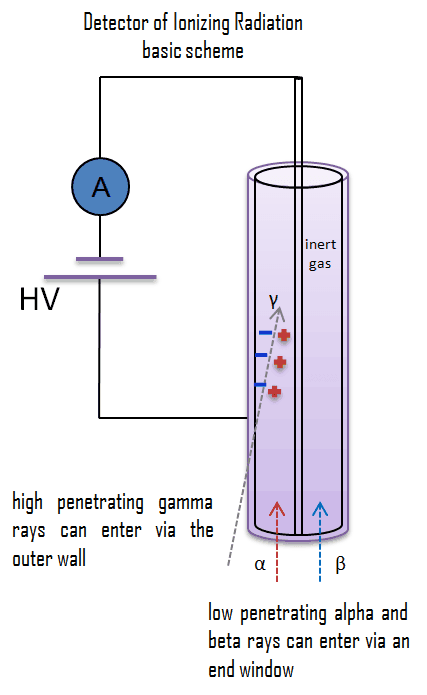
Let assume gaseous ionization detectors. Basic gaseous ionization detector consists of a chamber that is filled with a suitable medium (air or a special fill gas) that can be easily ionized. As a general rule, the center wire is the positive electrode (anode) and the outer cylinder is the negative electrode (cathode), so that (negative) electrons are attracted to the center wire and positive ions are attracted to the outer cylinder. The anode is at a positive voltage with respect to the detector wall. As ionizing radiation enters the gas between the electrodes, a finite number of ion-pairs are formed. Under the influence of the electric field, the positive ions will move toward the negatively charged electrode (outer cylinder), and the negative ions (electrons) will migrate toward the positive electrode (central wire). The collection of these ions will produce a charge on the electrodes and an electrical pulse across the detection circuit. However it is a small signal, this signal can be amplified, and then recorded using standard electronics.
Signal-to-Noise Ratio
Signal-to-noise ratio, SNR, is a measure used in science and engineering that compares the electrical output signal to the electrical noise generated in the cable run or in the instrumentation.
Signal-to-Noise Ratio – Germanium Detectors
Total absorption of a 1 MeV photon produces around 3 x 10⁵ electron-hole pairs. This value is minor in comparison the total number of free carriers in a 1 cm3 intrinsic semiconductor.
Particle passing through the detector ionizes the atoms of semiconductor, producing the electron-hole pairs. But in germanium-based detectors at room temperature, thermal excitation is dominant. It is caused by impurities, irregularity in structure lattice or by dopant. It strongly depends on the Egap (a distance between valence and conduction band), which is very low for germanium (Egap= 0.67 eV). Since thermal excitation results in the detector noise, active cooling is required for some types of semiconductors (e.g. germanium).
Note that, a 1 cm3 sample of pure germanium at 20 °C contains about 4.2×10²² atoms, but also contains about 2.5 x 10¹³ free electrons and 2.5 x 10¹³ holes. . As can be seen, the signal to noise ratio (S/N) would be minimal. The addition of 0.001% of arsenic (an impurity) donates an extra 1017 free electrons in the same volume and the electrical conductivity is increased by a factor of 10,000. In doped material the signal to noise ratio (S/N) would be even smaller. Because germanium has relatively low band gap, these detectors must be cooled in order to reduce the thermal generation of charge carriers (thus reverse leakage current) to an acceptable level. Otherwise, leakage current induced noise destroys the energy resolution of the detector.
Robert Reed Burn, Introduction to Nuclear Reactor Operation, 1988.
U.S. Department of Energy, Nuclear Physics and Reactor Theory. DOE Fundamentals Handbook, Volume 1 and 2. January 1993.
Paul Reuss, Neutron Physics. EDP Sciences, 2008. ISBN: 978-2759800414.
See also:
Detection
We hope, this article, Signal-to-Noise Ratio, helps you. If so, give us a like in the sidebar. Main purpose of this website is to help the public to learn some interesting and important information about radiation and dosimeters.
Principle and Description of Gaseous Ionization Detectors. The chamber has a cathode and an anode that are held at some large relative voltage. As ionizing radiation enters the gas between the electrodes, a finite number of ion-pairs are formed and a signal is created. Radiation Dosimetry
Detectors of ionizing radiation consist of two parts that are usually connected. The first part consists of a sensitive material, consisting of a compound that experiences changes when exposed to radiation. The other component is a device that converts these changes into measurable signals.
Principles of Detectors
In their basic principles of operation, most detectors of ionizing radiation follow similar characteristics. Detectors of ionizing radiation consist of two parts that are usually connected. The first part consists of a sensitive material, consisting of a compound that experiences changes when exposed to radiation. The other component is a device that converts these changes into measurable signals. All detectors require that radiation must deposit some of its energy in sensitive material that forms part of the instrument. The radiation enters the detector, interacts with atoms of the detector material and deposits some energy to sensitive material. Each event may generate a signal, which can be a pulse, hole, light signal, ion pairs in a gas, and many others. The main task is to generate sufficient signal, amplify it and to record it.
Description of Gaseous Ionization Detectors
The chamber has a cathode and an anode that are held at some large relative voltage, and the device is characterized by a capacitance that is determined by the geometry of the electrodes. As ionizing radiation enters the gas between the electrodes, a finite number of ion-pairs are formed. The behavior of the resultant ion-pairs is affected by the potential gradient of the electric field within the gas and the type and pressure of the fill gas. Under the influence of the electric field, the positive ions will move toward the negatively charged electrode (outer cylinder), and the negative ions (electrons) will migrate toward the positive electrode (central wire). The electric field in this region keeps the ions from recombining with the electrons. The collection of these ions will produce a charge on the electrodes and an electrical pulse across the detection circuit. In air, the average energy needed to produce an ion is about 34 eV, therefore a 1 MeV radiation completely absorbed in the detector produces about 3 x 10⁴ pair of ions. However it is a small signal, this signal can be considerably amplified using standard electronics.
Types of Detectors of Ionizing Radiation
As a result, there are three basic types of gaseous ionization detectors, which are categorized according to the voltage applied to the detector:
ionization chambers,
proportional counters,
Geiger-Müller tubes.
As with other detectors, ionization chambers can be operated in current or pulse mode. In contrast, proportional counters or Geiger counters are almost always used in pulse mode. Detectors of ionizing radiation can be used both for activity measurements as well as for dose measurement. With knowledge about the energy needed to form an pair of ions – the dose can be obtained.
Robert Reed Burn, Introduction to Nuclear Reactor Operation, 1988.
U.S. Department of Energy, Nuclear Physics and Reactor Theory. DOE Fundamentals Handbook, Volume 1 and 2. January 1993.
Paul Reuss, Neutron Physics. EDP Sciences, 2008. ISBN: 978-2759800414.
See also:
Gaseous Detectors
We hope, this article, Principle and Description of Gaseous Ionization Detectors, helps you. If so, give us a like in the sidebar. Main purpose of this website is to help the public to learn some interesting and important information about radiation and dosimeters.
There are six main practical operating regions, where three (ionization, proportional and Geiger-Mueller region) are useful to detect ionizing radiation. Radiation Dosimetry
Detector of Ionizing Radiation – Geiger Tube
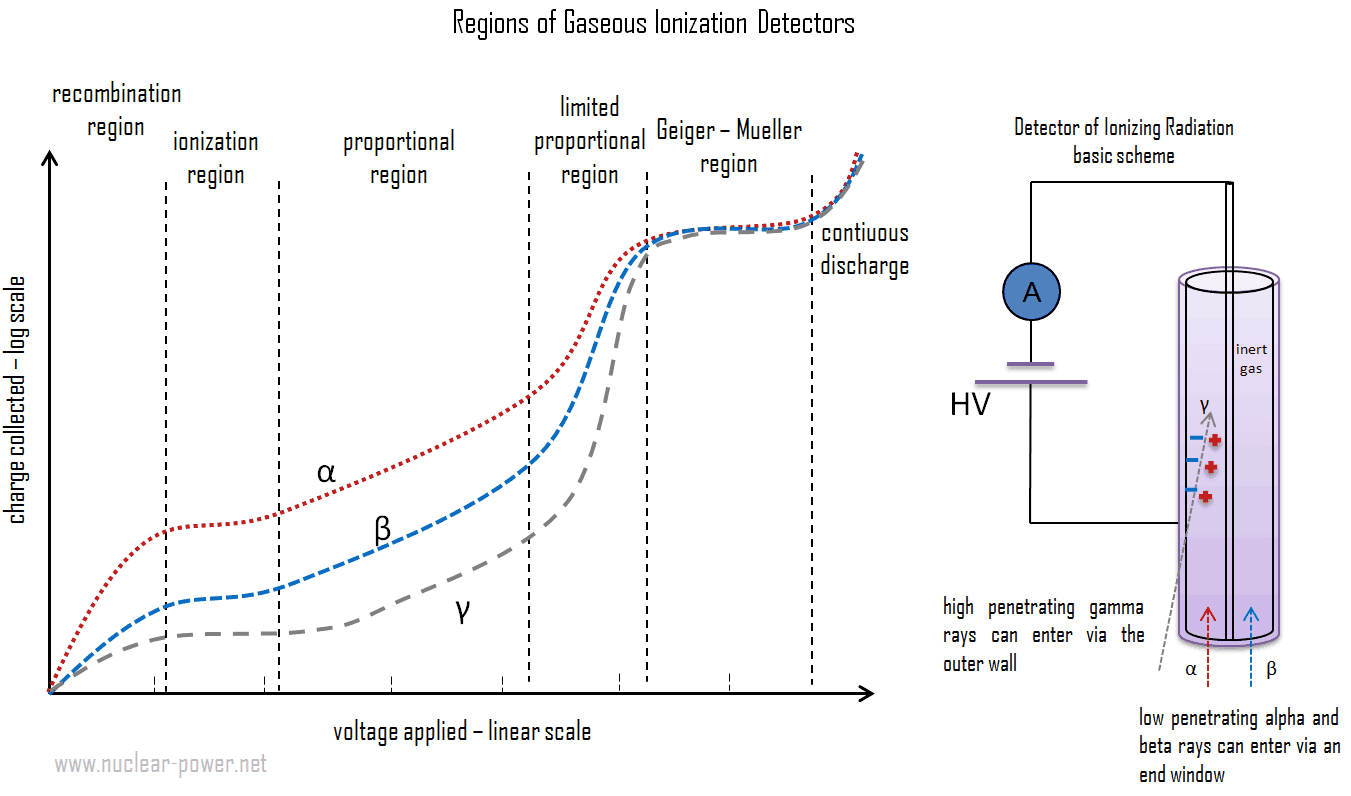
The relationship between the applied voltage and pulse height in a detector is very complex. Pulse height and the number of ion pairs collected are directly related. As was written, the voltages can vary widely depending upon the detector geometry and the gas type and pressure. The figure schematically indicates the different voltage regions for alpha, beta and gamma rays. There are six main practical operating regions, where three (ionization, proportional and Geiger-Mueller region) are useful to detect ionizing radiation. These reqions are shown below. The alpha curve is higher than the beta and gamma curve from recombination region to part of limited proportionality region due to the larger number of ion pairs produced by the initial reaction of the incident radiation.
This diagram shows the number of ion pairs generated in the gas-filled detector, which varies according to the applied voltage for constant incident radiation. The voltages can vary widely depending upon the detector geometry and the gas type and pressure. This figure schematically indicates the different voltage regions for alpha, beta and gamma rays. There are six main practical operating regions, where three (ionization, proportional and Geiger-Mueller region) are useful to detect ionizing radiation. Alpha particles are more ionising than beta particles and than gamma rays, so more current is produced in the ion chamber region by alpha than beta and gamma, but the particles cannot be differentiated. More current is produced in the proportional counting region by alpha particles than beta, but by the nature of proportional counting it is possible to differentiate alpha, beta and gamma pulses. In the Geiger region, there is no differentiation of alpha and beta as any single ionisation event in the gas results in the same current output.
Recombination Region. At low voltage, the electric field is not large enough to accelerate electrons and ions. The electrons and ions can recombine soon after they are produced, and only a small fraction of the produced electrons and ions reach their respective electrodes. As the detector voltage is increased, however, an increasingly large fraction of the ions produced will reach the electrodes. This increase continues until the “saturation” voltage is attained. The range of operating voltage where this occurs is referred to as the recombination region. Detectors are not operated in this region, because neither the number of recombinations nor the number of ion-pairs initially produced can be determined accurately.
Ionization Region. In the ionization region, an increase in voltage does not cause a substantial increase in the number of ion-pairs collected. The number of ion-pairs collected by the electrodes is equal to the number of ion-pairs produced by the incident radiation, and is dependent on the type and energy of the particles or rays in the incident radiation. Therefore, in this region the curve is flat. The voltage must be higher than the point where dissociated ion-pairs can recombine. On the other hand, the voltage is not high enough to produce gas amplification (secondary ionization). Detectors in the ionization region operate at a low electric field strength, selected such that no gas multiplication takes place. Their current is independent of the applied voltage, and they are preferred for high radiation dose rates because they have no “dead time”, a phenomenon which affects the accuracy of the Geiger-Mueller tube at high dose rates.
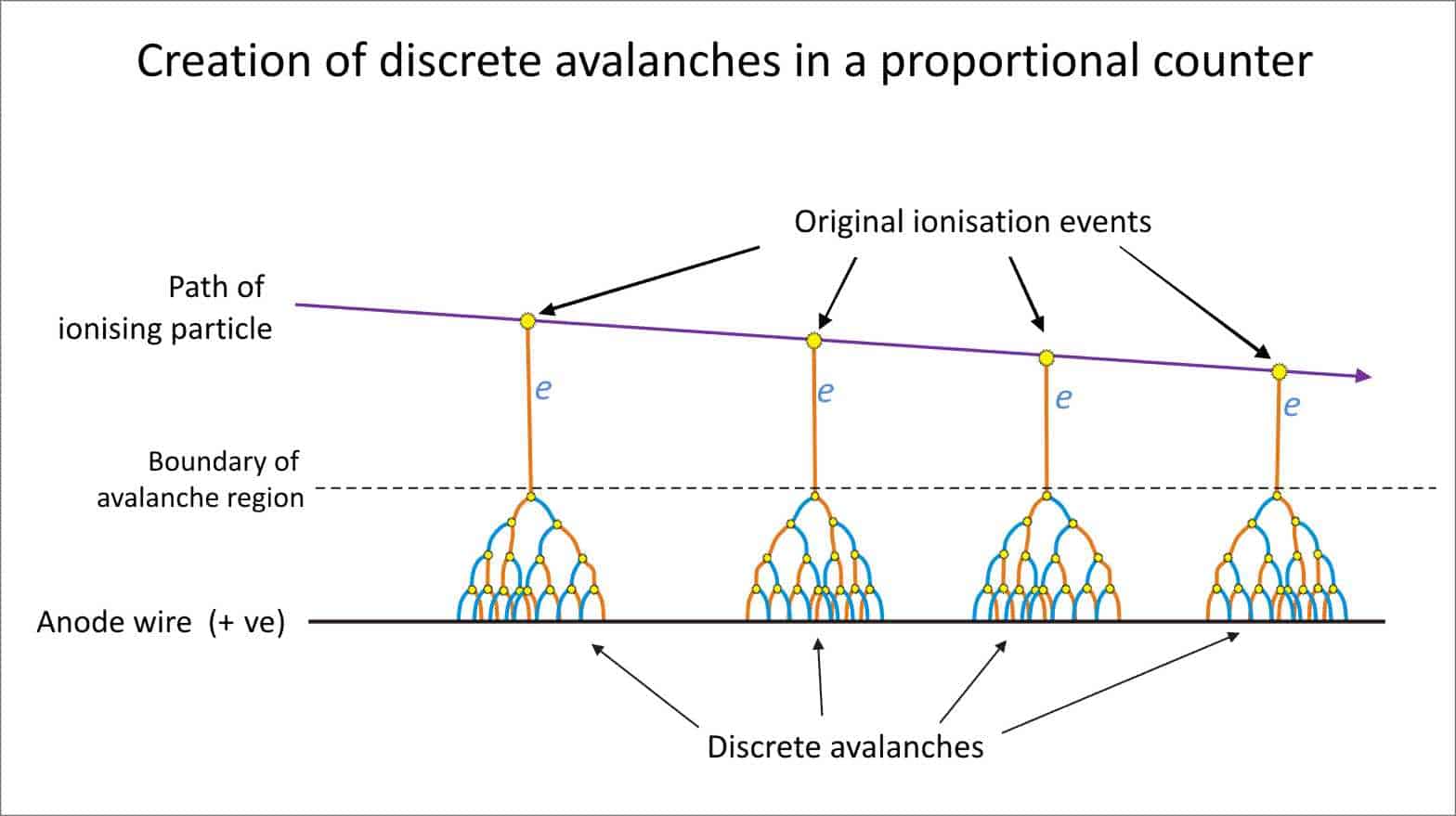
The generation of discrete Townsend avalanches in a proportional counter. Source: wikpedia.org License: CC BY-SA 3.0
Proportional Region. In the proportional region, the charge collected increases with a further increase in the detector voltage, while the number of primary ion-pairs remains unchanged. Increasing the voltage, provides the primary electrons with sufficient acceleration and energy so that they can ionize additional atoms of the medium. These secondary ions formed are also accelerated causing an effect known as Townsend avalanches, which creates a single large electrical pulse. Even though there is a large number of secondary ions (about 103 – 105) for each primary event, the chamber is always operated such that the number of secondary ions is proportional to the number of primary events. It is very important, because the primary ionization is dependent on the type and energy of the particles or rays in the intercepted radiation field. The number of ion pairs collected divided by the number of ion pairs produced by the primary ionization provides the gas amplification factor (denoted by A). The gas amplification that occurs in this region can increase the total amount of ionization to a measurable value. The process of charge amplification greatly improves the signal-to-noise ratio of the detector and reduces the subsequent electronic amplification required. When instruments are operated in the proportional region, the voltage must be kept constant. If a voltage remains constant the gas amplification factor also does not change. Proportional counter detection instruments are very sensitive to low levels of radiation. Moreover, proportional counters are capable of particle identification and energy measurement (spectroscopy). Different energies of radiation and different types of radiation can be distinguished by analyzing the pulse height, since they significantly differ in the primary ionization.
Limited Proportional Region. In the limited proportional region, the gas amplification factor does not continue to increase proportionally to the voltage. Additional ionizations and nonlinear effects causes, that there is no proportionality of the output signal to the deposited energy at a given applied voltage. The electric field in the chamber is distorted due to the high positive ion concentration. Free electrons are much lighter than the positive ions, thus, they are drawn toward the positive central electrode much faster than the positive ions are drawn to the chamber wall. The resulting cloud of positive ions near the electrode leads to distortions in gas multiplication. This region is usually avoided as a detection region.
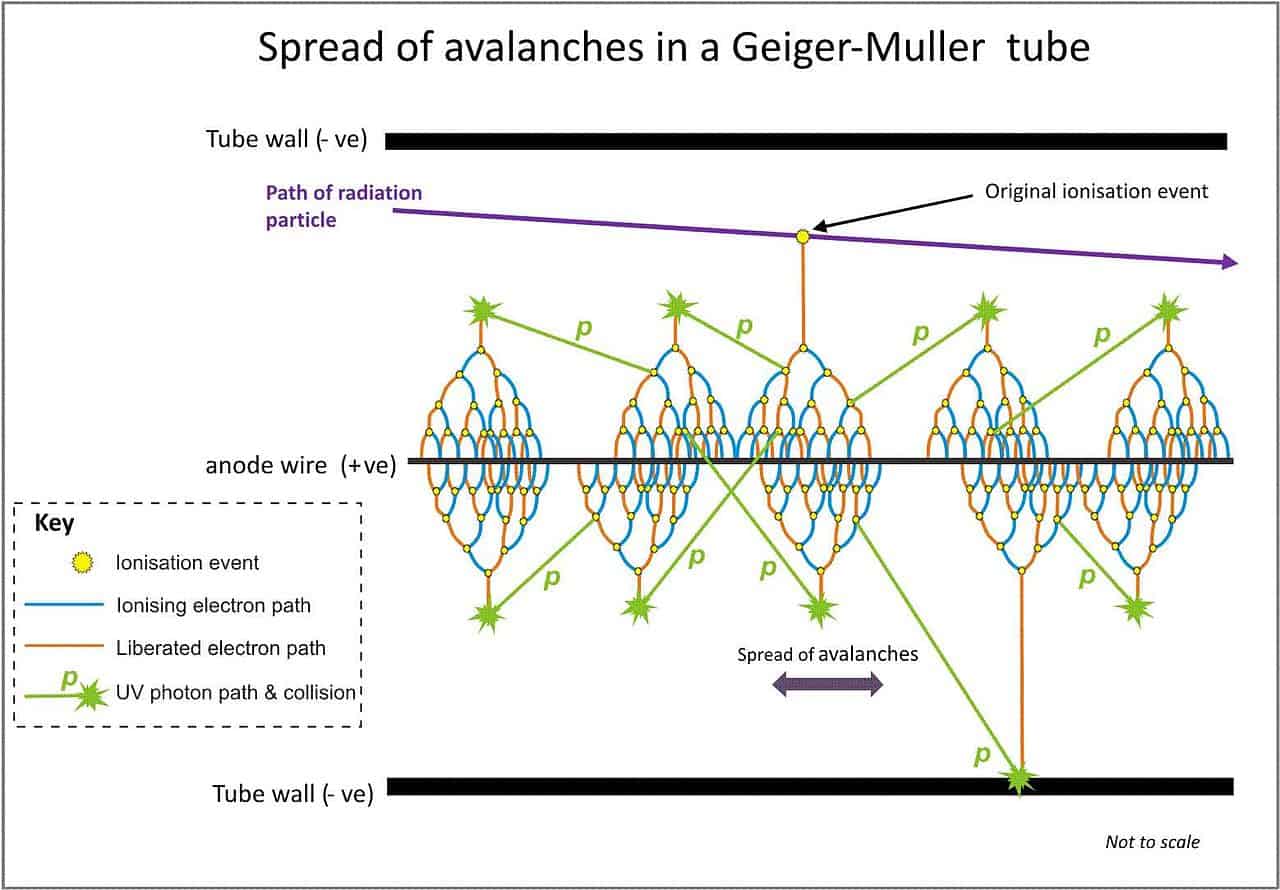
Visualisation of the spread of Townsend avalanches by means of UV photons. Source: wikpedia.org License: CC BY-SA 3.0
Geiger-Mueller Region. In the Geiger-Mueller region, the voltage and thus the electric field is so strong that secondary avalanches can occur. These avalanches can be triggered and propagated by photons emitted by atoms excited in the original avalanche. Since these photons are not affected by the electric field, they may interact far (e.g. laterally to the axis) from the primary avalanche, the entire Geiger tube is participating in the process. A strong signal (the amplification factor can reach about 1010) is produced by these avalanches with shape and height independently of the primary ionization and the energy of the detected photon. Detectors, which are operated in the Geiger-Mueller region, are capable of detection of gamma rays, and also of all types of charged particles, that can enter the detector. These detectors are known as Geiger counters. Main advantage of these instruments is that they usually do not require any signal amplifiers. Since the positive ions do not move far from the avalanche region, a positively charged ion cloud disturbs the electric field and terminates the avalanche process. In practice the termination of the avalanche is improved by the use of “quenching” techniques. In contrast to proportional counters the energy or even incident radiation particle cannot not be distinguished by Geiger counters, since the output signal is independent of the amount and type of original ionization.
Discharge Region. Finally, at still higher voltages (above Geiger-Mueller region), the electric field generates a continuous discharge of the medium, with the chamber no longer being sensitive to any incident ionization. This region is not used for detection or measurement of ionizing radiation. If the Geiger tube voltage is increased above the end of the plateau the count rate begins to increase rapidly again, until the onset of continuous discharge where the tube cannot detect radiation, and may be damaged.
Types of Detectors of Ionizing Radiation
As a result, there are three basic types of gaseous ionization detectors, which are categorized according to the voltage applied to the detector:
ionization chambers,
proportional counters,
Geiger-Müller tubes.
As with other detectors, ionization chambers can be operated in current or pulse mode. In contrast, proportional counters or Geiger counters are almost always used in pulse mode. Detectors of ionizing radiation can be used both for activity measurements as well as for dose measurement. With knowledge about the energy needed to form an pair of ions – the dose can be obtained.
Robert Reed Burn, Introduction to Nuclear Reactor Operation, 1988.
U.S. Department of Energy, Nuclear Physics and Reactor Theory. DOE Fundamentals Handbook, Volume 1 and 2. January 1993.
Paul Reuss, Neutron Physics. EDP Sciences, 2008. ISBN: 978-2759800414.
See also:
Gaseous Detectors
We hope, this article, Operating Region of Ionizing Detectors – Detector Voltage, helps you. If so, give us a like in the sidebar. Main purpose of this website is to help the public to learn some interesting and important information about radiation and dosimeters.
The Townsend avalanche or Townsend discharge significantly infuelnce the number of ion pairs collected in gaseous ionization detectors. The Townsend avalanche is a gas ionisation process where free electrons are accelerated by an electric field. Radiation Dosimetry
The relationship between the applied voltage and pulse height in a detector is very complex. Pulse height and the number of ion pairs collected are directly related. The Townsend avalanche or Townsend discharge significantly infuelnce the number of ion pairs collected in gaseous ionization detectors. The Townsend avalanche is a gas ionisation process where free electrons are accelerated by an electric field, collide with gas molecules, and consequently free secondary electrons. The result is an avalanche multiplication that permits electrical conduction through the gas.
Townsend Avalanche – Proportional Region
The generation of discrete Townsend avalanches in a proportional counter. Source: wikpedia.org License: CC BY-SA 3.0
In the proportional region, the charge collected increases with a further increase in the detector voltage, while the number of primary ion-pairs remains unchanged. Increasing the voltage, provides the primary electrons with sufficient acceleration and energy so that they can ionize additional atoms of the medium. These secondary ions formed are also accelerated causing an effect known as Townsend avalanches, which creates a single large electrical pulse. Even though there is a large number of secondary ions (about 103 – 105) for each primary event, the chamber is always operated such that the number of secondary ions is proportional to the number of primary events. It is very important, because the primary ionization is dependent on the type and energy of the particles or rays in the intercepted radiation field. The number of ion pairs collected divided by the number of ion pairs produced by the primary ionization provides the gas amplification factor (denoted by A). The gas amplification that occurs in this region can increase the total amount of ionization to a measurable value. The process of charge amplification greatly improves the signal-to-noise ratio of the detector and reduces the subsequent electronic amplification required. When instruments are operated in the proportional region, the voltage must be kept constant. If a voltage remains constant the gas amplification factor also does not change. Proportional counter detection instruments are very sensitive to low levels of radiation. Moreover, proportional counters are capable of particle identification and energy measurement (spectroscopy). Different energies of radiation and different types of radiation can be distinguished by analyzing the pulse height, since they significantly differ in the primary ionization.
Townsend Avalanche – Geiger-Mueller Region
Visualisation of the spread of Townsend avalanches by means of UV photons. Source: wikpedia.org License: CC BY-SA 3.0
In this region, the voltage is high enough to provide the primary electrons with sufficient acceleration and energy so that they can ionize additional atoms of the medium. These secondary ions (gas amplification) formed are also accelerated causing an effect known as Townsend avalanches. These avalanches can be triggered and propagated by photons emitted by atoms excited in the original avalanche. Since these photons are not affected by the electric field, they may interact far (e.g. laterally to the axis) from the primary avalanche, the entire Geiger tube is participating in the process. A strong signal (the amplification factor can reach about 1010) is produced by these avalanches with shape and height independently of the primary ionization and the energy of the detected photon. The voltage pulse in this case would be a large and easily detectable ≈ 1.6 V.
Robert Reed Burn, Introduction to Nuclear Reactor Operation, 1988.
U.S. Department of Energy, Nuclear Physics and Reactor Theory. DOE Fundamentals Handbook, Volume 1 and 2. January 1993.
Paul Reuss, Neutron Physics. EDP Sciences, 2008. ISBN: 978-2759800414.
See also:
Gaseous Detectors
We hope, this article, Townsend Avalanche, helps you. If so, give us a like in the sidebar. Main purpose of this website is to help the public to learn some interesting and important information about radiation and dosimeters.
In the recombination region, the electric field is not large enough to accelerate electrons and ions. The electrons and ions can recombine soon after they are produced, and only a small fraction of the produced electrons and ions reach their respective electrodes. Radiation Dosimetry
The relationship between the applied voltage and pulse height in a detector is very complex. Pulse height and the number of ion pairs collected are directly related. As was written, the voltages can vary widely depending upon the detector geometry and the gas type and pressure. The figure schematically indicates the different voltage regions for alpha, beta and gamma rays. There are six main practical operating regions, where three (ionization, proportional and Geiger-Mueller region) are useful to detect ionizing radiation. These reqions are shown below. The alpha curve is higher than the beta and gamma curve from recombination region to part of limited proportionality region due to the larger number of ion pairs produced by the initial reaction of the incident radiation.
This diagram shows the number of ion pairs generated in the gas-filled detector, which varies according to the applied voltage for constant incident radiation. The voltages can vary widely depending upon the detector geometry and the gas type and pressure. This figure schematically indicates the different voltage regions for alpha, beta and gamma rays. There are six main practical operating regions, where three (ionization, proportional and Geiger-Mueller region) are useful to detect ionizing radiation. Alpha particles are more ionising than beta particles and than gamma rays, so more current is produced in the ion chamber region by alpha than beta and gamma, but the particles cannot be differentiated. More current is produced in the proportional counting region by alpha particles than beta, but by the nature of proportional counting it is possible to differentiate alpha, beta and gamma pulses. In the Geiger region, there is no differentiation of alpha and beta as any single ionisation event in the gas results in the same current output.
Recombination Region
At low voltage, the electric field is not large enough to accelerate electrons and ions. The electrons and ions can recombine soon after they are produced, and only a small fraction of the produced electrons and ions reach their respective electrodes. As the detector voltage is increased, however, an increasingly large fraction of the ions produced will reach the electrodes. This increase continues until the “saturation” voltage is attained. The range of operating voltage where this occurs is referred to as the recombination region. Detectors are not operated in this region, because neither the number of recombinations nor the number of ion-pairs initially produced can be determined accurately.
Robert Reed Burn, Introduction to Nuclear Reactor Operation, 1988.
U.S. Department of Energy, Nuclear Physics and Reactor Theory. DOE Fundamentals Handbook, Volume 1 and 2. January 1993.
Paul Reuss, Neutron Physics. EDP Sciences, 2008. ISBN: 978-2759800414.
See also:
Gaseous Detectors
We hope, this article, Recombination Region – Ionization Detector, helps you. If so, give us a like in the sidebar. Main purpose of this website is to help the public to learn some interesting and important information about radiation and dosimeters.
In the ionization region, an increase in voltage does not cause a substantial increase in the number of ion-pairs collected. Ionization Region – Ionization Detector
The relationship between the applied voltage and pulse height in a detector is very complex. Pulse height and the number of ion pairs collected are directly related. As was written, the voltages can vary widely depending upon the detector geometry and the gas type and pressure. The figure schematically indicates the different voltage regions for alpha, beta and gamma rays. There are six main practical operating regions, where three (ionization region, proportional and Geiger-Mueller region) are useful to detect ionizing radiation. These reqions are shown below. The alpha curve is higher than the beta and gamma curve from recombination region to part of limited proportionality region due to the larger number of ion pairs produced by the initial reaction of the incident radiation.
This diagram shows the number of ion pairs generated in the gas-filled detector, which varies according to the applied voltage for constant incident radiation. The voltages can vary widely depending upon the detector geometry and the gas type and pressure. This figure schematically indicates the different voltage regions for alpha, beta and gamma rays. There are six main practical operating regions, where three (ionization, proportional and Geiger-Mueller region) are useful to detect ionizing radiation. Alpha particles are more ionising than beta particles and than gamma rays, so more current is produced in the ion chamber region by alpha than beta and gamma, but the particles cannot be differentiated. More current is produced in the proportional counting region by alpha particles than beta, but by the nature of proportional counting it is possible to differentiate alpha, beta and gamma pulses. In the Geiger region, there is no differentiation of alpha and beta as any single ionisation event in the gas results in the same current output.
Ionization Region
In the ionization region, an increase in voltage does not cause a substantial increase in the number of ion-pairs collected. The number of ion-pairs collected by the electrodes is equal to the number of ion-pairs produced by the incident radiation, and is dependent on the type and energy of the particles or rays in the incident radiation. Therefore, in this region the curve is flat. The voltage must be higher than the point where dissociated ion-pairs can recombine. On the other hand, the voltage is not high enough to produce gas amplification (secondary ionization). Detectors in the ionization region operate at a low electric field strength, selected such that no gas multiplication takes place. Their current is independent of the applied voltage, and they are preferred for high radiation dose rates because they have no “dead time”, a phenomenon which affects the accuracy of the Geiger-Mueller tube at high dose rates.
Robert Reed Burn, Introduction to Nuclear Reactor Operation, 1988.
U.S. Department of Energy, Nuclear Physics and Reactor Theory. DOE Fundamentals Handbook, Volume 1 and 2. January 1993.
Paul Reuss, Neutron Physics. EDP Sciences, 2008. ISBN: 978-2759800414.
See also:
Gaseous Detectors
We hope, this article, Ionization Region – Ionization Detector, helps you. If so, give us a like in the sidebar. Main purpose of this website is to help the public to learn some interesting and important information about radiation and dosimeters.
In the proportional region, the charge collected increases with a further increase in the detector voltage, while the number of primary ion-pairs remains unchanged. Radiation Dosimetry
The relationship between the applied voltage and pulse height in a detector is very complex. Pulse height and the number of ion pairs collected are directly related. As was written, the voltages can vary widely depending upon the detector geometry and the gas type and pressure. The figure schematically indicates the different voltage regions for alpha, beta and gamma rays. There are six main practical operating regions, where three (ionization, proportional and Geiger-Mueller region) are useful to detect ionizing radiation. These reqions are shown below. The alpha curve is higher than the beta and gamma curve from recombination region to part of limited proportionality region due to the larger number of ion pairs produced by the initial reaction of the incident radiation.
This diagram shows the number of ion pairs generated in the gas-filled detector, which varies according to the applied voltage for constant incident radiation. The voltages can vary widely depending upon the detector geometry and the gas type and pressure. This figure schematically indicates the different voltage regions for alpha, beta and gamma rays. There are six main practical operating regions, where three (ionization, proportional and Geiger-Mueller region) are useful to detect ionizing radiation. Alpha particles are more ionising than beta particles and than gamma rays, so more current is produced in the ion chamber region by alpha than beta and gamma, but the particles cannot be differentiated. More current is produced in the proportional counting region by alpha particles than beta, but by the nature of proportional counting it is possible to differentiate alpha, beta and gamma pulses. In the Geiger region, there is no differentiation of alpha and beta as any single ionisation event in the gas results in the same current output.
The generation of discrete Townsend avalanches in a proportional counter. Source: wikpedia.org License: CC BY-SA 3.0
Proportional Region
In the proportional region, the charge collected increases with a further increase in the detector voltage, while the number of primary ion-pairs remains unchanged. Increasing the voltage, provides the primary electrons with sufficient acceleration and energy so that they can ionize additional atoms of the medium. These secondary ions formed are also accelerated causing an effect known as Townsend avalanches, which creates a single large electrical pulse. Even though there is a large number of secondary ions (about 103 – 105) for each primary event, the chamber is always operated such that the number of secondary ions is proportional to the number of primary events. It is very important, because the primary ionization is dependent on the type and energy of the particles or rays in the intercepted radiation field. The number of ion pairs collected divided by the number of ion pairs produced by the primary ionization provides the gas amplification factor (denoted by A). The gas amplification that occurs in this region can increase the total amount of ionization to a measurable value. The process of charge amplification greatly improves the signal-to-noise ratio of the detector and reduces the subsequent electronic amplification required. When instruments are operated in the proportional region, the voltage must be kept constant. If a voltage remains constant the gas amplification factor also does not change. Proportional counter detection instruments are very sensitive to low levels of radiation. Moreover, proportional counters are capable of particle identification and energy measurement (spectroscopy). Different energies of radiation and different types of radiation can be distinguished by analyzing the pulse height, since they significantly differ in the primary ionization.
Robert Reed Burn, Introduction to Nuclear Reactor Operation, 1988.
U.S. Department of Energy, Nuclear Physics and Reactor Theory. DOE Fundamentals Handbook, Volume 1 and 2. January 1993.
Paul Reuss, Neutron Physics. EDP Sciences, 2008. ISBN: 978-2759800414.
See also:
Gaseous Detectors
We hope, this article, Proportional Region – Ionization Detector, helps you. If so, give us a like in the sidebar. Main purpose of this website is to help the public to learn some interesting and important information about radiation and dosimeters.
Radiation Exposures from Nuclear Fuel Cycle. Radiation exposures from nuclear fuel cycle are, according to UNSCEAR, evaluated from entire life cycle of nuclear fuel. Radiation Dosimetry
Radiation is all around us. In, around, and above the world we live in. It is a natural energy force that surrounds us. It is a part of our natural world that has been here since the birth of our planet. All living creatures, from the beginning of time, have been, and are still being, exposed to ionizing radiation. Ionizing radiation is generated through nuclear reactions, nuclear decay, by very high temperature, or via acceleration of charged particles in electromagnetic fields.
Radiation Exposures from Nuclear Fuel Cycle
The nuclear fuel cycle is a process chain consisting of a series of differing stages. In general, nuclear fuel cycle consists of steps in the front end (the preparation of the fuel), steps in the service period (fuel burnup), and steps in the back end (reprocessing or disposal of spent nuclear fuel). Radiation exposures from nuclear fuel cycle are, according to UNSCEAR, evaluated from entire life cycle of nuclear fuel and this includes:
uranium mining, milling and mill tailings,
fabrication of fuel assemblies
power plant operation (except accidents),
spent fuel storage or reprocessing,
disposal of radioactive waste,
decommissioning activities.
The collective dose, which results from nuclear fuel cycle is:
130 man Sv for nuclear fuel cycle,
Almost half of the contribution to public exposures from the nuclear fuel cycle comes from discharges of natural radionuclides during uranium mining and milling activities.
The normalized collective dose (per gigawatt and year) is:
0.43 man Sv/GW.a (man sievert per gigawatt year) for nuclear fuel cycle
Special Reference: Sources and effects of ionizing radiation, UNSCEAR 2016 – Annex B. New York, 2017. ISBN: 978-92-1-142316-7.
In the following points we try to express ranges of radiation exposure from electricity generation together with doses from, which can be obtained from various sources.
05 µSv – Sleeping next to someone
09 µSv – Living within 30 miles of a nuclear power plant for a year
1 µSv – Eating one banana
3 µSv – Living within 50 miles of a coal power plant for a year
10 µSv – Average daily dose received from natural background
The above doses are related to public exposure. If we consider occupational exposure, regarding the uranium mining, power plant workers etc., the collective dose is higher especially uranium miners. The miners are surrounded by rocks and sloshing through ground water that is exuding radon.
Note that, the collective effective dose is often used to estimate the total health effects, but according to the ICRP this should be avoided.
Robert Reed Burn, Introduction to Nuclear Reactor Operation, 1988.
U.S. Department of Energy, Nuclear Physics and Reactor Theory. DOE Fundamentals Handbook, Volume 1 and 2. January 1993.
Paul Reuss, Neutron Physics. EDP Sciences, 2008. ISBN: 978-2759800414.
See also:
Electricity Generation
We hope, this article, Radiation Exposure from Nuclear Fuel Cycle, helps you. If so, give us a like in the sidebar. Main purpose of this website is to help the public to learn some interesting and important information about radiation and dosimeters.
Radiation is all around us. This radiation is known as background radiation. Background radiation is ionizing radiation present in the environment, that originates from a variety of natural and artificial sources. Radiation Dosimetry
Radiation is all around us. In, around, and above the world we live in. It is a natural energy force that surrounds us. It is a part of our natural world that has been here since the birth of our planet. All living creatures, from the beginning of time, have been, and are still being, exposed to ionizing radiation. Ionizing radiation is generated through nuclear reactions, nuclear decay, by very high temperature, or via acceleration of charged particles in electromagnetic fields. This radiation is known as background radiation. Background radiation is ionizing radiation present in the environment, that originates from a variety of natural and artificial sources.
There are two broad categories of radiation sources:
Natural Background Radiation. Natural background radiation includes radiation produced by the Sun, lightnings, primordial radioisotopes or supernova explosions etc.
Man-Made Sources of Radiation. Man-made sources include medical uses of radiation, residues from nuclear tests, industrial uses of radiation etc.
Special Reference: Sources and effects of ionizing radiation, Annex B. UNSCEAR. New York, 2010. ISBN: 978-92-1-142274-0.
Natural Background Radiation
Natural background radiation is ionizing radiation, that originates from a variety of natural sources. All living creatures, from the beginning of time, have been, and are still being, exposed to ionizing radiation. This radiation is not associated with any human activity. There are radioactive isotopes in our bodies, houses, air, water and in the soil. We all are also exposed to radiation from outer space.
Sources of Natural Background Radiation
We divide all these natural radiation sources into three groups:
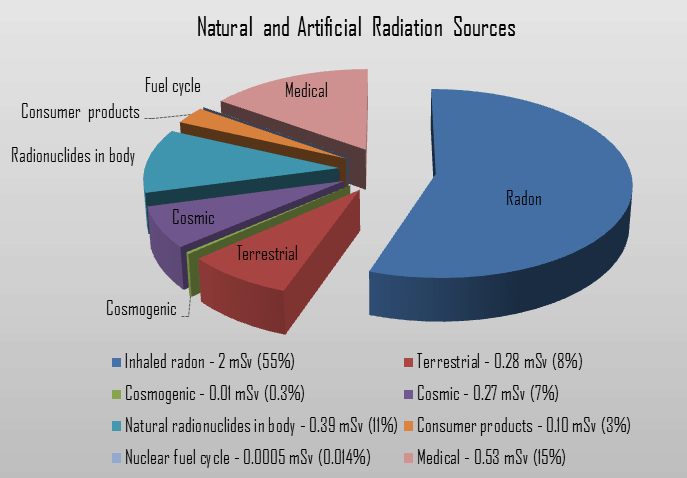
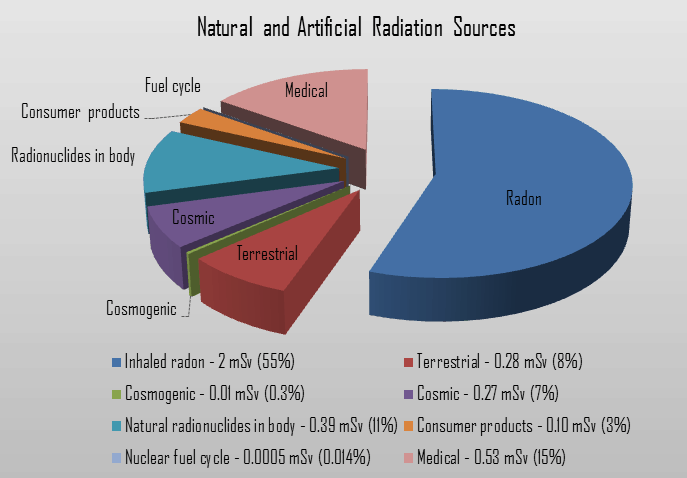
Cosmic Radiation. Cosmic radiation refers to sources of radiation in the form of cosmic rays that come from the sun or from outer space. At ground level the muons, with energies mostly between 1 and 20 GeV, contribute about 75 % of the absorbed dose rate in free air. The remainder comes from electrons produced by the muons or present in the electromagnetic cascade. The annual cosmic ray dose at sea level is around 0.27 mSv (27 mrem). If you live at higher elevations or are a frequent airline passenger, this exposure can be significantly higher, since the atmosphere is thinner here. The effects of the earth’s magnetic field also determines the dose from cosmic radiation.
Terrestrial Radiation. Terrestrial radiation refers to sources of radiation that are in the soil, water, and vegetation. The major isotopes of concern for terrestrial radiation are uranium and the decay products of uranium, such as thorium, radium, and radon. The average dose rate that originates from terrestrial nuclides (except radon exposure) is about 0.057 µGy/hr. The maximum values have been measured on monazite sand in Guarapari, Brazil (up to 50 µGy/hr and in Kerala, India (about 2 µGy/hr), and on rocks with a high radium concentration in Ramsar, Iran (from 1 to 10 µGy/hr). The average annual radiation dose to a person from radon is about 2 mSv/year and it may vary over many orders of magnitude from place to place. Radon is so important, that it is usually treated separately.
Internal Radiation. In addition to the cosmic and terrestrial sources, all people also have radioactive potassium-40, carbon-14, lead-210, and other isotopes inside their bodies from birth. The concentration of potassium-40 is nearly stable in all persons at a level of about 55 Bq/kg (3850 Bq in total), which corresponds to the annual effective dose of 0.2 mSv. The annual dose from carbon-14 is estimated to be about 12 μSv/year.
Man-made Sources of Radiation
Since ionizing radiation has many industrial, and medical uses, people can be exposed also to man-made sources of radiation. Man-made sources include medical uses of radiation, residues from nuclear tests, industrial uses of radiation, television, and numerous other radiation producing devices. For example, in some kind of smoke detectors, you can meet man-made radionuclides such as americium-241. This man-made radionuclide is used to ionize air and to detect smoke.
It must be noted, most of these exposures are very low in intensity and the total dose and does not posse larger health effects. In each case, usefulness of ionizing radiation must be balanced with its hazards. Nowadays a compromise was found and most of uses of radiation are optimized. Today it is almost unbelievable that x-rays was, at one time, used to find the right pair of shoes (i.e. shoe-fitting fluoroscopy). Measurements made in recent years indicate that the doses to the feet were in the range 0.07 – 0.14 Gy for a 20 second exposure. This practice was halted when the risks of ionizing radiation were better understood.
In general, the following man-made sources expose the public to radiation:
To a lesser degree, the public is also exposed to radiation from the nuclear fuel cycle, from uranium mining and milling to disposal of used (spent) fuel. Noteworthy, the public is also exposed to radiation from so called “enhanced sources of naturally occurring radioactive material”. This means also industries such as metal mining, coal mining and power production from coal creates additional exposures due to densification of naturally occurring radionuclides. The public receives some minimal exposure from the transportation of radioactive materials and fallout from nuclear weapons testing and reactor accidents (such as Chernobyl).
Background Radiation and Health Hazard
You can not go through life without radiation. The danger of ionizing radiation lies in the fact that the radiation is invisible and not directly detectable by human senses. People can neither see nor feel radiation, yet it deposits energy to the molecules of the body.
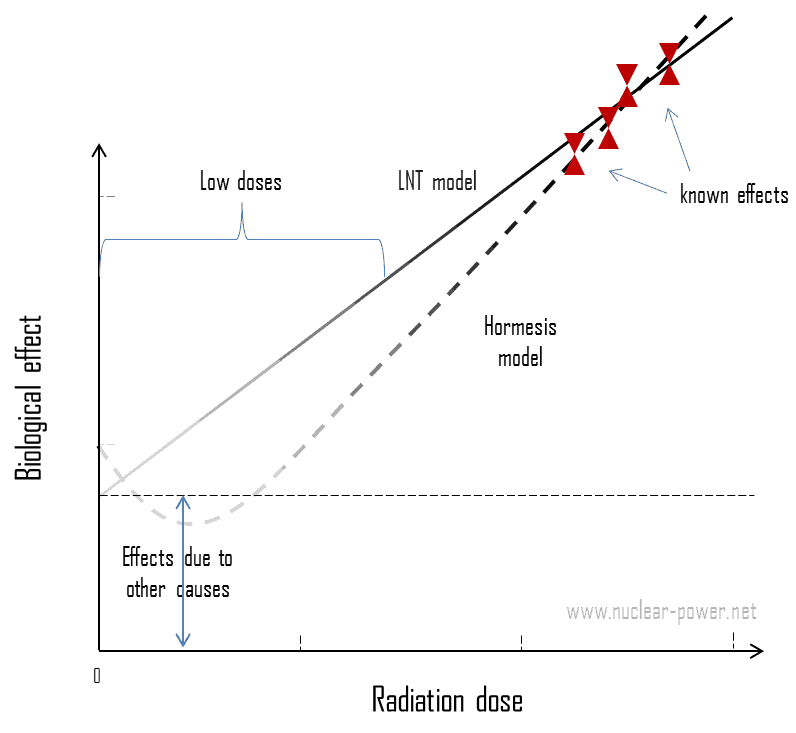
Alternative assumptions for the extrapolation of the cancer risk vs. radiation dose to low-dose levels, given a known risk at a high dose: LNT model, and hormesis model.
But don’t worry, the doses from background radiation are usually very small (except radon exposure). Low dose here means additional small doses comparable to the normal background radiation (10 µSv = average daily dose received from natural background). The problem is that, at very low doses, it is practically impossible to correlate any irradiation with certain biological effects. This is because the baseline cancer rate is already very high and the risk of developing cancer fluctuates 40% because of individual life style and environmental effects, obscuring the subtle effects of low-level radiation.
Secondly, and this is crucial, the truth about low-dose radiation health effects still needs to be found. It is not exactly known, whether these low doses of radiation are detrimental or beneficial (and where is the threshold). Government and regulatory bodies assume a LNT model instead of a threshold or hormesis not because it is the more scientifically convincing, but because it is the more conservative estimate. Problem of this model is that it neglects a number of defence biological processes that may be crucial at low doses. The research during the last two decades is very interesting and show that small doses of radiation given at a low dose rate stimulate the defense mechanisms. Therefore the LNT model is not universally accepted with some proposing an adaptive dose–response relationship where low doses are protective and high doses are detrimental. Many studies have contradicted the LNT model and many of these have shown adaptive response to low dose radiation resulting in reduced mutations and cancers. This phenomenon is known as radiation hormesis.
According to the radiation hormesis hypothesis, radiation exposure comparable to and just above the natural background level of radiation is not harmful but beneficial, while accepting that much higher levels of radiation are hazardous. Arguments for hormesis center around some large-scale epidemiological studies and the evidence from animal irradiation experiments, but most notably the recent advances in knowledge of the adaptive response. Proponents of radiation hormesis typically claim that radio-protective responses in cells and the immune system not only counter the harmful effects of radiation but additionally act to inhibit spontaneous cancer not related to radiation exposure.
Robert Reed Burn, Introduction to Nuclear Reactor Operation, 1988.
U.S. Department of Energy, Nuclear Physics and Reactor Theory. DOE Fundamentals Handbook, Volume 1 and 2. January 1993.
Paul Reuss, Neutron Physics. EDP Sciences, 2008. ISBN: 978-2759800414.
See also:
Sources of Radiation
We hope, this article, Background Radiation – Natural and Artificial, helps you. If so, give us a like in the sidebar. Main purpose of this website is to help the public to learn some interesting and important information about radiation and dosimeters.