Facebook Instagram Youtube Twitter

What is Rhodium Emitter – Rhodium-based SPND – Definition

A SPND with a rhodium emitter has a relatively high sensitivity, high burn-up rate, perturbs the local power density and has a (two-fold) delayed signal. Rhodium Emitter – Rhodium-based SPND

Self-Powered Neutron Detectors (SPND) are neutron detectors, that are being widely used in reactors to monitor neutron flux due to its adaptability for in-core severe environment. SPNDs may be a part of the incore neutron flux monitoring system, which provides detailed information on neutron flux distribution and thus the margins to these peak power limits. These detectors use the basic radioactive decay process of its neutron activation material to produce an output signal. As the name implies,  SPNDs do not require an external voltage source to create a voltage potential in the detector. Instead, a current is produced in the detector as the result of neutron activation and subsequent beta decay of the detector itself. Because of the emission of these beta particles (electrons), the wire becomes more and more positively charged. The positive potential of the wire causes a current to flow in resistor, R. The electron current from beta decay can be measured directly with an ammeter.

There are two main advantages of the self-powered neutron detector:

  • Very little instrumentation is required, usually only a millivoltmeter or an ammeter
  • The emitter material has a much greater lifetime than boron or uranium-235 lining used in fission chambers.

On the other hand, there are also disadvantages, one is associated with the fact that currents even at full power operation are very low. Therefore, SPNDs are unable to provide with information about flux distribution at low power operation (10% and less). The main disadvantage of the self-powered neutron detector is that the emitter material decays with a characteristic half-life, which determines the response time of the detector.

The typical SPND is a coaxial cable consisting of:

  • Emitter. An inner electrode, which is made from a material that absorbs a neutron and undergoes radioactive decay by emitting an electron (beta decay). The emitter is usually made of rhodium and is used to produce electrons.
  • Insulation. The emitter is surrounded by insulation, which is usually made of aluminum oxide.
  • Collector. The metal walls of the detector encase these parts and serve as a collector for the. electrons that are produced.- The collector is attached to ground potential,

Self-powered neutron detectors are usually placed into the instrumentation tube of a fuel assembly, they can monitor the entire length of selected fuel assemblies to provide an extremely accurate, three-dimensional map of the neutron flux distribution. Using these data, neutron flux reconstruction can be performed also in the rest of the reactor core.

Typical materials used for the emitter are cobalt, cadmium, rhodium, and vanadium. These materials should be used because they possess relatively high melting temperatures, relatively high cross sections to thermal neutrons and are compatible with the SPND manufacturing process.

Special Reference: William H. Todt, Sr. CHARACTERISTICS OF SELF-POWERED NEUTRON DETECTORS USED IN POWER REACTORS. Imaging and Sensing Technology Corporation. New York.

Rhodium Emitter – Rhodium-based SPND
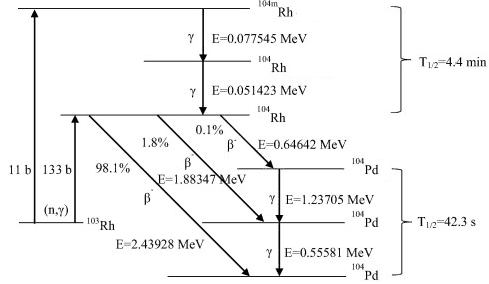
self-powered neutron detector - incore instrumentationOne of possible materials is rhodium as the emitter. A SPND with a rhodium emitter has a relatively high sensitivity, high burn-up rate, perturbs the local power density and has a (two-fold) delayed signal. Rhodium-based detector is the beta-current type of self-powered detector, which uses the following activation reaction to produce a current that can be measured.

1n + 103Rh → 104Rh → 104Pd + β

As can be seen, a neutron captured by rhodium-103 causes a rhodium-103 atom to become a radioactive rhodium-104 atom. The rhodium-104 then decays into palladium-104 plus a beta particle (electron). The beta particle has enough energy to pass through the insulator and reach the collector. The half-life of activated rhodium-104 is 42.3 seconds, which delays the emission of the charged particle. Rhodium based detector uses this production of beta particles (electrons) to create a current that is proportional to the number of neutrons captured by the emitter, which is also proportional to local reactor power density. A portion of the detector’s current flow is due to gamma rays. In order to compensate for this erroneous signal, a background correction is performed via background detector, which consists of the same components as the detector, except the rhodium is removed.

Rhodium-103 has a capture cross-section of 133 barns for thermal neutrons and a resonance at 1.25 eV. This reaction leads to production of 104Rh with T1/2 = 42 sec which is beta radioactive. It must be noted about 11 barns belong to reaction in which an isomer 104mRh is produced (with T1/2 = 4.4 min).

The following characteristics are typical when used in thermal power reactor (e.g. PWR).

  • The rhodium burnup rate is 0.39% per month in a thermal neutron flux of 1013n/cm2/sec.
  • 92% of the signal has a half-life of 42 seconds.
  • 8% of the signal has a half-life of 4.4 minutes.
  • The beta emission has an energy of 2.44 MeV.
References:

Radiation Protection:

  1. Knoll, Glenn F., Radiation Detection and Measurement 4th Edition, Wiley, 8/2010. ISBN-13: 978-0470131480.
  2. Stabin, Michael G., Radiation Protection and Dosimetry: An Introduction to Health Physics, Springer, 10/2010. ISBN-13: 978-1441923912.
  3. Martin, James E., Physics for Radiation Protection 3rd Edition, Wiley-VCH, 4/2013. ISBN-13: 978-3527411764.
  4. U.S.NRC, NUCLEAR REACTOR CONCEPTS
  5. U.S. Department of Energy, Instrumantation and Control. DOE Fundamentals Handbook, Volume 2 of 2. June 1992.

Nuclear and Reactor Physics:

  1. J. R. Lamarsh, Introduction to Nuclear Reactor Theory, 2nd ed., Addison-Wesley, Reading, MA (1983).
  2. J. R. Lamarsh, A. J. Baratta, Introduction to Nuclear Engineering, 3d ed., Prentice-Hall, 2001, ISBN: 0-201-82498-1.
  3. W. M. Stacey, Nuclear Reactor Physics, John Wiley & Sons, 2001, ISBN: 0- 471-39127-1.
  4. Glasstone, Sesonske. Nuclear Reactor Engineering: Reactor Systems Engineering, Springer; 4th edition, 1994, ISBN: 978-0412985317
  5. W.S.C. Williams. Nuclear and Particle Physics. Clarendon Press; 1 edition, 1991, ISBN: 978-0198520467
  6. G.R.Keepin. Physics of Nuclear Kinetics. Addison-Wesley Pub. Co; 1st edition, 1965
  7. Robert Reed Burn, Introduction to Nuclear Reactor Operation, 1988.
  8. U.S. Department of Energy, Nuclear Physics and Reactor Theory. DOE Fundamentals Handbook, Volume 1 and 2. January 1993.
  9. Paul Reuss, Neutron Physics. EDP Sciences, 2008. ISBN: 978-2759800414.

See also:

Incore Instrumentation

We hope, this article, Rhodium Emitter – Rhodium-based SPND, helps you. If so, give us a like in the sidebar. Main purpose of this website is to help the public to learn some interesting and important information about radiation and dosimeters.
What is Advantage and Disadvantage of Self-powered Neutron Detector – Definition

Advantages of SPNDsThere are two main advantages of the self-powered neutron detector: Very little instrumentation is required, usually only a millivoltmeter or an ammeter. Radiation Dosimetry

self-powered neutron detector - incore instrumentationSelf-Powered Neutron Detectors (SPND) are neutron detectors, that are being widely used in reactors to monitor neutron flux due to its adaptability for in-core severe environment. SPNDs may be a part of the incore neutron flux monitoring system, which provides detailed information on neutron flux distribution and thus the margins to these peak power limits. These detectors use the basic radioactive decay process of its neutron activation material to produce an output signal. As the name implies,  SPNDs do not require an external voltage source to create a voltage potential in the detector. Instead, a current is produced in the detector as the result of neutron activation and subsequent beta decay of the detector itself. Because of the emission of these beta particles (electrons), the wire becomes more and more positively charged. The positive potential of the wire causes a current to flow in resistor, R. The electron current from beta decay can be measured directly with an ammeter.

Advantages of SPNDs

There are two main advantages of the self-powered neutron detector:

  • Very little instrumentation is required, usually only a millivoltmeter or an ammeter
  • The emitter material has a much greater lifetime than boron or uranium-235 lining used in fission chambers.

Disadvantages of SPNDs

On the other hand, there are also disadvantages, one is associated with the fact that currents even at full power operation are very low. Therefore, SPNDs are unable to provide with information about flux distribution at low power operation (10% and less). The main disadvantage of the self-powered neutron detector is that the emitter material decays with a characteristic half-life, which determines the response time of the detector.

Special Reference: William H. Todt, Sr. CHARACTERISTICS OF SELF-POWERED NEUTRON DETECTORS USED IN POWER REACTORS. Imaging and Sensing Technology Corporation. New York.

References:

Radiation Protection:

  1. Knoll, Glenn F., Radiation Detection and Measurement 4th Edition, Wiley, 8/2010. ISBN-13: 978-0470131480.
  2. Stabin, Michael G., Radiation Protection and Dosimetry: An Introduction to Health Physics, Springer, 10/2010. ISBN-13: 978-1441923912.
  3. Martin, James E., Physics for Radiation Protection 3rd Edition, Wiley-VCH, 4/2013. ISBN-13: 978-3527411764.
  4. U.S.NRC, NUCLEAR REACTOR CONCEPTS
  5. U.S. Department of Energy, Instrumantation and Control. DOE Fundamentals Handbook, Volume 2 of 2. June 1992.

Nuclear and Reactor Physics:

  1. J. R. Lamarsh, Introduction to Nuclear Reactor Theory, 2nd ed., Addison-Wesley, Reading, MA (1983).
  2. J. R. Lamarsh, A. J. Baratta, Introduction to Nuclear Engineering, 3d ed., Prentice-Hall, 2001, ISBN: 0-201-82498-1.
  3. W. M. Stacey, Nuclear Reactor Physics, John Wiley & Sons, 2001, ISBN: 0- 471-39127-1.
  4. Glasstone, Sesonske. Nuclear Reactor Engineering: Reactor Systems Engineering, Springer; 4th edition, 1994, ISBN: 978-0412985317
  5. W.S.C. Williams. Nuclear and Particle Physics. Clarendon Press; 1 edition, 1991, ISBN: 978-0198520467
  6. G.R.Keepin. Physics of Nuclear Kinetics. Addison-Wesley Pub. Co; 1st edition, 1965
  7. Robert Reed Burn, Introduction to Nuclear Reactor Operation, 1988.
  8. U.S. Department of Energy, Nuclear Physics and Reactor Theory. DOE Fundamentals Handbook, Volume 1 and 2. January 1993.
  9. Paul Reuss, Neutron Physics. EDP Sciences, 2008. ISBN: 978-2759800414.

See also:

Incore Instrumentation

We hope, this article, Advantage and Disadvantage of Self-powered Neutron Detector, helps you. If so, give us a like in the sidebar. Main purpose of this website is to help the public to learn some interesting and important information about radiation and dosimeters.

What is Nitrogen-16 Power Monitoring – Definition

There are power plants, that measure the thermal power using nitrogen-16 power monitoring. An N-16 power monitoring has several advantages over the ΔT and excore power measurements. Radiation Dosimetry

In nuclear reactors, the thermal power produced by nuclear fissions is proportional to neutron flux level. Therefore, from reactor safety point of view, it is of the highest importance to measure and control the neutron flux and the spatial distribution of the neutron flux in the reactor correctly and by appropriate instrumentation. For this purpose, various nuclear instrumentations are installed. These measurements are usually performed outside the reactor core, but there are also measurements performed from inside the core. Therefore, nuclear instrumentations are usually categorized as:

Nitrogen-16 - table of isotopes
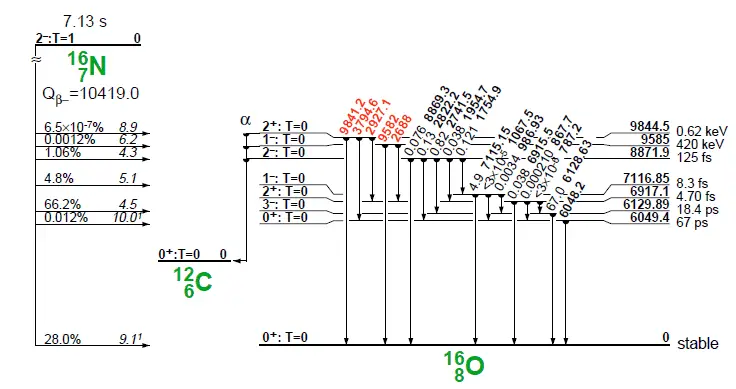
Decay scheme of N-16. Source: Richard B. Firestone. Table of Isotopes, EIGHTH EDITION. John Wiley & Sons, 1996. ISBN-13: 978-0471077305.

Both systems are based on detection of neutrons. But there are power plants, that measure the thermal power using nitrogen-16 power monitoring. An N-16 power monitoring has several advantages over the ΔT and excore power measurements. The system based on this method monitors the thermal power of the NSSS (Nuclear Steam Supply System) by detecting the level of nitrogen-16 present in the coolant system. Nitrogen-16 is an isotope of nitrogen generated by neutron activation of oxygen contained in the water. It has a short half-life of 7.1 sec and it decays via beta decay. This decay is accompanied by emission of a very energetic gamma rays (6 MeV), which can readily penetrate the wall of the high-pressure piping and are therefore can be easily measured by ion chambers located on the hot leg piping of each coolant loop.

1n + 16O → 1p + 16N   (activation reaction)

 16N → 16O + β + γ   (radioactive decay)

Isotopes of nitrogen-16 are formed by fast neutron activation of oxygen-16 contained in the water. Activation results from a threshold reaction requiring >10 MeV fast neutrons. The concentration of nitrogen-16 present in the primary coolant is in radioactive equilibrium and it is directly proportional to the fission rate in the core, thus to the reactor power. This activation of the coolant water requires extra biological shielding around the nuclear reactor plant. It is the high energy gamma ray from nitrogen-16 that causes the major concern. This is why water that has recently been inside a nuclear reactor core must be shielded until this radiation subsides. One to two minutes is generally sufficient.

Similarly as for the excore nuclear instrumentation system, also this N-16 monitoring system must be calibrated. The accurate thermal power of the reactor can be measured only by methods based on energy balance of primary circuit or energy balance of secondary circuit. These methods provide the most accurate reactor power.

References:

Radiation Protection:

  1. Knoll, Glenn F., Radiation Detection and Measurement 4th Edition, Wiley, 8/2010. ISBN-13: 978-0470131480.
  2. Stabin, Michael G., Radiation Protection and Dosimetry: An Introduction to Health Physics, Springer, 10/2010. ISBN-13: 978-1441923912.
  3. Martin, James E., Physics for Radiation Protection 3rd Edition, Wiley-VCH, 4/2013. ISBN-13: 978-3527411764.
  4. U.S.NRC, NUCLEAR REACTOR CONCEPTS
  5. U.S. Department of Energy, Instrumantation and Control. DOE Fundamentals Handbook, Volume 2 of 2. June 1992.

Nuclear and Reactor Physics:

  1. J. R. Lamarsh, Introduction to Nuclear Reactor Theory, 2nd ed., Addison-Wesley, Reading, MA (1983).
  2. J. R. Lamarsh, A. J. Baratta, Introduction to Nuclear Engineering, 3d ed., Prentice-Hall, 2001, ISBN: 0-201-82498-1.
  3. W. M. Stacey, Nuclear Reactor Physics, John Wiley & Sons, 2001, ISBN: 0- 471-39127-1.
  4. Glasstone, Sesonske. Nuclear Reactor Engineering: Reactor Systems Engineering, Springer; 4th edition, 1994, ISBN: 978-0412985317
  5. W.S.C. Williams. Nuclear and Particle Physics. Clarendon Press; 1 edition, 1991, ISBN: 978-0198520467
  6. G.R.Keepin. Physics of Nuclear Kinetics. Addison-Wesley Pub. Co; 1st edition, 1965
  7. Robert Reed Burn, Introduction to Nuclear Reactor Operation, 1988.
  8. U.S. Department of Energy, Nuclear Physics and Reactor Theory. DOE Fundamentals Handbook, Volume 1 and 2. January 1993.
  9. Paul Reuss, Neutron Physics. EDP Sciences, 2008. ISBN: 978-2759800414.

See also:

Incore Instrumentation

We hope, this article, Nitrogen-16 Power Monitoring, helps you. If so, give us a like in the sidebar. Main purpose of this website is to help the public to learn some interesting and important information about radiation and dosimeters.
What is Thermal Neutrons Detection – Definition

Methods for thermal neutrons detection are based on the fact, that thermal neutrons have a different and often much larger effective neutron absorption cross-section (fission or radiative capture) for a given nuclide than fast neutrons. Radiation Dosimetry
neutron detection
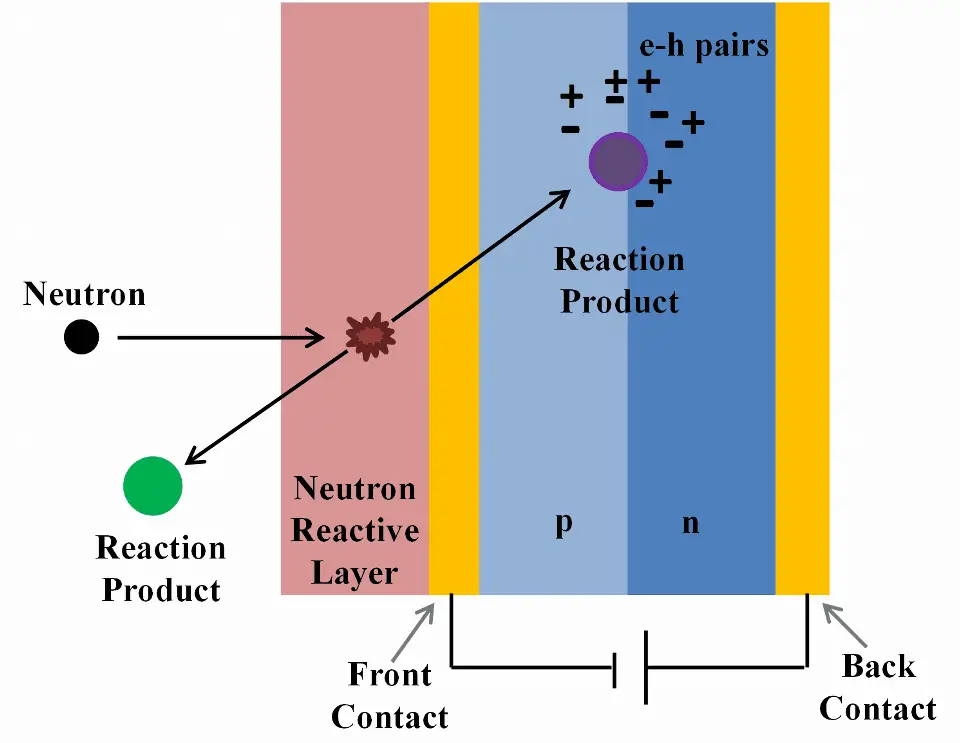
Generally every type of neutron detector must be equipped with converter and one of the conventional radiation detectors.
Source: large.stanford.edu

Thermal neutrons are neutrons in thermal equilibrium with a surrounding medium of temperature 290K (17 °C or 62 °F). Most probable energy at 17°C (62°F) for Maxwellian distribution is 0.025 eV (~2 km/s). This part of neutron’s energy spectrum constitutes most important part of spectrum in thermal reactors.

Thermal neutrons have a different and often much larger effective neutron absorption cross-section (fission or radiative capture) for a given nuclide than fast neutrons.

In general, there are many detection principles and many types of detectors. In nuclear reactors, gaseous ionization detectors are the most common, since they are very efficient, reliable and cover a wide range of neutron flux. Various types of gaseous ionization detectors constitute so called the excore nuclear instrumentation system (NIS). The excore nuclear instrumentation system monitors the power level of the reactor by detecting neutron leakage from the reactor core.

Detection of Neutrons using Ionization Chamber

Ionization chambers are often used as the charged particle detection device. For example, if the inner surface of the ionization chamber is coated with a thin coat of boron, the (n,alpha) reaction can take place. Most of (n,alpha) reactions of thermal neutrons are 10B(n,alpha)7Li reactions accompanied by 0.48 MeV (n,alpha) reactions of 10B

Moreover, isotope boron-10 has high (n,alpha) reaction cross-section along the entire neutron energy spectrum. The alpha particle causes ionization within the chamber, and ejected electrons cause further secondary ionizations.

Another method for detecting neutrons using an ionization chamber is to use the gas boron trifluoride (BF3) instead of air in the chamber. The incoming neutrons produce alpha particles when they react with the boron atoms in the detector gas. Either method may be used to detect neutrons in nuclear reactor. It must be noted, BF3 counters are usually operated in the proportional region.

Fission Chamber – Wide Range Detectors

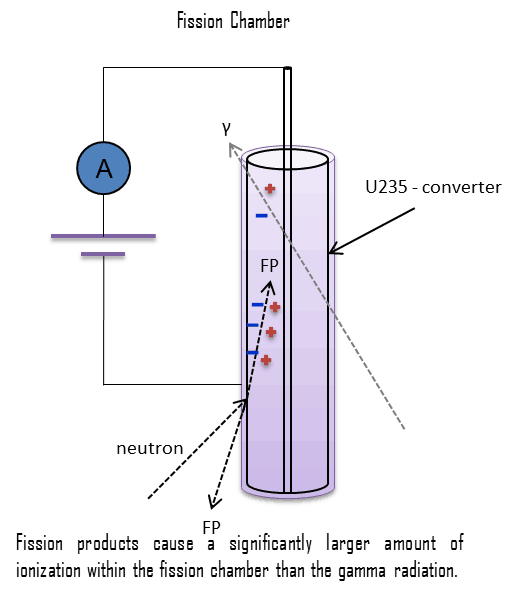
fission chamber - detection of neutronsFission chambers are ionization detectors used to detect neutrons. Fission chambers may be used as the intermediate range detectors to monitor neutron flux (reactor power) at the intermediate flux level. They also provide indication, alarms, and reactor trip signals. The design of this instrument is chosen to provide overlap between the source range channels and full span of the power range instruments.

In case of fission chambers, the chamber is coated with a thin layer of highly enriched uranium-235 to detect neutrons.  Neutrons are not directly ionizing and they have usually to be converted into charged particles before they can be detected. A thermal neutron will cause an atom of uranium-235 to fission, with the two fission fragments produced having a high kinetic energy and causing ionization of the argon gas within the detector. One advantage of using uranium-235 coating rather than boron-10 is that the fission fragments have a much higher energy than the alpha particle from a boron reaction. Therefore fission chambers are very sensitive to neutron flux and this allows the fission chambers to operate in higher gamma fields than an uncompensated ion chamber with boron lining.

Activation Foils and Flux Wires

Neutrons may be detected using activation foils and flux wires. This method is based on neutron activation, where an analyzed sample is first irradiated with neutrons to produce specific radionuclides. The radioactive decay of these produced radionuclides is specific for each element (nuclide). Each nuclide emits the characteristic gamma rays which are measured using gamma spectroscopy, where gamma rays detected at a particular energy are indicative of a specific radionuclide and determine concentrations of the elements.

Selected materials for activation foils are for example:

  • indium,
  • gold,
  • rhodium,
  • iron
  • aluminum  
  • niobium

These elements have large cross sections for the radiative capture of neutrons. Use of multiple absorber samples allows characterization of the neutron energy spectrum. Activation also allows recreation of an historic neutron exposure.  Commercially available criticality accident dosimeters often utilize this method. By measuring the radioactivity of thin foils, we can determine the amount of neutrons to which the foils were exposed.

Flux wires may be used in nuclear reactors to measure reactor neutron flux profiles. Principles are the same. Wire or foil is inserted directly into the reactor core, remains in the core for the length of time required for activation to the desired level. After activation, the flux wire or foil is rapidly removed from the reactor core and the activity counted. Activated foils can also discriminate energy levels by placing a cover over the foil to filter out (absorb) certain energy level neutrons. For example, cadmium is widely used to absorb thermal neutrons in a thermal neutron filters.

See also:

Detection of Neutrons

We hope, this article, Thermal Neutrons Detection, helps you. If so, give us a like in the sidebar. Main purpose of this website is to help the public to learn some interesting and important information about radiation and dosimeters.
What is Type of Neutron Detectors – Definition

In general, there are many detection principles and many types of neutron detectors. In nuclear reactors, gaseous ionization detectors are the most common, since they are very efficient, reliable and cover a wide range of neutron flux. Radiation Dosimetry
neutron detection
Generally every type of neutron detector must be equipped with converter and one of the conventional radiation detectors.
Source: large.stanford.edu

Detection of neutrons is very specific, since the neutrons are electrically neutral particles, thus they are mainly subject to strong nuclear forces but not to electric forces. Therefore neutrons are not directly ionizing and they have usually to be converted into charged particles before they can be detected. Generally every type of neutron detector must be equipped with converter (to convert neutron radiation to common detectable radiation) and one of the conventional radiation detectors (scintillation detector, gaseous detector, semiconductor detector, etc.).

Detection of Thermal Neutrons

Thermal neutrons are neutrons in thermal equilibrium with a surrounding medium of temperature 290K (17 °C or 62 °F). Most probable energy at 17°C (62°F) for Maxwellian distribution is 0.025 eV (~2 km/s). This part of neutron’s energy spectrum constitutes most important part of spectrum in thermal reactors.

Thermal neutrons have a different and often much larger effective neutron absorption cross-section (fission or radiative capture) for a given nuclide than fast neutrons.

In general, there are many detection principles and many types of detectors. In nuclear reactors, gaseous ionization detectors are the most common, since they are very efficient, reliable and cover a wide range of neutron flux. Various types of gaseous ionization detectors constitute so called the excore nuclear instrumentation system (NIS). The excore nuclear instrumentation system monitors the power level of the reactor by detecting neutron leakage from the reactor core.

Detection of Neutrons using Ionization Chamber

Ionization chambers are often used as the charged particle detection device. For example, if the inner surface of the ionization chamber is coated with a thin coat of boron, the (n,alpha) reaction can take place. Most of (n,alpha) reactions of thermal neutrons are 10B(n,alpha)7Li reactions accompanied by 0.48 MeV (n,alpha) reactions of 10B

Moreover, isotope boron-10 has high (n,alpha) reaction cross-section along the entire neutron energy spectrum. The alpha particle causes ionization within the chamber, and ejected electrons cause further secondary ionizations.

Another method for detecting neutrons using an ionization chamber is to use the gas boron trifluoride (BF3) instead of air in the chamber. The incoming neutrons produce alpha particles when they react with the boron atoms in the detector gas. Either method may be used to detect neutrons in nuclear reactor. It must be noted, BF3 counters are usually operated in the proportional region.

Fission Chamber – Wide Range Detectors

fission chamber - detection of neutronsFission chambers are ionization detectors used to detect neutrons. Fission chambers may be used as the intermediate range detectors to monitor neutron flux (reactor power) at the intermediate flux level. They also provide indication, alarms, and reactor trip signals. The design of this instrument is chosen to provide overlap between the source range channels and full span of the power range instruments.

In case of fission chambers, the chamber is coated with a thin layer of highly enriched uranium-235 to detect neutrons.  Neutrons are not directly ionizing and they have usually to be converted into charged particles before they can be detected. A thermal neutron will cause an atom of uranium-235 to fission, with the two fission fragments produced having a high kinetic energy and causing ionization of the argon gas within the detector. One advantage of using uranium-235 coating rather than boron-10 is that the fission fragments have a much higher energy than the alpha particle from a boron reaction. Therefore fission chambers are very sensitive to neutron flux and this allows the fission chambers to operate in higher gamma fields than an uncompensated ion chamber with boron lining.

Activation Foils and Flux Wires

Neutrons may be detected using activation foils and flux wires. This method is based on neutron activation, where an analyzed sample is first irradiated with neutrons to produce specific radionuclides. The radioactive decay of these produced radionuclides is specific for each element (nuclide). Each nuclide emits the characteristic gamma rays which are measured using gamma spectroscopy, where gamma rays detected at a particular energy are indicative of a specific radionuclide and determine concentrations of the elements.

Selected materials for activation foils are for example:

  • indium,
  • gold,
  • rhodium,
  • iron
  • aluminum  
  • niobium

These elements have large cross sections for the radiative capture of neutrons. Use of multiple absorber samples allows characterization of the neutron energy spectrum. Activation also allows recreation of an historic neutron exposure.  Commercially available criticality accident dosimeters often utilize this method. By measuring the radioactivity of thin foils, we can determine the amount of neutrons to which the foils were exposed.

Flux wires may be used in nuclear reactors to measure reactor neutron flux profiles. Principles are the same. Wire or foil is inserted directly into the reactor core, remains in the core for the length of time required for activation to the desired level. After activation, the flux wire or foil is rapidly removed from the reactor core and the activity counted. Activated foils can also discriminate energy levels by placing a cover over the foil to filter out (absorb) certain energy level neutrons. For example, cadmium is widely used to absorb thermal neutrons in a thermal neutron filters.

Detection of Fast Neutrons

Fast neutrons are neutrons of kinetic energy greater than 1 MeV (~15 000 km/s). In nuclear reactors, these neutrons are usually named fission neutrons. The fission neutrons have a Maxwell-Boltzmann distribution of energy with a mean energy (for 235U fission) 2 MeV. Inside a nuclear reactor the fast neutrons are slowed down to the thermal energies via a process called neutron moderation. These neutrons are also produced by nuclear processes such as nuclear fission or (ɑ,n) reactions.

In general, there are many detection principles and many types of detectors. Bu it must be added, detection of fast neutrons is very sophisticated discipline, since fast neutrons cross section are much smaller than in the energy range for slow neutrons. Fast neutrons are often detected by first moderating (slowing) them to thermal energies. However, during that process the information on the original energy of the neutron, its direction of travel, and the time of emission is lost.

Proton Recoil – Recoil Detectors

The most important type of detectors for fast neutrons are those which directly detect recoil particles, in particular recoil protons resulting from elastic (n, p) scattering. In fact, only hydrogen and helium nuclei are light enough for practical application.  In the latter case the recoil particles are detected in a detector. Neutrons can transfer more energy to light nuclei. This method is appropriate for detecting fast neutrons allowing detection of fast neutrons without a moderator. This methods allows the energy of the neutron to be measured together with the neutron fluence, i.e. the detector can be used as a spectrometer. Typical fast neutron detectors are liquid scintillators, helium-4 based noble gas detectors and plastic detectors (scintillators). For example, the plastic has a high hydrogen content, therefore, it is useful for fast neutron detectors, when used as a scintillator.

Bonner Spheres Spectrometer

There are several methods for detecting slow neutrons, and few methods for detecting fast neutrons. Therefore, one technique for measuring fast neutrons is to convert them to slow
neutrons, and then measure the slow neutrons. One of possible methods is based on Bonner spheres. The method was first described in 1960 by Ewing and Tom W. Bonner and employs thermal neutron detectors (usually inorganic scintillators such as 6LiI) embedded in moderating spheres of different sizes.  Bonner spheres have been used widely for the measurement of neutron spectra with neutron energies ranged from thermal up to at least 20 MeV. A Bonner sphere neutron spectrometer (BSS) consists of a thermal-neutron detector, a set polyethylene spherical shells and two optional lead shells of various sizes. In order to detect thermal neutrons a 3He detector or inorganic scintillators such as 6LiI can be used. LiGlass scintillators are very popular for detection of thermal neutrons. The advantage of LiGlass scintillators is their stability and their large range of sizes.

Detection of Neutrons using Scintillation Counter

Scintillation counters are used to measure radiation in a variety of applications including hand held radiation survey meters, personnel and environmental monitoring for radioactive contamination, medical imaging, radiometric assay, nuclear security and nuclear plant safety. They are widely used because they can be made inexpensively yet with good efficiency, and can measure both the intensity and the energy of incident radiation.

Scintillation counters can be used to detect alpha, beta, gamma radiation. They can be used also for detection of neutrons. For these purposes, different scintillators are used.

  • Neutrons. Since the neutrons are electrically neutral particles, they are mainly subject to strong nuclear forces but not to electric forces. Therefore neutrons are not directly ionizing and they have usually to be converted into charged particles before they can be detected. Generally every type of neutron detector must be equipped with converter (to convert neutron radiation to common detectable radiation) and one of the conventional radiation detectors (scintillation detector, gaseous detector, semiconductor detector, etc.).  Fast neutrons (>0.5 MeV) primarily rely on the recoil proton in (n,p) reactions. Materials rich in hydrogen, for example plastic scintillators, are therefore best suited for their detection. Thermal neutrons rely on nuclear reactions such as the (n,γ) or (n,α) reactions, to produce ionization. Materials such as LiI(Eu) or glass silicates are therefore particularly well-suited for the detection of thermal neutrons. The advantage of 6LiGlass scintillators is their stability and their large range of sizes.

See also:

Detection of Neutrons

We hope, this article, Type of Neutron Detectors, helps you. If so, give us a like in the sidebar. Main purpose of this website is to help the public to learn some interesting and important information about radiation and dosimeters.
What is Neutron Converter – How neutrons can be detected – Definition

Generally every type of neutron detector must be equipped with converter (to convert neutron radiation to common detectable radiation) and one of the conventional radiation detectors. Radiation Dosimetry
neutron detection
Generally every type of neutron detector must be equipped with converter and one of the conventional radiation detectors.
Source: large.stanford.edu

Detection of neutrons is very specific, since the neutrons are electrically neutral particles, thus they are mainly subject to strong nuclear forces but not to electric forces. Therefore neutrons are not directly ionizing and they have usually to be converted into charged particles before they can be detected. Generally every type of neutron detector must be equipped with converter (to convert neutron radiation to common detectable radiation) and one of the conventional radiation detectors (scintillation detector, gaseous detector, semiconductor detector, etc.).

Neutron Converters

Two basic types of neutron interactions with matter are for this purpose available:

  • Elastic scattering. The free neutron can be scattered by a nucleus, transferring some of its kinetic energy to the nucleus. If the neutron has enough energy to scatter off nuclei the recoiling nucleus ionizes the material surrounding the converter. In fact, only hydrogen and helium nuclei are light enough for practical application. Charge produced in this way can be collected by the conventional detector to produce a detected signal. Neutrons can transfer more energy to light nuclei. This method is appropriate for detecting fast neutrons (fast neutrons do not have high cross-section for absorption) allowing detection of fast neutrons without a moderator.
  • Neutron absorption. This is a common method allowing detection of neutrons of entire energy spectrum. This method is is based on variety of absorption reactions (radiation capture, nuclear fission, rearrangement reactions, etc.). The neutron is here absorbed by target material (converter) emitting secondary particles such as protons, alpha particles, beta particles, photons (gamma rays) or fission fragments. Some reactions are threshold reactions (requiring a minimum energy of neutrons), but most of reactions occurs at epithermal and thermal energies. That means the moderation of fast neutrons is required leading in poor energy information of the neutrons. Most common nuclei for the neutron converter material are:
    • 10B(n,α). Where the neutron capture cross-section for thermal neutrons is σ = 3820 barns and the natural boron has abundance of 10B 19,8%.
    • 3He(n,p). Where the neutron capture cross-section for thermal neutrons is σ = 5350 barns and the natural helium has abundance of 3He 0.014%.
    • 6Li(n,α). Where the neutron capture cross-section for thermal neutrons is σ = 925 barns and the natural lithium has abundance of 6Li 7,4%.
    • 113Cd(n,ɣ). Where the neutron capture cross-section for thermal neutrons is σ = 20820 barns and the natural cadmium has abundance of 113Cd 12,2%.
    • 235U(n,fission). Where the fission cross-section for thermal neutrons is σ = 585 barns and the natural uranium has abundance of 235U 0.711%. Uranium as a converter produces fission fragments which are heavy charged particles. This have significant advantage. The heavy charged particles (fission fragments) create a high output signal, because the fragments deposit a large amount of energy in a detector sensitive volume. This allows an easy discrimination of the background radiation (e.i. gamma radiation). This important feature can be used for example in a nuclear reactor power measurement, where the neutron field is accompanied  by a significant gamma background.

Example – Neutron Converter

Fission Chamber – Wide Range Detectors

fission chamber - detection of neutronsFission chambers are ionization detectors used to detect neutrons. Fission chambers may be used as the intermediate range detectors to monitor neutron flux (reactor power) at the intermediate flux level. They also provide indication, alarms, and reactor trip signals. The design of this instrument is chosen to provide overlap between the source range channels and full span of the power range instruments.

In case of fission chambers, the chamber is coated with a thin layer of highly enriched uranium-235 to detect neutrons.  Neutrons are not directly ionizing and they have usually to be converted into charged particles before they can be detected. A thermal neutron will cause an atom of uranium-235 to fission, with the two fission fragments produced having a high kinetic energy and causing ionization of the argon gas within the detector. One advantage of using uranium-235 coating rather than boron-10 is that the fission fragments have a much higher energy than the alpha particle from a boron reaction. Therefore fission chambers are very sensitive to neutron flux and this allows the fission chambers to operate in higher gamma fields than an uncompensated ion chamber with boron lining.

Proton Recoil – Recoil Detectors

The most important type of detectors for fast neutrons are those which directly detect recoil particles, in particular recoil protons resulting from elastic (n, p) scattering. In fact, only hydrogen and helium nuclei are light enough for practical application.  In the latter case the recoil particles are detected in a detector. Neutrons can transfer more energy to light nuclei. This method is appropriate for detecting fast neutrons allowing detection of fast neutrons without a moderator. This methods allows the energy of the neutron to be measured together with the neutron fluence, i.e. the detector can be used as a spectrometer. Typical fast neutron detectors are liquid scintillators, helium-4 based noble gas detectors and plastic detectors (scintillators). For example, the plastic has a high hydrogen content, therefore, it is useful for fast neutron detectors, when used as a scintillator.

See also:

Detection of Neutrons

We hope, this article, Neutron Converter – How neutrons can be detected, helps you. If so, give us a like in the sidebar. Main purpose of this website is to help the public to learn some interesting and important information about radiation and dosimeters.
What is Activation Foil and Flux Wire – Definition

Neutrons may be detected using activation foils and flux wires. This method is based on neutron activation, where an analyzed sample is first irradiated with neutrons to produce specific radionuclides. Radiation Dosimetry
neutron detection
Generally every type of neutron detector must be equipped with converter and one of the conventional radiation detectors.
Source: large.stanford.edu

Neutrons may be detected using activation foils and flux wires. This method is based on neutron activation, where an analyzed sample is first irradiated with neutrons to produce specific radionuclides. The radioactive decay of these produced radionuclides is specific for each element (nuclide). Each nuclide emits the characteristic gamma rays which are measured using gamma spectroscopy, where gamma rays detected at a particular energy are indicative of a specific radionuclide and determine concentrations of the elements.

Selected materials for activation foils are for example:

  • indium,
  • gold,
  • rhodium,
  • iron
  • aluminum  
  • niobium

These elements have large cross sections for the radiative capture of neutrons. Use of multiple absorber samples allows characterization of the neutron energy spectrum. Activation also allows recreation of an historic neutron exposure.  Commercially available criticality accident dosimeters often utilize this method. By measuring the radioactivity of thin foils, we can determine the amount of neutrons to which the foils were exposed.

Flux wires may be used in nuclear reactors to measure reactor neutron flux profiles. Principles are the same. Wire or foil is inserted directly into the reactor core, remains in the core for the length of time required for activation to the desired level. After activation, the flux wire or foil is rapidly removed from the reactor core and the activity counted. Activated foils can also discriminate energy levels by placing a cover over the foil to filter out (absorb) certain energy level neutrons. For example, cadmium is widely used to absorb thermal neutrons in a thermal neutron filters.

See also:

Detection of Neutrons

We hope, this article, Activation Foil and Flux Wire, helps you. If so, give us a like in the sidebar. Main purpose of this website is to help the public to learn some interesting and important information about radiation and dosimeters.

What is Fast Neutron Detection – Definition

Fast neutron detection is very sophisticated discipline, since fast neutrons cross section are much smaller than in the energy range for slow neutrons. Fast neutrons are often detected by first moderating (slowing) them to thermal energies. Radiation Dosimetry

Fast neutrons are neutrons of kinetic energy greater than 1 MeV (~15 000 km/s). In nuclear reactors, these neutrons are usually named fission neutrons. The fission neutrons have a Maxwell-Boltzmann distribution of energy with a mean energy (for 235U fission) 2 MeV. Inside a nuclear reactor the fast neutrons are slowed down to the thermal energies via a process called neutron moderation. These neutrons are also produced by nuclear processes such as nuclear fission or (ɑ,n) reactions.

In general, there are many detection principles and many types of detectors. But it must be added, fast neutron detection is very sophisticated discipline, since fast neutrons cross section are much smaller than in the energy range for slow neutrons. Fast neutrons are often detected by first moderating (slowing) them to thermal energies. However, during that process the information on the original energy of the neutron, its direction of travel, and the time of emission is lost.

Proton Recoil – Recoil Detectors

The most important type of detectors for fast neutrons are those which directly detect recoil particles, in particular recoil protons resulting from elastic (n, p) scattering. In fact, only hydrogen and helium nuclei are light enough for practical application.  In the latter case the recoil particles are detected in a detector. Neutrons can transfer more energy to light nuclei. This method is appropriate for detecting fast neutrons allowing detection of fast neutrons without a moderator. This methods allows the energy of the neutron to be measured together with the neutron fluence, i.e. the detector can be used as a spectrometer. Typical fast neutron detectors are liquid scintillators, helium-4 based noble gas detectors and plastic detectors (scintillators). For example, the plastic has a high hydrogen content, therefore, it is useful for fast neutron detectors, when used as a scintillator.

Bonner Spheres Spectrometer

There are several methods for detecting slow neutrons, and few methods for detecting fast neutrons. Therefore, one technique for measuring fast neutrons is to convert them to slow
neutrons, and then measure the slow neutrons. One of possible methods is based on Bonner spheres. The method was first described in 1960 by Ewing and Tom W. Bonner and employs thermal neutron detectors (usually inorganic scintillators such as 6LiI) embedded in moderating spheres of different sizes.  Bonner spheres have been used widely for the measurement of neutron spectra with neutron energies ranged from thermal up to at least 20 MeV. A Bonner sphere neutron spectrometer (BSS) consists of a thermal-neutron detector, a set polyethylene spherical shells and two optional lead shells of various sizes. In order to detect thermal neutrons a 3He detector or inorganic scintillators such as 6LiI can be used. LiGlass scintillators are very popular for detection of thermal neutrons. The advantage of LiGlass scintillators is their stability and their large range of sizes.

Detection of Neutrons using Scintillation Counter

Scintillation counters are used to measure radiation in a variety of applications including hand held radiation survey meters, personnel and environmental monitoring for radioactive contamination, medical imaging, radiometric assay, nuclear security and nuclear plant safety. They are widely used because they can be made inexpensively yet with good efficiency, and can measure both the intensity and the energy of incident radiation.

Scintillation counters can be used to detect alpha, beta, gamma radiation. They can be used also for detection of neutrons. For these purposes, different scintillators are used.

  • Neutrons. Since the neutrons are electrically neutral particles, they are mainly subject to strong nuclear forces but not to electric forces. Therefore neutrons are not directly ionizing and they have usually to be converted into charged particles before they can be detected. Generally every type of neutron detector must be equipped with converter (to convert neutron radiation to common detectable radiation) and one of the conventional radiation detectors (scintillation detector, gaseous detector, semiconductor detector, etc.).  Fast neutrons (>0.5 MeV) primarily rely on the recoil proton in (n,p) reactions. Materials rich in hydrogen, for example plastic scintillators, are therefore best suited for their detection. Thermal neutrons rely on nuclear reactions such as the (n,γ) or (n,α) reactions, to produce ionization. Materials such as LiI(Eu) or glass silicates are therefore particularly well-suited for the detection of thermal neutrons. The advantage of 6LiGlass scintillators is their stability and their large range of sizes.

See also:

Detection of Neutrons

We hope, this article, Fast Neutron Detection, helps you. If so, give us a like in the sidebar. Main purpose of this website is to help the public to learn some interesting and important information about radiation and dosimeters.

What is Fission Neutron – Definition

Fission neutrons are neutrons produced in nuclear fission. They have typical spectrum and it is known the fission neutrons are of importance in any chain-reacting system. Radiation Dosimetry

Fission neutrons are neutrons produced in nuclear fission. They have typical spectrum and it is known the fission neutrons are of importance in any chain-reacting system. Neutrons trigger the nuclear fission of some nuclei (235U, 238U or even 232Th). What is crucial the fission of such nuclei produces 2, 3 or more free neutrons.

But not all neutrons are released at the same time following fission. Even the nature of creation of these neutrons is different. From this point of view we usually divide the fission neutrons into two following groups:

  • Prompt Neutrons. Prompt neutrons are emitted directly from fission and they are emitted within very short time of about 10-14 second.
  • Delayed Neutrons. Delayed neutrons are emitted by neutron rich fission fragments that are called the delayed neutron precursors. These precursors usually undergo beta decay but a small fraction of them are excited enough to undergo neutron emission. The fact the neutron is produced via this type of decay and this happens orders of magnitude later compared to the emission of the prompt neutrons, plays an extremely important role in the control of the reactor.

Spectrum of Fission Neutrons

Region of Fast Neutrons

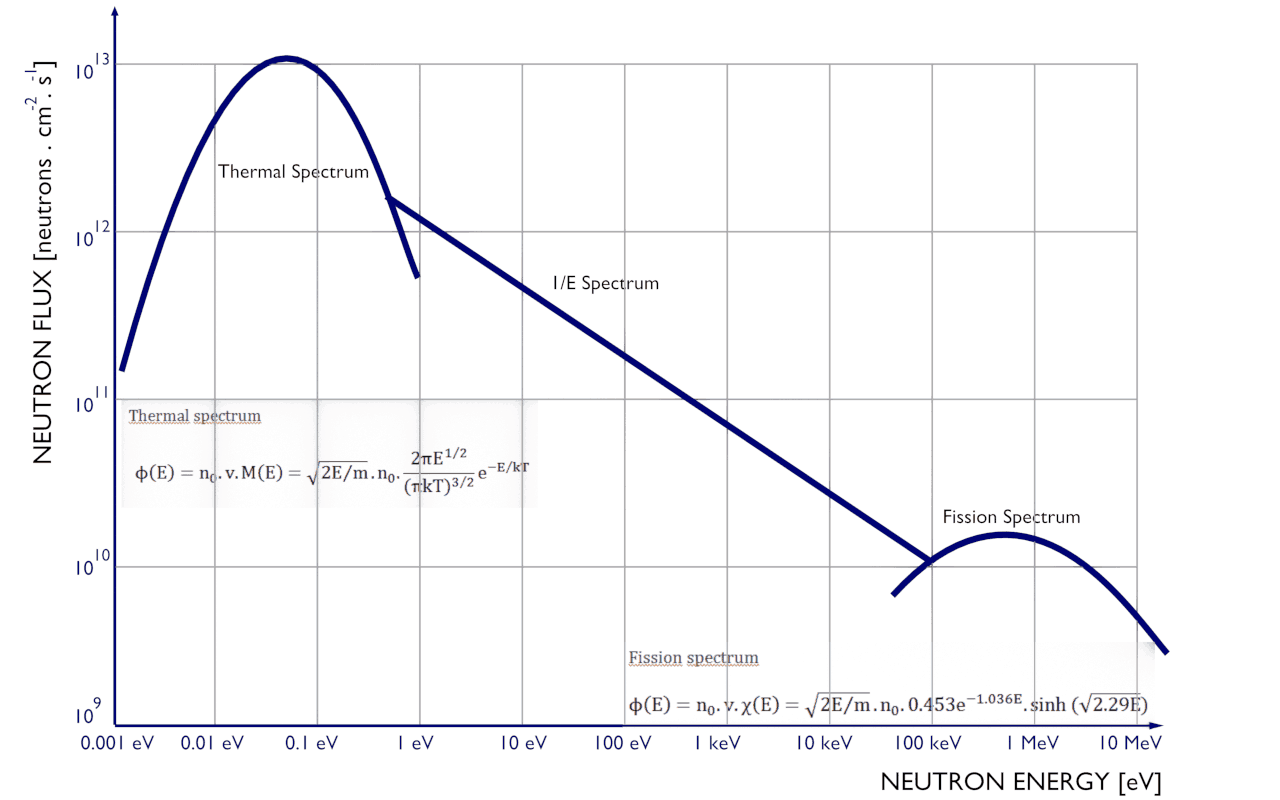
Thermal Reactor Neutron SpectrumThe first part of the neutron flux spectrum in thermal reactors, is the region of fast neutrons. All neutrons produced by fission are born as fast neutrons with high kinetic energy.

At first we have to distinguish between fast neutrons and prompt neutrons. The prompt neutrons can be sometimes incorretly confused with the fast neutrons. But there is an essential difference between them. Fast neutrons are neutrons categorized according to the kinetic energy, while prompt neutrons are categorized according to the time of their release.

Most of the neutrons produced in fission are prompt neutrons. Usually more than 99 percent of the fission neutrons are the prompt neutrons, but the exact fraction is dependent on the nuclide to be fissioned and is also dependent on an incident neutron energy (usually increases with energy). For example a fission of 235U by thermal neutron yields 2.43 neutrons, of which 2.42 neutrons are the prompt neutrons and 0.01585 neutrons (0.01585/2.43=0.0065=ß) are the delayed neutrons.

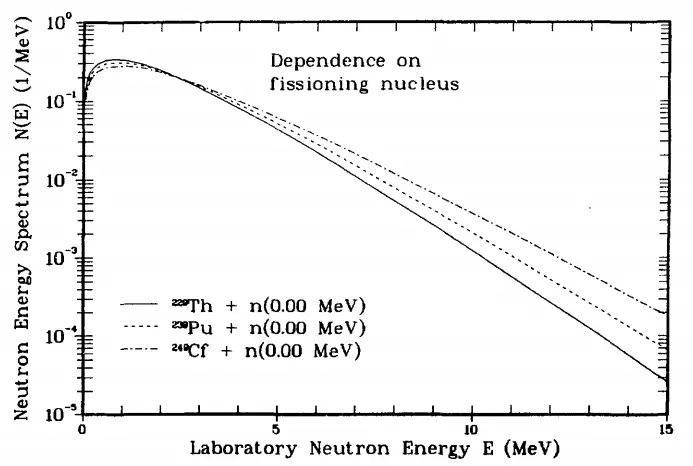
Prompt Neutron Energy Spectra - Dependence on fissioning nucleus.The vast of the prompt neutrons and even the delayed neutrons are born as fast neutrons (i.e. with kinetic energy higher than > 1 keV). But these two groups of fission neutrons have different energy spectra, therefore they contribute to the fission spectrum differently. Since more than 99 percent of the fission neutrons are the prompt neutrons, it is obvious, that they will dominate the entire spectrum.

Therefore the fast neutron spectrum can be described by following points:

  • Almost all fission neutrons have energies between 0.1 MeV and 10 MeV.
  • The mean neutron energy is about 2 MeV.
  • The most probable neutron energy is about 0.7 MeV.

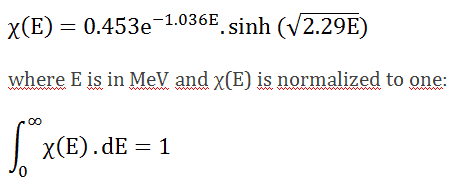
The fast neutron spectrum can be approximated by the following  (normalized to one) distribution:

Fast neutrons flux - distribution

The neutrons released during fission with an average energy of 2 MeV in a reactor on average undergo a number of collisions (elastic or inelastic) before they are absorbed. As a result of these collisions they lose energy, so that the reactor spectrum is not identical to the fission spectrum, it is always ‘softer’ than the fission spectrum. The fact is that the fission spectrum is the part of the reactor spectrum.

See also:

Neutrons

We hope, this article, Fission Neutron, helps you. If so, give us a like in the sidebar. Main purpose of this website is to help the public to learn some interesting and important information about radiation and dosimeters.

What is Proton Recoil – Recoil Detector – Definition

Proton Recoil – Recoil Detectors. The most important type of detectors for fast neutrons are those which directly detect recoil particles, in particular recoil protons resulting from elastic (n, p) scattering. Radiation Dosimetry

Detection of neutrons is very specific, since the neutrons are electrically neutral particles, thus they are mainly subject to strong nuclear forces but not to electric forces. Therefore neutrons are not directly ionizing and they have usually to be converted into charged particles before they can be detected. Generally every type of neutron detector must be equipped with converter (to convert neutron radiation to common detectable radiation) and one of the conventional radiation detectors (scintillation detector, gaseous detector, semiconductor detector, etc.).

One of basic types of neutron interactions with matter that are for this purpose available is:

  • Elastic scattering. The free neutron can be scattered by a nucleus, transferring some of its kinetic energy to the nucleus. If the neutron has enough energy to scatter off nuclei the recoiling nucleus ionizes the material surrounding the converter. In fact, only hydrogen and helium nuclei are light enough for practical application. Charge produced in this way can be collected by the conventional detector to produce a detected signal. Neutrons can transfer more energy to light nuclei. This method is appropriate for detecting fast neutrons (fast neutrons do not have high cross-section for absorption) allowing detection of fast neutrons without a moderator.

Proton Recoil – Recoil Detector

The most important type of detectors for fast neutrons are those which directly detect recoil particles, in particular recoil protons resulting from elastic (n, p) scattering. In fact, only hydrogen and helium nuclei are light enough for practical application.  In the latter case the recoil particles are detected in a detector. Neutrons can transfer more energy to light nuclei. This method is appropriate for detecting fast neutrons allowing detection of fast neutrons without a moderator. This methods allows the energy of the neutron to be measured together with the neutron fluence, i.e. the detector can be used as a spectrometer. Typical fast neutron detectors are liquid scintillators, helium-4 based noble gas detectors and plastic detectors (scintillators). For example, the plastic has a high hydrogen content, therefore, it is useful for fast neutron detectors, when used as a scintillator.

See also:

Detection of Neutrons

We hope, this article, Proton Recoil – Recoil Detector, helps you. If so, give us a like in the sidebar. Main purpose of this website is to help the public to learn some interesting and important information about radiation and dosimeters.