Proportional counters are capable of particle identification and energy measurement (spectroscopy). Different energies of radiation and different types of radiation can be distinguished by analyzing the pulse height. Spectroscopy using Proportional Counters
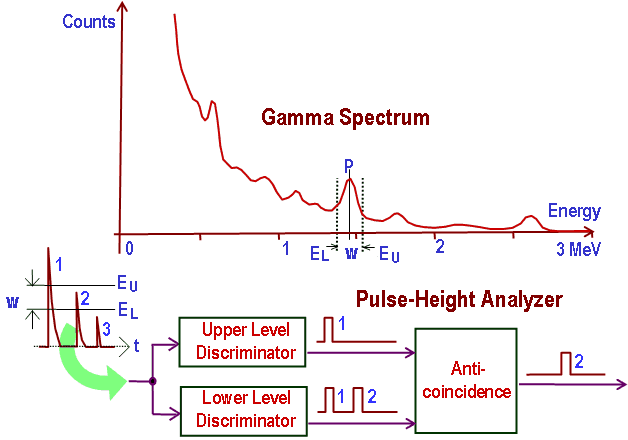
In general, spectroscopes are devices designed to measure the spectral power distribution of a source. The incident radiation generates a signal that allows to determine the energy of the incident particle.
Source: wikipedia.org License: Public Domain
In proportional counters, the number of electrons produced is proportional to the energy and type of the incident particle. Therefore, proportional counters are capable of particle identification and energy measurement (spectroscopy). Different energies of radiation and different types of radiation can be distinguished by analyzing the pulse height, since they significantly differ in the primary ionization (low-LET vs high-LET). Proportional counters may be used for example to analyse a spectrum of alpha radiations or a spectrum of beta particles. The energy resolution of a proportional counter, however, is limited because both the initial ionization event and the subsequent ‘multiplication’ event are subject to statistical fluctuations characterized by a standard deviation equal to the square root of the average number formed.
A large volume spherical proportional counter can be used for neutron measurements. The pure N2 gas is studied for thermal and fast neutron detection, providing a new way for neutron spectroscopy. The neutrons are detected via the 14N(n,p)14C and 14N(n,α)11B reactions.
It must be noted, for gamma spectrometry, the most common detectors include sodium iodide (NaI) scintillation counters and high-purity germanium detectors.
Robert Reed Burn, Introduction to Nuclear Reactor Operation, 1988.
U.S. Department of Energy, Nuclear Physics and Reactor Theory. DOE Fundamentals Handbook, Volume 1 and 2. January 1993.
Paul Reuss, Neutron Physics. EDP Sciences, 2008. ISBN: 978-2759800414.
See also:
Proportional Counter
We hope, this article, Spectroscopy using Proportional Counters, helps you. If so, give us a like in the sidebar. Main purpose of this website is to help the public to learn some interesting and important information about radiation and dosimeters.
Proportional counters can be used both for activity measurements as well as for dose measurement. Proportional counters are capable of particle identification and energy measurement (spectroscopy). Application of Proportional Counters
A proportional counter, also known as the proportional detector, is an electrical device that detects various types of ionizing radiation. The voltage of detector is adjusted so that the conditions correspond to the proportional region. In this region, the voltage is high enough to provide the primary electrons with sufficient acceleration and energy so that they can ionize additional atoms of the medium. These secondary ions (gas amplification) formed are also accelerated causing an effect known as Townsend avalanches, which creates a single large electrical pulse. Gaseous proportional counters usually operate in high electric fields of the order of 10 kV/cm and achieve typical amplification factors of about 105. Since the amplification factor is strongly dependent on the applied voltage, the charge collected (output signal) is also dependent on the applied voltage and proportional counters require constant voltage.
This is a subtle, but important difference between ionization chambers and proportional counters. An ionization chamber will produce a current that is proportional to the number of electrons collected each second. This current is averaged and is used to drive a display reading in Bq, or μSv/h. Proportional counters do not work in this way. Instead, they amplify each of the individual bursts of ionisation so that each ionising event is detected separately. They therefore measure the number of ionising events (which is why they are called counters).
The process of charge amplification greatly improves the signal-to-noise ratio of the detector and reduces the subsequent electronic amplification required. When instruments are operated in the proportional region, the voltage must be kept constant. If a voltage remains constant the gas amplification factor also does not change. Proportional counter detection instruments are very sensitive to low levels of radiation. By proper functional arrangements, modifications, and biasing, the proportional counter can be used to detect alpha, beta, gamma, or neutron radiation in mixed radiation fields. Moreover, proportional counters are capable of particle identification and energy measurement (spectroscopy). The pulse height reflects the energy deposited by the incident radiation in the detector gas. As such, it is possible to distinguish the larger pulses produced by alpha particles from the smaller pulses produced by beta particles or gamma rays.
While ionization chambers can be operated in current or pulse mode, proportional counters or Geiger counters are almost always used in pulse mode. Detectors of ionizing radiation can be used both for activity measurements as well as for dose measurement. With knowledge about the energy needed to form an pair of ions – the dose can be obtained.
Application of Proportional Counters
Detection of Alpha, Beta and Gamma Radiation using Proportional Counter
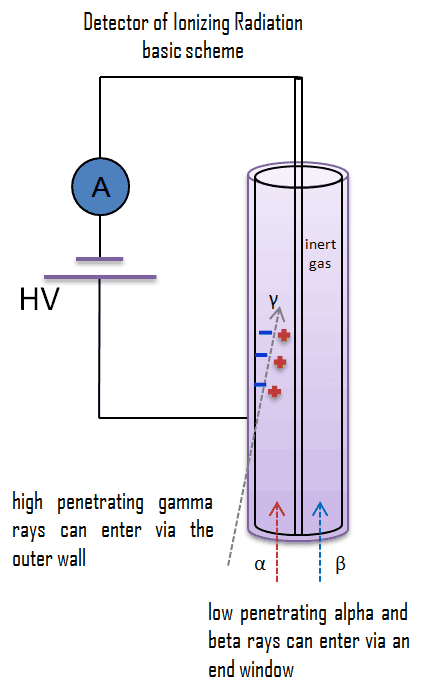
Proportional counters in the form of large area planar detectors are used extensively to check for radioactive contamination on personnel, flat surfaces, tools, and items of clothing. Proportional counters are normally used to detect alpha and beta particles, and can enable discrimination between them by providing a pulse output proportional to the energy deposited in the chamber by each particle. They have a high efficiency for beta, but lower for alpha. For alpha and beta particles to be detected by proportional counters, they must be provided with a thin window. This “end-window” must be thin enough for the alpha and beta particles to penetrate. However, a window of almost any thickness will prevent an alpha particle from entering the chamber. The window is usually made of mica with a density of about 1.5 – 2.0 mg/cm2 to allow low-energy beta particles (e.g. from carbon-14) to enter the detector. The efficiency reduction for alpha is due to the attenuation effect of the end window, though distance from the surface being checked also has a significant effect, and ideally a source of alpha radiation should be less than 10mm from the detector due to attenuation in air.
Gamma rays have very little trouble in penetrating the metal walls of the chamber. Therefore, proportional counters may be used to detect gamma radiation and X-rays (thin-walled tubes) collectively known as photons, and for this the windowless tube is used.
The main drawback to using proportional counters in portable instruments is that they require a very stable power supply and amplifier to ensure constant operating conditions (in the middle of the proportional region). This is difficult to provide in a portable instrument, and that is why proportional counters tend to be used more in fixed or lab instruments.
Proportional Counter – Spectroscopy
In general, spectroscopes are devices designed to measure the spectral power distribution of a source. The incident radiation generates a signal that allows to determine the energy of the incident particle.
Source: wikipedia.org License: Public Domain
In proportional counters, the number of electrons produced is proportional to the energy and type of the incident particle. Therefore, proportional counters are capable of particle identification and energy measurement (spectroscopy). Different energies of radiation and different types of radiation can be distinguished by analyzing the pulse height, since they significantly differ in the primary ionization (low-LET vs high-LET). Proportional counters may be used for example to analyse a spectrum of alpha radiations or a spectrum of beta particles. The energy resolution of a proportional counter, however, is limited because both the initial ionization event and the subsequent ‘multiplication’ event are subject to statistical fluctuations characterized by a standard deviation equal to the square root of the average number formed.
A large volume spherical proportional counter can be used for neutron measurements. The pure N2 gas is studied for thermal and fast neutron detection, providing a new way for neutron spectroscopy. The neutrons are detected via the 14N(n,p)14C and 14N(n,α)11B reactions.
It must be noted, for gamma spectrometry, the most common detectors include sodium iodide (NaI) scintillation counters and high-purity germanium detectors.
Multi-wire Proportional Chamber – MWPC
A multi-wire proportional chamber is a type of proportional counter used especially in high energy particle physics to detect charged particles and photons and can give positional information on their trajectory. This device was developed by Georges Charpak and his collaborators. This invention resulted in him winning the Nobel Prize for Physics in 1992. The multi-wire chamber uses an array of wires at high voltage (anode), which run through a chamber with conductive walls held at ground potential (cathode). The principle is to have a plane of anode wires positioned precisely, with typical wire-spacings of about 2 mm. By computing pulses from all the wires, the particle trajectory can be found.
Detection of Neutrons using Proportional Counter
Since the neutrons are electrically neutral particles, they are mainly subject to strong nuclear forces but not to electric forces. Therefore neutrons are not directly ionizing and they have usually to be converted into charged particles before they can be detected. Generally every type of neutron detector must be equipped with converter (to convert neutron radiation to common detectable radiation) and one of the conventional radiation detectors (scintillation detector, gaseous detector, semiconductor detector, etc.).
Proportional counters are often used as the charged particle detection device. In nuclear power plants, gas-filled (BF3) proportional counters are normally used as source range detectors. These detectors use the gas boron trifluoride (BF3) instead of air in the chamber. The incoming neutrons produce alpha particles when they react with the boron atoms in the detector gas. Most of (n,alpha) reactions of thermal neutrons are 10B(n,alpha)7Li reactions accompanied by 0.48 MeV gamma emission.
Moreover, isotope boron-10 has high (n,alpha) reaction cross-section along the entire neutron energy spectrum. The alpha particle causes ionization within the chamber, and ejected electrons cause further secondary ionizations.
Proportional counter output is in the form of one pulse for every ionizing event; therefore, there is a series of random pulses varying in magnitude representing neutron and gamma ionizing events. The pulse height may only be a few millivolts, which is too low to be directly used without amplification. The discriminator excludes passage of pulses that are less than a predetermined level. The function of the discriminator is to exclude noise and gamma pulses that are lower in magnitude than neutron pulses.
Robert Reed Burn, Introduction to Nuclear Reactor Operation, 1988.
U.S. Department of Energy, Nuclear Physics and Reactor Theory. DOE Fundamentals Handbook, Volume 1 and 2. January 1993.
Paul Reuss, Neutron Physics. EDP Sciences, 2008. ISBN: 978-2759800414.
See also:
Proportional Counter
We hope, this article, Application of Proportional Counters, helps you. If so, give us a like in the sidebar. Main purpose of this website is to help the public to learn some interesting and important information about radiation and dosimeters.
Advantages and Disadvantages of Proportional Counters. The high amplification factor of the proportional counter is the major advantage over the ionization chamber. Radiation Dosimetry
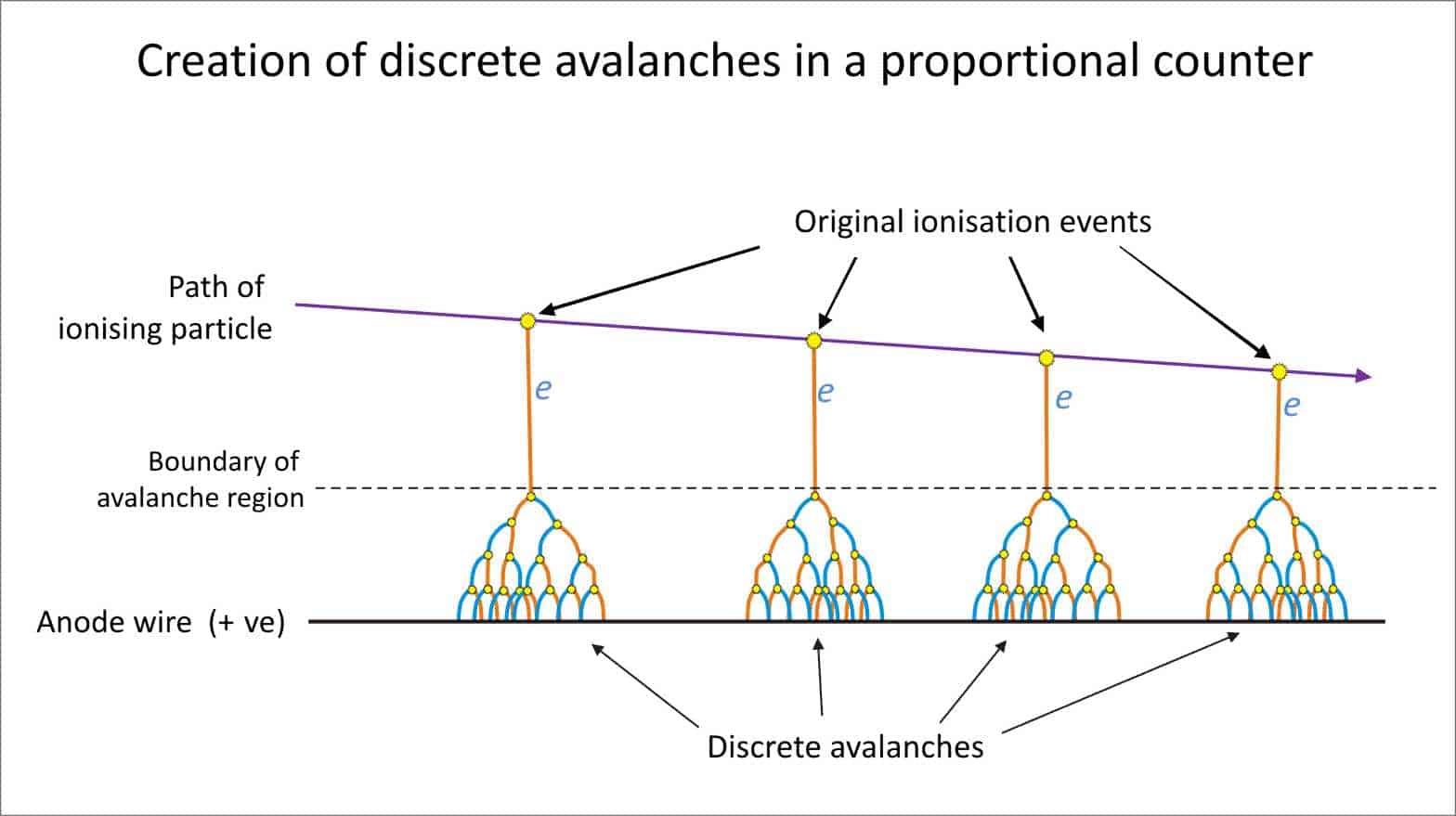
The generation of discrete Townsend avalanches in a proportional counter. Source: wikpedia.org License: CC BY-SA 3.0
A proportional counter, also known as the proportional detector, is an electrical device that detects various types of ionizing radiation. The voltage of detector is adjusted so that the conditions correspond to the proportional region. In this region, the voltage is high enough to provide the primary electrons with sufficient acceleration and energy so that they can ionize additional atoms of the medium. These secondary ions (gas amplification) formed are also accelerated causing an effect known as Townsend avalanches, which creates a single large electrical pulse.
Advantages of Proportional Counters
Amplification. Gaseous proportional counters usually operate in high electric fields of the order of 10 kV/cm and achieve typical amplification factors of about 105. Since the amplification factor is strongly dependent on the applied voltage, the charge collected (output signal) is also dependent on the applied voltage and proportional counters require constant voltage. The high amplification factor of the proportional counter is the major advantage over the ionization chamber.
Sensitivity. The process of charge amplification greatly improves the signal-to-noise ratio of the detector and reduces the subsequent electronic amplification required. Since the process of charge amplification greatly improves the signal-to-noise ratio of the detector, the subsequent electronic amplification is usually not required. Proportional counter detection instruments are very sensitive to low levels of radiation. Moreover, when measuring current output, a proportional detector is useful for dose rates
since the output signal is proportional to the energy deposited by ionization and
therefore proportional to the dose rate.
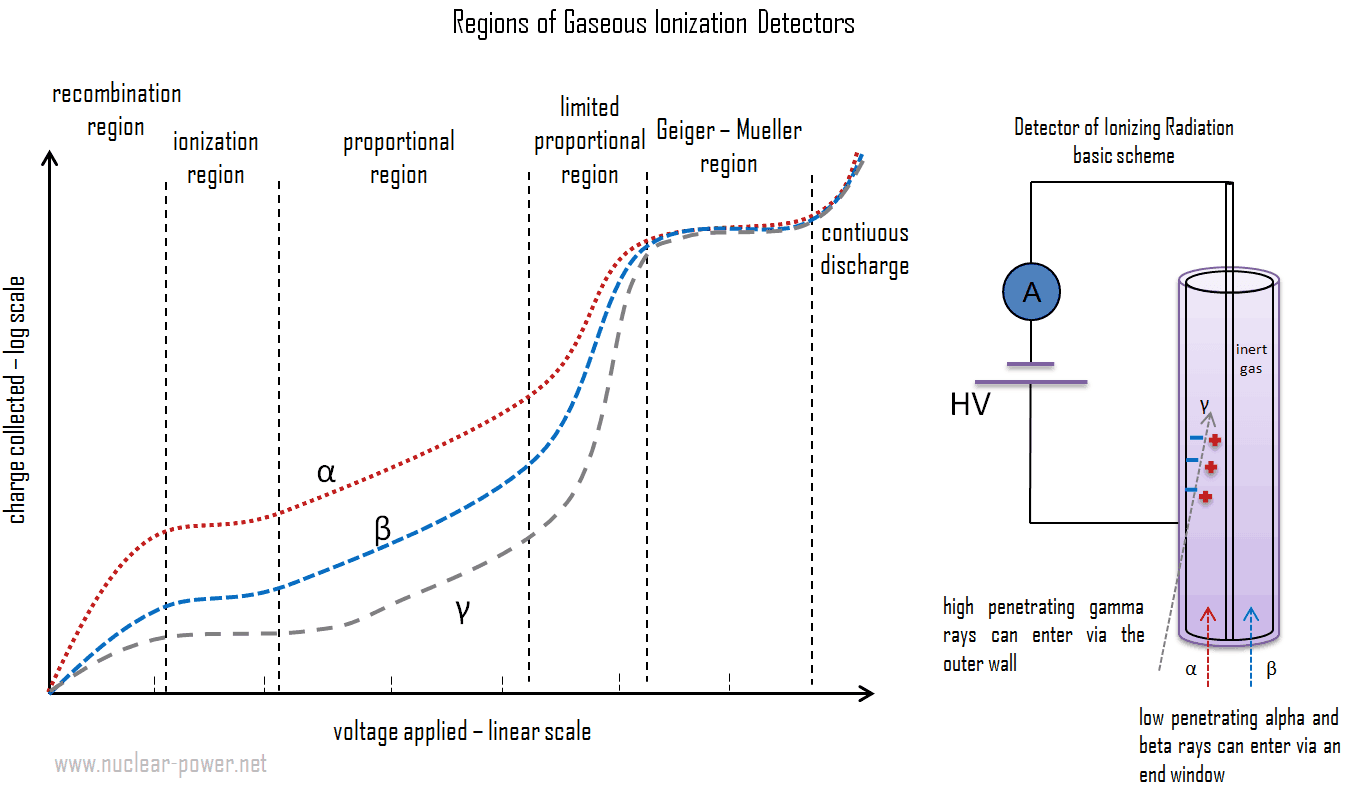
This diagram shows the number of ion pairs generated in the gas-filled detector, which varies according to the applied voltage for constant incident radiation. The voltages can vary widely depending upon the detector geometry and the gas type and pressure. This figure schematically indicates the different voltage regions for alpha, beta and gamma rays. There are six main practical operating regions, where three (ionization, proportional and Geiger-Mueller region) are useful to detect ionizing radiation. Alpha particles are more ionising than beta particles and than gamma rays, so more current is produced in the ion chamber region by alpha than beta and gamma, but the particles cannot be differentiated. More current is produced in the proportional counting region by alpha particles than beta, but by the nature of proportional counting it is possible to differentiate alpha, beta and gamma pulses. In the Geiger region, there is no differentiation of alpha and beta as any single ionisation event in the gas results in the same current output.
Spectroscopy. By proper functional arrangements, modifications, and biasing, the proportional counter can be used to detect alpha, beta, gamma, or neutron radiation in mixed radiation fields. Moreover, proportional counters are capable of particle identification and energy measurement (spectroscopy). The pulse height reflects the energy deposited by the incident radiation in the detector gas. As such, it is possible to distinguish the larger pulses produced by alpha particles from the smaller pulses produced by beta particles or gamma rays.
Disadvantages of Proportional Counters
Constant Voltage. When instruments are operated in the proportional region, the voltage must be kept constant. If a voltage remains constant the gas amplification factor also does not change. The main drawback to using proportional counters in portable instruments is that they require a very stable power supply and amplifier to ensure constant operating conditions (in the middle of the proportional region). This is difficult to provide in a portable instrument, and that is why proportional counters tend to be used more in fixed or lab instruments.
Quenching. For each electron collected in the chamber, there is a positively charged gas ion left over. These gas ions are heavy compared to an electron and move much more slowly. Free electrons are much lighter than the positive ions, thus, they are drawn toward the positive central electrode much faster than the positive ions are drawn to the chamber wall. The resulting cloud of positive ions near the electrode leads to distortions in gas multiplication. Eventually the positive ions move away from the positively charged central wire to the negatively charged wall and are neutralized by gaining an electron. In the process, some energy is given off, which causes additional ionization of the gas atoms. The electrons produced by this ionization move toward the central wire and are multiplied en route. This pulse of charge is unrelated to the radiation to be detected and can set off a series of pulses. In practice the termination of the avalanche is improved by the use of “quenching” techniques.
Special Reference: U.S. Department of Energy, Instrumantation and Control. DOE Fundamentals Handbook, Volume 2 of 2. June 1992.
Robert Reed Burn, Introduction to Nuclear Reactor Operation, 1988.
U.S. Department of Energy, Nuclear Physics and Reactor Theory. DOE Fundamentals Handbook, Volume 1 and 2. January 1993.
Paul Reuss, Neutron Physics. EDP Sciences, 2008. ISBN: 978-2759800414.
See also:
Proportional Counter
We hope, this article, Advantage and Disadvantage of Proportional Counters, helps you. If so, give us a like in the sidebar. Main purpose of this website is to help the public to learn some interesting and important information about radiation and dosimeters.
Proportional counters are normally used to detect alpha and beta particles, and can enable discrimination between them by providing a pulse output proportional to the energy deposited in the chamber by each particle. Detection of Alpha, Beta and Gamma Radiation using Proportional Counter
A proportional counter, also known as the proportional detector, is an electrical device that detects various types of ionizing radiation. The voltage of detector is adjusted so that the conditions correspond to the proportional region. In this region, the voltage is high enough to provide the primary electrons with sufficient acceleration and energy so that they can ionize additional atoms of the medium. These secondary ions (gas amplification) formed are also accelerated causing an effect known as Townsend avalanches, which creates a single large electrical pulse. Gaseous proportional counters usually operate in high electric fields of the order of 10 kV/cm and achieve typical amplification factors of about 105. Since the amplification factor is strongly dependent on the applied voltage, the charge collected (output signal) is also dependent on the applied voltage and proportional counters require constant voltage.
Detection of Alpha, Beta and Gamma Radiation using Proportional Counter
Proportional counters in the form of large area planar detectors are used extensively to check for radioactive contamination on personnel, flat surfaces, tools, and items of clothing. Proportional counters are normally used to detect alpha and beta particles, and can enable discrimination between them by providing a pulse output proportional to the energy deposited in the chamber by each particle. They have a high efficiency for beta, but lower for alpha. For alpha and beta particles to be detected by proportional counters, they must be provided with a thin window. This “end-window” must be thin enough for the alpha and beta particles to penetrate. However, a window of almost any thickness will prevent an alpha particle from entering the chamber. The window is usually made of mica with a density of about 1.5 – 2.0 mg/cm2 to allow low-energy beta particles (e.g. from carbon-14) to enter the detector. The efficiency reduction for alpha is due to the attenuation effect of the end window, though distance from the surface being checked also has a significant effect, and ideally a source of alpha radiation should be less than 10mm from the detector due to attenuation in air.
Gamma rays have very little trouble in penetrating the metal walls of the chamber. Therefore, proportional counters may be used to detect gamma radiation and X-rays (thin-walled tubes) collectively known as photons, and for this the windowless tube is used.
The main drawback to using proportional counters in portable instruments is that they require a very stable power supply and amplifier to ensure constant operating conditions (in the middle of the proportional region). This is difficult to provide in a portable instrument, and that is why proportional counters tend to be used more in fixed or lab instruments.
Proportional Counter – Spectroscopy
In general, spectroscopes are devices designed to measure the spectral power distribution of a source. The incident radiation generates a signal that allows to determine the energy of the incident particle.
Source: wikipedia.org License: Public Domain
In proportional counters, the number of electrons produced is proportional to the energy and type of the incident particle. Therefore, proportional counters are capable of particle identification and energy measurement (spectroscopy). Different energies of radiation and different types of radiation can be distinguished by analyzing the pulse height, since they significantly differ in the primary ionization (low-LET vs high-LET). Proportional counters may be used for example to analyse a spectrum of alpha radiations or a spectrum of beta particles. The energy resolution of a proportional counter, however, is limited because both the initial ionization event and the subsequent ‘multiplication’ event are subject to statistical fluctuations characterized by a standard deviation equal to the square root of the average number formed.
A large volume spherical proportional counter can be used for neutron measurements. The pure N2 gas is studied for thermal and fast neutron detection, providing a new way for neutron spectroscopy. The neutrons are detected via the 14N(n,p)14C and 14N(n,α)11B reactions.
It must be noted, for gamma spectrometry, the most common detectors include sodium iodide (NaI) scintillation counters and high-purity germanium detectors.
Multi-wire Proportional Chamber – MWPC
A multi-wire proportional chamber is a type of proportional counter used especially in high energy particle physics to detect charged particles and photons and can give positional information on their trajectory. This device was developed by Georges Charpak and his collaborators. This invention resulted in him winning the Nobel Prize for Physics in 1992. The multi-wire chamber uses an array of wires at high voltage (anode), which run through a chamber with conductive walls held at ground potential (cathode). The principle is to have a plane of anode wires positioned precisely, with typical wire-spacings of about 2 mm. By computing pulses from all the wires, the particle trajectory can be found.
Robert Reed Burn, Introduction to Nuclear Reactor Operation, 1988.
U.S. Department of Energy, Nuclear Physics and Reactor Theory. DOE Fundamentals Handbook, Volume 1 and 2. January 1993.
Paul Reuss, Neutron Physics. EDP Sciences, 2008. ISBN: 978-2759800414.
See also:
Proportional Counter
We hope, this article, Detection of Alpha, Beta and Gamma Radiation using Proportional Counter, helps you. If so, give us a like in the sidebar. Main purpose of this website is to help the public to learn some interesting and important information about radiation and dosimeters.
Argon and helium are the most frequently used fill gases and allow for the detection of alpha, beta, and gamma radiation. For neutron detection He-3 and BF3 (Boron Trifluoride) are the most commonly employed gases. Proportional Chamber – Gas Mixtures
A proportional counter, also known as the proportional detector, is an electrical device that detects various types of ionizing radiation. The voltage of detector is adjusted so that the conditions correspond to the proportional region. In this region, the voltage is high enough to provide the primary electrons with sufficient acceleration and energy so that they can ionize additional atoms of the medium. These secondary ions (gas amplification) formed are also accelerated causing an effect known as Townsend avalanches, which creates a single large electrical pulse. Gaseous proportional counters usually operate in high electric fields of the order of 10 kV/cm and achieve typical amplification factors of about 105. Since the amplification factor is strongly dependent on the applied voltage, the charge collected (output signal) is also dependent on the applied voltage and proportional counters require constant voltage.
Argon and helium are the most frequently used fill gases and allow for the detection of alpha, beta, and gamma radiation. For neutron detection He-3 and BF3 (Boron Trifluoride) are the most commonly employed gases. For special purposes other mixtures of gases have been used, such as a tissue equivalent gas mixture consisting of 64.4% methane, 32.4% carbon dioxide and 3.2% nitrogen.
Quenching – Proportional Counters
In a proportional counter the fill gas of the chamber is an inert gas which is ionized by incident radiation, and a quench gas to ensure each pulse discharge terminates; a common mixture is 90% argon, 10% methane, known as P-10.
For each electron collected in the chamber, there is a positively charged gas ion left over. These gas ions are heavy compared to an electron and move much more slowly. Free electrons are much lighter than the positive ions, thus, they are drawn toward the positive central electrode much faster than the positive ions are drawn to the chamber wall. The resulting cloud of positive ions near the electrode leads to distortions in gas multiplication. Eventually the positive ions move away from the positively charged central wire to the negatively charged wall and are neutralized by gaining an electron. In the process, some energy is given off, which causes additional ionization of the gas atoms. The electrons produced by this ionization move toward the central wire and are multiplied en route. This pulse of charge is unrelated to the radiation to be detected and can set off a series of pulses. In practice the termination of the avalanche is improved by the use of “quenching” techniques.
The quenching gas molecules have a weaker affinity for electrons than the chamber gas does; therefore, the ionized atoms of the chamber gas readily take electrons from the quenching gas molecules. Thus, the ionized molecules of quenching gas reach the chamber wall instead of the chamber gas. The ionized molecules of the quenching gas are neutralized by gaining an electron, and the energy liberated does not cause further ionization, but causes dissociation of the molecule.
Special Reference: U.S. Department of Energy, Instrumantation and Control. DOE Fundamentals Handbook, Volume 2 of 2. June 1992.
Detection of Neutrons using Proportional Counter
Since the neutrons are electrically neutral particles, they are mainly subject to strong nuclear forces but not to electric forces. Therefore neutrons are not directly ionizing and they have usually to be converted into charged particles before they can be detected. Generally every type of neutron detector must be equipped with converter (to convert neutron radiation to common detectable radiation) and one of the conventional radiation detectors (scintillation detector, gaseous detector, semiconductor detector, etc.).
Proportional counters are often used as the charged particle detection device. In nuclear power plants, gas-filled (BF3) proportional counters are normally used as source range detectors. These detectors use the gas boron trifluoride (BF3) instead of air in the chamber. The incoming neutrons produce alpha particles when they react with the boron atoms in the detector gas. Most of (n,alpha) reactions of thermal neutrons are 10B(n,alpha)7Li reactions accompanied by 0.48 MeV gamma emission.
Moreover, isotope boron-10 has high (n,alpha) reaction cross-section along the entire neutron energy spectrum. The alpha particle causes ionization within the chamber, and ejected electrons cause further secondary ionizations.
Robert Reed Burn, Introduction to Nuclear Reactor Operation, 1988.
U.S. Department of Energy, Nuclear Physics and Reactor Theory. DOE Fundamentals Handbook, Volume 1 and 2. January 1993.
Paul Reuss, Neutron Physics. EDP Sciences, 2008. ISBN: 978-2759800414.
See also:
Proportional Counter
We hope, this article, Proportional Chamber – Gas Mixtures, helps you. If so, give us a like in the sidebar. Main purpose of this website is to help the public to learn some interesting and important information about radiation and dosimeters.
In practice the termination of the avalanche is improved by the use of “quenching” techniques.The quenching gas molecules have a weaker affinity for electrons than the chamber gas does.
In a proportional counter the fill gas of the chamber is an inert gas which is ionized by incident radiation, and a quench gas to ensure each pulse discharge terminates; a common mixture is 90% argon, 10% methane, known as P-10.
For each electron collected in the chamber, there is a positively charged gas ion left over. These gas ions are heavy compared to an electron and move much more slowly. Free electrons are much lighter than the positive ions, thus, they are drawn toward the positive central electrode much faster than the positive ions are drawn to the chamber wall. The resulting cloud of positive ions near the electrode leads to distortions in gas multiplication. Eventually the positive ions move away from the positively charged central wire to the negatively charged wall and are neutralized by gaining an electron. In the process, some energy is given off, which causes additional ionization of the gas atoms. The electrons produced by this ionization move toward the central wire and are multiplied en route. This pulse of charge is unrelated to the radiation to be detected and can set off a series of pulses. In practice the termination of the avalanche is improved by the use of “quenching” techniques.
The quenching gas molecules have a weaker affinity for electrons than the chamber gas does; therefore, the ionized atoms of the chamber gas readily take electrons from the quenching gas molecules. Thus, the ionized molecules of quenching gas reach the chamber wall instead of the chamber gas. The ionized molecules of the quenching gas are neutralized by gaining an electron, and the energy liberated does not cause further ionization, but causes dissociation of the molecule.
Special Reference: U.S. Department of Energy, Instrumantation and Control. DOE Fundamentals Handbook, Volume 2 of 2. June 1992.
Robert Reed Burn, Introduction to Nuclear Reactor Operation, 1988.
U.S. Department of Energy, Nuclear Physics and Reactor Theory. DOE Fundamentals Handbook, Volume 1 and 2. January 1993.
Paul Reuss, Neutron Physics. EDP Sciences, 2008. ISBN: 978-2759800414.
See also:
Proportional Counter
We hope, this article, Quenching – Proportional Counters, helps you. If so, give us a like in the sidebar. Main purpose of this website is to help the public to learn some interesting and important information about radiation and dosimeters.
Basic Principle of Proportional Counters – Description. The proportional counter has a cathode and an anode that are held at some voltage (above 1000 V), and the device is characterized by a capacitance that is determined by the geometry of the electrodes. Radiation Dosimetry
Detectors of ionizing radiation consist of two parts that are usually connected. The first part consists of a sensitive material, consisting of a compound that experiences changes when exposed to radiation. The other component is a device that converts these changes into measurable signals.
The proportional counter has a cathode and an anode that are held at some voltage (above 1000 V), and the device is characterized by a capacitance that is determined by the geometry of the electrodes. In a proportional counter the fill gas of the chamber is an inert gas which is ionized by incident radiation, and a quench gas to ensure each pulse discharge terminates; a common mixture is 90% argon, 10% methane, known as P-10.
As ionizing radiation enters the gas between the electrodes, a finite number of ion-pairs are formed. In air, the average energy needed to produce an ion is about 34 eV, therefore a 1 MeV radiation completely absorbed in the detector produces about 3 x 10⁴ pair of ions. The behavior of the resultant ion-pairs is affected by the potential gradient of the electric field within the gas and the type and pressure of the fill gas. Under the influence of the electric field, the positive ions will move toward the negatively charged electrode (outer cylinder), and the negative ions (electrons) will migrate toward the positive electrode (central wire). The electric field in this region keeps the ions from recombining with the electrons. In the immediate vicinity of the anode wire, the field strength becomes large enough to produce Townsend avalanches. This avalanche region occurs only fractions of a millimeter from the anode wire, which itself is of a very small diameter. The purpose of this is to use the multiplication effect of the avalanche produced by each ion pair. This is the “avalanche” region. A key design goal is that each original ionizing event due to incident radiation produces only one avalanche. Gas amplification factors can range from unity in the ionization region to 103 or 104 in the proportional region. The high amplification factor of the proportional counter is the major advantage over the ionization chamber.
The collection of all these electrons will produce a charge on the electrodes and an electrical pulse across the detection circuit. Each pulse corresponds to one gamma ray or particle interaction. The pulse height is proportional to the number of original electrons produced. But in this case the pulse height is significantly amplified by the detector. The proportionality factor in this case is the gas amplification factor. The number of electrons produced is proportional to the energy of the incident particle. Therefore, proportional counters are capable of particle identification and energy measurement (spectroscopy). Different energies of radiation and different types of radiation can be distinguished by analyzing the pulse height, since they significantly differ in the primary ionization (low-LET vs high-LET). Since the process of charge amplification greatly improves the signal-to-noise ratio of the detector, the subsequent electronic amplification is usually not required.
Ionization chamber construction differs from the proportional counter. The flat plate design is preferred for ionization chambers, or concentric cylinders may be utilized in the construction to allow for the integration of pulses produced by the incident radiation. Proportional counters and Geiger counters usually utilize cylinder and central electrode. The proportional counter would require such exact control of the electric field between the electrodes that it would not be practical.
Robert Reed Burn, Introduction to Nuclear Reactor Operation, 1988.
U.S. Department of Energy, Nuclear Physics and Reactor Theory. DOE Fundamentals Handbook, Volume 1 and 2. January 1993.
Paul Reuss, Neutron Physics. EDP Sciences, 2008. ISBN: 978-2759800414.
See also:
Proportional Counter
We hope, this article, Basic Principle of Proportional Counters – Description, helps you. If so, give us a like in the sidebar. Main purpose of this website is to help the public to learn some interesting and important information about radiation and dosimeters.
Gas amplification factors can range from unity in the ionization region to 10^3 or 10^4 in the proportional region and to 10^10 in the Geiger-Mueller region. The high amplification factor of the proportional and G-M counters is the major advantage over the ionization chamber. Radiation Dosimetry
This diagram shows the number of ion pairs generated in the gas-filled detector (i.e. the gas amplification factor), which varies according to the applied voltage for constant incident radiation. The voltages can vary widely depending upon the detector geometry and the gas type and pressure. This figure schematically indicates the different voltage regions for alpha, beta and gamma rays. There are six main practical operating regions, where three (ionization, proportional and Geiger-Mueller region) are useful to detect ionizing radiation. Alpha particles are more ionising than beta particles and than gamma rays, so more current is produced in the ion chamber region by alpha than beta and gamma, but the particles cannot be differentiated. More current is produced in the proportional counting region by alpha particles than beta, but by the nature of proportional counting it is possible to differentiate alpha, beta and gamma pulses. In the Geiger region, there is no differentiation of alpha and beta as any single ionisation event in the gas results in the same current output.
As ionizing radiation enters the gas between the electrodes, a finite number of ion-pairs are formed. In air, the average energy needed to produce an ion is about 34 eV, therefore a 1 MeV radiation completely absorbed in the detector produces about 3 x 10⁴ pair of ions. The behavior of the resultant ion-pairs is affected by the potential gradient of the electric field within the gas and the type and pressure of the fill gas. Under the influence of the electric field, the positive ions will move toward the negatively charged electrode (outer cylinder), and the negative ions (electrons) will migrate toward the positive electrode (central wire). The electric field in this region keeps the ions from recombining with the electrons. In the immediate vicinity of the anode wire, the field strength becomes large enough to produce Townsend avalanches. This avalanche region occurs only fractions of a millimeter from the anode wire, which itself is of a very small diameter. The purpose of this is to use the multiplication effect of the avalanche produced by each ion pair. This is the “avalanche” region. A key design goal is that each original ionizing event due to incident radiation produces only one avalanche. Gas amplification factors can range from unity in the ionization region to 103 or 104 in the proportional region and to 1010 in the Geiger-Mueller region. The high amplification factor of the proportional and G-M counters is the major advantage over the ionization chamber. The process of charge amplification greatly improves the signal-to-noise ratio of the detector and reduces the subsequent electronic amplification required.
Gas Amplification in Proportional Region
In the proportional region, the voltage of the detectors is high enough to provide the primary electrons with sufficient acceleration and energy so that they can ionize additional atoms of the medium. These secondary ions (gas amplification) formed are also accelerated causing an effect known as Townsend avalanches, which creates a single large electrical pulse. Gaseous proportional counters usually operate in high electric fields of the order of 10 kV/cm and achieve typical amplification factors of about 105. Since the amplification factor is strongly dependent on the applied voltage, the charge collected (output signal) is also dependent on the applied voltage and proportional counters require constant voltage.
This is a subtle, but important difference between ionization chambers and proportional counters. An ionization chamber will produce a current that is proportional to the number of electrons collected each second. This current is averaged and is used to drive a display reading in Bq, or μSv/h. Proportional counters do not work in this way. Instead, they amplify each of the individual bursts of ionisation so that each ionising event is detected separately. They therefore measure the number of ionising events (which is why they are called counters).
The generation of discrete Townsend avalanches in a proportional counter. Source: wikpedia.org License: CC BY-SA 3.0
The process of charge amplification greatly improves the signal-to-noise ratio of the detector and reduces the subsequent electronic amplification required. When instruments are operated in the proportional region, the voltage must be kept constant. If a voltage remains constant the gas amplification factor also does not change. Proportional counter detection instruments are very sensitive to low levels of radiation. By proper functional arrangements, modifications, and biasing, the proportional counter can be used to detect alpha, beta, gamma, or neutron radiation in mixed radiation fields. Moreover, proportional counters are capable of particle identification and energy measurement (spectroscopy). The pulse height reflects the energy deposited by the incident radiation in the detector gas. As such, it is possible to distinguish the larger pulses produced by alpha particles from the smaller pulses produced by beta particles or gamma rays.
Gas Amplification in Geiger-Mueller Region
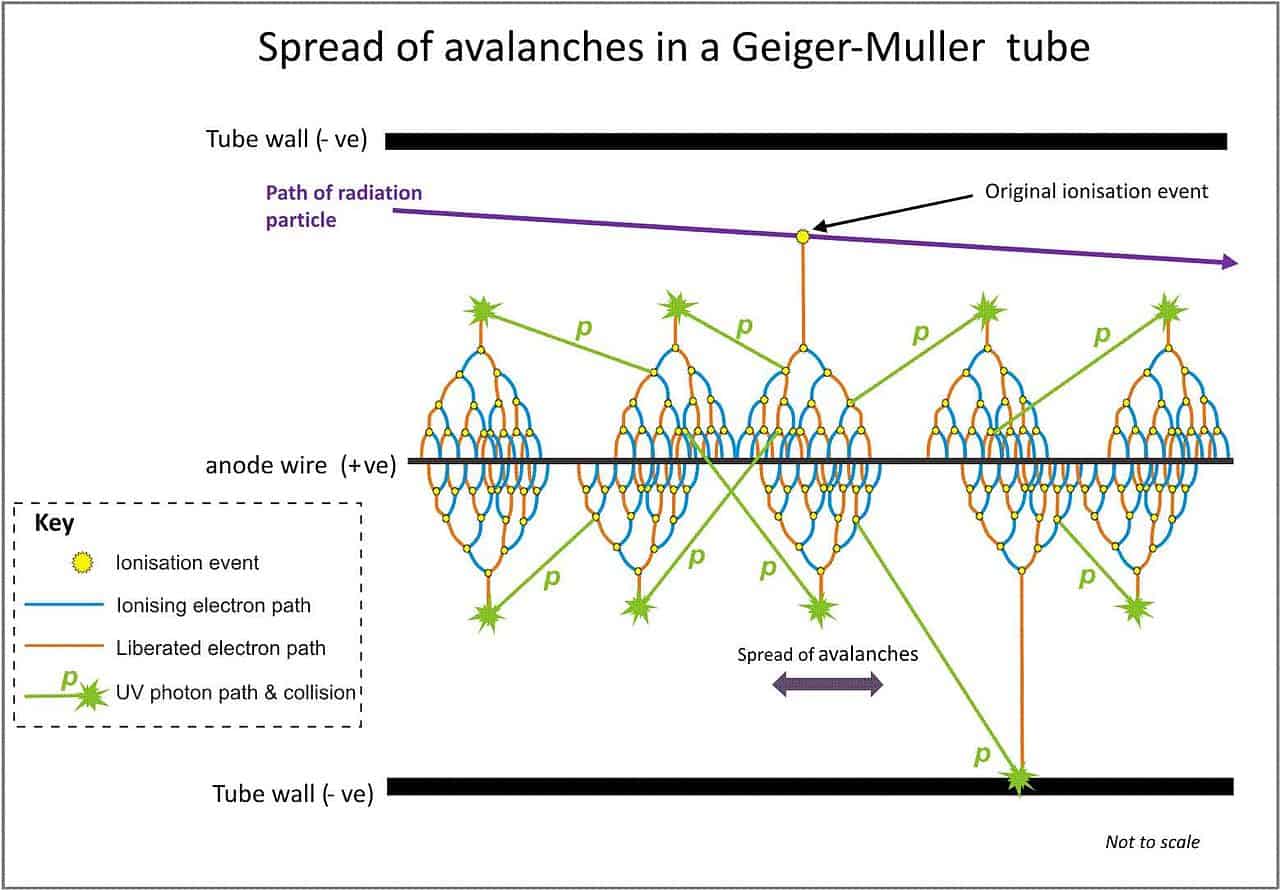
Visualisation of the spread of Townsend avalanches by means of UV photons. Source: wikpedia.org License: CC BY-SA 3.0
In this region, the voltage is high enough to provide the primary electrons with sufficient acceleration and energy so that they can ionize additional atoms of the medium. These secondary ions (gas amplification) formed are also accelerated causing an effect known as Townsend avalanches. These avalanches can be triggered and propagated by photons emitted by atoms excited in the original avalanche. Since these photons are not affected by the electric field, they may interact far (e.g. laterally to the axis) from the primary avalanche, the entire Geiger tube is participating in the process. A strong signal (the amplification factor can reach about 1010) is produced by these avalanches with shape and height independently of the primary ionization and the energy of the detected photon. The voltage pulse in this case would be a large and easily detectable ≈ 1.6 V.
Robert Reed Burn, Introduction to Nuclear Reactor Operation, 1988.
U.S. Department of Energy, Nuclear Physics and Reactor Theory. DOE Fundamentals Handbook, Volume 1 and 2. January 1993.
Paul Reuss, Neutron Physics. EDP Sciences, 2008. ISBN: 978-2759800414.
See also:
Proportional Counter
We hope, this article, Gas Amplification Factor – Gas Amplification Curve, helps you. If so, give us a like in the sidebar. Main purpose of this website is to help the public to learn some interesting and important information about radiation and dosimeters.
Applications of Ionization Chambers. Ionization chambers may be used for measuring of various radiation fields as well they are used nuclear reactors. Radiation Dosimetry
Detectors of ionizing radiation consist of two parts that are usually connected. The first part consists of a sensitive material, consisting of a compound that experiences changes when exposed to radiation. The other component is a device that converts these changes into measurable signals.
The ionization chamber, also known as the ion chamber, is electrical device that detects various types of ionizing radiation. The voltage of detector is adjusted so that the conditions correspond to the ionization region. The voltage is not high enough to produce gas amplification (secondary ionization). Detectors in the ionization region operate at a low electric field strength, selected such that no gas multiplication takes place. The charge collected (output signal) is independent of the applied voltage and for single minimum-ionizing particles tends to be quite small and usually require special low-noise amplifiers for attaining efficient operating performance. Ionization chambers are preferred for high radiation dose rates because they have no “dead time”, a phenomenon which affects the accuracy of the Geiger-Mueller tube at high dose rates. This is due to the fact, there is no inherent amplification of signal in the operating medium and therefore these types of counters do not require much time to recover from large currents. In addition, because there is no amplification, they provide excellent energy resolution, which is limited primarily by electronic noise.
Ionization chambers can be operated in current or pulse mode. In contrast, proportional counters or Geiger counters are almost always used in pulse mode. Detectors of ionizing radiation can be used both for activity measurements as well as for dose measurement. With knowledge about the energy needed to form an pair of ions – the dose can be obtained.
Detection of Alpha Radiation using Ionization Chamber
For alpha and beta particles to be detected by ionization chambers, they must be provided with a thin window. This “end-window” must be thin enough for the alpha and beta particles to penetrate. However, a window of almost any thickness will prevent an alpha particle from entering the chamber. The window is usually made of mica with a density of about 1.5 – 2.0 mg/cm2. But it does not mean, alpha radiation cannot be detected by an ionization chamber.
For example, in some kind of smoke detectors, you can meet man-made radionuclides such as americium-241, which is a source of alpha particles. The smoke detector has two ionization chambers, one open to the air, and a reference chamber which does not allow the entry of particles. The radioactive source emits alpha particles into both chambers, which ionizes some air molecules. The free-air chamber allows the entry of smoke particles to the sensitive volume and to change attenuation of alpha particles. If any smoke particles enter the free-air chamber, some of the ions will attach to the particles and not be available to carry the current in that chamber. An electronic circuit detects that a current difference has developed between the open and sealed chambers, and sounds the alarm.
Detection of Beta Radiation using Ionization Chamber
For alpha and beta particles to be detected by ionization chambers, they must be provided with a thin window. This “end-window” must be thin enough for the alpha and beta particles to penetrate. However, a window of almost any thickness will prevent an alpha particle from entering the chamber. The window is usually made of mica with a density of about 1.5 – 2.0 mg/cm2.
Ionization chamber may be, for example, used for the measurement of tritium in the air. These devices are known as tritium-in-air monitors. Tritium is a radioactive isotope, but it emits a very weak form of radiation, a low-energy beta particle that is similar to an electron. It is a pure beta emitter (i.e. beta emitter without an accompanying gamma radiation). The electron’s kinetic energy varies, with an average of 5.7 keV, while the remaining energy is carried off by the nearly undetectable electron antineutrino. Such a very low energy of electron causes, that the electron cannot penetrate the skin or even does not travel very far in air. Beta particles from tritium can penetrate only about 6.0 mm of air. It is practically impossible to design a detector whose walls these beta particles can penetrate. Instead, tritium-in-air monitor pumps the tritium-contaminated air right through an ionization chamber, so that all of the energy of the beta particles can be usefully converted to producing ion pairs inside the chamber.
Detection of Gamma Radiation using Ionization Chamber
Gamma rays have very little trouble in penetrating the metal walls of the chamber. Therefore, ionization chambers may be used to detect gamma radiation and X-rays collectively known as photons, and for this the windowless tube is used. Ionization chambers have a good uniform response to radiation over a wide range of energies and are the preferred means of measuring high levels of gamma radiation. Some problems are caused by the fact, that alpha particles are more ionising than beta particles and than gamma rays, so more current is produced in the ionization chamber region by alpha than beta and gamma. Gamma rays deposit significantly lower amount of energy to the detector than other particles.
The efficiency of the chamber can be further increased by the use of a high pressure gas. Typically a pressure of 8-10 atmospheres can be used, and various noble gases are employed. For example, high-pressure xenon (HPXe) ionization chambers are ideal for use in uncontrolled environments, as a detector’s response has been shown to be uniform over large temperature ranges (20–170°C). The higher pressure results in a greater gas density and thereby a greater chance of collision with the fill gas and ion-pair creation by incident gamma radiation. Because of the increased wall thickness required to withstand this high pressure, only gamma radiation can be detected. These detectors are used in survey meters and for environmental monitoring.
Detection of Neutrons using Ionization Chamber
Since the neutrons are electrically neutral particles, they are mainly subject to strong nuclear forces but not to electric forces. Therefore neutrons are not directly ionizing and they have usually to be converted into charged particles before they can be detected. Generally every type of neutron detector must be equipped with converter (to convert neutron radiation to common detectable radiation) and one of the conventional radiation detectors (scintillation detector, gaseous detector, semiconductor detector, etc.).
Ionization chambers are often used as the charged particle detection device. For example, if the inner surface of the ionization chamber is coated with a thin coat of boron, the (n,alpha) reaction can take place. Most of (n,alpha) reactions of thermal neutrons are 10B(n,alpha)7Li reactions accompanied by 0.48 MeV gamma emission.
Moreover, isotope boron-10 has high (n,alpha) reaction cross-section along the entire neutron energy spectrum. The alpha particle causes ionization within the chamber, and ejected electrons cause further secondary ionizations.
Another method for detecting neutrons using an ionization chamber is to use the gas boron trifluoride (BF3) instead of air in the chamber. The incoming neutrons produce alpha particles when they react with the boron atoms in the detector gas. Either method may be used to detect neutrons in nuclear reactor. It must be noted, BF3 counters are usually operated in the proportional region.
Robert Reed Burn, Introduction to Nuclear Reactor Operation, 1988.
U.S. Department of Energy, Nuclear Physics and Reactor Theory. DOE Fundamentals Handbook, Volume 1 and 2. January 1993.
Paul Reuss, Neutron Physics. EDP Sciences, 2008. ISBN: 978-2759800414.
See also:
Ionization Chamber
We hope, this article, Application of Ionization Chambers, helps you. If so, give us a like in the sidebar. Main purpose of this website is to help the public to learn some interesting and important information about radiation and dosimeters.
High-pressure Ionization Chamber – Gamma Survey Meter. High-pressure xenon (HPXe) ionization chambers are ideal for use in uncontrolled environments, as a detector’s response has been shown to be uniform over large temperature ranges (20–170°C).
The ionization chamber, also known as the ion chamber, is electrical device that detects various types of ionizing radiation. The voltage of detector is adjusted so that the conditions correspond to the ionization region. The voltage is not high enough to produce gas amplification (secondary ionization). Detectors in the ionization region operate at a low electric field strength, selected such that no gas multiplication takes place. The charge collected (output signal) is independent of the applied voltage and for single minimum-ionizing particles tends to be quite small and usually require special low-noise amplifiers for attaining efficient operating performance. Ionization chambers are preferred for high radiation dose rates because they have no “dead time”, a phenomenon which affects the accuracy of the Geiger-Mueller tube at high dose rates. This is due to the fact, there is no inherent amplification of signal in the operating medium and therefore these types of counters do not require much time to recover from large currents. In addition, because there is no amplification, they provide excellent energy resolution, which is limited primarily by electronic noise.
Ionization chambers can be operated in current or pulse mode. In contrast, proportional counters or Geiger counters are almost always used in pulse mode. Detectors of ionizing radiation can be used both for activity measurements as well as for dose measurement. With knowledge about the energy needed to form an pair of ions – the dose can be obtained.
High-pressure Ionization Chamber – Gamma Survey Meter
Gamma rays have very little trouble in penetrating the metal walls of the chamber. Therefore, ionization chambers may be used to detect gamma radiation and X-rays collectively known as photons, and for this the windowless tube is used. Ionization chambers have a good uniform response to radiation over a wide range of energies and are the preferred means of measuring high levels of gamma radiation. Some problems are caused by the fact, that alpha particles are more ionising than beta particles and than gamma rays, so more current is produced in the ionization chamber region by alpha than beta and gamma. Gamma rays deposit significantly lower amount of energy to the detector than other particles.
The efficiency of the chamber can be further increased by the use of a high pressure gas. Typically a pressure of 8-10 atmospheres can be used, and various noble gases are employed. For example, high-pressure xenon (HPXe) ionization chambers are ideal for use in uncontrolled environments, as a detector’s response has been shown to be uniform over large temperature ranges (20–170°C). The higher pressure results in a greater gas density and thereby a greater chance of collision with the fill gas and ion-pair creation by incident gamma radiation. Because of the increased wall thickness required to withstand this high pressure, only gamma radiation can be detected. These detectors are used in survey meters and for environmental monitoring.
Robert Reed Burn, Introduction to Nuclear Reactor Operation, 1988.
U.S. Department of Energy, Nuclear Physics and Reactor Theory. DOE Fundamentals Handbook, Volume 1 and 2. January 1993.
Paul Reuss, Neutron Physics. EDP Sciences, 2008. ISBN: 978-2759800414.
See also:
Ionization Chamber
We hope, this article, High-pressure Ionization Chamber – Gamma Survey Meter, helps you. If so, give us a like in the sidebar. Main purpose of this website is to help the public to learn some interesting and important information about radiation and dosimeters.