Facebook Instagram Youtube Twitter

What is Proportional Counter vs Scintillation Detector – Definition

Proportional Counter vs Scintillation Detector. A scintillation detector has usually a higher energy resolution than a proportional counter, allowing for more accurate energy determinations. Radiation Dosimetry

Proportional Counter

A proportional counter, also known as the proportional detector, is an electrical device that detects various types of ionizing radiation. The voltage of detector is adjusted so that the conditions correspond to the proportional region. In this region, the voltage is high enough to provide the primary electrons with sufficient acceleration and energy so that they can ionize additional atoms of the medium. These secondary ions (gas amplification) formed are also accelerated causing an effect known as Townsend avalanches, which creates a single large electrical pulse.

Advantages of Proportional Counters

  • Amplification. Gaseous proportional counters usually operate in high electric fields of the order of 10 kV/cm and achieve typical amplification factors of about 105. Since the amplification factor is strongly dependent on the applied voltage, the charge collected (output signal) is also dependent on the applied voltage and proportional counters require constant voltage. The high amplification factor of the proportional counter is the major advantage over the ionization chamber.
  • Sensitivity. The process of charge amplification greatly improves the signal-to-noise ratio of the detector and reduces the subsequent electronic amplification required. Since the process of charge amplification greatly improves the signal-to-noise ratio of the detector, the subsequent electronic amplification is usually not required. Proportional counter detection instruments are very sensitive to low levels of radiation. Moreover, when measuring current output, a proportional detector is useful for dose rates
    since the output signal is proportional to the energy deposited by ionization and
    therefore proportional to the dose rate.
  • Spectroscopy. By proper functional arrangements, modifications, and biasing, the proportional counter can be used to detect alpha, beta, gamma, or neutron radiation in mixed radiation fields. Moreover, proportional counters are capable of particle identification and energy measurement (spectroscopy). The pulse height reflects the energy deposited by the incident radiation in the detector gas. As such, it is possible to distinguish the larger pulses produced by alpha particles from the smaller pulses produced by beta particles or gamma rays.

Disadvantages of Proportional Counters

  • Constant Voltage. When instruments are operated in the proportional region, the voltage must be kept constant. If a voltage remains constant the gas amplification factor also does not change. The main drawback to using proportional counters in portable instruments is that they require a very stable power supply and amplifier to ensure constant operating conditions (in the middle of the proportional region). This is difficult to provide in a portable instrument, and that is why proportional counters tend to be used more in fixed or lab instruments.
  • Quenching. For each electron collected in the chamber, there is a positively charged gas ion left over. These gas ions are heavy compared to an electron and move much more slowly. Free electrons are much lighter than the positive ions, thus, they are drawn toward the positive central electrode much faster than the positive ions are drawn to the chamber wall. The resulting cloud of positive ions near the electrode leads to distortions in gas multiplication. Eventually the positive ions move away from the positively charged central wire to the negatively charged wall and are neutralized by gaining an electron. In the process, some energy is given off, which causes additional ionization of the gas atoms. The electrons produced by this ionization move toward the central wire and are multiplied en route. This pulse of charge is unrelated to the radiation to be detected and can set off a series of pulses. In practice the termination of the avalanche is improved by the use of “quenching” techniques.

Scintillation Detectors

A scintillation counter or scintillation detector is a radiation detector which uses the effect known as scintillation. Scintillation is a flash of light produced in a transparent material by the passage of a particle (an electron, an alpha particle, an ion, or a high-energy photon). Scintillation occurs in the scintillator, which is a key part of a scintillation detector. In general, a scintillation detector consists of:

  • Scintillator. A scintillator generates photons in response to incident radiation.
  • Photodetector. A sensitive photodetector (usually a photomultiplier tube (PMT), a charge-coupled device (CCD) camera, or a photodiode), which converts the light to an electrical signal and electronics to process this signal.

The basic principle of operation involves the radiation reacting with a scintillator, which produces a series of flashes of varying intensity. The intensity of the flashes is proportional to the energy of the radiation. This feature is very important. These counters are suited to measure the energy of  gamma radiation (gamma spectroscopy) and, therefore, can be used to identify gamma emitting isotopes.

Scintillation counters are widely used in radiation protection, assay of radioactive materials and physics research because they can be made inexpensively yet with good efficiency, and can measure both the intensity and the energy of incident radiation. Hospitals all over the world have gamma cameras based on the scintillation effect and, therefore, they are also called scintillation cameras.

Advantages and disadvantages of scintillation counters are determined by the scintillator. The following features are not general for all scintillators.

Advantages of Scintillation Detectors

  • Efficiency. The advantages of a scintillation counter are its efficiency and the high precision and counting rates that are possible. These latter attributes are a consequence of the extremely short duration of the light flashes, from about 10-9  (organic scintillators) to 10-6 (inorganic scintillators) seconds.
  • Spectroscopy. The intensity of the flashes and the amplitude of the output voltage pulse are proportional to the energy of the radiation. Therefore, scintillation counters can be used to determine the energy, as well as the number, of the exciting particles (or gamma photons). For gamma spectrometry, the most common detectors include sodium iodide (NaI) scintillation counters and high-purity germanium detectors. The NaI(Tl) scintillator has a higher energy resolution than a proportional counter, allowing for more accurate energy determinations. On the other hand, if a perfect energy resolution is required, we have to use germanium-based detector, such as the HPGe detector.

Disadvantages of Scintillation Detectors

  • Hygroscopicity. A disadvantage of some inorganic crystals, e.g., NaI, is their hygroscopicity, a property which requires them to be housed in an airtight container to protect them from moisture.
  • NaI(Tl) has no beta or alpha response and poor low energy gamma response.
  • Liquid scintillators are relatively cumbersome.
References:

Radiation Protection:

  1. Knoll, Glenn F., Radiation Detection and Measurement 4th Edition, Wiley, 8/2010. ISBN-13: 978-0470131480.
  2. Stabin, Michael G., Radiation Protection and Dosimetry: An Introduction to Health Physics, Springer, 10/2010. ISBN-13: 978-1441923912.
  3. Martin, James E., Physics for Radiation Protection 3rd Edition, Wiley-VCH, 4/2013. ISBN-13: 978-3527411764.
  4. U.S.NRC, NUCLEAR REACTOR CONCEPTS
  5. U.S. Department of Energy, Instrumantation and Control. DOE Fundamentals Handbook, Volume 2 of 2. June 1992.

Nuclear and Reactor Physics:

  1. J. R. Lamarsh, Introduction to Nuclear Reactor Theory, 2nd ed., Addison-Wesley, Reading, MA (1983).
  2. J. R. Lamarsh, A. J. Baratta, Introduction to Nuclear Engineering, 3d ed., Prentice-Hall, 2001, ISBN: 0-201-82498-1.
  3. W. M. Stacey, Nuclear Reactor Physics, John Wiley & Sons, 2001, ISBN: 0- 471-39127-1.
  4. Glasstone, Sesonske. Nuclear Reactor Engineering: Reactor Systems Engineering, Springer; 4th edition, 1994, ISBN: 978-0412985317
  5. W.S.C. Williams. Nuclear and Particle Physics. Clarendon Press; 1 edition, 1991, ISBN: 978-0198520467
  6. G.R.Keepin. Physics of Nuclear Kinetics. Addison-Wesley Pub. Co; 1st edition, 1965
  7. Robert Reed Burn, Introduction to Nuclear Reactor Operation, 1988.
  8. U.S. Department of Energy, Nuclear Physics and Reactor Theory. DOE Fundamentals Handbook, Volume 1 and 2. January 1993.
  9. Paul Reuss, Neutron Physics. EDP Sciences, 2008. ISBN: 978-2759800414.

See also:

Scintillation Detectors

We hope, this article, Proportional Counter vs Scintillation Detector, helps you. If so, give us a like in the sidebar. Main purpose of this website is to help the public to learn some interesting and important information about radiation and dosimeters.
What is HPGe Detector vs NaI(Tl) Scintillation Detector – Definition

HPGe Detectors vs NaI(Tl) Scintillation Detectors. For gamma spectrometry, the most common detectors include sodium iodide (NaI) scintillation counters and high-purity germanium detectors. Radiation Dosimetry

HPGe Detectors

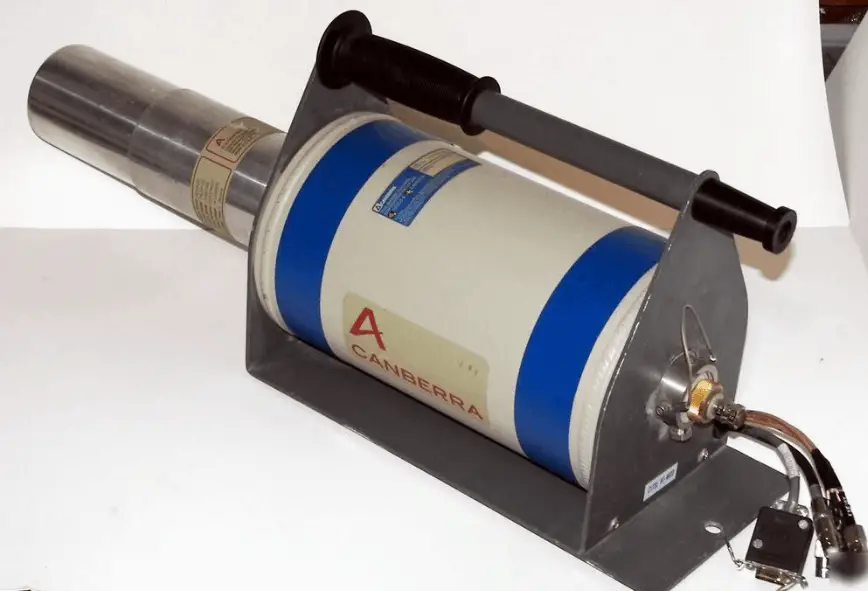
High-purity germanium detectors (HPGe detectors) are the best solution for precise gamma and x-ray spectroscopy. In comparison to silicon detectors, germanium is much more efficient than silicon for radiation detection due to its atomic number being much higher than silicon and due to lower average energy necessary to create an electron-hole pair, which is 3.6 eV for silicon and 2.9 eV for germanium. Due to its higher atomic number, Ge has a much lager linear attenuation coefficient, which leads to a shorter mean free path. Moreover silicon detectors cannot be thicker than a few millimeters, while germanium can have a depleted, sensitive thickness of centimeters, and therefore can be used as a total absorption detector for gamma rays up to few MeV.

Advantages of HPGe Detectors

  • Higher atomic number. Germanium is preferred due to its atomic number being much higher than silicon and which increases the probability of gamma ray interaction.
  • Germanium has lower average energy necessary to create an electron-hole pair, which is 3.6 eV for silicon and 2.9 eV for germanium.
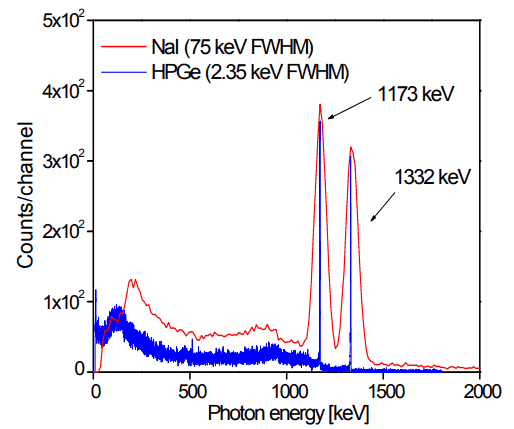
  • Very good energy resolution. The FWHM for germanium detectors is a function of energy. For a 1.3 MeV photon, the FWHM is 2.1 keV, which is very low.
  • Large Crystals. While silicon-based detectors cannot be thicker than a few millimeters, germanium can have a depleted, sensitive thickness of centimeters, and therefore can be used as a total absorption detector for gamma rays up to few MeV.

Disadvantages of HPGe Detectors

  • Cooling. The major drawback of HPGe detectors is that they must be cooled to liquid nitrogen temperatures. Because germanium has relatively low band gap, these detectors must be cooled in order to reduce the thermal generation of charge carriers to an acceptable level. Otherwise, leakage current induced noise destroys the energy resolution of the detector. Recall, the band gap (a distance between valence and conduction band) is very low for germanium (Egap= 0.67 eV). Cooling to liquid nitrogen temperature (-195.8°C; -320°F) reduces thermal excitations of valence electrons so that only a gamma ray interaction can give an electron the energy necessary to cross the band gap and reach the conduction band.
  • Price. The disadvantage is that germanium detectors are much more expensive than ionization chambers or scintillation counters.

NaI(Tl) Scintillators

A scintillation counter or scintillation detector is a radiation detector which uses the effect known as scintillation. Scintillation is a flash of light produced in a transparent material by the passage of a particle (an electron, an alpha particle, an ion, or a high-energy photon). Scintillation occurs in the scintillator, which is a key part of a scintillation detector. In general, a scintillation detector consists of:

  • Scintillator. A scintillator generates photons in response to incident radiation.
  • Photodetector. A sensitive photodetector (usually a photomultiplier tube (PMT), a charge-coupled device (CCD) camera, or a photodiode), which converts the light to an electrical signal and electronics to process this signal.

The most widely used scintillation material is NaI(Tl) (thallium-doped sodium iodide). NaI(Tl) as the scintillator is used in scintillation detectors, traditionally in nuclear medicine, geophysics, nuclear physics, and environmental measurements. The iodine provides most of the stopping power in sodium iodide (since it has a high Z = 53). These crystalline scintillators are characterized by high density, high atomic number, and pulse decay times of approximately 1 microsecond (~ 10-6 sec). The wavelength of maximum emission is 415 nm.

Advantages of Scintillation Counters

  • Efficiency. The advantages of a scintillation counter are its efficiency and the high precision and counting rates that are possible. These latter attributes are a consequence of the extremely short duration of the light flashes about 10-6 (inorganic scintillators) seconds.
  • Spectroscopy. The intensity of the flashes and the amplitude of the output voltage pulse are proportional to the energy of the radiation. Therefore, scintillation counters can be used to determine the energy, as well as the number, of the exciting particles (or gamma photons). For gamma spectrometry, the most common detectors include sodium iodide (NaI) scintillation counters and high-purity germanium detectors. The NaI(Tl) scintillator has a higher energy resolution than a proportional counter, allowing for more accurate energy determinations. On the other hand, if a perfect energy resolution is required, we have to use germanium-based detector, such as the HPGe detector.

Disadvantages of Scintillation Counters

  • Hygroscopicity. A disadvantage of some inorganic crystals, e.g., NaI, is their hygroscopicity, a property which requires them to be housed in an airtight container to protect them from moisture.
  • NaI(Tl) has no beta or alpha response and poor low energy gamma response.
References:

Radiation Protection:

  1. Knoll, Glenn F., Radiation Detection and Measurement 4th Edition, Wiley, 8/2010. ISBN-13: 978-0470131480.
  2. Stabin, Michael G., Radiation Protection and Dosimetry: An Introduction to Health Physics, Springer, 10/2010. ISBN-13: 978-1441923912.
  3. Martin, James E., Physics for Radiation Protection 3rd Edition, Wiley-VCH, 4/2013. ISBN-13: 978-3527411764.
  4. U.S.NRC, NUCLEAR REACTOR CONCEPTS
  5. U.S. Department of Energy, Instrumantation and Control. DOE Fundamentals Handbook, Volume 2 of 2. June 1992.

Nuclear and Reactor Physics:

  1. J. R. Lamarsh, Introduction to Nuclear Reactor Theory, 2nd ed., Addison-Wesley, Reading, MA (1983).
  2. J. R. Lamarsh, A. J. Baratta, Introduction to Nuclear Engineering, 3d ed., Prentice-Hall, 2001, ISBN: 0-201-82498-1.
  3. W. M. Stacey, Nuclear Reactor Physics, John Wiley & Sons, 2001, ISBN: 0- 471-39127-1.
  4. Glasstone, Sesonske. Nuclear Reactor Engineering: Reactor Systems Engineering, Springer; 4th edition, 1994, ISBN: 978-0412985317
  5. W.S.C. Williams. Nuclear and Particle Physics. Clarendon Press; 1 edition, 1991, ISBN: 978-0198520467
  6. G.R.Keepin. Physics of Nuclear Kinetics. Addison-Wesley Pub. Co; 1st edition, 1965
  7. Robert Reed Burn, Introduction to Nuclear Reactor Operation, 1988.
  8. U.S. Department of Energy, Nuclear Physics and Reactor Theory. DOE Fundamentals Handbook, Volume 1 and 2. January 1993.
  9. Paul Reuss, Neutron Physics. EDP Sciences, 2008. ISBN: 978-2759800414.

See also:

HPGe Detectors

We hope, this article, HPGe Detector vs NaI(Tl) Scintillation Detector, helps you. If so, give us a like in the sidebar. Main purpose of this website is to help the public to learn some interesting and important information about radiation and dosimeters.
What is Scintillation Detector vs Germanium Detector – Definition

Scintillation detectors and germanium detectors are widely used in nuclear power plants. Scintillation counters are widely used in radiation protection. Germanium detectors have very good energy resolution. Radiation Dosimetry

Scintillation Counters

A scintillation counter or scintillation detector is a radiation detector which uses the effect known as scintillation. Scintillation is a flash of light produced in a transparent material by the passage of a particle (an electron, an alpha particle, an ion, or a high-energy photon). Scintillation occurs in the scintillator, which is a key part of a scintillation detector.

The basic principle of operation involves the radiation reacting with a scintillator, which produces a series of flashes of varying intensity. The intensity of the flashes is proportional to the energy of the radiation. This feature is very important. These counters are suited to measure the energy of  gamma radiation (gamma spectroscopy) and, therefore, can be used to identify gamma emitting isotopes.

Scintillation counters are widely used in radiation protection, assay of radioactive materials and physics research because they can be made inexpensively yet with good efficiency, and can measure both the intensity and the energy of incident radiation. Hospitals all over the world have gamma cameras based on the scintillation effect and, therefore, they are also called scintillation cameras.

Advantages and disadvantages of scintillation counters are determined by the scintillator. The following features are not general for all scintillators.

Advantages of Scintillation Counters

  • Efficiency. The advantages of a scintillation counter are its efficiency and the high precision and counting rates that are possible. These latter attributes are a consequence of the extremely short duration of the light flashes, from about 10-9  (organic scintillators) to 10-6 (inorganic scintillators) seconds.
  • Spectroscopy. The intensity of the flashes and the amplitude of the output voltage pulse are proportional to the energy of the radiation. Therefore, scintillation counters can be used to determine the energy, as well as the number, of the exciting particles (or gamma photons). For gamma spectrometry, the most common detectors include sodium iodide (NaI) scintillation counters and high-purity germanium detectors. The NaI(Tl) scintillator has a higher energy resolution than a proportional counter, allowing for more accurate energy determinations. On the other hand, if a perfect energy resolution is required, we have to use germanium-based detector, such as the HPGe detector.

Disadvantages of Scintillation Counters

  • Hygroscopicity. A disadvantage of some inorganic crystals, e.g., NaI, is their hygroscopicity, a property which requires them to be housed in an airtight container to protect them from moisture.
  • NaI(Tl) has no beta or alpha response and poor low energy gamma response.
  • Liquid scintillators are relatively cumbersome.

Germanium Detectors

A semiconductor detector is a radiation detector which is based on a semiconductor, such as silicon or germanium to measure the effect of incident charged particles or photons. Semiconductor detectors are widely used in radiation protection, assay of radioactive materials and physics research.

Advantages of Germanium Detectors

  • Higher atomic number. Germanium is preferred due to its atomic number being much higher than silicon and which increases the probability of gamma ray interaction.
  • Germanium has lower average energy necessary to create an electron-hole pair, which is 3.6 eV for silicon and 2.9 eV for germanium.
  • Very good energy resolution. The FWHM for germanium detectors is a function of energy. For a 1.3 MeV photon, the FWHM is 2.1 keV, which is very low.
  • Large Crystals. While silicon-based detectors cannot be thicker than a few millimeters, germanium can have a depleted, sensitive thickness of centimeters, and therefore can be used as a total absorption detector for gamma rays up to few MeV.

Disadvantages of Germanium Detectors

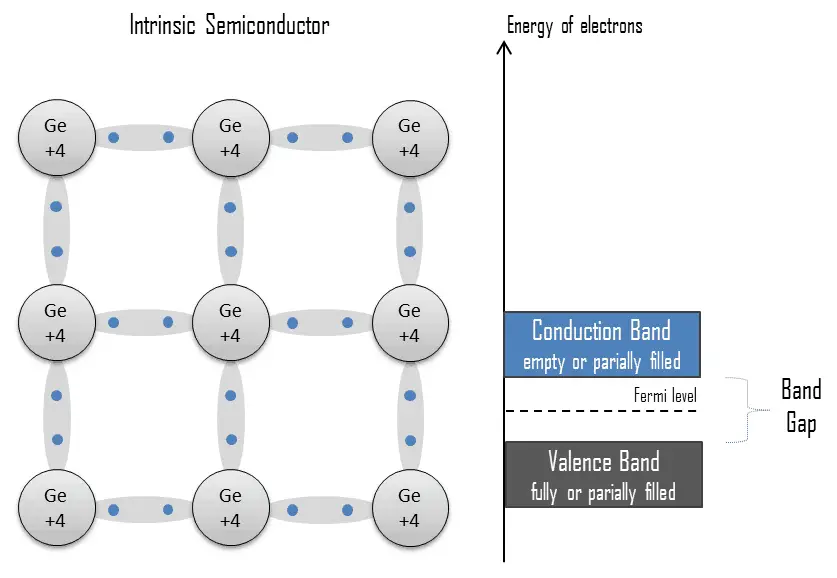
  • Cooling. The major drawback of HPGe detectors is that they must be cooled to liquid nitrogen temperatures. Because germanium has relatively low band gap, these detectors must be cooled in order to reduce the thermal generation of charge carriers to an acceptable level. Otherwise, leakage current induced noise destroys the energy resolution of the detector. Recall, the band gap (a distance between valence and conduction band) is very low for germanium (Egap= 0.67 eV). Cooling to liquid nitrogen temperature (-195.8°C; -320°F) reduces thermal excitations of valence electrons so that only a gamma ray interaction can give an electron the energy necessary to cross the band gap and reach the conduction band.
  • Price. The disadvantage is that germanium detectors are much more expensive than ionization chambers or scintillation counters.
References:

Radiation Protection:

  1. Knoll, Glenn F., Radiation Detection and Measurement 4th Edition, Wiley, 8/2010. ISBN-13: 978-0470131480.
  2. Stabin, Michael G., Radiation Protection and Dosimetry: An Introduction to Health Physics, Springer, 10/2010. ISBN-13: 978-1441923912.
  3. Martin, James E., Physics for Radiation Protection 3rd Edition, Wiley-VCH, 4/2013. ISBN-13: 978-3527411764.
  4. U.S.NRC, NUCLEAR REACTOR CONCEPTS
  5. U.S. Department of Energy, Instrumantation and Control. DOE Fundamentals Handbook, Volume 2 of 2. June 1992.

Nuclear and Reactor Physics:

  1. J. R. Lamarsh, Introduction to Nuclear Reactor Theory, 2nd ed., Addison-Wesley, Reading, MA (1983).
  2. J. R. Lamarsh, A. J. Baratta, Introduction to Nuclear Engineering, 3d ed., Prentice-Hall, 2001, ISBN: 0-201-82498-1.
  3. W. M. Stacey, Nuclear Reactor Physics, John Wiley & Sons, 2001, ISBN: 0- 471-39127-1.
  4. Glasstone, Sesonske. Nuclear Reactor Engineering: Reactor Systems Engineering, Springer; 4th edition, 1994, ISBN: 978-0412985317
  5. W.S.C. Williams. Nuclear and Particle Physics. Clarendon Press; 1 edition, 1991, ISBN: 978-0198520467
  6. G.R.Keepin. Physics of Nuclear Kinetics. Addison-Wesley Pub. Co; 1st edition, 1965
  7. Robert Reed Burn, Introduction to Nuclear Reactor Operation, 1988.
  8. U.S. Department of Energy, Nuclear Physics and Reactor Theory. DOE Fundamentals Handbook, Volume 1 and 2. January 1993.
  9. Paul Reuss, Neutron Physics. EDP Sciences, 2008. ISBN: 978-2759800414.

See also:

Scintillation Detectors

We hope, this article, Scintillation Detector vs Germanium Detector, helps you. If so, give us a like in the sidebar. Main purpose of this website is to help the public to learn some interesting and important information about radiation and dosimeters.

What is Scintillation Detector vs Semiconductor Detector – Definition

Scintillation detectors and semiconductor detectors are widely used in nuclear power plants. Scintillation counters are widely used in radiation protection. Semiconductor detectors are widely used for gamma ray spectroscopy. Radiation Dosimetry

Scintillation Counters

A scintillation counter or scintillation detector is a radiation detector which uses the effect known as scintillation. Scintillation is a flash of light produced in a transparent material by the passage of a particle (an electron, an alpha particle, an ion, or a high-energy photon). Scintillation occurs in the scintillator, which is a key part of a scintillation detector. In general, a scintillation detector consists of:

  • Scintillator. A scintillator generates photons in response to incident radiation.
  • Photodetector. A sensitive photodetector (usually a photomultiplier tube (PMT), a charge-coupled device (CCD) camera, or a photodiode), which converts the light to an electrical signal and electronics to process this signal.

The basic principle of operation involves the radiation reacting with a scintillator, which produces a series of flashes of varying intensity. The intensity of the flashes is proportional to the energy of the radiation. This feature is very important. These counters are suited to measure the energy of  gamma radiation (gamma spectroscopy) and, therefore, can be used to identify gamma emitting isotopes.

Scintillation counters are widely used in radiation protection, assay of radioactive materials and physics research because they can be made inexpensively yet with good efficiency, and can measure both the intensity and the energy of incident radiation. Hospitals all over the world have gamma cameras based on the scintillation effect and, therefore, they are also called scintillation cameras.

Advantages and disadvantages of scintillation counters are determined by the scintillator. The following features are not general for all scintillators.

Advantages of Scintillation Counters

  • Efficiency. The advantages of a scintillation counter are its efficiency and the high precision and counting rates that are possible. These latter attributes are a consequence of the extremely short duration of the light flashes, from about 10-9  (organic scintillators) to 10-6 (inorganic scintillators) seconds.
  • Spectroscopy. The intensity of the flashes and the amplitude of the output voltage pulse are proportional to the energy of the radiation. Therefore, scintillation counters can be used to determine the energy, as well as the number, of the exciting particles (or gamma photons). For gamma spectrometry, the most common detectors include sodium iodide (NaI) scintillation counters and high-purity germanium detectors. The NaI(Tl) scintillator has a higher energy resolution than a proportional counter, allowing for more accurate energy determinations. On the other hand, if a perfect energy resolution is required, we have to use germanium-based detector, such as the HPGe detector.

Disadvantages of Scintillation Counters

  • Hygroscopicity. A disadvantage of some inorganic crystals, e.g., NaI, is their hygroscopicity, a property which requires them to be housed in an airtight container to protect them from moisture.
  • NaI(Tl) has no beta or alpha response and poor low energy gamma response.
  • Liquid scintillators are relatively cumbersome.

Semiconductor Detectors

A semiconductor detector is a radiation detector which is based on a semiconductor, such as silicon or germanium to measure the effect of incident charged particles or photons. Semiconductor detectors are widely used in radiation protection, assay of radioactive materials and physics research.

Advantages of HPGe Detectors

  • Higher atomic number. Germanium is preferred due to its atomic number being much higher than silicon and which increases the probability of gamma ray interaction.
  • Germanium has lower average energy necessary to create an electron-hole pair, which is 3.6 eV for silicon and 2.9 eV for germanium.
  • Very good energy resolution. The FWHM for germanium detectors is a function of energy. For a 1.3 MeV photon, the FWHM is 2.1 keV, which is very low.
  • Large Crystals. While silicon-based detectors cannot be thicker than a few millimeters, germanium can have a depleted, sensitive thickness of centimeters, and therefore can be used as a total absorption detector for gamma rays up to few MeV.

Disadvantages of HPGe Detectors

  • Cooling. The major drawback of HPGe detectors is that they must be cooled to liquid nitrogen temperatures. Because germanium has relatively low band gap, these detectors must be cooled in order to reduce the thermal generation of charge carriers to an acceptable level. Otherwise, leakage current induced noise destroys the energy resolution of the detector. Recall, the band gap (a distance between valence and conduction band) is very low for germanium (Egap= 0.67 eV). Cooling to liquid nitrogen temperature (-195.8°C; -320°F) reduces thermal excitations of valence electrons so that only a gamma ray interaction can give an electron the energy necessary to cross the band gap and reach the conduction band.
  • Price. The disadvantage is that germanium detectors are much more expensive than ionization chambers or scintillation counters.

Advantages of Silicon Detectors

  • Compared with gaseous ionization detectors, the density of a semiconductor detector is very high, and charged particles of high energy can give off their energy in a semiconductor of relatively small dimensions.
  • Silicon has a high density of  2.329 g/cm3 and therefore the average energy loss per unit of length allows building thin detectors (e.g. 300 µm) that still produce measurable signals. For example, in case of minimum ionizing particle (MIP) the energy loss is 390 eV/µm. The silicon detectors are mechanically rigid and therefore no special supporting structures are needed.
  • Silicon-based detectors are very good for tracking charged particles, they constitute a substantial part of detection system at the LHC in CERN.
  • Silicon detectors can be used in strong magnetic fields.

Disadvantages of Silicon Detectors

  • Price. The disadvantage is that silicon detectors are much more expensive than cloud chambers or wire chambers.
  • Degradation. They also suffer degradation over time from radiation, however this can be greatly reduced thanks to the Lazarus effect.
  • High FWHM. In gamma spectroscopy, germanium is preferred due to its atomic number being much higher than silicon and which increases the probability of gamma ray interaction. Moreover, germanium has lower average energy necessary to create an electron-hole pair, which is 3.6 eV for silicon and 2.9 eV for germanium. This also provides the latter a better resolution in energy.
References:

Radiation Protection:

  1. Knoll, Glenn F., Radiation Detection and Measurement 4th Edition, Wiley, 8/2010. ISBN-13: 978-0470131480.
  2. Stabin, Michael G., Radiation Protection and Dosimetry: An Introduction to Health Physics, Springer, 10/2010. ISBN-13: 978-1441923912.
  3. Martin, James E., Physics for Radiation Protection 3rd Edition, Wiley-VCH, 4/2013. ISBN-13: 978-3527411764.
  4. U.S.NRC, NUCLEAR REACTOR CONCEPTS
  5. U.S. Department of Energy, Instrumantation and Control. DOE Fundamentals Handbook, Volume 2 of 2. June 1992.

Nuclear and Reactor Physics:

  1. J. R. Lamarsh, Introduction to Nuclear Reactor Theory, 2nd ed., Addison-Wesley, Reading, MA (1983).
  2. J. R. Lamarsh, A. J. Baratta, Introduction to Nuclear Engineering, 3d ed., Prentice-Hall, 2001, ISBN: 0-201-82498-1.
  3. W. M. Stacey, Nuclear Reactor Physics, John Wiley & Sons, 2001, ISBN: 0- 471-39127-1.
  4. Glasstone, Sesonske. Nuclear Reactor Engineering: Reactor Systems Engineering, Springer; 4th edition, 1994, ISBN: 978-0412985317
  5. W.S.C. Williams. Nuclear and Particle Physics. Clarendon Press; 1 edition, 1991, ISBN: 978-0198520467
  6. G.R.Keepin. Physics of Nuclear Kinetics. Addison-Wesley Pub. Co; 1st edition, 1965
  7. Robert Reed Burn, Introduction to Nuclear Reactor Operation, 1988.
  8. U.S. Department of Energy, Nuclear Physics and Reactor Theory. DOE Fundamentals Handbook, Volume 1 and 2. January 1993.
  9. Paul Reuss, Neutron Physics. EDP Sciences, 2008. ISBN: 978-2759800414.

See also:

Scintillation Detectors

We hope, this article, Scintillation Detector vs Semiconductor Detector, helps you. If so, give us a like in the sidebar. Main purpose of this website is to help the public to learn some interesting and important information about radiation and dosimeters.

What is Gaseous Detector vs Semiconductor Detector – Definition

Gaseous detectors and semiconductor detectors are widely used in nuclear power plants. Gaseous detectors are used in nuclear instrumentation system. Semiconductor detectors are widely used for gamma ray spectroscopy. Radiation Dosimetry

Gaseous Ionization Detectors

Gaseous ionization detectors are widely used in nuclear power plants, for the most part, to measure alpha and beta particles, neutrons, and gamma rays. The detectors operate in the ionization, proportional, and Geiger-Mueller regions with an arrangement most sensitive to the type of radiation being measured. Neutron detectors utilize ionization chambers or proportional counters of appropriate design. Compensated ion chambers, BF3 counters, fission counters, and proton recoil counters are examples of neutron detectors.

Advantages and Disadvantages depending on Detector Voltage

The relationship between the applied voltage and pulse height in a detector is very complex. Pulse height and the number of ion pairs collected are directly related. As was written, the voltages can vary widely depending upon the detector geometry and the gas type and pressure. The figure schematically indicates the different voltage regions for alpha, beta and gamma rays. There are six main practical operating regions, where three (ionization, proportional and Geiger-Mueller region) are useful to detect ionizing radiation. These reqions are shown below. The alpha curve is higher than the beta and gamma curve from recombination region to part of limited proportionality region due to the larger number of ion pairs produced by the initial reaction of the incident radiation.

  • Ionization Region. In the ionization region, an increase in voltage does not cause a substantial increase in the number of ion-pairs collected. The number of ion-pairs collected by the electrodes is equal to the number of ion-pairs produced by the incident radiation, and is dependent on the type and energy of the particles or rays in the incident radiation. Therefore, in this region the curve is flat. The voltage must be higher than the point where dissociated ion-pairs can recombine. On the other hand, the voltage is not high enough to produce gas amplification (secondary ionization). Detectors in the ionization region operate at a low electric field strength, selected such that no gas multiplication takes place. Their current is independent of the applied voltage, and they are preferred for high radiation dose rates because they have no “dead time”, a phenomenon which affects the accuracy of the Geiger-Mueller tube at high dose rates.
  • Proportional Region. In the proportional region, the charge collected increases with a further increase in the detector voltage, while the number of primary ion-pairs remains unchanged. Increasing the voltage, provides the primary electrons with sufficient acceleration and energy so that they can ionize additional atoms of the medium. These secondary ions formed are also accelerated causing an effect known as Townsend avalanches, which creates a single large electrical pulse. Even though there is a large number of secondary ions (about 103 – 105) for each primary event, the chamber is always operated such that the number of secondary ions is proportional to the number of primary events. It is very important, because the primary ionization is dependent on the type and energy of the particles or rays in the intercepted radiation field. The number of ion pairs collected divided by the number of ion pairs produced by the primary ionization provides the gas amplification factor (denoted by A). The gas amplification that occurs in this region can increase the total amount of ionization to a measurable value. The process of charge amplification greatly improves the signal-to-noise ratio of the detector and reduces the subsequent electronic amplification required. When instruments are operated in the proportional region, the voltage must be kept constant. If a voltage remains constant the gas amplification factor also does not change. Proportional counter detection instruments are very sensitive to low levels of radiation. Moreover, proportional counters are capable of particle identification and energy measurement (spectroscopy). Different energies of radiation and different types of radiation can be distinguished by analyzing the pulse height, since they significantly differ in the primary ionization.
  • Geiger-Mueller Region. In the Geiger-Mueller region, the voltage and thus  the electric field is so strong that secondary avalanches can occur. These avalanches can be triggered and propagated by photons emitted by atoms excited in the original avalanche. Since these photons are not affected by the electric field, they may interact far (e.g. laterally to the axis) from the primary avalanche, the entire Geiger tube is participating in the process. A strong signal (the amplification factor can reach about 1010) is produced by these avalanches with shape and height independently of the primary ionization and the energy of the detected photon.  Detectors, which are operated in the Geiger-Mueller region, are capable of detection of gamma rays, and also of all types of charged particles, that can enter the detector. These detectors are known as Geiger counters. Main advantage of these instruments is that they usually do not require any signal amplifiers. Since the positive ions do not move far from the avalanche region, a positively charged ion cloud disturbs the electric field and terminates the avalanche process. In practice the termination of the avalanche is improved by the use of “quenching” techniques. In contrast to proportional counters the energy or even incident radiation particle cannot not be distinguished by Geiger counters, since the output signal is independent of the amount and type of original ionization.

Semiconductor Detectors

A semiconductor detector is a radiation detector which is based on a semiconductor, such as silicon or germanium to measure the effect of incident charged particles or photons. Semiconductor detectors are widely used in radiation protection, assay of radioactive materials and physics research because they have some unique features, can be made inexpensively yet with good efficiency, and can measure both the intensity and the energy of incident radiation. These detectors are employed to measure the energy of the radiation and for identification of particles. Of the available semiconductor materials, silicon is mainly used for charged particle detectors (especially for tracking charged particles) and soft X-ray detectors while germanium is widely used for gamma ray spectroscopy. A large, clean and almost perfect semiconductor is ideal as a counter for radioactivity. However, it is difficult to make large crystals with sufficient purity. The semiconductor detectors have, therefore, low efficiency, but they do give a very precise measure of the energy. Semiconductor detectors, especially germanium based detectors, are most commonly used where a very good energy resolution is required. In order to achieve maximum efficiency the detectors must operate at the very low temperatures of liquid nitrogen (-196°C). Therefore, the drawback is that semiconductor detectors are much more expensive than other detectors and require sophisticated cooling to reduce leakage currents (noise).

Advantages of HPGe Detectors

  • Higher atomic number. Germanium is preferred due to its atomic number being much higher than silicon and which increases the probability of gamma ray interaction.
  • Germanium has lower average energy necessary to create an electron-hole pair, which is 3.6 eV for silicon and 2.9 eV for germanium.
  • Very good energy resolution. The FWHM for germanium detectors is a function of energy. For a 1.3 MeV photon, the FWHM is 2.1 keV, which is very low.
  • Large Crystals. While silicon-based detectors cannot be thicker than a few millimeters, germanium can have a depleted, sensitive thickness of centimeters, and therefore can be used as a total absorption detector for gamma rays up to few MeV.

Disadvantages of HPGe Detectors

  • Cooling. The major drawback of HPGe detectors is that they must be cooled to liquid nitrogen temperatures. Because germanium has relatively low band gap, these detectors must be cooled in order to reduce the thermal generation of charge carriers to an acceptable level. Otherwise, leakage current induced noise destroys the energy resolution of the detector. Recall, the band gap (a distance between valence and conduction band) is very low for germanium (Egap= 0.67 eV). Cooling to liquid nitrogen temperature (-195.8°C; -320°F) reduces thermal excitations of valence electrons so that only a gamma ray interaction can give an electron the energy necessary to cross the band gap and reach the conduction band.
  • Price. The disadvantage is that germanium detectors are much more expensive than ionization chambers or scintillation counters.

Advantages of Silicon Detectors

  • Compared with gaseous ionization detectors, the density of a semiconductor detector is very high, and charged particles of high energy can give off their energy in a semiconductor of relatively small dimensions.
  • Silicon has a high density of  2.329 g/cm3 and therefore the average energy loss per unit of length allows building thin detectors (e.g. 300 µm) that still produce measurable signals. For example, in case of minimum ionizing particle (MIP) the energy loss is 390 eV/µm. The silicon detectors are mechanically rigid and therefore no special supporting structures are needed.
  • Silicon-based detectors are very good for tracking charged particles, they constitute a substantial part of detection system at the LHC in CERN.
  • Silicon detectors can be used in strong magnetic fields.

Disadvantages of Silicon Detectors

  • Price. The disadvantage is that silicon detectors are much more expensive than cloud chambers or wire chambers.
  • Degradation. They also suffer degradation over time from radiation, however this can be greatly reduced thanks to the Lazarus effect.
  • High FWHM. In gamma spectroscopy, germanium is preferred due to its atomic number being much higher than silicon and which increases the probability of gamma ray interaction. Moreover, germanium has lower average energy necessary to create an electron-hole pair, which is 3.6 eV for silicon and 2.9 eV for germanium. This also provides the latter a better resolution in energy.
References:

Radiation Protection:

  1. Knoll, Glenn F., Radiation Detection and Measurement 4th Edition, Wiley, 8/2010. ISBN-13: 978-0470131480.
  2. Stabin, Michael G., Radiation Protection and Dosimetry: An Introduction to Health Physics, Springer, 10/2010. ISBN-13: 978-1441923912.
  3. Martin, James E., Physics for Radiation Protection 3rd Edition, Wiley-VCH, 4/2013. ISBN-13: 978-3527411764.
  4. U.S.NRC, NUCLEAR REACTOR CONCEPTS
  5. U.S. Department of Energy, Instrumantation and Control. DOE Fundamentals Handbook, Volume 2 of 2. June 1992.

Nuclear and Reactor Physics:

  1. J. R. Lamarsh, Introduction to Nuclear Reactor Theory, 2nd ed., Addison-Wesley, Reading, MA (1983).
  2. J. R. Lamarsh, A. J. Baratta, Introduction to Nuclear Engineering, 3d ed., Prentice-Hall, 2001, ISBN: 0-201-82498-1.
  3. W. M. Stacey, Nuclear Reactor Physics, John Wiley & Sons, 2001, ISBN: 0- 471-39127-1.
  4. Glasstone, Sesonske. Nuclear Reactor Engineering: Reactor Systems Engineering, Springer; 4th edition, 1994, ISBN: 978-0412985317
  5. W.S.C. Williams. Nuclear and Particle Physics. Clarendon Press; 1 edition, 1991, ISBN: 978-0198520467
  6. G.R.Keepin. Physics of Nuclear Kinetics. Addison-Wesley Pub. Co; 1st edition, 1965
  7. Robert Reed Burn, Introduction to Nuclear Reactor Operation, 1988.
  8. U.S. Department of Energy, Nuclear Physics and Reactor Theory. DOE Fundamentals Handbook, Volume 1 and 2. January 1993.
  9. Paul Reuss, Neutron Physics. EDP Sciences, 2008. ISBN: 978-2759800414.

See also:

Gaseous Detectors

We hope, this article, Gaseous Detector vs Semiconductor Detector, helps you. If so, give us a like in the sidebar. Main purpose of this website is to help the public to learn some interesting and important information about radiation and dosimeters.

What is Gaseous Detector vs Scintillation Detector – Definition

Gaseous detectors and scintillation detectors are widely used in nuclear power plants. Gaseous detectors are used in nuclear instrumentation system. Scintillation detectors are widely used in dosimetry. Radiation Dosimetry

Gaseous Ionization Detectors

Gaseous ionization detectors are widely used in nuclear power plants, for the most part, to measure alpha and beta particles, neutrons, and gamma rays. The detectors operate in the ionization, proportional, and Geiger-Mueller regions with an arrangement most sensitive to the type of radiation being measured. Neutron detectors utilize ionization chambers or proportional counters of appropriate design. Compensated ion chambers, BF3 counters, fission counters, and proton recoil counters are examples of neutron detectors.

Advantages and Disadvantages depending on Detector Voltage

The relationship between the applied voltage and pulse height in a detector is very complex. Pulse height and the number of ion pairs collected are directly related. As was written, the voltages can vary widely depending upon the detector geometry and the gas type and pressure. The figure schematically indicates the different voltage regions for alpha, beta and gamma rays. There are six main practical operating regions, where three (ionization, proportional and Geiger-Mueller region) are useful to detect ionizing radiation. These reqions are shown below. The alpha curve is higher than the beta and gamma curve from recombination region to part of limited proportionality region due to the larger number of ion pairs produced by the initial reaction of the incident radiation.

  • Ionization Region. In the ionization region, an increase in voltage does not cause a substantial increase in the number of ion-pairs collected. The number of ion-pairs collected by the electrodes is equal to the number of ion-pairs produced by the incident radiation, and is dependent on the type and energy of the particles or rays in the incident radiation. Therefore, in this region the curve is flat. The voltage must be higher than the point where dissociated ion-pairs can recombine. On the other hand, the voltage is not high enough to produce gas amplification (secondary ionization). Detectors in the ionization region operate at a low electric field strength, selected such that no gas multiplication takes place. Their current is independent of the applied voltage, and they are preferred for high radiation dose rates because they have no “dead time”, a phenomenon which affects the accuracy of the Geiger-Mueller tube at high dose rates.
  • Proportional Region. In the proportional region, the charge collected increases with a further increase in the detector voltage, while the number of primary ion-pairs remains unchanged. Increasing the voltage, provides the primary electrons with sufficient acceleration and energy so that they can ionize additional atoms of the medium. These secondary ions formed are also accelerated causing an effect known as Townsend avalanches, which creates a single large electrical pulse. Even though there is a large number of secondary ions (about 103 – 105) for each primary event, the chamber is always operated such that the number of secondary ions is proportional to the number of primary events. It is very important, because the primary ionization is dependent on the type and energy of the particles or rays in the intercepted radiation field. The number of ion pairs collected divided by the number of ion pairs produced by the primary ionization provides the gas amplification factor (denoted by A). The gas amplification that occurs in this region can increase the total amount of ionization to a measurable value. The process of charge amplification greatly improves the signal-to-noise ratio of the detector and reduces the subsequent electronic amplification required. When instruments are operated in the proportional region, the voltage must be kept constant. If a voltage remains constant the gas amplification factor also does not change. Proportional counter detection instruments are very sensitive to low levels of radiation. Moreover, proportional counters are capable of particle identification and energy measurement (spectroscopy). Different energies of radiation and different types of radiation can be distinguished by analyzing the pulse height, since they significantly differ in the primary ionization.
  • Geiger-Mueller Region. In the Geiger-Mueller region, the voltage and thus  the electric field is so strong that secondary avalanches can occur. These avalanches can be triggered and propagated by photons emitted by atoms excited in the original avalanche. Since these photons are not affected by the electric field, they may interact far (e.g. laterally to the axis) from the primary avalanche, the entire Geiger tube is participating in the process. A strong signal (the amplification factor can reach about 1010) is produced by these avalanches with shape and height independently of the primary ionization and the energy of the detected photon.  Detectors, which are operated in the Geiger-Mueller region, are capable of detection of gamma rays, and also of all types of charged particles, that can enter the detector. These detectors are known as Geiger counters. Main advantage of these instruments is that they usually do not require any signal amplifiers. Since the positive ions do not move far from the avalanche region, a positively charged ion cloud disturbs the electric field and terminates the avalanche process. In practice the termination of the avalanche is improved by the use of “quenching” techniques. In contrast to proportional counters the energy or even incident radiation particle cannot not be distinguished by Geiger counters, since the output signal is independent of the amount and type of original ionization.

Scintillation Counters

A scintillation counter or scintillation detector is a radiation detector which uses the effect known as scintillation. Scintillation is a flash of light produced in a transparent material by the passage of a particle (an electron, an alpha particle, an ion, or a high-energy photon). Scintillation occurs in the scintillator, which is a key part of a scintillation detector. In general, a scintillation detector consists of:

  • Scintillator. A scintillator generates photons in response to incident radiation.
  • Photodetector. A sensitive photodetector (usually a photomultiplier tube (PMT), a charge-coupled device (CCD) camera, or a photodiode), which converts the light to an electrical signal and electronics to process this signal.

The basic principle of operation involves the radiation reacting with a scintillator, which produces a series of flashes of varying intensity. The intensity of the flashes is proportional to the energy of the radiation. This feature is very important. These counters are suited to measure the energy of  gamma radiation (gamma spectroscopy) and, therefore, can be used to identify gamma emitting isotopes.

Scintillation counters are widely used in radiation protection, assay of radioactive materials and physics research because they can be made inexpensively yet with good efficiency, and can measure both the intensity and the energy of incident radiation. Hospitals all over the world have gamma cameras based on the scintillation effect and, therefore, they are also called scintillation cameras.

Advantages and disadvantages of scintillation counters are determined by the scintillator. The following features are not general for all scintillators.

Advantages of Scintillation Counters

  • Efficiency. The advantages of a scintillation counter are its efficiency and the high precision and counting rates that are possible. These latter attributes are a consequence of the extremely short duration of the light flashes, from about 10-9  (organic scintillators) to 10-6 (inorganic scintillators) seconds.
  • Spectroscopy. The intensity of the flashes and the amplitude of the output voltage pulse are proportional to the energy of the radiation. Therefore, scintillation counters can be used to determine the energy, as well as the number, of the exciting particles (or gamma photons). For gamma spectrometry, the most common detectors include sodium iodide (NaI) scintillation counters and high-purity germanium detectors. The NaI(Tl) scintillator has a higher energy resolution than a proportional counter, allowing for more accurate energy determinations. On the other hand, if a perfect energy resolution is required, we have to use germanium-based detector, such as the HPGe detector.

Disadvantages of Scintillation Counters

  • Hygroscopicity. A disadvantage of some inorganic crystals, e.g., NaI, is their hygroscopicity, a property which requires them to be housed in an airtight container to protect them from moisture.
  • NaI(Tl) has no beta or alpha response and poor low energy gamma response.
  • Liquid scintillators are relatively cumbersome.
References:

Radiation Protection:

  1. Knoll, Glenn F., Radiation Detection and Measurement 4th Edition, Wiley, 8/2010. ISBN-13: 978-0470131480.
  2. Stabin, Michael G., Radiation Protection and Dosimetry: An Introduction to Health Physics, Springer, 10/2010. ISBN-13: 978-1441923912.
  3. Martin, James E., Physics for Radiation Protection 3rd Edition, Wiley-VCH, 4/2013. ISBN-13: 978-3527411764.
  4. U.S.NRC, NUCLEAR REACTOR CONCEPTS
  5. U.S. Department of Energy, Instrumantation and Control. DOE Fundamentals Handbook, Volume 2 of 2. June 1992.

Nuclear and Reactor Physics:

  1. J. R. Lamarsh, Introduction to Nuclear Reactor Theory, 2nd ed., Addison-Wesley, Reading, MA (1983).
  2. J. R. Lamarsh, A. J. Baratta, Introduction to Nuclear Engineering, 3d ed., Prentice-Hall, 2001, ISBN: 0-201-82498-1.
  3. W. M. Stacey, Nuclear Reactor Physics, John Wiley & Sons, 2001, ISBN: 0- 471-39127-1.
  4. Glasstone, Sesonske. Nuclear Reactor Engineering: Reactor Systems Engineering, Springer; 4th edition, 1994, ISBN: 978-0412985317
  5. W.S.C. Williams. Nuclear and Particle Physics. Clarendon Press; 1 edition, 1991, ISBN: 978-0198520467
  6. G.R.Keepin. Physics of Nuclear Kinetics. Addison-Wesley Pub. Co; 1st edition, 1965
  7. Robert Reed Burn, Introduction to Nuclear Reactor Operation, 1988.
  8. U.S. Department of Energy, Nuclear Physics and Reactor Theory. DOE Fundamentals Handbook, Volume 1 and 2. January 1993.
  9. Paul Reuss, Neutron Physics. EDP Sciences, 2008. ISBN: 978-2759800414.

See also:

Gaseous Detectors

We hope, this article, Gaseous Detector vs Scintillation Detector, helps you. If so, give us a like in the sidebar. Main purpose of this website is to help the public to learn some interesting and important information about radiation and dosimeters.

What is Advantage and Disadvantage of Semiconductor Detectors – Definition

Advantages and Disadvantages of Semiconductor Detectors. The drawback is that semiconductor detectors are much more expensive than other detectors and require sophisticated cooling to reduce leakage currents (noise). Radiation Dosimetry
HPGe Detector - Germanium
HPGe detector with LN2 cryostat Source: canberra.com

A semiconductor detector is a radiation detector which is based on a semiconductor, such as silicon or germanium to measure the effect of incident charged particles or photons. Semiconductor detectors are widely used in radiation protection, assay of radioactive materials and physics research because they have some unique features, can be made inexpensively yet with good efficiency, and can measure both the intensity and the energy of incident radiation. These detectors are employed to measure the energy of the radiation and for identification of particles. Of the available semiconductor materials, silicon is mainly used for charged particle detectors (especially for tracking charged particles) and soft X-ray detectors while germanium is widely used for gamma ray spectroscopy. A large, clean and almost perfect semiconductor is ideal as a counter for radioactivity. However, it is difficult to make large crystals with sufficient purity. The semiconductor detectors have, therefore, low efficiency, but they do give a very precise measure of the energy. Semiconductor detectors, especially germanium based detectors, are most commonly used where a very good energy resolution is required. In order to achieve maximum efficiency the detectors must operate at the very low temperatures of liquid nitrogen (-196°C). Therefore, the drawback is that semiconductor detectors are much more expensive than other detectors and require sophisticated cooling to reduce leakage currents (noise).

Advantages and Disadvantages of Semiconductor Detectors

Advantages of HPGe Detectors

  • Higher atomic number. Germanium is preferred due to its atomic number being much higher than silicon and which increases the probability of gamma ray interaction.
  • Germanium has lower average energy necessary to create an electron-hole pair, which is 3.6 eV for silicon and 2.9 eV for germanium.
  • Very good energy resolution. The FWHM for germanium detectors is a function of energy. For a 1.3 MeV photon, the FWHM is 2.1 keV, which is very low.
  • Large Crystals. While silicon-based detectors cannot be thicker than a few millimeters, germanium can have a depleted, sensitive thickness of centimeters, and therefore can be used as a total absorption detector for gamma rays up to few MeV.

Disadvantages of HPGe Detectors

  • Cooling. The major drawback of HPGe detectors is that they must be cooled to liquid nitrogen temperatures. Because germanium has relatively low band gap, these detectors must be cooled in order to reduce the thermal generation of charge carriers to an acceptable level. Otherwise, leakage current induced noise destroys the energy resolution of the detector. Recall, the band gap (a distance between valence and conduction band) is very low for germanium (Egap= 0.67 eV). Cooling to liquid nitrogen temperature (-195.8°C; -320°F) reduces thermal excitations of valence electrons so that only a gamma ray interaction can give an electron the energy necessary to cross the band gap and reach the conduction band.
  • Price. The disadvantage is that germanium detectors are much more expensive than ionization chambers or scintillation counters.

Advantages of Silicon Detectors

  • Compared with gaseous ionization detectors, the density of a semiconductor detector is very high, and charged particles of high energy can give off their energy in a semiconductor of relatively small dimensions.
  • Silicon has a high density of  2.329 g/cm3 and therefore the average energy loss per unit of length allows building thin detectors (e.g. 300 µm) that still produce measurable signals. For example, in case of minimum ionizing particle (MIP) the energy loss is 390 eV/µm. The silicon detectors are mechanically rigid and therefore no special supporting structures are needed.
  • Silicon-based detectors are very good for tracking charged particles, they constitute a substantial part of detection system at the LHC in CERN.
  • Silicon detectors can be used in strong magnetic fields.

Disadvantages of Silicon Detectors

  • Price. The disadvantage is that silicon detectors are much more expensive than cloud chambers or wire chambers.
  • Degradation. They also suffer degradation over time from radiation, however this can be greatly reduced thanks to the Lazarus effect.
  • High FWHM. In gamma spectroscopy, germanium is preferred due to its atomic number being much higher than silicon and which increases the probability of gamma ray interaction. Moreover, germanium has lower average energy necessary to create an electron-hole pair, which is 3.6 eV for silicon and 2.9 eV for germanium. This also provides the latter a better resolution in energy.
References:

Radiation Protection:

  1. Knoll, Glenn F., Radiation Detection and Measurement 4th Edition, Wiley, 8/2010. ISBN-13: 978-0470131480.
  2. Stabin, Michael G., Radiation Protection and Dosimetry: An Introduction to Health Physics, Springer, 10/2010. ISBN-13: 978-1441923912.
  3. Martin, James E., Physics for Radiation Protection 3rd Edition, Wiley-VCH, 4/2013. ISBN-13: 978-3527411764.
  4. U.S.NRC, NUCLEAR REACTOR CONCEPTS
  5. U.S. Department of Energy, Instrumantation and Control. DOE Fundamentals Handbook, Volume 2 of 2. June 1992.

Nuclear and Reactor Physics:

  1. J. R. Lamarsh, Introduction to Nuclear Reactor Theory, 2nd ed., Addison-Wesley, Reading, MA (1983).
  2. J. R. Lamarsh, A. J. Baratta, Introduction to Nuclear Engineering, 3d ed., Prentice-Hall, 2001, ISBN: 0-201-82498-1.
  3. W. M. Stacey, Nuclear Reactor Physics, John Wiley & Sons, 2001, ISBN: 0- 471-39127-1.
  4. Glasstone, Sesonske. Nuclear Reactor Engineering: Reactor Systems Engineering, Springer; 4th edition, 1994, ISBN: 978-0412985317
  5. W.S.C. Williams. Nuclear and Particle Physics. Clarendon Press; 1 edition, 1991, ISBN: 978-0198520467
  6. G.R.Keepin. Physics of Nuclear Kinetics. Addison-Wesley Pub. Co; 1st edition, 1965
  7. Robert Reed Burn, Introduction to Nuclear Reactor Operation, 1988.
  8. U.S. Department of Energy, Nuclear Physics and Reactor Theory. DOE Fundamentals Handbook, Volume 1 and 2. January 1993.
  9. Paul Reuss, Neutron Physics. EDP Sciences, 2008. ISBN: 978-2759800414.

See also:

Semiconductor Detectors

We hope, this article, Advantage and Disadvantage of Semiconductor Detectors, helps you. If so, give us a like in the sidebar. Main purpose of this website is to help the public to learn some interesting and important information about radiation and dosimeters.

What is Advantage and Disadvantage of HPGe Detectors – Definition

Main advantage of HPGe detectors is their very good energy resolution. Main disadvantage is that they must be cooled to liquid nitrogen temperatures. Radiation Dosimetry
HPGe Detector - Germanium
HPGe detector with LN2 cryostat Source: canberra.com

High-purity germanium detectors (HPGe detectors) are the best solution for precise gamma and x-ray spectroscopy. In comparison to silicon detectors, germanium is much more efficient than silicon for radiation detection due to its atomic number being much higher than silicon and due to lower average energy necessary to create an electron-hole pair, which is 3.6 eV for silicon and 2.9 eV for germanium. Due to its higher atomic number, Ge has a much lager linear attenuation coefficient, which leads to a shorter mean free path. Moreover silicon detectors cannot be thicker than a few millimeters, while germanium can have a depleted, sensitive thickness of centimeters, and therefore can be used as a total absorption detector for gamma rays up to few MeV.

Advantages and Disadvantages of HPGe Detectors

Advantages of HPGe Detectors

  • Higher atomic number. Germanium is preferred due to its atomic number being much higher than silicon and which increases the probability of gamma ray interaction.
  • Germanium has lower average energy necessary to create an electron-hole pair, which is 3.6 eV for silicon and 2.9 eV for germanium.
  • Very good energy resolution. The FWHM for germanium detectors is a function of energy. For a 1.3 MeV photon, the FWHM is 2.1 keV, which is very low.
  • Large Crystals. While silicon-based detectors cannot be thicker than a few millimeters, germanium can have a depleted, sensitive thickness of centimeters, and therefore can be used as a total absorption detector for gamma rays up to few MeV.

Disadvantages of HPGe Detectors

  • Cooling. The major drawback of HPGe detectors is that they must be cooled to liquid nitrogen temperatures. Because germanium has relatively low band gap, these detectors must be cooled in order to reduce the thermal generation of charge carriers to an acceptable level. Otherwise, leakage current induced noise destroys the energy resolution of the detector. Recall, the band gap (a distance between valence and conduction band) is very low for germanium (Egap= 0.67 eV). Cooling to liquid nitrogen temperature (-195.8°C; -320°F) reduces thermal excitations of valence electrons so that only a gamma ray interaction can give an electron the energy necessary to cross the band gap and reach the conduction band.
  • Price. The disadvantage is that germanium detectors are much more expensive than ionization chambers or scintillation counters.
References:

Radiation Protection:

  1. Knoll, Glenn F., Radiation Detection and Measurement 4th Edition, Wiley, 8/2010. ISBN-13: 978-0470131480.
  2. Stabin, Michael G., Radiation Protection and Dosimetry: An Introduction to Health Physics, Springer, 10/2010. ISBN-13: 978-1441923912.
  3. Martin, James E., Physics for Radiation Protection 3rd Edition, Wiley-VCH, 4/2013. ISBN-13: 978-3527411764.
  4. U.S.NRC, NUCLEAR REACTOR CONCEPTS
  5. U.S. Department of Energy, Instrumantation and Control. DOE Fundamentals Handbook, Volume 2 of 2. June 1992.

Nuclear and Reactor Physics:

  1. J. R. Lamarsh, Introduction to Nuclear Reactor Theory, 2nd ed., Addison-Wesley, Reading, MA (1983).
  2. J. R. Lamarsh, A. J. Baratta, Introduction to Nuclear Engineering, 3d ed., Prentice-Hall, 2001, ISBN: 0-201-82498-1.
  3. W. M. Stacey, Nuclear Reactor Physics, John Wiley & Sons, 2001, ISBN: 0- 471-39127-1.
  4. Glasstone, Sesonske. Nuclear Reactor Engineering: Reactor Systems Engineering, Springer; 4th edition, 1994, ISBN: 978-0412985317
  5. W.S.C. Williams. Nuclear and Particle Physics. Clarendon Press; 1 edition, 1991, ISBN: 978-0198520467
  6. G.R.Keepin. Physics of Nuclear Kinetics. Addison-Wesley Pub. Co; 1st edition, 1965
  7. Robert Reed Burn, Introduction to Nuclear Reactor Operation, 1988.
  8. U.S. Department of Energy, Nuclear Physics and Reactor Theory. DOE Fundamentals Handbook, Volume 1 and 2. January 1993.
  9. Paul Reuss, Neutron Physics. EDP Sciences, 2008. ISBN: 978-2759800414.

See also:

HPGe Detector

We hope, this article, Advantage and Disadvantage of HPGe Detectors, helps you. If so, give us a like in the sidebar. Main purpose of this website is to help the public to learn some interesting and important information about radiation and dosimeters.

What is Application of HPGe Detectors – Definition

Since HPGe detectors are used to measure radiation in a variety of applications including personnel and environmental monitoring. Application of HPGe detectors
HPGe Detector - Germanium
HPGe detector with LN2 cryostat Source: canberra.com

High-purity germanium detectors (HPGe detectors) are the best solution for precise gamma and x-ray spectroscopy. In comparison to silicon detectors, germanium is much more efficient than silicon for radiation detection due to its atomic number being much higher than silicon and due to lower average energy necessary to create an electron-hole pair, which is 3.6 eV for silicon and 2.9 eV for germanium. Due to its higher atomic number, Ge has a much lager linear attenuation coefficient, which leads to a shorter mean free path. Moreover silicon detectors cannot be thicker than a few millimeters, while germanium can have a depleted, sensitive thickness of centimeters, and therefore can be used as a total absorption detector for gamma rays up to few MeV.

Since HPGe detectors produce the highest resolution commonly available today, they are used to measure radiation in a variety of applications including personnel and environmental monitoring for radioactive contamination, medical applications, radiometric assay, nuclear security and nuclear plant safety.

Application of HPGe Detectors – Gamma Spectroscopy

As was written, the study and analysis of gamma ray spectra for scientific and technical use is called gamma spectroscopy, and gamma ray spectrometers are the instruments which observe and collect such data. A gamma ray spectrometer (GRS) is a sophisticated device for measuring the energy distribution of gamma radiation. For the measurement of gamma rays above several hundred keV, there are two detector categories of major importance, inorganic scintillators as NaI(Tl) and semiconductor detectors. In the previous articles, we described the gamma spectroscopy using scintillation detector, which consists of a suitable scintillator crystal, a photomultiplier tube, and a circuit for measuring the height of the pulses produced by the photomultiplier. The advantages of a scintillation counter are its efficiency (large size and high density) and the high precision and counting rates that are possible. Due to the high atomic number of iodine, a large number of all interactions will result in complete absorption of gamma-ray energy, so the photo fraction will be high.

HPGe Detector spectrum
Figure: Caption: Comparison of NaI(Tl) and HPGe spectra for cobalt-60. Source: Radioisotopes and Radiation Methodology I, II. Soo Hyun Byun, Lecture Notes. McMaster University, Canada.

But if a perfect energy resolution is required, we have to use germanium-based detector, such as the HPGe detector. Germanium-based semiconductor detectors are most commonly used where a very good energy resolution is required, especially for gamma spectroscopy, as well as x-ray spectroscopy. In gamma spectroscopy, germanium is preferred due to its atomic number being much higher than silicon and which increases the probability of gamma ray interaction. Moreover, germanium has lower average energy necessary to create an electron-hole pair, which is 3.6 eV for silicon and 2.9 eV for germanium. This also provides the latter a better resolution in energy. The FWHM (full width at half maximum) for germanium detectors is a function of energy. For a 1.3 MeV photon, the FWHM is 2.1 keV, which is very low.

References:

Radiation Protection:

  1. Knoll, Glenn F., Radiation Detection and Measurement 4th Edition, Wiley, 8/2010. ISBN-13: 978-0470131480.
  2. Stabin, Michael G., Radiation Protection and Dosimetry: An Introduction to Health Physics, Springer, 10/2010. ISBN-13: 978-1441923912.
  3. Martin, James E., Physics for Radiation Protection 3rd Edition, Wiley-VCH, 4/2013. ISBN-13: 978-3527411764.
  4. U.S.NRC, NUCLEAR REACTOR CONCEPTS
  5. U.S. Department of Energy, Instrumantation and Control. DOE Fundamentals Handbook, Volume 2 of 2. June 1992.

Nuclear and Reactor Physics:

  1. J. R. Lamarsh, Introduction to Nuclear Reactor Theory, 2nd ed., Addison-Wesley, Reading, MA (1983).
  2. J. R. Lamarsh, A. J. Baratta, Introduction to Nuclear Engineering, 3d ed., Prentice-Hall, 2001, ISBN: 0-201-82498-1.
  3. W. M. Stacey, Nuclear Reactor Physics, John Wiley & Sons, 2001, ISBN: 0- 471-39127-1.
  4. Glasstone, Sesonske. Nuclear Reactor Engineering: Reactor Systems Engineering, Springer; 4th edition, 1994, ISBN: 978-0412985317
  5. W.S.C. Williams. Nuclear and Particle Physics. Clarendon Press; 1 edition, 1991, ISBN: 978-0198520467
  6. G.R.Keepin. Physics of Nuclear Kinetics. Addison-Wesley Pub. Co; 1st edition, 1965
  7. Robert Reed Burn, Introduction to Nuclear Reactor Operation, 1988.
  8. U.S. Department of Energy, Nuclear Physics and Reactor Theory. DOE Fundamentals Handbook, Volume 1 and 2. January 1993.
  9. Paul Reuss, Neutron Physics. EDP Sciences, 2008. ISBN: 978-2759800414.

See also:

HPGe Detector

We hope, this article, Application of HPGe Detectors, helps you. If so, give us a like in the sidebar. Main purpose of this website is to help the public to learn some interesting and important information about radiation and dosimeters.

What is Principle of Operation of HPGe Detectors – Definition

HPGe Detector – Principle of Operation. The operation of semiconductor detectors is summarized in the following points: Ionizing radiation enters the sensitive volume… Radiation Dosimetry
HPGe Detector - Germanium
HPGe detector with LN2 cryostat Source: canberra.com

High-purity germanium detectors (HPGe detectors) are the best solution for precise gamma and x-ray spectroscopy. In comparison to silicon detectors, germanium is much more efficient than silicon for radiation detection due to its atomic number being much higher than silicon and due to lower average energy necessary to create an electron-hole pair, which is 3.6 eV for silicon and 2.9 eV for germanium. Due to its higher atomic number, Ge has a much lager linear attenuation coefficient, which leads to a shorter mean free path. Moreover silicon detectors cannot be thicker than a few millimeters, while germanium can have a depleted, sensitive thickness of centimeters, and therefore can be used as a total absorption detector for gamma rays up to few MeV.

In order to achieve maximum efficiency the HPGe detectors must operate at the very low temperatures of liquid nitrogen (-196°C), because at room temperatures the noise caused by thermal excitation is very high.

HPGe Detector – Principle of Operation

The operation of semiconductor detectors is summarized in the following points:

  • Ionizing radiation enters the sensitive volume (germanium crystal) of the detector and interacts with the semiconductor material.
  • High-energy photon passing through the detector ionizes the atoms of semiconductor, producing the electron-hole pairs. The number of electron-hole pairs is proportional to the energy of the radiation to the semiconductor. As a result, a number of electrons are transferred from the valence band to the conduction band, and an equal number of holes are created in the valence band.
  • Since germanium can have a depleted, sensitive thickness of centimeters, they are able to absorb high-energy photons totally (up to few MeV).
  • Under the influence of an electric field, electrons and holes travel to the electrodes, where they result in a pulse that can be measured in an outer circuit.
  • This pulse carries information about the energy of the original incident radiation. The number of such pulses per unit time also gives information about the intensity of the radiation.

In all cases, a photon deposits a portion of its energy along its path and can be absorbed totally. Total absorption of a 1 MeV photon produces around 3 x 10⁵ electron-hole pairs. This value is minor in comparison the total number of free carriers in a 1 cm3 intrinsic semiconductor. Particle passing through the detector ionizes the atoms of semiconductor, producing the electron-hole pairs. But in germanium-based detectors at room temperature, thermal excitation is dominant. It is caused by impurities, irregularity in structure lattice or by dopant. It strongly depends on the Egap (a distance between valence and conduction band), which is very low for germanium (Egap= 0.67 eV). Since thermal excitation results in the detector noise, active cooling is required for some types of semiconductors (e.g. germanium).

Germanium - semiconductorNote that, a 1 cm3 sample of pure germanium at 20 °C contains about 4.2×10²² atoms, but also contains about 2.5 x 10¹³ free electrons and 2.5 x 10¹³ holes constantly generated from thermal energy. As can be seen, the signal to noise ratio (S/N) would be minimal (compare it with 3 x 10⁵ electron-hole pairs). The addition of 0.001% of arsenic (an impurity) donates an extra 1017 free electrons in the same volume and the electrical conductivity is increased by a factor of 10,000. In doped material the signal to noise ratio (S/N) would be even smaller. Because germanium has relatively low band gap, these detectors must be cooled in order to reduce the thermal generation of charge carriers (thus reverse leakage current) to an acceptable level. Otherwise, leakage current induced noise destroys the energy resolution of the detector.

References:

Radiation Protection:

  1. Knoll, Glenn F., Radiation Detection and Measurement 4th Edition, Wiley, 8/2010. ISBN-13: 978-0470131480.
  2. Stabin, Michael G., Radiation Protection and Dosimetry: An Introduction to Health Physics, Springer, 10/2010. ISBN-13: 978-1441923912.
  3. Martin, James E., Physics for Radiation Protection 3rd Edition, Wiley-VCH, 4/2013. ISBN-13: 978-3527411764.
  4. U.S.NRC, NUCLEAR REACTOR CONCEPTS
  5. U.S. Department of Energy, Instrumantation and Control. DOE Fundamentals Handbook, Volume 2 of 2. June 1992.

Nuclear and Reactor Physics:

  1. J. R. Lamarsh, Introduction to Nuclear Reactor Theory, 2nd ed., Addison-Wesley, Reading, MA (1983).
  2. J. R. Lamarsh, A. J. Baratta, Introduction to Nuclear Engineering, 3d ed., Prentice-Hall, 2001, ISBN: 0-201-82498-1.
  3. W. M. Stacey, Nuclear Reactor Physics, John Wiley & Sons, 2001, ISBN: 0- 471-39127-1.
  4. Glasstone, Sesonske. Nuclear Reactor Engineering: Reactor Systems Engineering, Springer; 4th edition, 1994, ISBN: 978-0412985317
  5. W.S.C. Williams. Nuclear and Particle Physics. Clarendon Press; 1 edition, 1991, ISBN: 978-0198520467
  6. G.R.Keepin. Physics of Nuclear Kinetics. Addison-Wesley Pub. Co; 1st edition, 1965
  7. Robert Reed Burn, Introduction to Nuclear Reactor Operation, 1988.
  8. U.S. Department of Energy, Nuclear Physics and Reactor Theory. DOE Fundamentals Handbook, Volume 1 and 2. January 1993.
  9. Paul Reuss, Neutron Physics. EDP Sciences, 2008. ISBN: 978-2759800414.

See also:

HPGe Detector

We hope, this article, Principle of Operation of HPGe Detectors, helps you. If so, give us a like in the sidebar. Main purpose of this website is to help the public to learn some interesting and important information about radiation and dosimeters.