Facebook Instagram Youtube Twitter

What is Alpha Decay vs Beta Decay – Radioactivity – Definition

Alpha Decay vs Beta Decay. This article summarizes main differences between alpha and beta decay, which have different nature. Beta particles are high-energy electrons, while alpha particles are nuclei of helium atoms. Radiation Dosimetry

Alpha decay (or α-decay and also alpha radioactivity) represents the disintegration of a parent nucleus to a daughter through the emission of the nucleus of a helium atom. This transition can be characterized as:
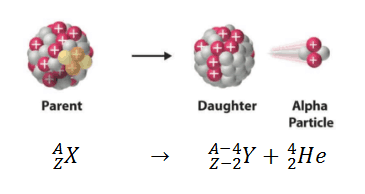
Alpha Decay - Alpha Radioactivity

As can be seen from the figure, alpha particle is emitted in alpha decay. Alpha particles are energetic nuclei of helium. Alpha particles consist of two protons and two neutrons bound together into a particle identical to a helium nucleus. Alpha particles are relatively large and carry a double positive charge. They are not very penetrating and a piece of paper can stop them. They travel only a few centimeters but deposit all their energies along their short paths.

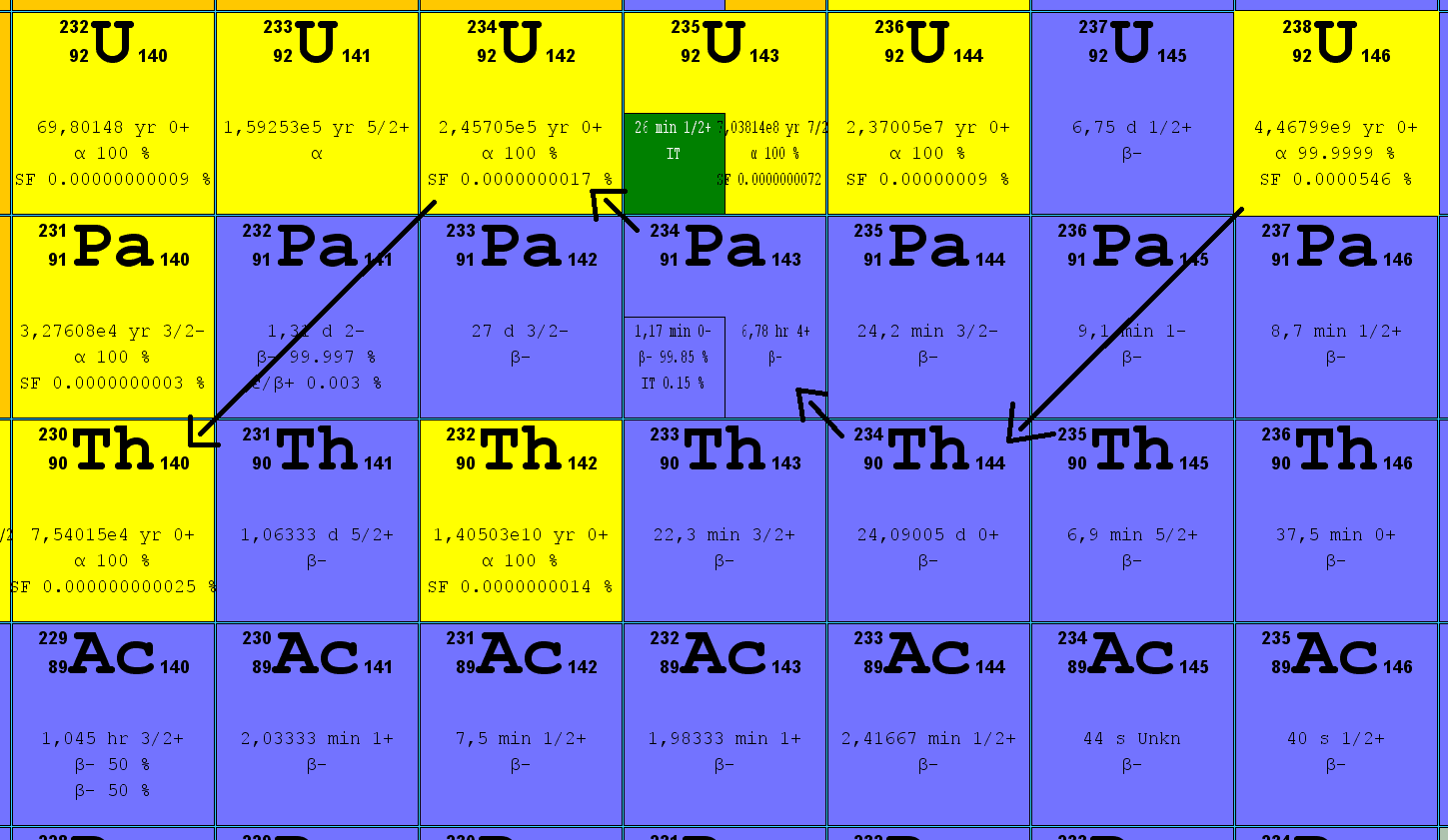
In practice, this mode of decay has only been observed in nuclides considerably heavier than nickel, with the lightest known alpha emitters being the lightest isotopes (mass numbers 106–110) of tellurium (element 52). In nuclear reactors alpha decay occurs for example in the fuel (alpha decay of heavy nuclei). Alpha particles are commonly emitted by all of the heavy radioactive nuclei occuring in the nature (uranium, thorium or radium), as well as the transuranic elements (neptunium, plutonium or americium).Uranium 238 decay.
Theory of Alpha Decay – Quantum Tunneling

Among the variety of channels in which a nucleus decays, alpha decay has been one of the most studied. The alpha decay channel in heavy and super heavy nuclei has provided information on the fundamental properties of nuclei far from stability, such as their ground state energies and the structure of their nuclear levels.

Alpha decay is a quantum tunneling process. In order to be emitted, the alpha particle must penetrate a potential barrier. This is similar to cluster decay, in which an atomic nucleus emits a small “cluster” of neutrons and protons (e.g. 12C).

The height of the Coulomb barrier for nuclei of A « 200 is about 20-25 MeV. The alpha particles emitted in nuclear decay have typical energies of about 5 MeV. On the one hand an incoming 5 MeV alpha particle is scattered from a heavy nucleus and it cannot penetrate the Coulomb barrier and get sufficiently close to the nucleus to interact via the strong force. On the other hand, a 5 MeV alpha particle bound in a nuclear potential well is able to tunnel that same Coulomb barrier.
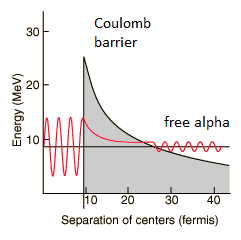
alpha decay - quantum tunnelingBy 1928, George Gamow (and independently by Ronald Gurney and Edward Condon) had solved the theory of alpha decay via quantum tunneling. They assumed that the alpha particle and the daughter nucleus exist within the parent nucleus prior to its dissociation, namely the decay of quasistationary states (QS).  A quasistationary state is defined as a long-lived state that eventually decays. Initially, the alpha cluster oscillates in the potential of the daughter nucleus, with the Coulomb potential preventing their separation. The alpha particle is trapped in a potential well by the nucleus. Classically, it is forbidden to escape, but according to the (then) newly discovered principles of quantum mechanics, it has a tiny (but non-zero) probability of “tunneling” through the barrier and appearing on the other side to escape the nucleus. Using the tunneling mechanism, Gamow, Condon and Gurney calculated the penetrability of the tunneling α particle through the Coulomb barrier, finding the lifetimes of some α emitting nuclei. The main success of this model was the reproduction of the semi-empirical Geiger-Nuttall law that expresses the lifetimes of the α emitters in terms of the energies of the released α particles. It must be noted, that other common forms of decay (e.g. beta decay) are governed by the interplay between both the nuclear force and the electromagnetic force.

Special Reference: W.S.C. Williams. Nuclear and Particle Physics. Clarendon Press; 1 edition, 1991, ISBN: 978-0198520467.


Beta decay or β decay represents the disintegration of a parent nucleus to a daughter through the emission of the beta particle. This transition (β– decay) can be characterized as:
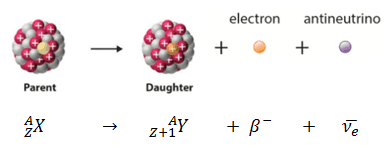
Beta Decay - Beta Radioactivity - definition

If a nucleus emits a beta particle, it loses an electron (or positron). In this case, the mass number of daughter nucleus remains the same, but daughter nucleus will form different element.

Beta particles are high-energy, high-speed electrons or positrons emitted by certain types of radioactive nuclei such as potassium-40. The beta particles have greater range of penetration than alpha particles, but still much less than gamma rays. The beta particles emitted are a form of ionizing radiation also known as beta rays. There are the following forms of beta decay:

  • Negative Beta Decay – Electron Decay. In electron decay, a neutron-rich nucleus emits a high-energy electron (β– particle). The electrons are negatively charged almost massless particles Due to the law of conservation of electric charge, the nuclear charge must increase by one unit. In this case, the process can be represented by: 

  • Positive Beta Decay – Positron Decay. In positron decay, a proton-rich nucleus emits a positron (positrons are antiparticles of electrons, and have the same mass as electrons but positive electric charge), and thereby reduces the nuclear charge by one unit. In this case, the process can be represented by: An annihilation occurs, when a low-energy positron collides with a low-energy electron.

  • Inverse Beta Decay – Electron Capture. Electron capture, known also as inverse beta decay is sometimes included as a type of beta decay, because the basic nuclear process, mediated by the weak interaction, is the same. In this process, a proton-rich nucleus can also reduce its nuclear charge by one unit by absorbing an atomic electron. 

Theory of Beta Decay – Weak Interaction

Beta decay is governed by the weak interaction. During beta decay one of two down quarks changes into an up quark by emitting a W– boson (carries away a negative charge). The W– boson then decays into a beta particle and an antineutrino. This process is equivalent to the process, in which a neutrino interacts with a neutron.
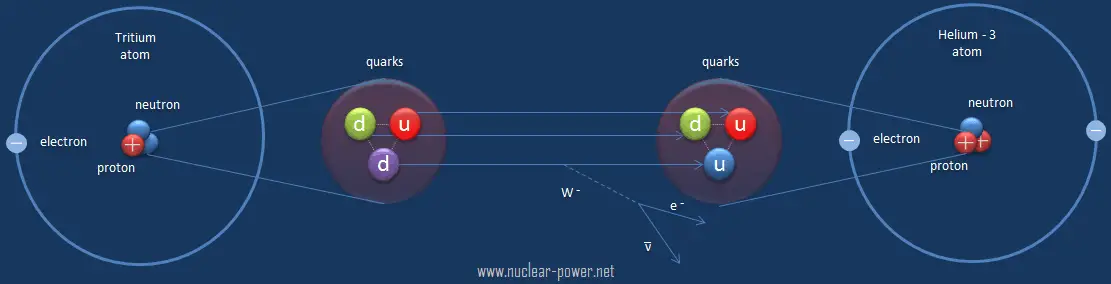
theory of beta decay - weak interaction

As can be seen from the figure, the weak interaction changes one flavor of quark into another. Note that, the Standard Model counts six flavours of quarks and six flavours of leptons. The weak interaction is the only process in which a quark can change to another quark, or a lepton to another lepton (flavor change). Neither the strong interaction nor electromagnetic permit flavour changing. This fact is crucial in many decays of nuclear particles. In the fusion process, which, for example, powers the Sun, two protons interact via the weak force to form a deuterium nucleus, which reacts further to generate helium. Without the weak interaction, the diproton would decay back into two hydrogen-1 unbound protons through proton emission. As a result, the sun would not burn without it since the weak interaction causes the transmutation p -> n.

In contrast to alpha decay, neither the beta particle nor its associated neutrino exist within the nucleus prior to beta decay, but are created in the decay process. By this process, unstable atoms obtain a more stable ratio of protons to neutrons. The probability of a nuclide decaying due to beta and other forms of decay is determined by its nuclear binding energy. For either electron or positron emission to be energetically possible, the energy release (see below) or Q value must be positive.


Energy Spectrum of Beta Decay

In both alpha and gamma decay, the resulting particle (alpha particle or photon) has a narrow energy distribution, since the particle carries the energy from the difference between the initial and final nuclear states. For example, in case of alpha decay, when a parent nucleus breaks down spontaneously to yield a daughter nucleus and an alpha particle, the sum of the mass of the two products does not quite equal the mass of the original nucleus (see Mass Defect). As a result of the law of conservation of energy, this difference appears in the form of the kinetic energy of the alpha particle. Since the same particles appear as products at every breakdown of a particular parent nucleus, the mass-difference should always be the same, and the kinetic energy of the alpha particles should also always be the same. In other words, the beam of alpha particles should be monoenergetic.

It was expected that the same considerations would hold for a parent nucleus breaking down to a daughter nucleus and a beta particle. Because only the electron and the recoiling daughter nucleus were observed beta decay, the process was initially assumed to be a two body process, very much like alpha decay. It would seem reasonable to suppose that the beta particles would form also a monoenergetic beam.

To demonstrate energetics of two-body beta decay, consider the beta decay in which an electron is emitted and the parent nucleus is at rest, conservation of energy requires:
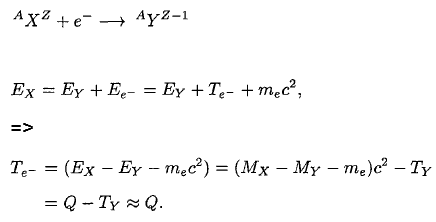
conservation-of-energy-beta-decay

Since the electron is much lighter particle it was expected that it will carry away most of the released energy, which would have a unique value Te-.
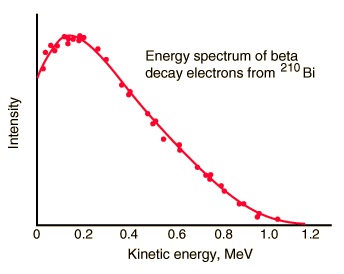
Energy spectrum of beta decay
The shape of this energy curve depends on what fraction of the reaction energy (Q value-the amount of energy released by the reaction) is carried by the electron or neutrino.

But the reality was different. The spectrum of beta particles measured by Lise Meitner and Otto Hahn in 1911 and by Jean Danysz in 1913 showed multiple lines on a diffuse background, however. Moreover virtually all of the emitted beta particles have energies below that predicted by energy conservation in two-body decays. The electrons emitted in beta decay have a continuous rather than a discrete spectrumappeared to contradict conservation of energy, under the then-current assumption that beta decay is the simple emission of an electron from a nucleus. When this was first observed, it appeared to threaten the survival of one of the most important conservation laws in physics!

To account for this energy release, Pauli proposed (in 1931) that there was emitted in the decay process another particle, later named by Fermi the neutrino. It was clear, this particle must be highly penetrating and that the conservation of electric charge requires the neutrino to be electrically neutral. This would explain why it was so hard to detect this particle. The term neutrino comes from Italian meaning “little neutral one” and neutrinos are denoted by the Greek letter ν (nu). In the process of beta decay the neutrino carries the missing energy and also in this process the law of conservation of energy remains valid.


References:

Radiation Protection:

  1. Knoll, Glenn F., Radiation Detection and Measurement 4th Edition, Wiley, 8/2010. ISBN-13: 978-0470131480.
  2. Stabin, Michael G., Radiation Protection and Dosimetry: An Introduction to Health Physics, Springer, 10/2010. ISBN-13: 978-1441923912.
  3. Martin, James E., Physics for Radiation Protection 3rd Edition, Wiley-VCH, 4/2013. ISBN-13: 978-3527411764.
  4. U.S.NRC, NUCLEAR REACTOR CONCEPTS
  5. U.S. Department of Energy, Nuclear Physics and Reactor Theory. DOE Fundamentals Handbook, Volume 1 and 2. January 1993.

Nuclear and Reactor Physics:

  1. J. R. Lamarsh, Introduction to Nuclear Reactor Theory, 2nd ed., Addison-Wesley, Reading, MA (1983).
  2. J. R. Lamarsh, A. J. Baratta, Introduction to Nuclear Engineering, 3d ed., Prentice-Hall, 2001, ISBN: 0-201-82498-1.
  3. W. M. Stacey, Nuclear Reactor Physics, John Wiley & Sons, 2001, ISBN: 0- 471-39127-1.
  4. Glasstone, Sesonske. Nuclear Reactor Engineering: Reactor Systems Engineering, Springer; 4th edition, 1994, ISBN: 978-0412985317
  5. W.S.C. Williams. Nuclear and Particle Physics. Clarendon Press; 1 edition, 1991, ISBN: 978-0198520467
  6. G.R.Keepin. Physics of Nuclear Kinetics. Addison-Wesley Pub. Co; 1st edition, 1965
  7. Robert Reed Burn, Introduction to Nuclear Reactor Operation, 1988.
  8. U.S. Department of Energy, Nuclear Physics and Reactor Theory. DOE Fundamentals Handbook, Volume 1 and 2. January 1993.
  9. Paul Reuss, Neutron Physics. EDP Sciences, 2008. ISBN: 978-2759800414.

See also:

Radioactive Decay

We hope, this article, Alpha Decay vs Beta Decay – Radioactivity, helps you. If so, give us a like in the sidebar. Main purpose of this website is to help the public to learn some interesting and important information about radiation and dosimeters.
What is Gamma Decay – Gamma Radioactivity – Definition

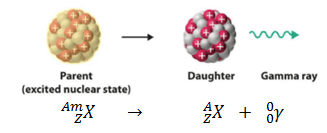
Gamma decay or γ decay represents the disintegration (gamma radioactivity) of a parent nucleus to a daughter through the emission of gamma rays (high energy photons). Gamma decay is governed by an electromagnetic interaction rather than a weak or strong interaction. Radiation Dosimetry

Gamma decay or γ decay represents the disintegration of a parent nucleus to a daughter through the emission of gamma rays (high energy photons). This transition (γ decay) can be characterized as:

Gamma Decay - Gamma Radioactivity - definition

As can be seen, if a nucleus emits a gamma ray, atomic and mass numbers of daughter nucleus remain the same, but daughter nucleus will form different energy state of the same element. Note that, nuclides with equal proton number and equal mass number (thus making them by definition the same isotope), but in a different energy state are known as nuclear isomers. We usually indicate isomers with a superscript m, thus: 241mAm or 110mAg.

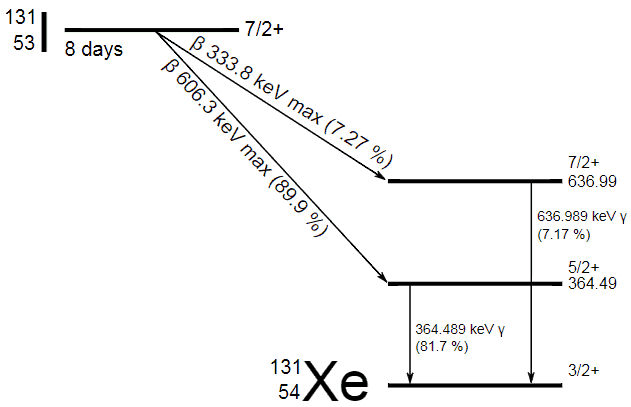
Iodine 131 - decay scheme
Iodine 131 – decay scheme

In most practical laboratory sources, the excited nuclear states are created in the decay of a parent radionuclide, therefore a gamma decay typically accompanies other forms of decay, such as alpha or beta decay. Typically after a beta decay (isobaric transition), nuclei usually contain too much energy to be in its final stable or daughter state.

Gamma rays are high-energy photons with very short wavelengths and thus very high frequency. Gamma rays from radioactive decay are in the energy range from a few keV to ~8 MeV, corresponding to the typical energy levels in nuclei with reasonably long lifetimes. As was written, they are produced by the decay of nuclei as they transition from a high energy state to a lower state. Since the gamma rays are in substance only a very high-energy photons, they are very penetrating matter and are thus biologically hazardous. Gamma rays can travel thousands of feet in air and can easily pass through the human body.

In contrast to alpha and beta radioactivity, gamma radioactivity is governed by an electromagnetic interaction rather than a weak or strong interaction. As in atomic transitions, the photon carries away at least one unit of angular momentum (the photon, being described by the vector electromagnetic field, has spin angular momentum of ħ), and the process conserves parity.

Prompt Gamma Decay

As was written, gamma decay may follow nuclear reactions such as neutron capture, nuclear fusion, or nuclear fission. Most of nuclear reactions produce extremely unstable nuclei that decay as soon as they are formed in nuclear reactions (half-life less than 10-11s) and are not generally classified as nuclear isomers. Moreover, these nuclei usually produce a cascade of gamma rays and the gamma-ray cascade concludes when all excess energy of the excited nucleus is released.

For example, following a nuclear fission prompt gamma rays are emitted from fission fragments. Most of prompt gamma rays are emitted after prompt neutrons. The fission reaction releases approximately ~7 MeV in prompt gamma rays and additional ~7 MeV (for 235U) in delayed gamma rays. This is a significant portion of energy (~7 % of fission energy released) and it must be considered in many fields of reactor design

Isomeric Transition

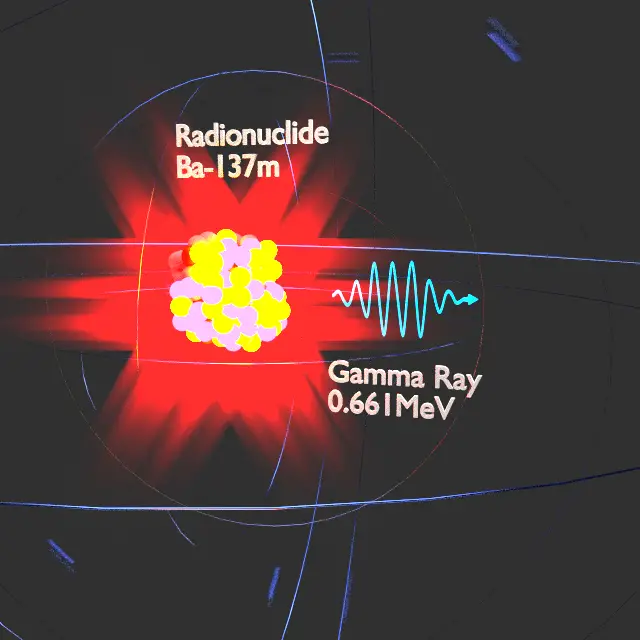
Barium-137m is a product of a common fission product - Caesium - 137. The main gamma ray of Barium-137m is 661keV photon.
Barium-137m is a product of a common fission product – Caesium – 137. The main gamma ray of Barium-137m is 661keV photon.

In certain cases, the excited nuclear state that follows the emission of a beta particle or other type of excitation, are able to stay in metastable state for a long time (hours, days and sometimes much longer) before undergoing gamma decay, in which they emit a gamma ray. These long-lived excited nuclei are known as isomeric states (or isomers) and their decays are termed isomeric transitions. The process of isomeric transition is therefore similar to any gamma emission, but differs in that it involves the intermediate metastable excited state(s) of the nuclei.

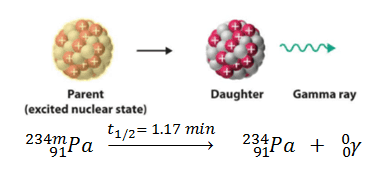
Metastable nuclei are often characterized by high nuclear spin, requiring a change in spin of several units or more with gamma decay, instead of a single unit transition that occurs in only 10−12 seconds. The rate of gamma decay is also slowed when the energy of excitation of the nucleus is small. An example is the decay of the isomer or metastable state of protactinium:

Extremely unstable nuclei that decay as soon as they are formed in nuclear reactions (half-life less than 10-11s) are not generally classified as nuclear isomers. Isomeric transitions must occur by higher order multipole transitions (in contrast to gamma emission that occurs by dipole radiation) that occur on a longer time-scale.

References:

Radiation Protection:

  1. Knoll, Glenn F., Radiation Detection and Measurement 4th Edition, Wiley, 8/2010. ISBN-13: 978-0470131480.
  2. Stabin, Michael G., Radiation Protection and Dosimetry: An Introduction to Health Physics, Springer, 10/2010. ISBN-13: 978-1441923912.
  3. Martin, James E., Physics for Radiation Protection 3rd Edition, Wiley-VCH, 4/2013. ISBN-13: 978-3527411764.
  4. U.S.NRC, NUCLEAR REACTOR CONCEPTS
  5. U.S. Department of Energy, Nuclear Physics and Reactor Theory. DOE Fundamentals Handbook, Volume 1 and 2. January 1993.

Nuclear and Reactor Physics:

  1. J. R. Lamarsh, Introduction to Nuclear Reactor Theory, 2nd ed., Addison-Wesley, Reading, MA (1983).
  2. J. R. Lamarsh, A. J. Baratta, Introduction to Nuclear Engineering, 3d ed., Prentice-Hall, 2001, ISBN: 0-201-82498-1.
  3. W. M. Stacey, Nuclear Reactor Physics, John Wiley & Sons, 2001, ISBN: 0- 471-39127-1.
  4. Glasstone, Sesonske. Nuclear Reactor Engineering: Reactor Systems Engineering, Springer; 4th edition, 1994, ISBN: 978-0412985317
  5. W.S.C. Williams. Nuclear and Particle Physics. Clarendon Press; 1 edition, 1991, ISBN: 978-0198520467
  6. G.R.Keepin. Physics of Nuclear Kinetics. Addison-Wesley Pub. Co; 1st edition, 1965
  7. Robert Reed Burn, Introduction to Nuclear Reactor Operation, 1988.
  8. U.S. Department of Energy, Nuclear Physics and Reactor Theory. DOE Fundamentals Handbook, Volume 1 and 2. January 1993.
  9. Paul Reuss, Neutron Physics. EDP Sciences, 2008. ISBN: 978-2759800414.

See also:

Radioactive Decay

We hope, this article, Gamma Decay – Gamma Radioactivity, helps you. If so, give us a like in the sidebar. Main purpose of this website is to help the public to learn some interesting and important information about radiation and dosimeters.
What is Isomeric Transition – Definition

These long-lived excited nuclei are known as isomeric states (or isomers) and their decays are termed isomeric transitions. The process of isomeric transition is therefore similar to any gamma emission, but differs in that it involves the intermediate metastable excited state(s) of the nuclei. Radiation Dosimetry

Gamma decay or γ decay represents the disintegration of a parent nucleus to a daughter through the emission of gamma rays (high energy photons). This transition (γ decay) can be characterized as:

Gamma Decay - Gamma Radioactivity - definition

As can be seen, if a nucleus emits a gamma ray, atomic and mass numbers of daughter nucleus remain the same, but daughter nucleus will form different energy state of the same element. Note that, nuclides with equal proton number and equal mass number (thus making them by definition the same isotope), but in a different energy state are known as nuclear isomers. We usually indicate isomers with a superscript m, thus: 241mAm or 110mAg.

Isomeric Transition

Barium-137m is a product of a common fission product - Caesium - 137. The main gamma ray of Barium-137m is 661keV photon.
Barium-137m is a product of a common fission product – Caesium – 137. The main gamma ray of Barium-137m is 661keV photon.

In certain cases, the excited nuclear state that follows the emission of a beta particle or other type of excitation, are able to stay in metastable state for a long time (hours, days and sometimes much longer) before undergoing gamma decay, in which they emit a gamma ray. These long-lived excited nuclei are known as isomeric states (or isomers) and their decays are termed isomeric transitions. The process of isomeric transition is therefore similar to any gamma emission, but differs in that it involves the intermediate metastable excited state(s) of the nuclei.

Metastable nuclei are often characterized by high nuclear spin, requiring a change in spin of several units or more with gamma decay, instead of a single unit transition that occurs in only 10−12 seconds. The rate of gamma decay is also slowed when the energy of excitation of the nucleus is small. An example is the decay of the isomer or metastable state of protactinium:

Extremely unstable nuclei that decay as soon as they are formed in nuclear reactions (half-life less than 10-11s) are not generally classified as nuclear isomers. Isomeric transitions must occur by higher order multipole transitions (in contrast to gamma emission that occurs by dipole radiation) that occur on a longer time-scale.

References:

Radiation Protection:

  1. Knoll, Glenn F., Radiation Detection and Measurement 4th Edition, Wiley, 8/2010. ISBN-13: 978-0470131480.
  2. Stabin, Michael G., Radiation Protection and Dosimetry: An Introduction to Health Physics, Springer, 10/2010. ISBN-13: 978-1441923912.
  3. Martin, James E., Physics for Radiation Protection 3rd Edition, Wiley-VCH, 4/2013. ISBN-13: 978-3527411764.
  4. U.S.NRC, NUCLEAR REACTOR CONCEPTS
  5. U.S. Department of Energy, Nuclear Physics and Reactor Theory. DOE Fundamentals Handbook, Volume 1 and 2. January 1993.

Nuclear and Reactor Physics:

  1. J. R. Lamarsh, Introduction to Nuclear Reactor Theory, 2nd ed., Addison-Wesley, Reading, MA (1983).
  2. J. R. Lamarsh, A. J. Baratta, Introduction to Nuclear Engineering, 3d ed., Prentice-Hall, 2001, ISBN: 0-201-82498-1.
  3. W. M. Stacey, Nuclear Reactor Physics, John Wiley & Sons, 2001, ISBN: 0- 471-39127-1.
  4. Glasstone, Sesonske. Nuclear Reactor Engineering: Reactor Systems Engineering, Springer; 4th edition, 1994, ISBN: 978-0412985317
  5. W.S.C. Williams. Nuclear and Particle Physics. Clarendon Press; 1 edition, 1991, ISBN: 978-0198520467
  6. G.R.Keepin. Physics of Nuclear Kinetics. Addison-Wesley Pub. Co; 1st edition, 1965
  7. Robert Reed Burn, Introduction to Nuclear Reactor Operation, 1988.
  8. U.S. Department of Energy, Nuclear Physics and Reactor Theory. DOE Fundamentals Handbook, Volume 1 and 2. January 1993.
  9. Paul Reuss, Neutron Physics. EDP Sciences, 2008. ISBN: 978-2759800414.

See also:

Radioactive Decay

We hope, this article, Isomeric Transition, helps you. If so, give us a like in the sidebar. Main purpose of this website is to help the public to learn some interesting and important information about radiation and dosimeters.
What is Internal Conversion – Definition

Internal conversion is an electromagnetic process, by which a nuclear excited state decays by the direct emission of one of its atomic electrons. Internal conversion competes with gamma emission. Radiation Dosimetry

Internal Conversion

Internal Conversion - ICE plus Auger
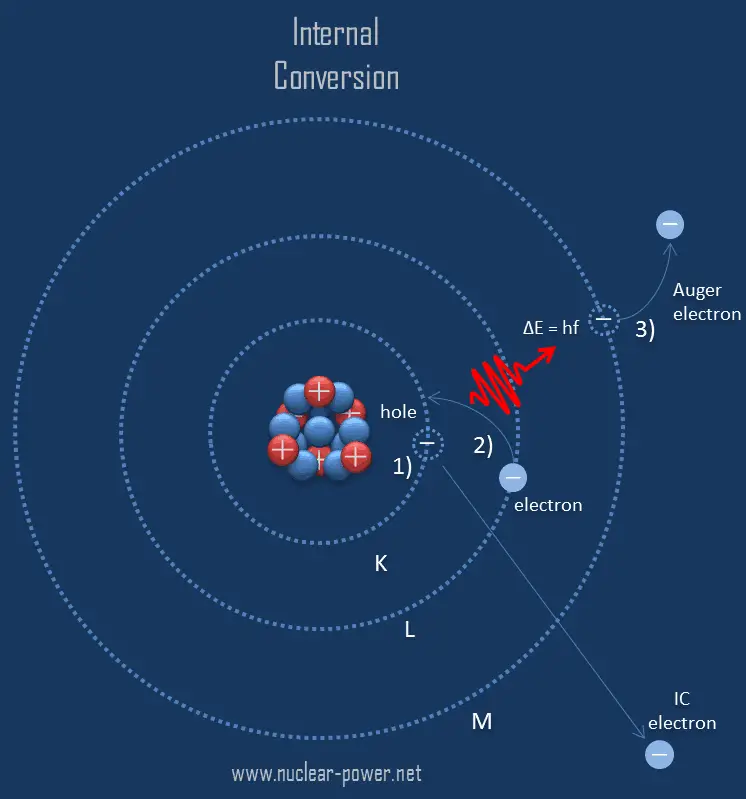
Internal conversion followed by Auger electron emission.

Internal conversion is an electromagnetic process, by which a nuclear excited state decays by the direct emission of one of its atomic electrons. Internal conversion competes with gamma emission, but in this case the electromagnetic multipole fields of the nucleus do not result in the emission of a gamma ray, instead, the fields interact directly with atomic electrons. In contrast to beta decay, which is governed by a weak force, the electron is emitted from the radioactive atom, but not from the nucleus. For this reason, internal conversion is possible whenever gamma decay is possible, except in the case where the atom is fully ionised.

Note that, the high energy electrons resulting from internal conversion are not called beta particles, since the latter come from beta decay, where they are newly created in the nuclear decay process.

As can be seen, if a nucleus decays via internal conversion, atomic and mass numbers of daughter nucleus remain the same, but daughter nucleus will form different energy state of the same element. This is very similar to gamma decay, but in this case, there is no gamma ray emitted from an excited nucleus.

Since the process leaves a vacancy in the electron energy level from which the electron came, the outer electrons of the atom cascade down to fill the lower atomic levels, and one or more characteristic X-rays are usually emitted. Sometimes X-ray may interact with another orbital electron, which may be ejected from the atom. This second ejected electron is called an Auger electron. This is very similar to electron capture, but in case of electron capture, a nucleus changes its atomic number. As a result, the atom thus emits primary high energy electron, characteristic X-rays or secondary Auger electron, none of which originate in that nucleus.

Theory of Internal Conversion

In the quantum mechanical model of the electron, there is a finite probability of finding the electron within the nucleus. During the internal conversion process, the wavefunction of the K shell electron (inner shell electron) is said to penetrate the volume of the atomic nucleus. Note that, typical nuclear radii are of the order 10-14 m. In this case, the electron may couple to an excited nucleus and take the energy of the nuclear transition directly, without an intermediate gamma ray. Therefore, most internal conversion electrons (ICE) come from the K shell, as these electrons have the highest probability of being within the nucleus. However, the s states in the L, M, and N shells are also able to couple to the nuclear fields and cause ICE ejections from those shells.

The internal conversion electron (ICE) energy, is the transition energy, Etransition, minus the binding energy of the orbital electron, Eb.e., as:

For example, 203Hg is beta radioactive nuclide, which produces a continuous beta spectrum with maximum energy 214 keV. This decay produces an excited state of the daughter nucleus 203Tl, which then decays very quickly (~ 10-10 s) to its ground state emitting a gamma ray of energy 279.2 keV or an internal conversion electron. If we analyze a spectrum of beta particles, we can see the typical continuous spectrum of beta particles as well as narrow peaks at specific energies. These peaks are produced by internal conversion electrons (ICE). Since the binding energy of the K electrons in 203Tl amounts to 85.5 keV, the K line has an energy of:

Te (K) = 279.2 – 85.5 = 194 keV

Because of lesser binding energies, the L- and M-lines have higher energies. Since the internal conversion process can interact with any of the orbital electrons, the result is a spectrum of internal conversion electrons which will be seen as superimposed upon the electron energy spectrum of the beta emission. These relative intensities of these ICE peaks can give information about the electric multipole character of the nucleus and about the decay process.

Special reference: Kenneth S. Krane. Introductory Nuclear Physics, 3rd Edition, Wiley, 1987, ISBN 978-0471805533

Internal Conversion Electrons - spectrum

 Internal Conversion Coefficient

The internal conversion coefficient (ICC), α, characterizes the competition between internal conversion and gamma ray emission. In some cases, internal conversion is favored over gamma decay. In others it may be completely negligible. The internal conversion coefficient is defined as the ratio of the number of internal conversion decays to the number of gamma decays. This ICC is defined for each electron shell (i.e., the K, L, and M shells, etc), such that the total ratio, αtotal, is the sum of the ICCs for each shell as:

αtotal = αK +  αL + αM = number of IC / number of gamma decays

For example, in the decay of the excited state at 35 keV of 125Te (which is produced by the decay of 125I), 7% of the decays emit gamma ray, while 93% emit a conversion electrons. Therefore, an internal conversion coefficient of this excited state (125Te) is ICC = 93/7 = 13.3.

Using the Band-Raman Internal Conversion Coefficient calculator, the ICCs can be calculated using principles of atomic physics since it depends primarily on the density of the atomic electrons at the center of the nucleus. For increasing atomic number (Z) and decreasing gamma-ray energy, internal conversion coefficients are observed to increase.

References:

Radiation Protection:

  1. Knoll, Glenn F., Radiation Detection and Measurement 4th Edition, Wiley, 8/2010. ISBN-13: 978-0470131480.
  2. Stabin, Michael G., Radiation Protection and Dosimetry: An Introduction to Health Physics, Springer, 10/2010. ISBN-13: 978-1441923912.
  3. Martin, James E., Physics for Radiation Protection 3rd Edition, Wiley-VCH, 4/2013. ISBN-13: 978-3527411764.
  4. U.S.NRC, NUCLEAR REACTOR CONCEPTS
  5. U.S. Department of Energy, Nuclear Physics and Reactor Theory. DOE Fundamentals Handbook, Volume 1 and 2. January 1993.

Nuclear and Reactor Physics:

  1. J. R. Lamarsh, Introduction to Nuclear Reactor Theory, 2nd ed., Addison-Wesley, Reading, MA (1983).
  2. J. R. Lamarsh, A. J. Baratta, Introduction to Nuclear Engineering, 3d ed., Prentice-Hall, 2001, ISBN: 0-201-82498-1.
  3. W. M. Stacey, Nuclear Reactor Physics, John Wiley & Sons, 2001, ISBN: 0- 471-39127-1.
  4. Glasstone, Sesonske. Nuclear Reactor Engineering: Reactor Systems Engineering, Springer; 4th edition, 1994, ISBN: 978-0412985317
  5. W.S.C. Williams. Nuclear and Particle Physics. Clarendon Press; 1 edition, 1991, ISBN: 978-0198520467
  6. G.R.Keepin. Physics of Nuclear Kinetics. Addison-Wesley Pub. Co; 1st edition, 1965
  7. Robert Reed Burn, Introduction to Nuclear Reactor Operation, 1988.
  8. U.S. Department of Energy, Nuclear Physics and Reactor Theory. DOE Fundamentals Handbook, Volume 1 and 2. January 1993.
  9. Paul Reuss, Neutron Physics. EDP Sciences, 2008. ISBN: 978-2759800414.

See also:

Radioactive Decay

We hope, this article, Internal Conversion, helps you. If so, give us a like in the sidebar. Main purpose of this website is to help the public to learn some interesting and important information about radiation and dosimeters.
What is Theory of Internal Conversion – Definition

Theory of internal conversion. In the quantum mechanical model of the electron, there is a finite probability of finding the electron within the nucleus. Radiation Dosimetry
Internal Conversion - ICE plus Auger
Internal conversion followed by Auger electron emission.

Theory of Internal Conversion

Internal conversion is an electromagnetic process, by which a nuclear excited state decays by the direct emission of one of its atomic electrons. Internal conversion competes with gamma emission, but in this case the electromagnetic multipole fields of the nucleus do not result in the emission of a gamma ray, instead, the fields interact directly with atomic electrons. In contrast to beta decay, which is governed by a weak force, the electron is emitted from the radioactive atom, but not from the nucleus. For this reason, internal conversion is possible whenever gamma decay is possible, except in the case where the atom is fully ionised.

In the quantum mechanical model of the electron, there is a finite probability of finding the electron within the nucleus. During the internal conversion process, the wavefunction of the K shell electron (inner shell electron) is said to penetrate the volume of the atomic nucleus. Note that, typical nuclear radii are of the order 10-14 m. In this case, the electron may couple to an excited nucleus and take the energy of the nuclear transition directly, without an intermediate gamma ray. Therefore, most internal conversion electrons (ICE) come from the K shell, as these electrons have the highest probability of being within the nucleus. However, the s states in the L, M, and N shells are also able to couple to the nuclear fields and cause ICE ejections from those shells.

The internal conversion electron (ICE) energy, is the transition energy, Etransition, minus the binding energy of the orbital electron, Eb.e., as:

For example, 203Hg is beta radioactive nuclide, which produces a continuous beta spectrum with maximum energy 214 keV. This decay produces an excited state of the daughter nucleus 203Tl, which then decays very quickly (~ 10-10 s) to its ground state emitting a gamma ray of energy 279.2 keV or an internal conversion electron. If we analyze a spectrum of beta particles, we can see the typical continuous spectrum of beta particles as well as narrow peaks at specific energies. These peaks are produced by internal conversion electrons (ICE). Since the binding energy of the K electrons in 203Tl amounts to 85.5 keV, the K line has an energy of:

Te (K) = 279.2 – 85.5 = 194 keV

Because of lesser binding energies, the L- and M-lines have higher energies. Since the internal conversion process can interact with any of the orbital electrons, the result is a spectrum of internal conversion electrons which will be seen as superimposed upon the electron energy spectrum of the beta emission. These relative intensities of these ICE peaks can give information about the electric multipole character of the nucleus and about the decay process.

Special reference: Kenneth S. Krane. Introductory Nuclear Physics, 3rd Edition, Wiley, 1987, ISBN 978-0471805533

Internal Conversion Electrons - spectrum

References:

Radiation Protection:

  1. Knoll, Glenn F., Radiation Detection and Measurement 4th Edition, Wiley, 8/2010. ISBN-13: 978-0470131480.
  2. Stabin, Michael G., Radiation Protection and Dosimetry: An Introduction to Health Physics, Springer, 10/2010. ISBN-13: 978-1441923912.
  3. Martin, James E., Physics for Radiation Protection 3rd Edition, Wiley-VCH, 4/2013. ISBN-13: 978-3527411764.
  4. U.S.NRC, NUCLEAR REACTOR CONCEPTS
  5. U.S. Department of Energy, Nuclear Physics and Reactor Theory. DOE Fundamentals Handbook, Volume 1 and 2. January 1993.

Nuclear and Reactor Physics:

  1. J. R. Lamarsh, Introduction to Nuclear Reactor Theory, 2nd ed., Addison-Wesley, Reading, MA (1983).
  2. J. R. Lamarsh, A. J. Baratta, Introduction to Nuclear Engineering, 3d ed., Prentice-Hall, 2001, ISBN: 0-201-82498-1.
  3. W. M. Stacey, Nuclear Reactor Physics, John Wiley & Sons, 2001, ISBN: 0- 471-39127-1.
  4. Glasstone, Sesonske. Nuclear Reactor Engineering: Reactor Systems Engineering, Springer; 4th edition, 1994, ISBN: 978-0412985317
  5. W.S.C. Williams. Nuclear and Particle Physics. Clarendon Press; 1 edition, 1991, ISBN: 978-0198520467
  6. G.R.Keepin. Physics of Nuclear Kinetics. Addison-Wesley Pub. Co; 1st edition, 1965
  7. Robert Reed Burn, Introduction to Nuclear Reactor Operation, 1988.
  8. U.S. Department of Energy, Nuclear Physics and Reactor Theory. DOE Fundamentals Handbook, Volume 1 and 2. January 1993.
  9. Paul Reuss, Neutron Physics. EDP Sciences, 2008. ISBN: 978-2759800414.

See also:

Internal Conversion

We hope, this article, Theory of Internal Conversion, helps you. If so, give us a like in the sidebar. Main purpose of this website is to help the public to learn some interesting and important information about radiation and dosimeters.
What is Internal Conversion Electron – ICE – Definition

Internal conversion electrons, ICE, are high energy electrons resulting from internal conversion process. These electrons comes from atomic orbitals. Radiation Dosimetry
Internal Conversion - ICE plus Auger
Internal conversion followed by Auger electron emission.

Internal conversion is an electromagnetic process, by which a nuclear excited state decays by the direct emission of one of its atomic electrons. Note that, the high energy electrons resulting from internal conversion are not called beta particles, since the latter come from beta decay, where they are newly created in the nuclear decay process. These electrons are known as internal conversion electrons.

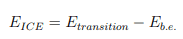
The internal conversion electron (ICE) energy, is the transition energy, Etransition, minus the binding energy of the orbital electron, Eb.e., as:

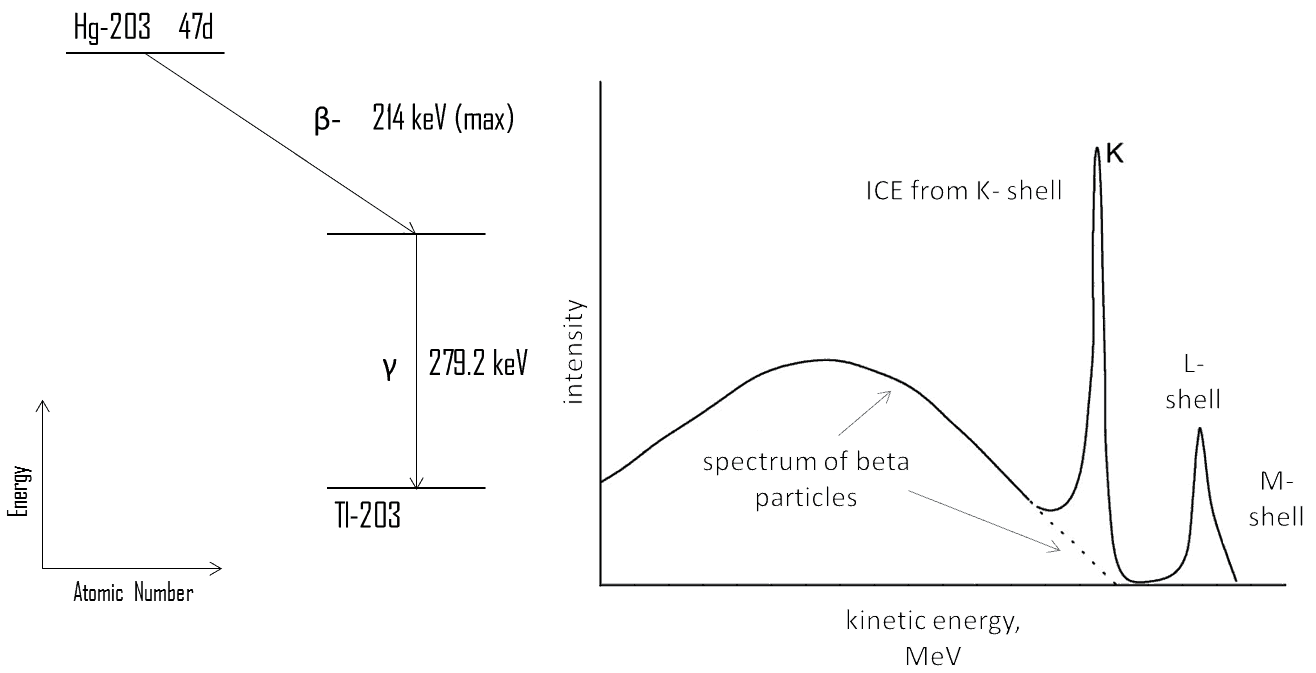
For example, 203Hg is beta radioactive nuclide, which produces a continuous beta spectrum with maximum energy 214 keV. This decay produces an excited state of the daughter nucleus 203Tl, which then decays very quickly (~ 10-10 s) to its ground state emitting a gamma ray of energy 279.2 keV or an internal conversion electron. If we analyze a spectrum of beta particles, we can see the typical continuous spectrum of beta particles as well as narrow peaks at specific energies. These peaks are produced by internal conversion electrons (ICE). Since the binding energy of the K electrons in 203Tl amounts to 85.5 keV, the K line has an energy of:

Te (K) = 279.2 – 85.5 = 194 keV

Because of lesser binding energies, the L- and M-lines have higher energies. Since the internal conversion process can interact with any of the orbital electrons, the result is a spectrum of internal conversion electrons which will be seen as superimposed upon the electron energy spectrum of the beta emission. These relative intensities of these ICE peaks can give information about the electric multipole character of the nucleus and about the decay process.

Special reference: Kenneth S. Krane. Introductory Nuclear Physics, 3rd Edition, Wiley, 1987, ISBN 978-0471805533

Internal Conversion Electrons - spectrum

References:

Radiation Protection:

  1. Knoll, Glenn F., Radiation Detection and Measurement 4th Edition, Wiley, 8/2010. ISBN-13: 978-0470131480.
  2. Stabin, Michael G., Radiation Protection and Dosimetry: An Introduction to Health Physics, Springer, 10/2010. ISBN-13: 978-1441923912.
  3. Martin, James E., Physics for Radiation Protection 3rd Edition, Wiley-VCH, 4/2013. ISBN-13: 978-3527411764.
  4. U.S.NRC, NUCLEAR REACTOR CONCEPTS
  5. U.S. Department of Energy, Nuclear Physics and Reactor Theory. DOE Fundamentals Handbook, Volume 1 and 2. January 1993.

Nuclear and Reactor Physics:

  1. J. R. Lamarsh, Introduction to Nuclear Reactor Theory, 2nd ed., Addison-Wesley, Reading, MA (1983).
  2. J. R. Lamarsh, A. J. Baratta, Introduction to Nuclear Engineering, 3d ed., Prentice-Hall, 2001, ISBN: 0-201-82498-1.
  3. W. M. Stacey, Nuclear Reactor Physics, John Wiley & Sons, 2001, ISBN: 0- 471-39127-1.
  4. Glasstone, Sesonske. Nuclear Reactor Engineering: Reactor Systems Engineering, Springer; 4th edition, 1994, ISBN: 978-0412985317
  5. W.S.C. Williams. Nuclear and Particle Physics. Clarendon Press; 1 edition, 1991, ISBN: 978-0198520467
  6. G.R.Keepin. Physics of Nuclear Kinetics. Addison-Wesley Pub. Co; 1st edition, 1965
  7. Robert Reed Burn, Introduction to Nuclear Reactor Operation, 1988.
  8. U.S. Department of Energy, Nuclear Physics and Reactor Theory. DOE Fundamentals Handbook, Volume 1 and 2. January 1993.
  9. Paul Reuss, Neutron Physics. EDP Sciences, 2008. ISBN: 978-2759800414.

See also:

Internal Conversion

We hope, this article, Internal Conversion Electron – ICE, helps you. If so, give us a like in the sidebar. Main purpose of this website is to help the public to learn some interesting and important information about radiation and dosimeters.
What is Internal Conversion Coefficient – ICC – Definition

The internal conversion coefficient (ICC), α, characterizes the competition between internal conversion and gamma ray emission. In some cases, internal conversion is favored over gamma decay. Radiation Dosimetry
Internal Conversion - ICE plus Auger
Internal conversion followed by Auger electron emission.

Internal conversion is an electromagnetic process, by which a nuclear excited state decays by the direct emission of one of its atomic electrons. Internal conversion competes with gamma emission, but in this case the electromagnetic multipole fields of the nucleus do not result in the emission of a gamma ray, instead, the fields interact directly with atomic electrons.

Internal Conversion Coefficient

The internal conversion coefficient (ICC), α, characterizes the competition between internal conversion and gamma ray emission. In some cases, internal conversion is favored over gamma decay. In others it may be completely negligible. The internal conversion coefficient is defined as the ratio of the number of internal conversion decays to the number of gamma decays. This ICC is defined for each electron shell (i.e., the K, L, and M shells, etc), such that the total ratio, αtotal, is the sum of the ICCs for each shell as:

αtotal = αK +  αL + αM = number of IC / number of gamma decays

For example, in the decay of the excited state at 35 keV of 125Te (which is produced by the decay of 125I), 7% of the decays emit gamma ray, while 93% emit a conversion electrons. Therefore, an internal conversion coefficient of this excited state (125Te) is ICC = 93/7 = 13.3.

Using the Band-Raman Internal Conversion Coefficient calculator, the ICCs can be calculated using principles of atomic physics since it depends primarily on the density of the atomic electrons at the center of the nucleus. For increasing atomic number (Z) and decreasing gamma-ray energy, internal conversion coefficients are observed to increase.

References:

Radiation Protection:

  1. Knoll, Glenn F., Radiation Detection and Measurement 4th Edition, Wiley, 8/2010. ISBN-13: 978-0470131480.
  2. Stabin, Michael G., Radiation Protection and Dosimetry: An Introduction to Health Physics, Springer, 10/2010. ISBN-13: 978-1441923912.
  3. Martin, James E., Physics for Radiation Protection 3rd Edition, Wiley-VCH, 4/2013. ISBN-13: 978-3527411764.
  4. U.S.NRC, NUCLEAR REACTOR CONCEPTS
  5. U.S. Department of Energy, Nuclear Physics and Reactor Theory. DOE Fundamentals Handbook, Volume 1 and 2. January 1993.

Nuclear and Reactor Physics:

  1. J. R. Lamarsh, Introduction to Nuclear Reactor Theory, 2nd ed., Addison-Wesley, Reading, MA (1983).
  2. J. R. Lamarsh, A. J. Baratta, Introduction to Nuclear Engineering, 3d ed., Prentice-Hall, 2001, ISBN: 0-201-82498-1.
  3. W. M. Stacey, Nuclear Reactor Physics, John Wiley & Sons, 2001, ISBN: 0- 471-39127-1.
  4. Glasstone, Sesonske. Nuclear Reactor Engineering: Reactor Systems Engineering, Springer; 4th edition, 1994, ISBN: 978-0412985317
  5. W.S.C. Williams. Nuclear and Particle Physics. Clarendon Press; 1 edition, 1991, ISBN: 978-0198520467
  6. G.R.Keepin. Physics of Nuclear Kinetics. Addison-Wesley Pub. Co; 1st edition, 1965
  7. Robert Reed Burn, Introduction to Nuclear Reactor Operation, 1988.
  8. U.S. Department of Energy, Nuclear Physics and Reactor Theory. DOE Fundamentals Handbook, Volume 1 and 2. January 1993.
  9. Paul Reuss, Neutron Physics. EDP Sciences, 2008. ISBN: 978-2759800414.

See also:

Internal Conversion

We hope, this article, Internal Conversion Coefficient – ICC, helps you. If so, give us a like in the sidebar. Main purpose of this website is to help the public to learn some interesting and important information about radiation and dosimeters.
What is Neutron Decay – Neutron Emission – Definition

Neutron decay is a type of radioactive decay of nuclei containing excess neutrons (especially fission products), in which a neutron is simply ejected from the nucleus. Radiation Dosimetry
Proton and Neutron Emission
Example: Proton and Neutron Decay
Source: JANIS (Java-based Nuclear Data Information Software); The JEFF-3.1.1 Nuclear Data Library

Neutron decay is a type of radioactive decay of nuclei containing excess neutrons (especially fission products), in which a neutron is simply ejected from the nucleus. This type of radiation plays key role in nuclear reactor control, because these neutrons are delayed  neutrons. At this place we must distinguish between:

  • Spontaneous neutron emission. Spontaneous neutron emission is a mode of radioactive decay in which one or more neutrons are ejected from a nucleus.
  • Decay of free neutron. The free neutron is, unlike a bounded neutron, subject to radioactive beta decay (with a half-life of about 611 seconds). It decays into a proton, an electron, and an antineutrino (the antimatter counterpart of the neutrino, a particle with no charge and little or no mass).
  • Induced neutron emission. Among nuclear reactions are also reactions, in which a neutron is ejected from nucleus and they may be referred to as neutron emission reactions. These nuclear reactions are, for example:
    • Scattering Reactions
    • Nuclear Fission
    • Photoneutrons Emission
    • Other nuclear reactions (e.g. (alpha,n) reactions)

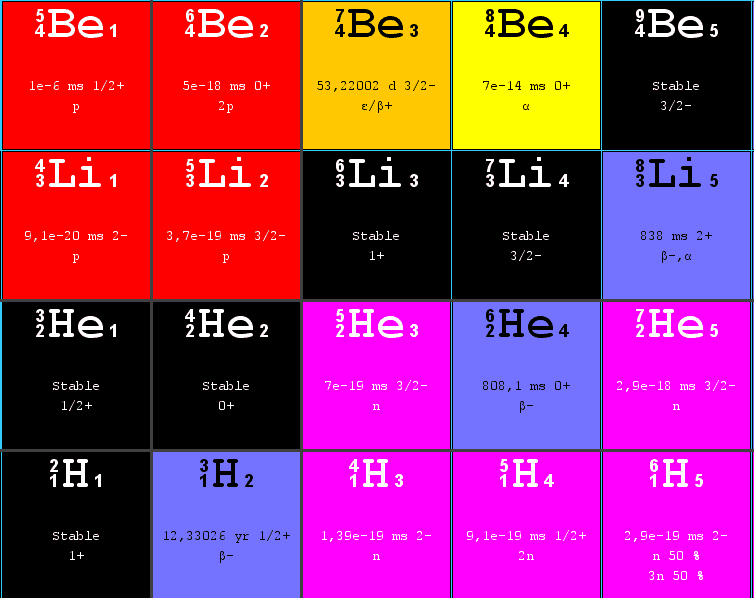
This article describes mainly spontaneous neutron emission (prompt neutron decay). This mode of decay occurs only in the most neutron-rich/proton-deficient nuclides (prompt neutron decay), and also from excited states of other nuclides as in photoneutron emission and beta-delayed neutron emission. As can be seen, if a nucleus decays via neutron emission, atomic number remains the same, but daughter become a different isotope of the same element. Nuclei which can decay by this mode are described as lying beyond the neutron drip line. Two examples of isotopes that emit neutrons are beryllium-13 (decaying to beryllium-12 with a mean life 2.7×10⁻²¹ s) and helium-5 (helium-4, 7×10⁻²² s).

Beta-delayed Neutron Emission – Delayed Neutrons

Precursors of Delayed Neutrons

Neutron emission usually happens from nuclei that are in an excited state, such as the excited 87Kr* produced from the beta decay of 87Br. This isotope has half-life of 55.6 seconds. It undergoes negative beta decay through its two main branches with emission of 2.6 MeV and 8 MeV beta particles. This decay leads to the formation of 87Kr* and the 87Kr* nucleus subsequently decays via two successive beta decays into the stable isotope 87Sr. But there is also one possible way for the 87Br nucleus to beta decay. The 87Br nucleus can beta decay into an excited state of the 87Kr* nucleus at an energy of 5.5 MeV, which is larger than the binding energy of a neutron in the 87Kr nucleus. In this case, the 87Kr* nucleus can undergo (with probability of 2.5%) a neutron emission leading to the formation of stable 86Kr isotope. The neutron emission process itself is controlled by the nuclear force and therefore is extremely fast, sometimes referred to as “nearly instantaneous”. The ejection of the neutron may be as a product of the movement of many nucleons, but it is ultimately mediated by the repulsive action of the nuclear force that exists at extremely short-range distances between nucleons. The life time of an ejected neutron inside the nucleus before it is emitted is usually comparable to the flight time of a typical neutron before it leaves the small nuclear “potential well”, or about 10−23 seconds. As can be seen, the rate of emission of these neutrons is governed primarily by beta decay, therefore this emission is known as beta-delayed neutron emission and is responsible for production of delayed neutrons in nuclear reactors.

While the most of the neutrons produced in fission are prompt neutrons, the delayed neutrons are of importance in the reactor control. In fact the presence of delayed neutrons is perhaps most important aspect of the fission process from the viewpoint of reactor control.

See also: Precursors of Delayed Neutrons

References:

Radiation Protection:

  1. Knoll, Glenn F., Radiation Detection and Measurement 4th Edition, Wiley, 8/2010. ISBN-13: 978-0470131480.
  2. Stabin, Michael G., Radiation Protection and Dosimetry: An Introduction to Health Physics, Springer, 10/2010. ISBN-13: 978-1441923912.
  3. Martin, James E., Physics for Radiation Protection 3rd Edition, Wiley-VCH, 4/2013. ISBN-13: 978-3527411764.
  4. U.S.NRC, NUCLEAR REACTOR CONCEPTS
  5. U.S. Department of Energy, Nuclear Physics and Reactor Theory. DOE Fundamentals Handbook, Volume 1 and 2. January 1993.

Nuclear and Reactor Physics:

  1. J. R. Lamarsh, Introduction to Nuclear Reactor Theory, 2nd ed., Addison-Wesley, Reading, MA (1983).
  2. J. R. Lamarsh, A. J. Baratta, Introduction to Nuclear Engineering, 3d ed., Prentice-Hall, 2001, ISBN: 0-201-82498-1.
  3. W. M. Stacey, Nuclear Reactor Physics, John Wiley & Sons, 2001, ISBN: 0- 471-39127-1.
  4. Glasstone, Sesonske. Nuclear Reactor Engineering: Reactor Systems Engineering, Springer; 4th edition, 1994, ISBN: 978-0412985317
  5. W.S.C. Williams. Nuclear and Particle Physics. Clarendon Press; 1 edition, 1991, ISBN: 978-0198520467
  6. G.R.Keepin. Physics of Nuclear Kinetics. Addison-Wesley Pub. Co; 1st edition, 1965
  7. Robert Reed Burn, Introduction to Nuclear Reactor Operation, 1988.
  8. U.S. Department of Energy, Nuclear Physics and Reactor Theory. DOE Fundamentals Handbook, Volume 1 and 2. January 1993.
  9. Paul Reuss, Neutron Physics. EDP Sciences, 2008. ISBN: 978-2759800414.

See also:

Internal Conversion

We hope, this article, Neutron Decay – Neutron Emission, helps you. If so, give us a like in the sidebar. Main purpose of this website is to help the public to learn some interesting and important information about radiation and dosimeters.
What is Proton Decay – Proton Emission – Definition

Proton decay is a rare type of radioactive decay of nuclei containing excess protons, in which a proton is simply ejected from the nucleus. Radiation Dosimetry
Proton and Neutron Emission
Example: Proton and Neutron Decay
Source: JANIS (Java-based Nuclear Data Information Software); The JEFF-3.1.1 Nuclear Data Library

Proton decay is a rare type of radioactive decay of nuclei containing excess protons, in which a proton is simply ejected from the nucleus. This article describes mainly spontaneous proton emission (proton decay) and does not describe decay of a free proton. Note that, a free proton (a proton not bound to nucleons or electrons) is a stable particle that has not been observed to break down spontaneously to other particles.

See also: Stability of Proton

Proton emission occurs in the most proton-rich/neutron-deficient nuclides (prompt proton emission), and also from high-lying excited states in a nucleus following a positive beta decay. Similarly as for neutron emission, the rate of emission of these neutrons following a positive beta decay is governed primarily by beta decay, therefore this emission is known as beta-delayed proton emission.

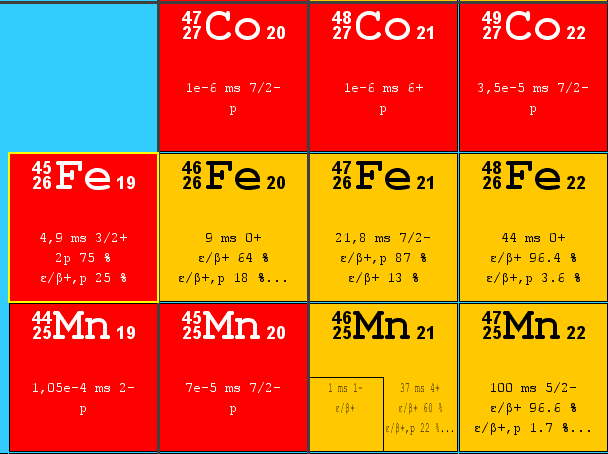
Proton Decay - Proton EmissionThe mechanism of the decay process is very similar to alpha decay. Proton decay is also a quantum tunneling process. In order to be emitted, the proton must penetrate a potential barrier. For a proton to escape a nucleus, the proton separation energy must be negative – the proton is therefore unbound, and tunnels out of the nucleus in a finite time. Some nuclei decay via double proton emission, such as 45Fe.

If a nucleus decays via proton emission, atomic and mass numbers change by one and a daughter nucleus becomes a different element. Nuclei which can decay by this mode are described as lying highly above the neutron drip line. Proton emission is not seen in naturally occurring isotopes. Proton radioactive isotopes can be produced via nuclear reactions, usually using particle accelerators.

References:

Radiation Protection:

  1. Knoll, Glenn F., Radiation Detection and Measurement 4th Edition, Wiley, 8/2010. ISBN-13: 978-0470131480.
  2. Stabin, Michael G., Radiation Protection and Dosimetry: An Introduction to Health Physics, Springer, 10/2010. ISBN-13: 978-1441923912.
  3. Martin, James E., Physics for Radiation Protection 3rd Edition, Wiley-VCH, 4/2013. ISBN-13: 978-3527411764.
  4. U.S.NRC, NUCLEAR REACTOR CONCEPTS
  5. U.S. Department of Energy, Nuclear Physics and Reactor Theory. DOE Fundamentals Handbook, Volume 1 and 2. January 1993.

Nuclear and Reactor Physics:

  1. J. R. Lamarsh, Introduction to Nuclear Reactor Theory, 2nd ed., Addison-Wesley, Reading, MA (1983).
  2. J. R. Lamarsh, A. J. Baratta, Introduction to Nuclear Engineering, 3d ed., Prentice-Hall, 2001, ISBN: 0-201-82498-1.
  3. W. M. Stacey, Nuclear Reactor Physics, John Wiley & Sons, 2001, ISBN: 0- 471-39127-1.
  4. Glasstone, Sesonske. Nuclear Reactor Engineering: Reactor Systems Engineering, Springer; 4th edition, 1994, ISBN: 978-0412985317
  5. W.S.C. Williams. Nuclear and Particle Physics. Clarendon Press; 1 edition, 1991, ISBN: 978-0198520467
  6. G.R.Keepin. Physics of Nuclear Kinetics. Addison-Wesley Pub. Co; 1st edition, 1965
  7. Robert Reed Burn, Introduction to Nuclear Reactor Operation, 1988.
  8. U.S. Department of Energy, Nuclear Physics and Reactor Theory. DOE Fundamentals Handbook, Volume 1 and 2. January 1993.
  9. Paul Reuss, Neutron Physics. EDP Sciences, 2008. ISBN: 978-2759800414.

See also:

Internal Conversion

We hope, this article, Proton Decay – Proton Emission, helps you. If so, give us a like in the sidebar. Main purpose of this website is to help the public to learn some interesting and important information about radiation and dosimeters.
What is Gamma Decay vs Beta Decay – Radioactivity – Definition

Gamma Decay vs Beta Decay. This article summarizes main differences between gamma and beta decay, which have different nature. Beta particles are high-energy electrons, while gamma rays are high-energy photons. Radiation Dosimetry

Gamma decay or γ decay represents the disintegration of a parent nucleus to a daughter through the emission of gamma rays (high energy photons). This transition (γ decay) can be characterized as:

Gamma Decay - Gamma Radioactivity - definition

As can be seen, if a nucleus emits a gamma ray, atomic and mass numbers of daughter nucleus remain the same, but daughter nucleus will form different energy state of the same element. Note that, nuclides with equal proton number and equal mass number (thus making them by definition the same isotope), but in a different energy state are known as nuclear isomers. We usually indicate isomers with a superscript m, thus: 241mAm or 110mAg.

Iodine 131 - decay scheme
Iodine 131 – decay scheme

In most practical laboratory sources, the excited nuclear states are created in the decay of a parent radionuclide, therefore a gamma decay typically accompanies other forms of decay, such as alpha or beta decay. Typically after a beta decay (isobaric transition), nuclei usually contain too much energy to be in its final stable or daughter state.

Gamma rays are high-energy photons with very short wavelengths and thus very high frequency. Gamma rays from radioactive decay are in the energy range from a few keV to ~8 MeV, corresponding to the typical energy levels in nuclei with reasonably long lifetimes. As was written, they are produced by the decay of nuclei as they transition from a high energy state to a lower state. Since the gamma rays are in substance only a very high-energy photons, they are very penetrating matter and are thus biologically hazardous. Gamma rays can travel thousands of feet in air and can easily pass through the human body.

In contrast to alpha and beta radioactivity, gamma radioactivity is governed by an electromagnetic interaction rather than a weak or strong interaction. As in atomic transitions, the photon carries away at least one unit of angular momentum (the photon, being described by the vector electromagnetic field, has spin angular momentum of ħ), and the process conserves parity.

Special Reference: W.S.C. Williams. Nuclear and Particle Physics. Clarendon Press; 1 edition, 1991, ISBN: 978-0198520467.


Beta decay or β decay represents the disintegration of a parent nucleus to a daughter through the emission of the beta particle. This transition (β– decay) can be characterized as:

Beta Decay - Beta Radioactivity - definition

If a nucleus emits a beta particle, it loses an electron (or positron). In this case, the mass number of daughter nucleus remains the same, but daughter nucleus will form different element.

Beta particles are high-energy, high-speed electrons or positrons emitted by certain types of radioactive nuclei such as potassium-40. The beta particles have greater range of penetration than alpha particles, but still much less than gamma rays. The beta particles emitted are a form of ionizing radiation also known as beta rays. There are the following forms of beta decay:

  • Negative Beta Decay – Electron Decay. In electron decay, a neutron-rich nucleus emits a high-energy electron (β– particle). The electrons are negatively charged almost massless particles Due to the law of conservation of electric charge, the nuclear charge must increase by one unit. In this case, the process can be represented by: 
  • Positive Beta Decay – Positron Decay. In positron decay, a proton-rich nucleus emits a positron (positrons are antiparticles of electrons, and have the same mass as electrons but positive electric charge), and thereby reduces the nuclear charge by one unit. In this case, the process can be represented by: An annihilation occurs, when a low-energy positron collides with a low-energy electron.
  • Inverse Beta Decay – Electron Capture. Electron capture, known also as inverse beta decay is sometimes included as a type of beta decay, because the basic nuclear process, mediated by the weak interaction, is the same. In this process, a proton-rich nucleus can also reduce its nuclear charge by one unit by absorbing an atomic electron. 

Theory of Beta Decay – Weak Interaction

Beta decay is governed by the weak interaction. During beta decay one of two down quarks changes into an up quark by emitting a W– boson (carries away a negative charge). The W– boson then decays into a beta particle and an antineutrino. This process is equivalent to the process, in which a neutrino interacts with a neutron.

theory of beta decay - weak interaction

As can be seen from the figure, the weak interaction changes one flavor of quark into another. Note that, the Standard Model counts six flavours of quarks and six flavours of leptons. The weak interaction is the only process in which a quark can change to another quark, or a lepton to another lepton (flavor change). Neither the strong interaction nor electromagnetic permit flavour changing. This fact is crucial in many decays of nuclear particles. In the fusion process, which, for example, powers the Sun, two protons interact via the weak force to form a deuterium nucleus, which reacts further to generate helium. Without the weak interaction, the diproton would decay back into two hydrogen-1 unbound protons through proton emission. As a result, the sun would not burn without it since the weak interaction causes the transmutation p -> n.

In contrast to alpha decay, neither the beta particle nor its associated neutrino exist within the nucleus prior to beta decay, but are created in the decay process. By this process, unstable atoms obtain a more stable ratio of protons to neutrons. The probability of a nuclide decaying due to beta and other forms of decay is determined by its nuclear binding energy. For either electron or positron emission to be energetically possible, the energy release (see below) or Q value must be positive.

References:

Radiation Protection:

  1. Knoll, Glenn F., Radiation Detection and Measurement 4th Edition, Wiley, 8/2010. ISBN-13: 978-0470131480.
  2. Stabin, Michael G., Radiation Protection and Dosimetry: An Introduction to Health Physics, Springer, 10/2010. ISBN-13: 978-1441923912.
  3. Martin, James E., Physics for Radiation Protection 3rd Edition, Wiley-VCH, 4/2013. ISBN-13: 978-3527411764.
  4. U.S.NRC, NUCLEAR REACTOR CONCEPTS
  5. U.S. Department of Energy, Nuclear Physics and Reactor Theory. DOE Fundamentals Handbook, Volume 1 and 2. January 1993.

Nuclear and Reactor Physics:

  1. J. R. Lamarsh, Introduction to Nuclear Reactor Theory, 2nd ed., Addison-Wesley, Reading, MA (1983).
  2. J. R. Lamarsh, A. J. Baratta, Introduction to Nuclear Engineering, 3d ed., Prentice-Hall, 2001, ISBN: 0-201-82498-1.
  3. W. M. Stacey, Nuclear Reactor Physics, John Wiley & Sons, 2001, ISBN: 0- 471-39127-1.
  4. Glasstone, Sesonske. Nuclear Reactor Engineering: Reactor Systems Engineering, Springer; 4th edition, 1994, ISBN: 978-0412985317
  5. W.S.C. Williams. Nuclear and Particle Physics. Clarendon Press; 1 edition, 1991, ISBN: 978-0198520467
  6. G.R.Keepin. Physics of Nuclear Kinetics. Addison-Wesley Pub. Co; 1st edition, 1965
  7. Robert Reed Burn, Introduction to Nuclear Reactor Operation, 1988.
  8. U.S. Department of Energy, Nuclear Physics and Reactor Theory. DOE Fundamentals Handbook, Volume 1 and 2. January 1993.
  9. Paul Reuss, Neutron Physics. EDP Sciences, 2008. ISBN: 978-2759800414.

See also:

Radioactive Decay

We hope, this article, Gamma Decay vs Beta Decay – Radioactivity, helps you. If so, give us a like in the sidebar. Main purpose of this website is to help the public to learn some interesting and important information about radiation and dosimeters.