Facebook Instagram Youtube Twitter

What is Lethal Dose of Radiation – Definition

The lethal dose of radiation (LD) is an indication of the lethal amount radiation. In radiation protection, the median lethal dose, LDXY, is usually used. Radiation Dosimetry

The lethal dose of radiation (LD) is an indication of the lethal amount radiation. In radiation protection, the median lethal dose, LDXY, is usually used. For example, the dose of radiation expected to cause death to 50 % of the irradiated persons within 30 days is LD50/30.  LD1 is the dose expected to cause death to 1% of the irradiated persons, consequently, LD99 is lethal for all (99%) persons irradiated. It is also very important, whether a person receives some medical treatment or not. The greater an acute radiation dose is, the greater is the possibility of it killing the individual. For a healthy adult, the LD50 is estimated to be somewhere between 3 and 5 Gy.

  • 2.5 Sv – Dose that kills a human with a 1% risk (LD1), if the dose is received over a very short duration.
  • 5 Sv – Dose that kills a human with a 50% risk within 30 days (LD50/30), if the dose is received over a very short duration. Cause of death will be loss of bone marrow function.
  • 8 Sv – Dose that kills a human with a 99% risk (LD99), if the dose is received over a very short duration. At around 10 Gy, acute inflammation of the lungs can occur and lead to death.

The lethal dose data given above apply to acute gamma doses delivered in a very short time, e.g., a few minutes. More dose is required to produce the effects listed above, if the dose is received over a period of hours or longer.

Deterministic Effects and Dose Limits

In radiation protection, dose limits are set to limit stochastic effects to an acceptable level, and to prevent deterministic effects completely. Note that, stochastic effects are those arising from chance: the greater the dose, the more likely the effect. Deterministic effects are those which normally have a threshold: above this, the severity of the effect increases with the dose. Dose limits are a fundamental component of radiation protection, and breaching these limits is against radiation regulation in most countries. Note that, the dose limits described in this article apply to routine operations. They do not apply to an emergency situation when human life is endangered. They do not apply in emergency exposure situations where an individual is attempting to prevent a catastrophic situation.

The limits are split into two groups, the public, and occupationally exposed workers. According to ICRP, occupational exposure refers to all exposure incurred by workers in the course of their work, with the exception of

  1. excluded exposures and exposures from exempt activities involving radiation or exempt sources
  2. any medical exposure
  3. the normal local natural background radiation.

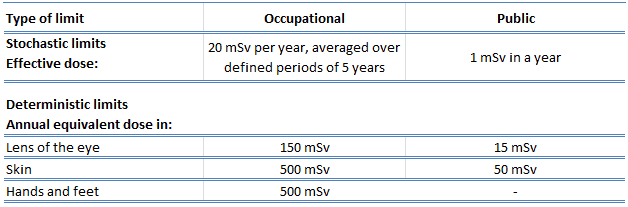
The following table summarizes dose limits for occupationally exposed workers and for the public:

dose limits - radiation
Table of dose limits for occupationally exposed workers and for the public.
Source of data: ICRP, 2007. The 2007 Recommendations of the International Commission on Radiological Protection. ICRP Publication 103. Ann. ICRP 37 (2-4).

According to the recommendation of the ICRP in its statement on tissue reactions of 21. April 2011, the equivalent dose limit for the lens of the eye for occupational exposure in planned exposure situations was reduced from 150 mSv/year to 20 mSv/year, averaged over defined periods of 5 years, with no annual dose in a single year exceeding 50 mSv.

References:

Radiation Protection:

  1. Knoll, Glenn F., Radiation Detection and Measurement 4th Edition, Wiley, 8/2010. ISBN-13: 978-0470131480.
  2. Stabin, Michael G., Radiation Protection and Dosimetry: An Introduction to Health Physics, Springer, 10/2010. ISBN-13: 978-1441923912.
  3. Martin, James E., Physics for Radiation Protection 3rd Edition, Wiley-VCH, 4/2013. ISBN-13: 978-3527411764.
  4. U.S.NRC, NUCLEAR REACTOR CONCEPTS
  5. U.S. Department of Energy, Nuclear Physics and Reactor Theory. DOE Fundamentals Handbook, Volume 1 and 2. January 1993.

Nuclear and Reactor Physics:

  1. J. R. Lamarsh, Introduction to Nuclear Reactor Theory, 2nd ed., Addison-Wesley, Reading, MA (1983).
  2. J. R. Lamarsh, A. J. Baratta, Introduction to Nuclear Engineering, 3d ed., Prentice-Hall, 2001, ISBN: 0-201-82498-1.
  3. W. M. Stacey, Nuclear Reactor Physics, John Wiley & Sons, 2001, ISBN: 0- 471-39127-1.
  4. Glasstone, Sesonske. Nuclear Reactor Engineering: Reactor Systems Engineering, Springer; 4th edition, 1994, ISBN: 978-0412985317
  5. W.S.C. Williams. Nuclear and Particle Physics. Clarendon Press; 1 edition, 1991, ISBN: 978-0198520467
  6. G.R.Keepin. Physics of Nuclear Kinetics. Addison-Wesley Pub. Co; 1st edition, 1965
  7. Robert Reed Burn, Introduction to Nuclear Reactor Operation, 1988.
  8. U.S. Department of Energy, Nuclear Physics and Reactor Theory. DOE Fundamentals Handbook, Volume 1 and 2. January 1993.
  9. Paul Reuss, Neutron Physics. EDP Sciences, 2008. ISBN: 978-2759800414.

See also:

Deterministic Effects

We hope, this article, Lethal Dose of Radiation, helps you. If so, give us a like in the sidebar. Main purpose of this website is to help the public to learn some interesting and important information about radiation and dosimeters.

What is Deterministic Effect and Dose Limit – Definition

In radiation protection, dose limits are set to prevent deterministic effects completely and to limit stochastic effects to an acceptable level. Deterministic Effects and Dose Limits

Deterministic effects (or non-stochastic health effects) are health effects, that are related directly to the absorbed radiation dose and the severity of the effect increases as the dose increases. Deterministic effects have a threshold below which no detectable clinical effects do occur. The threshold may be very low (of the order of magnitude of 0.1 Gy or higher) and may vary from person to person. For doses between 0.25 Gy and 0.5 Gy slight blood changes may be detected by medical evaluations and for doses between 0.5 Gy and 1.5 Gy blood changes will be noted and symptoms of nausea, fatigue, vomiting occur.

Deterministic Effects and Dose Limits

In radiation protection, dose limits are set to limit stochastic effects to an acceptable level, and to prevent deterministic effects completely. Note that, stochastic effects are those arising from chance: the greater the dose, the more likely the effect. Deterministic effects are those which normally have a threshold: above this, the severity of the effect increases with the dose. Dose limits are a fundamental component of radiation protection, and breaching these limits is against radiation regulation in most countries. Note that, the dose limits described in this article apply to routine operations. They do not apply to an emergency situation when human life is endangered. They do not apply in emergency exposure situations where an individual is attempting to prevent a catastrophic situation.

The limits are split into two groups, the public, and occupationally exposed workers. According to ICRP, occupational exposure refers to all exposure incurred by workers in the course of their work, with the exception of

  1. excluded exposures and exposures from exempt activities involving radiation or exempt sources
  2. any medical exposure
  3. the normal local natural background radiation.

The following table summarizes dose limits for occupationally exposed workers and for the public:

dose limits - radiation
Table of dose limits for occupationally exposed workers and for the public.
Source of data: ICRP, 2007. The 2007 Recommendations of the International Commission on Radiological Protection. ICRP Publication 103. Ann. ICRP 37 (2-4).

According to the recommendation of the ICRP in its statement on tissue reactions of 21. April 2011, the equivalent dose limit for the lens of the eye for occupational exposure in planned exposure situations was reduced from 150 mSv/year to 20 mSv/year, averaged over defined periods of 5 years, with no annual dose in a single year exceeding 50 mSv.

Limits on effective dose are for the sum of the relevant effective doses from external exposure in the specified time period and the committed effective dose from intakes of radionuclides in the same period. For adults, the committed effective dose is computed for a 50-year period after intake, whereas for children it is computed for the period up to age 70 years. The effective whole-body dose limit of 20 mSv is an average value over five years. The real limit is 100 mSv in 5 years, with not more than 50 mSv in any one year.

References:

Radiation Protection:

  1. Knoll, Glenn F., Radiation Detection and Measurement 4th Edition, Wiley, 8/2010. ISBN-13: 978-0470131480.
  2. Stabin, Michael G., Radiation Protection and Dosimetry: An Introduction to Health Physics, Springer, 10/2010. ISBN-13: 978-1441923912.
  3. Martin, James E., Physics for Radiation Protection 3rd Edition, Wiley-VCH, 4/2013. ISBN-13: 978-3527411764.
  4. U.S.NRC, NUCLEAR REACTOR CONCEPTS
  5. U.S. Department of Energy, Nuclear Physics and Reactor Theory. DOE Fundamentals Handbook, Volume 1 and 2. January 1993.

Nuclear and Reactor Physics:

  1. J. R. Lamarsh, Introduction to Nuclear Reactor Theory, 2nd ed., Addison-Wesley, Reading, MA (1983).
  2. J. R. Lamarsh, A. J. Baratta, Introduction to Nuclear Engineering, 3d ed., Prentice-Hall, 2001, ISBN: 0-201-82498-1.
  3. W. M. Stacey, Nuclear Reactor Physics, John Wiley & Sons, 2001, ISBN: 0- 471-39127-1.
  4. Glasstone, Sesonske. Nuclear Reactor Engineering: Reactor Systems Engineering, Springer; 4th edition, 1994, ISBN: 978-0412985317
  5. W.S.C. Williams. Nuclear and Particle Physics. Clarendon Press; 1 edition, 1991, ISBN: 978-0198520467
  6. G.R.Keepin. Physics of Nuclear Kinetics. Addison-Wesley Pub. Co; 1st edition, 1965
  7. Robert Reed Burn, Introduction to Nuclear Reactor Operation, 1988.
  8. U.S. Department of Energy, Nuclear Physics and Reactor Theory. DOE Fundamentals Handbook, Volume 1 and 2. January 1993.
  9. Paul Reuss, Neutron Physics. EDP Sciences, 2008. ISBN: 978-2759800414.

See also:

Deterministic Effects

We hope, this article, Deterministic Effect and Dose Limit, helps you. If so, give us a like in the sidebar. Main purpose of this website is to help the public to learn some interesting and important information about radiation and dosimeters.

What is Stochastic Effect and Effective Dose – Definition

Stochastic Effects and Effective Dose. Effective dose allows to determine stochastic biological consequences of of all types of radiation. Radiation Dosimetry

Stochastic effects of ionizing radiation occur by chance, generally occurring without a threshold level of dose. Probability of occurrence of stochastic effects is proportional to the dose but the severity of the effect is independent of the dose received. The biological effects of radiation on people can be grouped into somatic and hereditary effects. Somatic effects are those suffered by the exposed person. Hereditary effects are those suffered by the offspring of the individual exposed. Cancer risk is usually mentioned as the main stochastic effect of ionizing radiation, but also hereditary disorders are stochastic effects.

Stochastic Effects and Effective Dose

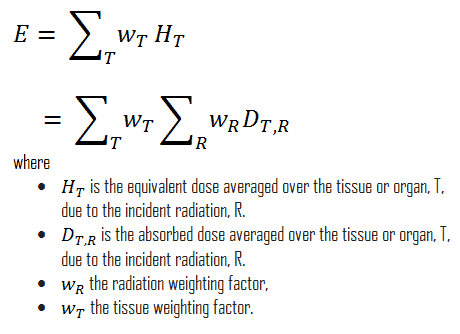
The effective dose is defined as the doubly weighted sum of absorbed dose in all the organs and tissues of the body. It is very important, whether a person is exposed partially or completelly and it is very important, whether a person is exposed to gamma rays or to another type of radiation. Effective dose allows to determine stochastic biological consequences of of all types of radiation. Dose limits are set in terms of effective dose and apply to the individual for radiological protection purposes, including the assessment of risk in general terms. Mathematically, the effective dose can be expressed as:
effective dose - definition

References:

Radiation Protection:

  1. Knoll, Glenn F., Radiation Detection and Measurement 4th Edition, Wiley, 8/2010. ISBN-13: 978-0470131480.
  2. Stabin, Michael G., Radiation Protection and Dosimetry: An Introduction to Health Physics, Springer, 10/2010. ISBN-13: 978-1441923912.
  3. Martin, James E., Physics for Radiation Protection 3rd Edition, Wiley-VCH, 4/2013. ISBN-13: 978-3527411764.
  4. U.S.NRC, NUCLEAR REACTOR CONCEPTS
  5. U.S. Department of Energy, Nuclear Physics and Reactor Theory. DOE Fundamentals Handbook, Volume 1 and 2. January 1993.

Nuclear and Reactor Physics:

  1. J. R. Lamarsh, Introduction to Nuclear Reactor Theory, 2nd ed., Addison-Wesley, Reading, MA (1983).
  2. J. R. Lamarsh, A. J. Baratta, Introduction to Nuclear Engineering, 3d ed., Prentice-Hall, 2001, ISBN: 0-201-82498-1.
  3. W. M. Stacey, Nuclear Reactor Physics, John Wiley & Sons, 2001, ISBN: 0- 471-39127-1.
  4. Glasstone, Sesonske. Nuclear Reactor Engineering: Reactor Systems Engineering, Springer; 4th edition, 1994, ISBN: 978-0412985317
  5. W.S.C. Williams. Nuclear and Particle Physics. Clarendon Press; 1 edition, 1991, ISBN: 978-0198520467
  6. G.R.Keepin. Physics of Nuclear Kinetics. Addison-Wesley Pub. Co; 1st edition, 1965
  7. Robert Reed Burn, Introduction to Nuclear Reactor Operation, 1988.
  8. U.S. Department of Energy, Nuclear Physics and Reactor Theory. DOE Fundamentals Handbook, Volume 1 and 2. January 1993.
  9. Paul Reuss, Neutron Physics. EDP Sciences, 2008. ISBN: 978-2759800414.

See also:

Stochastic Effects

We hope, this article, Stochastic Effect and Effective Dose, helps you. If so, give us a like in the sidebar. Main purpose of this website is to help the public to learn some interesting and important information about radiation and dosimeters.

What is Stochastic Effect and Dose Limit – Definition

In radiation protection, dose limits are set to limit stochastic effects to an acceptable level, and to prevent deterministic effects completely. Stochastic Effects and Dose Limits

Stochastic effects of ionizing radiation occur by chance, generally occurring without a threshold level of dose. Probability of occurrence of stochastic effects is proportional to the dose but the severity of the effect is independent of the dose received. The biological effects of radiation on people can be grouped into somatic and hereditary effects. Somatic effects are those suffered by the exposed person. Hereditary effects are those suffered by the offspring of the individual exposed. Cancer risk is usually mentioned as the main stochastic effect of ionizing radiation, but also hereditary disorders are stochastic effects.

According to ICRP:

(83) On the basis of these calculations the Commission proposes nominal probability coefficients for detriment-adjusted cancer risk as 5.5 x 10⁻² Sv-1 for the whole population and 4.1 x 10⁻² Sv-1 for adult workers. For heritable effects, the detriment-adjusted nominal risk in the whole population is estimated as 0.2 x 10⁻² Sv-1 and in adult workers as 0.1 x 10⁻² Sv-1 .

Special Reference: ICRP, 2007. The 2007 Recommendations of the International Commission on Radiological Protection. ICRP Publication 103. Ann. ICRP 37 (2-4).

The SI unit for effective dose, the sievert, represents the equivalent biological effect of the deposit of a joule of gamma rays energy in a kilogram of human tissue. As a result, one sievert represents a 5.5% chance of developing cancer. Note that, the effective dose is not intended as a measure of deterministic health effects, which is the severity of acute tissue damage that is certain to happen, that is measured by the quantity absorbed dose.

Stochastic Effects and Dose Limits

In radiation protection, dose limits are set to limit stochastic effects to an acceptable level, and to prevent deterministic effects completely. Note that, stochastic effects are those arising from chance: the greater the dose, the more likely the effect. Deterministic effects are those which normally have a threshold: above this, the severity of the effect increases with the dose. Dose limits are a fundamental component of radiation protection, and breaching these limits is against radiation regulation in most countries. Note that, the dose limits described in this article apply to routine operations. They do not apply to an emergency situation when human life is endangered. They do not apply in emergency exposure situations where an individual is attempting to prevent a catastrophic situation.

The limits are split into two groups, the public, and occupationally exposed workers. According to ICRP, occupational exposure refers to all exposure incurred by workers in the course of their work, with the exception of

  1. excluded exposures and exposures from exempt activities involving radiation or exempt sources
  2. any medical exposure
  3. the normal local natural background radiation.

The following table summarizes dose limits for occupationally exposed workers and for the public:

dose limits - radiation
Table of dose limits for occupationally exposed workers and for the public.
Source of data: ICRP, 2007. The 2007 Recommendations of the International Commission on Radiological Protection. ICRP Publication 103. Ann. ICRP 37 (2-4).

According to the recommendation of the ICRP in its statement on tissue reactions of 21. April 2011, the equivalent dose limit for the lens of the eye for occupational exposure in planned exposure situations was reduced from 150 mSv/year to 20 mSv/year, averaged over defined periods of 5 years, with no annual dose in a single year exceeding 50 mSv.

Limits on effective dose are for the sum of the relevant effective doses from external exposure in the specified time period and the committed effective dose from intakes of radionuclides in the same period. For adults, the committed effective dose is computed for a 50-year period after intake, whereas for children it is computed for the period up to age 70 years. The effective whole-body dose limit of 20 mSv is an average value over five years. The real limit is 100 mSv in 5 years, with not more than 50 mSv in any one year.

References:

Radiation Protection:

  1. Knoll, Glenn F., Radiation Detection and Measurement 4th Edition, Wiley, 8/2010. ISBN-13: 978-0470131480.
  2. Stabin, Michael G., Radiation Protection and Dosimetry: An Introduction to Health Physics, Springer, 10/2010. ISBN-13: 978-1441923912.
  3. Martin, James E., Physics for Radiation Protection 3rd Edition, Wiley-VCH, 4/2013. ISBN-13: 978-3527411764.
  4. U.S.NRC, NUCLEAR REACTOR CONCEPTS
  5. U.S. Department of Energy, Nuclear Physics and Reactor Theory. DOE Fundamentals Handbook, Volume 1 and 2. January 1993.

Nuclear and Reactor Physics:

  1. J. R. Lamarsh, Introduction to Nuclear Reactor Theory, 2nd ed., Addison-Wesley, Reading, MA (1983).
  2. J. R. Lamarsh, A. J. Baratta, Introduction to Nuclear Engineering, 3d ed., Prentice-Hall, 2001, ISBN: 0-201-82498-1.
  3. W. M. Stacey, Nuclear Reactor Physics, John Wiley & Sons, 2001, ISBN: 0- 471-39127-1.
  4. Glasstone, Sesonske. Nuclear Reactor Engineering: Reactor Systems Engineering, Springer; 4th edition, 1994, ISBN: 978-0412985317
  5. W.S.C. Williams. Nuclear and Particle Physics. Clarendon Press; 1 edition, 1991, ISBN: 978-0198520467
  6. G.R.Keepin. Physics of Nuclear Kinetics. Addison-Wesley Pub. Co; 1st edition, 1965
  7. Robert Reed Burn, Introduction to Nuclear Reactor Operation, 1988.
  8. U.S. Department of Energy, Nuclear Physics and Reactor Theory. DOE Fundamentals Handbook, Volume 1 and 2. January 1993.
  9. Paul Reuss, Neutron Physics. EDP Sciences, 2008. ISBN: 978-2759800414.

See also:

Stochastic Effects

We hope, this article, Stochastic Effect and Dose Limit, helps you. If so, give us a like in the sidebar. Main purpose of this website is to help the public to learn some interesting and important information about radiation and dosimeters.

What is Somatic Effect – Hereditary Effect – Ionizing Radiation – Definition

The biological effects of radiation on people can be grouped into somatic and hereditary effects. Somatic effects are those suffered by the exposed person. Hereditary effects are those suffered by the offspring of the individual exposed. Radiation Dosimetry

Stochastic effects of ionizing radiation occur by chance, generally occurring without a threshold level of dose. Probability of occurrence of stochastic effects is proportional to the dose but the severity of the effect is independent of the dose received. The biological effects of radiation on people can be grouped into somatic and hereditary effects. Somatic effects are those suffered by the exposed person. Hereditary effects are those suffered by the offspring of the individual exposed. Cancer risk is usually mentioned as the main stochastic effect of ionizing radiation, but also hereditary disorders are stochastic effects.

According to ICRP:

(83) On the basis of these calculations the Commission proposes nominal probability coefficients for detriment-adjusted cancer risk as 5.5 x 10⁻² Sv-1 for the whole population and 4.1 x 10⁻² Sv-1 for adult workers. For heritable effects, the detriment-adjusted nominal risk in the whole population is estimated as 0.2 x 10⁻² Sv-1 and in adult workers as 0.1 x 10⁻² Sv-1 .

Special Reference: ICRP, 2007. The 2007 Recommendations of the International Commission on Radiological Protection. ICRP Publication 103. Ann. ICRP 37 (2-4).

The SI unit for effective dose, the sievert, represents the equivalent biological effect of the deposit of a joule of gamma rays energy in a kilogram of human tissue. As a result, one sievert represents a 5.5% chance of developing cancer. Note that, the effective dose is not intended as a measure of deterministic health effects, which is the severity of acute tissue damage that is certain to happen, that is measured by the quantity absorbed dose.

There are three general categories of stochastic effects resulting from exposure to low doses of radiation. These are:

  • Genetic effects. The genetic effect is suffered by the offspring of the individual exposed. It involves the mutation of very specific cells, namely the sperm or egg cells. Radiation is an example of a physical mutagenic agent. Note that, there are also many chemical agents as well as biological agents (such as viruses) that cause mutations. One very important fact to remember is that radiation increases the spontaneous mutation rate, but does not produce any new mutations.
  • Somatic effects. Somatic effects are those suffered by the exposed person. The most common impact of irradiation is the stochastic induction of cancer with a latent period of years or decades after exposure. Since cancer is the primary result, it is sometimes called the carcinogenic effect. Radiation is an example of a physical carcinogenic, while cigarettes are an example of a chemical cancer causing agent. Viruses are examples of biological carcinogenic agents.
  • In-Utero effects involve the production of malformations in developing embryos. However, this is actually a special case of the somatic effect, since the embryo/fetus is the one exposed to the radiation.

Somatic effects as a result of exposure to radiation are thought by most to occur in a stochastic manner. The most widely accepted model posits that the incidence of cancers due to ionizing radiation increases linearly with effective radiation dose at a rate of 5.5% per sievert. This model is known as the linear no-threshold model (LNT). This model assumes, that there is no threshold point and risk increases linearly with a dose. If this linear model is correct, then natural background radiation is the most hazardous source of radiation to general public health, followed by medical imaging as a close second. The LNT is not universally accepted with some proposing an adaptive dose–response relationship where low doses are protective and high doses are detrimental. It must be emphasized, that a number of organisations disagree with using the linear no-threshold model to estimate risk from environmental and occupational low-level radiation exposure.

References:

Radiation Protection:

  1. Knoll, Glenn F., Radiation Detection and Measurement 4th Edition, Wiley, 8/2010. ISBN-13: 978-0470131480.
  2. Stabin, Michael G., Radiation Protection and Dosimetry: An Introduction to Health Physics, Springer, 10/2010. ISBN-13: 978-1441923912.
  3. Martin, James E., Physics for Radiation Protection 3rd Edition, Wiley-VCH, 4/2013. ISBN-13: 978-3527411764.
  4. U.S.NRC, NUCLEAR REACTOR CONCEPTS
  5. U.S. Department of Energy, Nuclear Physics and Reactor Theory. DOE Fundamentals Handbook, Volume 1 and 2. January 1993.

Nuclear and Reactor Physics:

  1. J. R. Lamarsh, Introduction to Nuclear Reactor Theory, 2nd ed., Addison-Wesley, Reading, MA (1983).
  2. J. R. Lamarsh, A. J. Baratta, Introduction to Nuclear Engineering, 3d ed., Prentice-Hall, 2001, ISBN: 0-201-82498-1.
  3. W. M. Stacey, Nuclear Reactor Physics, John Wiley & Sons, 2001, ISBN: 0- 471-39127-1.
  4. Glasstone, Sesonske. Nuclear Reactor Engineering: Reactor Systems Engineering, Springer; 4th edition, 1994, ISBN: 978-0412985317
  5. W.S.C. Williams. Nuclear and Particle Physics. Clarendon Press; 1 edition, 1991, ISBN: 978-0198520467
  6. G.R.Keepin. Physics of Nuclear Kinetics. Addison-Wesley Pub. Co; 1st edition, 1965
  7. Robert Reed Burn, Introduction to Nuclear Reactor Operation, 1988.
  8. U.S. Department of Energy, Nuclear Physics and Reactor Theory. DOE Fundamentals Handbook, Volume 1 and 2. January 1993.
  9. Paul Reuss, Neutron Physics. EDP Sciences, 2008. ISBN: 978-2759800414.

See also:

Radiobiology

We hope, this article, Somatic Effect – Hereditary Effect – Ionizing Radiation, helps you. If so, give us a like in the sidebar. Main purpose of this website is to help the public to learn some interesting and important information about radiation and dosimeters.

What is Linear no-threshold model – Definition

The linear no-threshold model (LNT model) is a conservative model used in radiation protection to estimate the health effects from small radiation doses. Radiation Dosimetry
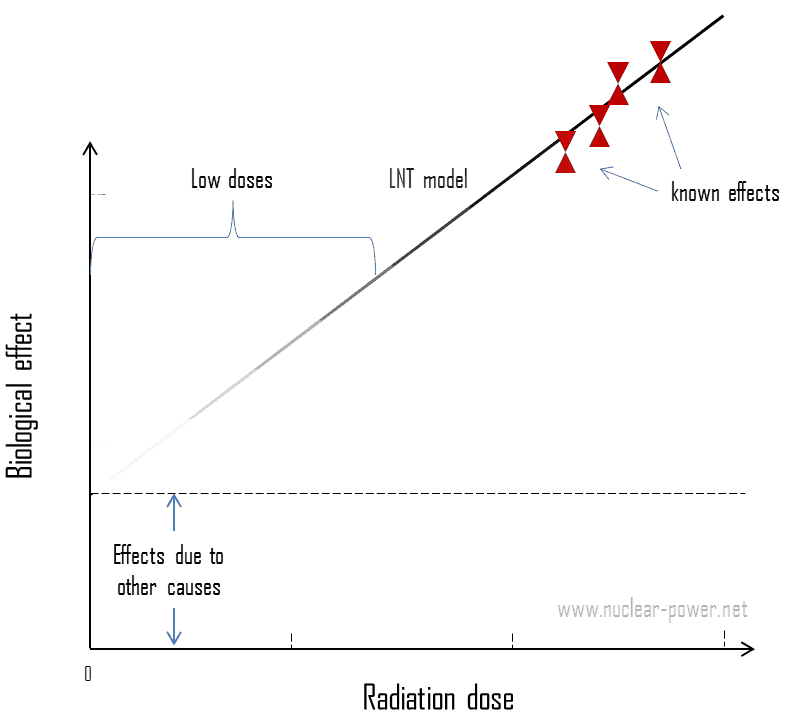
linear no-threshold model
LNT model allows for the extrapolation of the cancer risk vs. radiation dose to low-dose levels, given a known risk at a high dose.

The linear no-threshold model (LNT model) is a conservative model used in radiation protection to estimate the health effects from small radiation doses. According to the LNT model, radiation is always considered harmful with no safety threshold, and the sum of several very small exposures are considered to have the same biological risk as one larger exposure (linearity). The problem is that, at very low doses, it is practically impossible to correlate any irradiation with certain biological effects. This is because the baseline cancer rate is already very high and the risk of developing cancer fluctuates 40% because of individual life style and environmental effects, obscuring the subtle effects of low-level radiation. Therefore it is very difficult to validate this model. Since data for low doses region are not available, biological effects for low doses of radiation must be therefore extrapolated. The question is how?

The LNT model is recommended by the ICRP and accepted by most radiation protection authorities in the world. It must be emphasized, conservativeness of this model has enormous consequences and a number of organisations disagree with using the linear no-threshold model to estimate risk from environmental and occupational low-level radiation exposure. This principle was introduced in the late 1950s and is still the basis for all dose limits recommended.

According to ICRP:

“A dose-response model which is based on the assumption that, in the low dose range, radiation doses greater than zero will increase the risk of excess cancer and/or heritable disease in a simple proportionate manner.“

Special Reference: ICRP, 2007. The 2007 Recommendations of the International Commission on Radiological Protection. ICRP Publication 103. Ann. ICRP 37 (2-4).

Today the protection system is based on the LNT-hypothesis, assuming that all radiation is bad and that the deleterious effect (essentially the cancer risk) increases linearly with dose with no threshold (start at zero dose). Since zero dose is not attainable the ALARA – principle (As Low As Reasonable Achievable) was introduced. This allows the summation by dosimeters of all radiation exposure, without taking into consideration dose levels or dose rates. However, the aggregation of very low individual doses over extended time periods is inappropriate, and in particular, the calculation of the number of cancer deaths based on collective effective doses from trivial individual doses should be avoided.

See also: Collective Dose

LNT Model – Dose-effect Curve

linear no-threshold model
LNT model allows for the extrapolation of the cancer risk vs. radiation dose to low-dose levels, given a known risk at a high dose.

As can be seen from the LNT dose-effect curve, the risk does not start at 0 because there is some risk of cancer, even with no occupational exposure. Note that, radiation is one of physical carcinogenic agents, while cigarettes are an example of a chemical cancer causing agent. Viruses are examples of biological carcinogenic agents. The slope of the line just means that a person that receives 5 mSv in a year incurs 10 times as much risk as a person that receives 0.5 mSv in a year.

As can be seen the linear no-threshold model assumes that more exposure means more risk, and there is no dose of radiation so small that it will not have some effect.

Consequences of LNT model

Today the protection system is based on the LNT-hypothesis, assuming that all radiation is bad and that the deleterious effect (essentially the cancer risk) increases linearly with dose with no threshold (start at zero dose). The probabilistic nature of stochastic effects and the properties of the LNT model make it impossible to derive a clear distinction between ‘safe’ and ‘dangerous’, and this creates some difficulties in explaining the control of radiation risks. The major consequence of the LNT model is that some finite risk, however small, must be assumed and a level of protection established based on what is deemed acceptable. Since zero dose is not attainable, the ICRP (Publication 103) defines the System of Radiological Protection, which is based on the following three principles:

  1. Justification. “Any decision that alters the radiation exposure situation should do more good than harm.”
  2. Optimisation of Protection. “Doses should all be kept as low as reasonably achievable, taking into account economic and societal factors.” (known as ALARA or ALARP)
  3. Dose Limitation. “The total dose to any individual … should not exceed the appropriate limits.”

All of these three principles have bases in the LNT model and the Commission considers that the LNT model remains a prudent basis for radiological protection at low doses and low dose rates.

LNT and Collective Dose

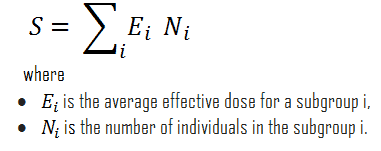
In case of collective dose, conservativeness of the LNT model has enormous consequences and the model is sometimes wrongly (perhaps intentionally) used to quantify the cancerous effect of collective doses of low-level radioactive contamination. A linear dose-effect curve makes it possible to use collective doses to calculate the detrimental effects to an irradiated population. Simply:

collective effective dose

But what does it mean? If ten million people receives an effective dose of 0.1 µSv (an equivalent of eating one banana), then the collective dose will be S = 1 Sv. Does it mean there is 5.5% chance of developing cancer for one person due to eating bananas? Note that, for high doses one sievert represents a 5.5% chance of developing cancer. A number of organisations disagree with this result and with using the linear no-threshold model to estimate risk from environmental and occupational low-level radiation exposure. There is a question, whether the collective dose is meaningful at all.

The ICRP alone states:

“The collective effective dose quantity is an instrument for optimisation, for comparing radiological technologies and protection procedures, predominantly in the context of occupational exposure. Collective effective dose is not intended as a tool for epidemiological risk assessment, and it is inappropriate to use it in risk projections. The aggregation of very low individual doses over extended time periods is inappropriate, and in particular, the calculation of the number of cancer deaths based on collective effective doses from trivial individual doses should be avoided.”

Special Reference: ICRP, 2007. The 2007 Recommendations of the International Commission on Radiological Protection. ICRP Publication 103. Ann. ICRP 37 (2-4).

Controversy of LNT Model

As was written, today the protection system is based on the LNT-hypothesis, which is a conservative model used in radiation protection to estimate the health effects from small radiation doses. This model is excellent for setting up a protection system for all use of ionizing radiation. This model assumes, that there is no threshold point and risk increases linearly with a dose, i.e. the LNT model implies that there is no safe dose of ionizing radiation. If this linear model is correct, then natural background radiation is the most hazardous source of radiation to general public health, followed by medical imaging as a close second.

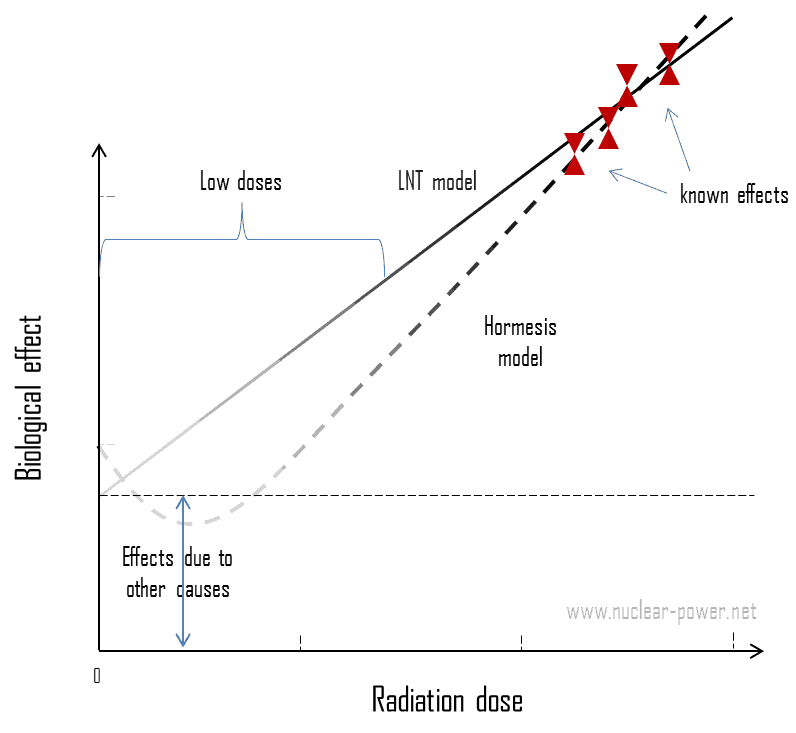
LNT Model and Hormesis Model
Alternative assumptions for the extrapolation of the cancer risk vs. radiation dose to low-dose levels, given a known risk at a high dose: LNT model, and hormesis model.

In case of low doses, its conservativeness has enormous consequences and the model is sometimes wrongly (perhaps intentionally) used to quantify the cancerous effect of collective doses of low-level radioactive contaminations. A linear dose-effect curve makes it possible to use collective doses to calculate the detrimental effects to an irradiated population. It is also argued that LNT model had caused an irrational fear of radiation, since every microsievert can be converted to the probability of cancer induction, however small this probability is. For example, if ten million people receives an effective dose of 0.1 µSv (an equivalent of eating one banana), then the collective dose will be S = 1 Sv. Does it mean there is 5.5% chance of developing cancer for one person due to eating banana? Note that, for high doses one sievert represents a 5.5% chance of developing cancer.

Problem of this model is that it neglects a number of defence biological processes that may be crucial at low doses. The research during the last two decades is very interesting and show that small doses of radiation given at a low dose rate stimulate the defense mechanisms. Therefore the LNT model is not universally accepted with some proposing an adaptive dose–response relationship where low doses are protective and high doses are detrimental. Many studies have contradicted the LNT model and many of these have shown adaptive response to low dose radiation resulting in reduced mutations and cancers. This phenomenon is known as radiation hormesis.


References:

Radiation Protection:

  1. Knoll, Glenn F., Radiation Detection and Measurement 4th Edition, Wiley, 8/2010. ISBN-13: 978-0470131480.
  2. Stabin, Michael G., Radiation Protection and Dosimetry: An Introduction to Health Physics, Springer, 10/2010. ISBN-13: 978-1441923912.
  3. Martin, James E., Physics for Radiation Protection 3rd Edition, Wiley-VCH, 4/2013. ISBN-13: 978-3527411764.
  4. U.S.NRC, NUCLEAR REACTOR CONCEPTS
  5. U.S. Department of Energy, Nuclear Physics and Reactor Theory. DOE Fundamentals Handbook, Volume 1 and 2. January 1993.

Nuclear and Reactor Physics:

  1. J. R. Lamarsh, Introduction to Nuclear Reactor Theory, 2nd ed., Addison-Wesley, Reading, MA (1983).
  2. J. R. Lamarsh, A. J. Baratta, Introduction to Nuclear Engineering, 3d ed., Prentice-Hall, 2001, ISBN: 0-201-82498-1.
  3. W. M. Stacey, Nuclear Reactor Physics, John Wiley & Sons, 2001, ISBN: 0- 471-39127-1.
  4. Glasstone, Sesonske. Nuclear Reactor Engineering: Reactor Systems Engineering, Springer; 4th edition, 1994, ISBN: 978-0412985317
  5. W.S.C. Williams. Nuclear and Particle Physics. Clarendon Press; 1 edition, 1991, ISBN: 978-0198520467
  6. G.R.Keepin. Physics of Nuclear Kinetics. Addison-Wesley Pub. Co; 1st edition, 1965
  7. Robert Reed Burn, Introduction to Nuclear Reactor Operation, 1988.
  8. U.S. Department of Energy, Nuclear Physics and Reactor Theory. DOE Fundamentals Handbook, Volume 1 and 2. January 1993.
  9. Paul Reuss, Neutron Physics. EDP Sciences, 2008. ISBN: 978-2759800414.

See also:

Radiobiology

We hope, this article, Linear no-threshold model, helps you. If so, give us a like in the sidebar. Main purpose of this website is to help the public to learn some interesting and important information about radiation and dosimeters.

What is LNT Model – Dose-effect Curve – Definition

As can be seen from the LNT dose-effect curve, the risk does not start at 0 because there is some risk of cancer, even with no occupational exposure. Radiation Dosimetry
linear no-threshold model
LNT model allows for the extrapolation of the cancer risk vs. radiation dose to low-dose levels, given a known risk at a high dose.

As can be seen from the LNT dose-effect curve, the risk does not start at 0 because there is some risk of cancer, even with no occupational exposure. Note that, radiation is one of physical carcinogenic agents, while cigarettes are an example of a chemical cancer causing agent. Viruses are examples of biological carcinogenic agents. The slope of the line just means that a person that receives 5 mSv in a year incurs 10 times as much risk as a person that receives 0.5 mSv in a year.

As can be seen the linear no-threshold model assumes that more exposure means more risk, and there is no dose of radiation so small that it will not have some effect.

The LNT model is recommended by the ICRP and accepted by most radiation protection authorities in the world. It must be emphasized, conservativeness of this model has enormous consequences and a number of organisations disagree with using the linear no-threshold model to estimate risk from environmental and occupational low-level radiation exposure. This principle was introduced in the late 1950s and is still the basis for all dose limits recommended.

According to ICRP:

“A dose-response model which is based on the assumption that, in the low dose range, radiation doses greater than zero will increase the risk of excess cancer and/or heritable disease in a simple proportionate manner.“

Special Reference: ICRP, 2007. The 2007 Recommendations of the International Commission on Radiological Protection. ICRP Publication 103. Ann. ICRP 37 (2-4).

Today the protection system is based on the LNT-hypothesis, assuming that all radiation is bad and that the deleterious effect (essentially the cancer risk) increases linearly with dose with no threshold (start at zero dose). Since zero dose is not attainable the ALARA – principle (As Low As Reasonable Achievable) was introduced. This allows the summation by dosimeters of all radiation exposure, without taking into consideration dose levels or dose rates. However, the aggregation of very low individual doses over extended time periods is inappropriate, and in particular, the calculation of the number of cancer deaths based on collective effective doses from trivial individual doses should be avoided.

References:

Radiation Protection:

  1. Knoll, Glenn F., Radiation Detection and Measurement 4th Edition, Wiley, 8/2010. ISBN-13: 978-0470131480.
  2. Stabin, Michael G., Radiation Protection and Dosimetry: An Introduction to Health Physics, Springer, 10/2010. ISBN-13: 978-1441923912.
  3. Martin, James E., Physics for Radiation Protection 3rd Edition, Wiley-VCH, 4/2013. ISBN-13: 978-3527411764.
  4. U.S.NRC, NUCLEAR REACTOR CONCEPTS
  5. U.S. Department of Energy, Nuclear Physics and Reactor Theory. DOE Fundamentals Handbook, Volume 1 and 2. January 1993.

Nuclear and Reactor Physics:

  1. J. R. Lamarsh, Introduction to Nuclear Reactor Theory, 2nd ed., Addison-Wesley, Reading, MA (1983).
  2. J. R. Lamarsh, A. J. Baratta, Introduction to Nuclear Engineering, 3d ed., Prentice-Hall, 2001, ISBN: 0-201-82498-1.
  3. W. M. Stacey, Nuclear Reactor Physics, John Wiley & Sons, 2001, ISBN: 0- 471-39127-1.
  4. Glasstone, Sesonske. Nuclear Reactor Engineering: Reactor Systems Engineering, Springer; 4th edition, 1994, ISBN: 978-0412985317
  5. W.S.C. Williams. Nuclear and Particle Physics. Clarendon Press; 1 edition, 1991, ISBN: 978-0198520467
  6. G.R.Keepin. Physics of Nuclear Kinetics. Addison-Wesley Pub. Co; 1st edition, 1965
  7. Robert Reed Burn, Introduction to Nuclear Reactor Operation, 1988.
  8. U.S. Department of Energy, Nuclear Physics and Reactor Theory. DOE Fundamentals Handbook, Volume 1 and 2. January 1993.
  9. Paul Reuss, Neutron Physics. EDP Sciences, 2008. ISBN: 978-2759800414.

See also:

LNT

We hope, this article, LNT Model – Dose-effect Curve, helps you. If so, give us a like in the sidebar. Main purpose of this website is to help the public to learn some interesting and important information about radiation and dosimeters.

What is Controversy of LNT Model – Definition

Controversy of LNT Model. Conservativeness of this model has enormous consequences and a number of organisations disagree with using the linear no-threshold model to estimate risk from environmental and occupational low-level radiation exposure. Radiation Dosimetry

As was written, today the protection system is based on the LNT-hypothesis, which is a conservative model used in radiation protection to estimate the health effects from small radiation doses. The LNT model is recommended by the ICRP and accepted by most radiation protection authorities in the world. It must be emphasized, conservativeness of this model has enormous consequences and a number of organisations disagree with using the linear no-threshold model to estimate risk from environmental and occupational low-level radiation exposure. This model is excellent for setting up a protection system for all use of ionizing radiation. This model assumes, that there is no threshold point and risk increases linearly with a dose, i.e. the LNT model implies that there is no safe dose of ionizing radiation. If this linear model is correct, then natural background radiation is the most hazardous source of radiation to general public health, followed by medical imaging as a close second.

LNT Model and Hormesis Model
Alternative assumptions for the extrapolation of the cancer risk vs. radiation dose to low-dose levels, given a known risk at a high dose: LNT model, and hormesis model.

In case of low doses, its conservativeness has enormous consequences and the model is sometimes wrongly (perhaps intentionally) used to quantify the cancerous effect of collective doses of low-level radioactive contaminations. A linear dose-effect curve makes it possible to use collective doses to calculate the detrimental effects to an irradiated population. It is also argued that LNT model had caused an irrational fear of radiation, since every microsievert can be converted to the probability of cancer induction, however small this probability is. For example, if ten million people receives an effective dose of 0.1 µSv (an equivalent of eating one banana), then the collective dose will be S = 1 Sv. Does it mean there is 5.5% chance of developing cancer for one person due to eating banana? Note that, for high doses one sievert represents a 5.5% chance of developing cancer.

Problem of this model is that it neglects a number of defence biological processes that may be crucial at low doses. The research during the last two decades is very interesting and show that small doses of radiation given at a low dose rate stimulate the defense mechanisms. Therefore the LNT model is not universally accepted with some proposing an adaptive dose–response relationship where low doses are protective and high doses are detrimental. Many studies have contradicted the LNT model and many of these have shown adaptive response to low dose radiation resulting in reduced mutations and cancers. This phenomenon is known as radiation hormesis.


References:

Radiation Protection:

  1. Knoll, Glenn F., Radiation Detection and Measurement 4th Edition, Wiley, 8/2010. ISBN-13: 978-0470131480.
  2. Stabin, Michael G., Radiation Protection and Dosimetry: An Introduction to Health Physics, Springer, 10/2010. ISBN-13: 978-1441923912.
  3. Martin, James E., Physics for Radiation Protection 3rd Edition, Wiley-VCH, 4/2013. ISBN-13: 978-3527411764.
  4. U.S.NRC, NUCLEAR REACTOR CONCEPTS
  5. U.S. Department of Energy, Nuclear Physics and Reactor Theory. DOE Fundamentals Handbook, Volume 1 and 2. January 1993.

Nuclear and Reactor Physics:

  1. J. R. Lamarsh, Introduction to Nuclear Reactor Theory, 2nd ed., Addison-Wesley, Reading, MA (1983).
  2. J. R. Lamarsh, A. J. Baratta, Introduction to Nuclear Engineering, 3d ed., Prentice-Hall, 2001, ISBN: 0-201-82498-1.
  3. W. M. Stacey, Nuclear Reactor Physics, John Wiley & Sons, 2001, ISBN: 0- 471-39127-1.
  4. Glasstone, Sesonske. Nuclear Reactor Engineering: Reactor Systems Engineering, Springer; 4th edition, 1994, ISBN: 978-0412985317
  5. W.S.C. Williams. Nuclear and Particle Physics. Clarendon Press; 1 edition, 1991, ISBN: 978-0198520467
  6. G.R.Keepin. Physics of Nuclear Kinetics. Addison-Wesley Pub. Co; 1st edition, 1965
  7. Robert Reed Burn, Introduction to Nuclear Reactor Operation, 1988.
  8. U.S. Department of Energy, Nuclear Physics and Reactor Theory. DOE Fundamentals Handbook, Volume 1 and 2. January 1993.
  9. Paul Reuss, Neutron Physics. EDP Sciences, 2008. ISBN: 978-2759800414.

See also:

LNT

We hope, this article, Controversy of LNT Model, helps you. If so, give us a like in the sidebar. Main purpose of this website is to help the public to learn some interesting and important information about radiation and dosimeters.

What is Effective Dose – Definition

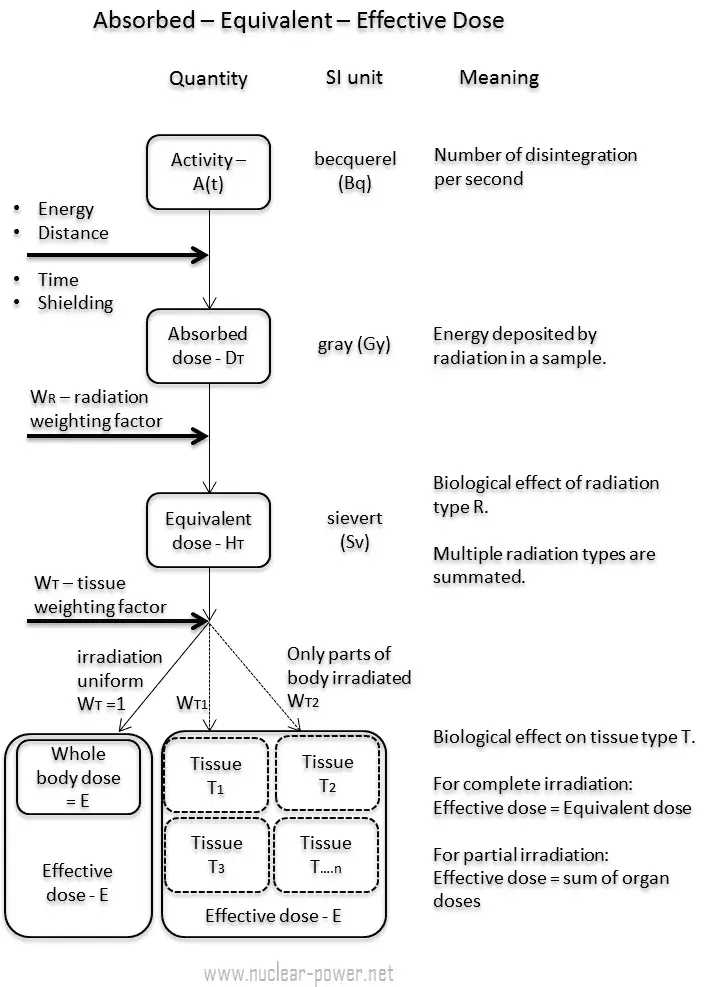
In radiation protection, the effective dose is a dose quantity defined as the sum of the tissue-equivalent doses weighted by the ICRP organ (tissue) weighting factors, wT, which takes into account the varying sensitivity of different organs and tissues to radiation. Radiation Dosimetry

Absorbed - Equivalent - Effective DoseIn radiation protection, the effective dose is a dose quantity defined as the sum of the tissue-equivalent doses weighted by the ICRP organ (tissue) weighting factors, wT, which takes into account the varying sensitivity of different organs and tissues to radiation. Effective dose is given the symbol E. The SI unit of E is the sievert (Sv) or but rem (roentgen equivalent man) is still commonly used (1 Sv = 100 rem). Unit of sievert was named after the Swedish scientist Rolf Sievert, who did a lot of the early work on dosimetry in radiation therapy.

As was written in previous chapter, equivalent dose, HT, is used for assessing stochastic health risk due to external radiation fields that penetrate uniformly through the whole body. However it needs further corrections when the field is applied only to part(s) of the body, or non-uniformly to measure the overall stochastic health risk to the body. To enable this a further dose quantity called effective dose must be used. Effective dose allows to determine the biological consequences of partial irradiation (non-uniform). It is due to the fact, various body tissues react to ionising radiation in different ways. Therefore the ICRP has assigned sensitivity factors to specified tissues and organs so that the effect of partial irradiation can be calculated if the irradiated regions are known.

In Publication 60, the ICRP defined the effective dose as the doubly weighted sum of absorbed dose in all the organs and tissues of the body. Dose limits are set in terms of effective dose and apply to the individual for radiological protection purposes, including the assessment of risk in general terms. Mathematically, the effective dose can be expressed as:

effective dose - definition

effective doseBoth equivalent dose and effective dose are quantities for use in radiological protection, including the assessment of risks in general terms. They provide a basis for estimating the probability of stochastic effects only for absorbed doses well below the thresholds for deterministic effects.

Units of effective dose:

  • Sievert. The sievert is a derived unit of equivalent dose and effective dose and for represents the equivalent biological effect of the deposit of a joule of gamma rays energy in a kilogram of human tissue.
  • REM. The rem (an abbreviation for Roentgen Equivalent Man) is the non-SI unit of equivalent dose and effective dose dose, which is used predominantly in the USA. It is a term for dose equivalence and equals the biological damage that would be caused by one rad of dose.

One sievert is a large amount of effective dose. A person who has absorbed a whole body dose of 1 Sv has absorbed one joule of energy in each kg of body tissue (in case of gamma rays).

Effective doses in industry and medicine often have usually lower doses than one sievert, and the following multiples are often used:

1 mSv (millisievert) = 1E-3 Sv

1 µSv (microsievert) = 1E-6 Sv

Conversions from the SI units to other units are as follows:

  • 1 Sv = 100 rem
  • 1 mSv = 100 mrem

Tissue Weighting Factors

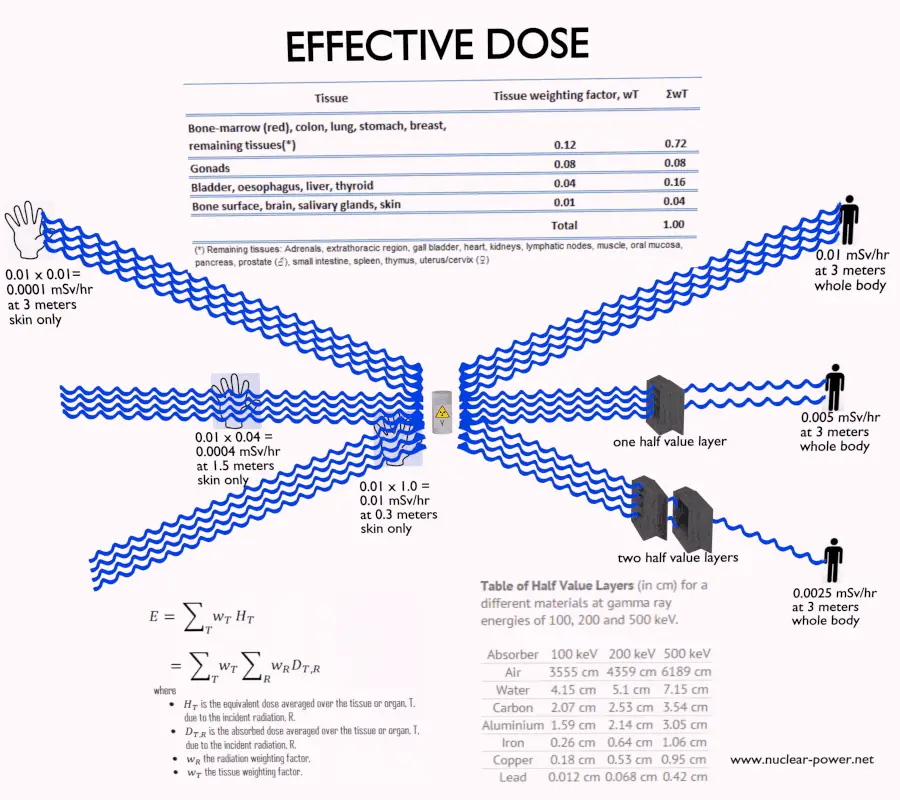
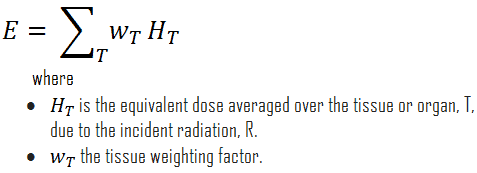
The tissue weighting factor, wT, is the factor by which the equivalent dose in a tissue or organ T is weighted to represent the relative contribution of that tissue or organ to the total health detriment resulting from uniform irradiation of the body (ICRP 1991b). It represents a measure of the risk of stochastic effects that might result from exposure of that specific tissue. The tissue weighting factors take into account the varying sensitivity of different organs and tissues to radiation.
effective dose - tissue weighting factor

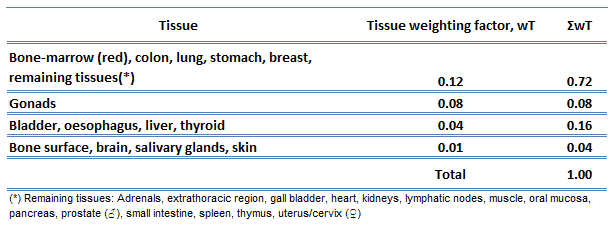
The tissue weighting factors are listed in various ICRP (International Commission on Radiological Protection) publications. According to the actual determination of the ICRP the risk factors are  in the following table (from ICRP publication 103 (ICRP 2007)).
tissue weighting factor - ICRP

Special Reference: ICRP, 2007. The 2007 Recommendations of the International Commission on Radiological Protection. ICRP Publication 103. Ann. ICRP 37 (2-4).

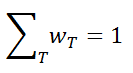
For this purpose, the body has been divided into 15 different organs – each with a weighting factor wT. If only part of the body is irradiated, then only those regions are used to calculate the effective dose. The tissue weighting factors summate to 1.0, so that if an entire body is radiated with uniformly penetrating external radiation, the effective dose for the entire body is equal to the equivalent dose for the entire body.
sum - tissue weighting factors

If a person is irradiated only partially, the dose will depend strongly on the tissue, which was irradiated. For example, a 10 mSv gamma dose to the whole body and a 50 mSv dose to the thyroid is the same, in terms of risk, as a whole-body dose of 10 + 0.04 x 50 = 12 mSv.

Examples of Doses in Sieverts

We must note that radiation is all around us. In, around, and above the world we live in. It is a natural energy force that surrounds us. It is a part of our natural world that has been here since the birth of our planet. In the following points we try to express enormous ranges of radiation exposure, which can be obtained from various sources.

  • 0.05 µSv – Sleeping next to someone
  • 0.09 µSv – Living within 30 miles of a nuclear power plant for a year
  • 0.1 µSv – Eating one banana
  • 0.3 µSv – Living within 50 miles of a coal power plant for a year
  • 10 µSv – Average daily dose received from natural background
  • 20 µSv – Chest X-ray
  • 40 µSv – A 5-hour airplane flight
  • 600 µSv – mammogram
  • 1 000 µSv – Dose limit for individual members of the public, total effective dose per annum
  • 3 650 µSv – Average yearly dose received from natural background
  • 5 800 µSv – Chest CT scan
  • 10 000 µSv – Average yearly dose received from natural background in Ramsar, Iran
  • 20 000 µSv – single full-body CT scan
  • 175 000 µSv – Annual dose from natural radiation on a monazite beach near Guarapari, Brazil.
  • 5 000 000 µSv – Dose that kills a human with a 50% risk within 30 days (LD50/30), if the dose is received over a very short duration.

As can be seen, low-level doses are common for everyday life. The previous examples can help illustrate relative magnitudes. From biological consequences point of view, it is very important to distinguish between doses received over short and extended periods.  An “acute dose” is one that occurs over a short and finite period of time, while a “chronic dose” is a dose that continues for an extended period of time so that it is better described by a dose rate. High doses tend to kill cells, while low doses tend to damage or change them. Low doses spread out over long periods of time don’t cause an immediate problem to any body organ. The effects of low doses of radiation occur at the level of the cell, and the results may not be observed for many years.

Effective Dose Rate

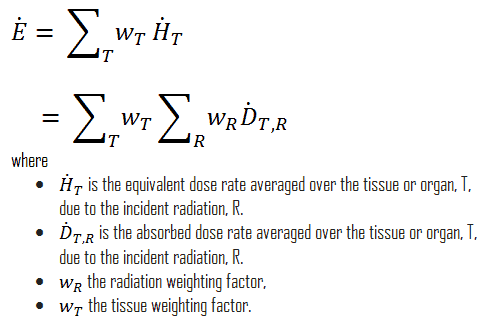
The effective dose rate is the rate at which an effective dose is received. It is a measure of radiation dose intensity (or strength). The effective dose rate is therefore defined as:
effective dose rate - definition

In conventional units, it is measured in mSv/sec, Sv/hr, mrem/sec or rem/hr. Since the amount of radiation exposure depends directly (linearly) on the time people spend near the source of radiation, the effective dose is equal to the strength of the radiation field (dose rate) multiplied by the length of time spent in that field. The example above indicates a person could expect to receive a dose of 25 millirems by staying in a 50 millirems/hour field for thirty minutes.

Calculation of Shielded Dose Rate

Assume the point isotropic source which contains 1.0 Ci of 137Cs, which has a half-life of 30.2 years. Note that the relationship between half-life and the amount of a radionuclide required to give an activity of one curie is shown below. This amount of material can be calculated using λ, which is the decay constant of certain nuclide:

Curie - Unit of Activity

About 94.6 percent decays by beta emission to a metastable nuclear isomer of barium: barium-137m. The main photon peak of Ba-137m is 662 keV. For this calculation, assume that all decays go through this channel.

Calculate the primary photon dose rate, in sieverts per hour (Sv.h-1), at the outer surface of a 5 cm thick lead shield. Then calculate the equivalent and effective dose rates for two cases.

  1. Assume that this external radiation field penetrates uniformly through the whole body. That means: Calculate the effective whole-body dose rate.
  2. Assume that this external radiation field penetrates only lungs and the other organs are completely shielded. That means: Calculate the effective dose rate.

Note that, primary photon dose rate neglects all secondary particles. Assume that the effective distance of the source from the dose point is 10 cm. We shall also assume that the dose point is soft tissue and it can reasonably be simulated by water and we use the mass energy absorption coefficient for water.

See also: Gamma Ray Attenuation

See also: Shielding of Gamma Rays

Solution:

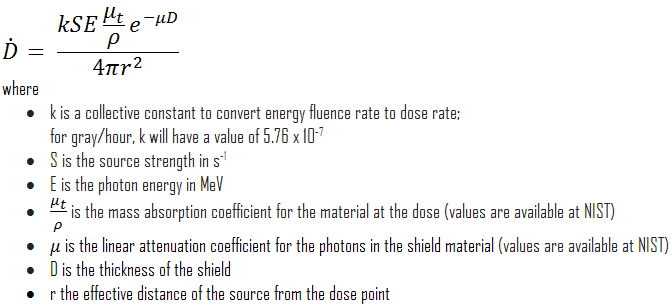
The primary photon dose rate is attenuated exponentially, and the dose rate from primary photons, taking account of the shield, is given by:
dose rate calculation

As can be seen, we do not account for the buildup of secondary radiation. If secondary particles are produced or if the primary radiation changes its energy or direction, then the effective attenuation will be much less.  This assumption generally underestimates the true dose rate, especially for thick shields and when the dose point is close to the shield surface, but this assumption simplifies all calculations. For this case the true dose rate (with the buildup of secondary radiation) will be more than two times higher.

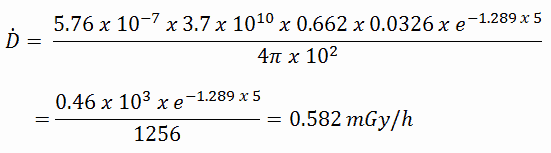
To calculate the absorbed dose rate, we have to use in the formula:

  • k = 5.76 x 10⁻⁷
  • S = 3.7 x 10¹⁰ s-1
  • E = 0.662 MeV
  • μt/ρ =  0.0326 cm2/g (values are available at NIST)
  • μ =  1.289 cm-1 (values are available at NIST)
  • D = 5 cm
  • r = 10 cm

Result:

The resulting absorbed dose rate in grays per hour is then:
absorbed dose rate - gray - calculation

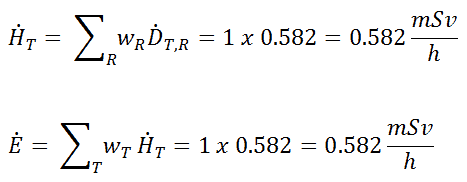
1) Uniform irradiation

Since the radiation weighting factor for gamma rays is equal to one and we have assumed the uniform radiation field (the tissue weighting factor is also equal to unity), we can directly calculate the equivalent dose rate and the effective dose rate (E = HT) from the absorbed dose rate as:
calculation - effective dose - uniform

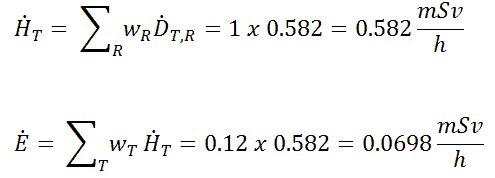
2) Partial irradiation

In this case we assume a partial irradiation of lungs only. Thus, we have to use the tissue weighting factor, which is equal to wT = 0.12. The radiation weighting factor for gamma rays is equal to one. As a result, we can calculate the effective dose rate as:
calculation - effective dose - non-uniform

Note that, if one part of the body (e.g.,the lungs) receives a radiation dose, it represents a risk for a particularly damaging effect (e.g., lung cancer). If the same dose is given to another organ it represents a different risk factor.

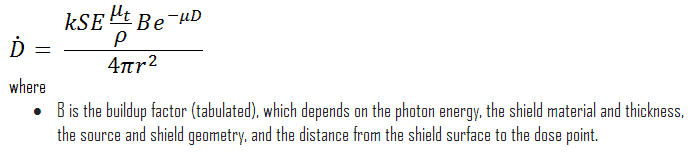
If we want to account for the buildup of secondary radiation, then we have to include the buildup factor. The extended formula for the dose rate is then:
absorbed dose rate - gray


——–

References:

Radiation Protection:

  1. Knoll, Glenn F., Radiation Detection and Measurement 4th Edition, Wiley, 8/2010. ISBN-13: 978-0470131480.
  2. Stabin, Michael G., Radiation Protection and Dosimetry: An Introduction to Health Physics, Springer, 10/2010. ISBN-13: 978-1441923912.
  3. Martin, James E., Physics for Radiation Protection 3rd Edition, Wiley-VCH, 4/2013. ISBN-13: 978-3527411764.
  4. U.S.NRC, NUCLEAR REACTOR CONCEPTS
  5. U.S. Department of Energy, Nuclear Physics and Reactor Theory. DOE Fundamentals Handbook, Volume 1 and 2. January 1993.

Nuclear and Reactor Physics:

  1. J. R. Lamarsh, Introduction to Nuclear Reactor Theory, 2nd ed., Addison-Wesley, Reading, MA (1983).
  2. J. R. Lamarsh, A. J. Baratta, Introduction to Nuclear Engineering, 3d ed., Prentice-Hall, 2001, ISBN: 0-201-82498-1.
  3. W. M. Stacey, Nuclear Reactor Physics, John Wiley & Sons, 2001, ISBN: 0- 471-39127-1.
  4. Glasstone, Sesonske. Nuclear Reactor Engineering: Reactor Systems Engineering, Springer; 4th edition, 1994, ISBN: 978-0412985317
  5. W.S.C. Williams. Nuclear and Particle Physics. Clarendon Press; 1 edition, 1991, ISBN: 978-0198520467
  6. G.R.Keepin. Physics of Nuclear Kinetics. Addison-Wesley Pub. Co; 1st edition, 1965
  7. Robert Reed Burn, Introduction to Nuclear Reactor Operation, 1988.
  8. U.S. Department of Energy, Nuclear Physics and Reactor Theory. DOE Fundamentals Handbook, Volume 1 and 2. January 1993.
  9. Paul Reuss, Neutron Physics. EDP Sciences, 2008. ISBN: 978-2759800414.

See also:

Radiation Protection

We hope, this article, Effective Dose, helps you. If so, give us a like in the sidebar. Main purpose of this website is to help the public to learn some interesting and important information about radiation and dosimeters.

What is Unit of Effective Dose – Definition

Units of Effective Dose. The SI unit of effective dose is the sievert (Sv) or but rem (roentgen equivalent man) is still commonly used (1 Sv = 100 rem). Unit of sievert was named after the Swedish scientist Rolf Sievert. Radiation Dosimetry

effective doseIn radiation protection, the effective dose is a dose quantity defined as the sum of the tissue-equivalent doses weighted by the ICRP organ (tissue) weighting factors, wT, which takes into account the varying sensitivity of different organs and tissues to radiation. Effective dose is given the symbol E. The SI unit of E is the sievert (Sv) or but rem (roentgen equivalent man) is still commonly used (1 Sv = 100 rem). Unit of sievert was named after the Swedish scientist Rolf Sievert, who did a lot of the early work on dosimetry in radiation therapy.

Units of effective dose

  • Sievert. The sievert is a derived unit of equivalent dose and effective dose and for represents the equivalent biological effect of the deposit of a joule of gamma rays energy in a kilogram of human tissue.
  • REM. The rem (an abbreviation for Roentgen Equivalent Man) is the non-SI unit of equivalent dose and effective dose dose, which is used predominantly in the USA. It is a term for dose equivalence and equals the biological damage that would be caused by one rad of dose.

One sievert is a large amount of effective dose. A person who has absorbed a whole body dose of 1 Sv has absorbed one joule of energy in each kg of body tissue (in case of gamma rays).

Effective doses in industry and medicine often have usually lower doses than one sievert, and the following multiples are often used:

1 mSv (millisievert) = 1E-3 Sv

1 µSv (microsievert) = 1E-6 Sv

Conversions from the SI units to other units are as follows:

  • 1 Sv = 100 rem
  • 1 mSv = 100 mrem
References:

Radiation Protection:

  1. Knoll, Glenn F., Radiation Detection and Measurement 4th Edition, Wiley, 8/2010. ISBN-13: 978-0470131480.
  2. Stabin, Michael G., Radiation Protection and Dosimetry: An Introduction to Health Physics, Springer, 10/2010. ISBN-13: 978-1441923912.
  3. Martin, James E., Physics for Radiation Protection 3rd Edition, Wiley-VCH, 4/2013. ISBN-13: 978-3527411764.
  4. U.S.NRC, NUCLEAR REACTOR CONCEPTS
  5. U.S. Department of Energy, Nuclear Physics and Reactor Theory. DOE Fundamentals Handbook, Volume 1 and 2. January 1993.

Nuclear and Reactor Physics:

  1. J. R. Lamarsh, Introduction to Nuclear Reactor Theory, 2nd ed., Addison-Wesley, Reading, MA (1983).
  2. J. R. Lamarsh, A. J. Baratta, Introduction to Nuclear Engineering, 3d ed., Prentice-Hall, 2001, ISBN: 0-201-82498-1.
  3. W. M. Stacey, Nuclear Reactor Physics, John Wiley & Sons, 2001, ISBN: 0- 471-39127-1.
  4. Glasstone, Sesonske. Nuclear Reactor Engineering: Reactor Systems Engineering, Springer; 4th edition, 1994, ISBN: 978-0412985317
  5. W.S.C. Williams. Nuclear and Particle Physics. Clarendon Press; 1 edition, 1991, ISBN: 978-0198520467
  6. G.R.Keepin. Physics of Nuclear Kinetics. Addison-Wesley Pub. Co; 1st edition, 1965
  7. Robert Reed Burn, Introduction to Nuclear Reactor Operation, 1988.
  8. U.S. Department of Energy, Nuclear Physics and Reactor Theory. DOE Fundamentals Handbook, Volume 1 and 2. January 1993.
  9. Paul Reuss, Neutron Physics. EDP Sciences, 2008. ISBN: 978-2759800414.

See also:

Effective Dose

We hope, this article, Unit of Effective Dose, helps you. If so, give us a like in the sidebar. Main purpose of this website is to help the public to learn some interesting and important information about radiation and dosimeters.