Radiation Dose-Response Relationship. This article desribes two of four dose-response models concerning the effects of low-dose radiation. Radiation Dosimetry
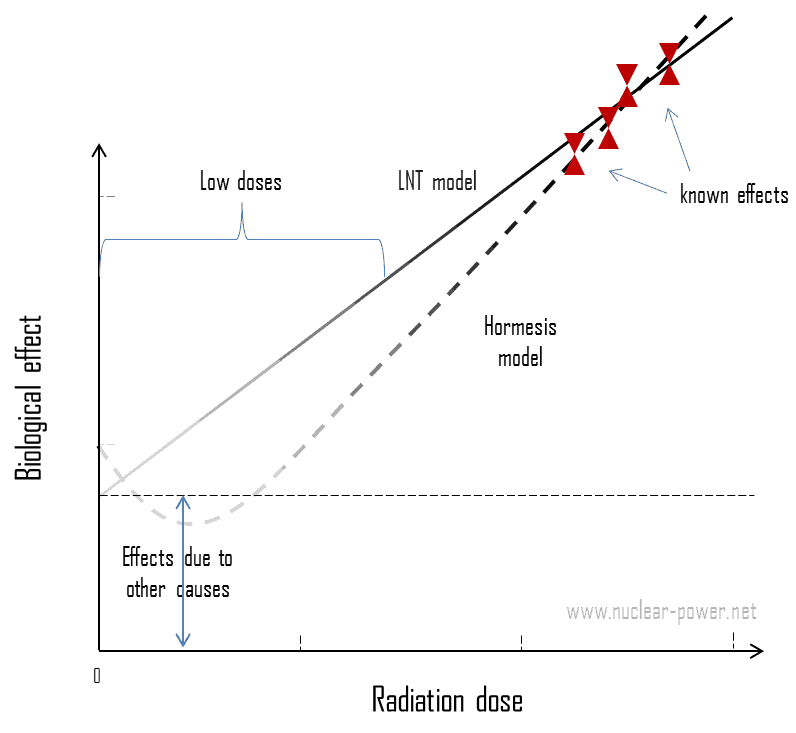
Alternative assumptions for the extrapolation of the cancer risk vs. radiation dose to low-dose levels, given a known risk at a high dose: LNT model, and hormesis model.
Generally, the dose–response relationship describes the change in effect on an organism caused by differing levels of exposure (or doses) to a stressor (usually a chemical) after a certain exposure time, or to a food. This article desribes two of four dose-response models concerning the effects of low-dose radiation. Four proposed dose-response models are:
supra-linear model,
linear-no-threshold (LNT) model,
threshold model,
hormesis model.
LNT Model
The linear no-threshold model (LNT model) is a conservativemodel used in radiation protection to estimate the health effects from small radiation doses. According to the LNT model, radiation is always considered harmful with no safety threshold, and the sum of several very small exposures are considered to have the same biological risk as one larger exposure (linearity).
According to ICRP:
“A dose-response model which is based on the assumption that, in the low dose range, radiation doses greater than zero will increase the risk of excess cancer and/or heritable disease in a simple proportionate manner.“
Special Reference: ICRP, 2007. The 2007 Recommendations of the International Commission on Radiological Protection. ICRP Publication 103. Ann. ICRP 37 (2-4).
Hormesis Model
Radiation hormesis is a dose-response phenomenon and it is one of alternative hypothesis, that low doses of ionizing radiation induces beneficial health effects. According to radiation hormesis hypothesis, low doses of low LET radiation can stimulate the activation of repair mechanisms, that protect against disease, that are not activated in absence of ionizing radiation. Low dose here means additional small doses comparable to the normal background radiation (10 µSv = average daily dose received from natural background). Since at high doses the negative effects are irrefutable, there must exist a threshold between the beneficial and the negative effects of radiation. This threshold is known as the Zero Equivalent Point (ZEP).
Radiation hormesis hypothesis proposes that radiation exposure comparable to and just above the natural background level of radiation is not harmful but beneficial, while accepting that much higher levels of radiation are hazardous. Arguments for hormesis center around some large-scale epidemiological studies and the evidence from animal irradiation experiments, but most notably the recent advances in knowledge of the adaptive response. Proponents of radiation hormesis typically claim that radio-protective responses in cells and the immune system not only counter the harmful effects of radiation but additionally act to inhibit spontaneous cancer not related to radiation exposure.
Controversy of LNT Model
As was written previously (LNT model), today the protection system is based on the LNT-hypothesis, which is a conservative model used in radiation protection to estimate the health effects from small radiation doses. This model is excellent for setting up a protection system for all use of ionizing radiation. In comparison to the hormesis model, the LNT model assumes, that there is no threshold point and risk increases linearly with a dose, i.e. the LNT model implies that there is no safe dose of ionizing radiation. If this linear model is correct, then natural background radiation is the most hazardous source of radiation to general public health, followed by medical imaging as a close second.
The LNT model is primarily based on the life span study (LSS) of atomic bomb survivors in Japan. However, while this pattern is undisputed at high doses, this linear extrapolation of risk to low doses is challenged by many recent experiments involving cell mechanisms and there is also high uncertainty involved in estimating risk using only epidemiological studies. The problem is that, at very low doses, it is practically impossible to correlate any irradiation with certain biological effects. This is because the baseline cancer rate is already very high and the risk of developing cancer fluctuates 40% because of individual life style and environmental effects, obscuring the subtle effects of low-level radiation. Government and regulatory bodies assume a LNT model instead of a threshold or hormesis not because it is the more scientifically convincing, but because it is the more conservative estimate.
In case of low doses, its conservativeness (linearity) has enormous consequences and the model is sometimes wrongly (perhaps intentionally) used to quantify the cancerous effect of collective doses of low-level radioactive contaminations. A linear dose-effect curve makes it possible to use collective doses to calculate the detrimental effects to an irradiated population. It is also argued that LNT model had caused an irrational fear of radiation, since every microsievert can be converted to the probability of cancer induction, however small this probability is. For example, if ten million people receives an effective dose of 0.1 µSv (an equivalent of eating one banana), then the collective dose will be S = 1 Sv. Does it mean there is 5.5% chance of developing cancer for one person due to eating banana? Note that, for high doses one sievert represents a 5.5% chance of developing cancer.
Problem of this model is that it neglects a number of defence biological processes that may be crucial at low doses. The research during the last two decades is very interesting and show that small doses of radiation given at a low dose rate stimulate the defense mechanisms. Therefore the LNT model is not universally accepted with some proposing an adaptive dose–response relationship where low doses are protective and high doses are detrimental. Many studies have contradicted the LNT model and many of these have shown adaptive response to low dose radiation resulting in reduced mutations and cancers.
Robert Reed Burn, Introduction to Nuclear Reactor Operation, 1988.
U.S. Department of Energy, Nuclear Physics and Reactor Theory. DOE Fundamentals Handbook, Volume 1 and 2. January 1993.
Paul Reuss, Neutron Physics. EDP Sciences, 2008. ISBN: 978-2759800414.
See also:
Radiobiology
We hope, this article, Radiation Dose-Response Relationship, helps you. If so, give us a like in the sidebar. Main purpose of this website is to help the public to learn some interesting and important information about radiation and dosimeters.
Radiation is all around us. In general, there are two broad categories of radiation sources: Natural Background Radiation and Man-Made Sources of Radiation. Radiation Dosimetry
Radiation is all around us. In, around, and above the world we live in. It is a natural energy force that surrounds us. It is a part of our natural world that has been here since the birth of our planet. All living creatures, from the beginning of time, have been, and are still being, exposed to ionizing radiation. Ionizing radiation is generated through nuclear reactions, nuclear decay, by very high temperature, or via acceleration of charged particles in electromagnetic fields. But in general, there are two broad categories of radiation sources:
Natural Background Radiation. Natural background radiation includes radiation produced by the Sun, lightnings, primordial radioisotopes or supernova explosions etc.
Man-Made Sources of Radiation. Man-made sources include medical uses of radiation, residues from nuclear tests, industrial uses of radiation etc.
Special Reference: Sources and effects of ionizing radiation, Annex B. UNSCEAR. New York, 2010. ISBN: 978-92-1-142274-0.
The United Nations Scientific Committee on the Effects of Atomic Radiation (UNSCEAR) itemized types of human exposures as:
public exposure, which is the exposure of individual members of the public and of the population in general
occupational radiation exposure, which is the exposure of workers in situations where their exposure is directly related to or required by their work
Natural Background Radiation
All living creatures, from the beginning of time, have been, and are still being, exposed to ionizing radiation. This radiation is not associated with any human activity. There are radioactive isotopes in our bodies, houses, air, water and in the soil. We all are also exposed to radiation from outer space.
Types of Natural Background Radiation
We divide all these natural radiation sources into three groups:
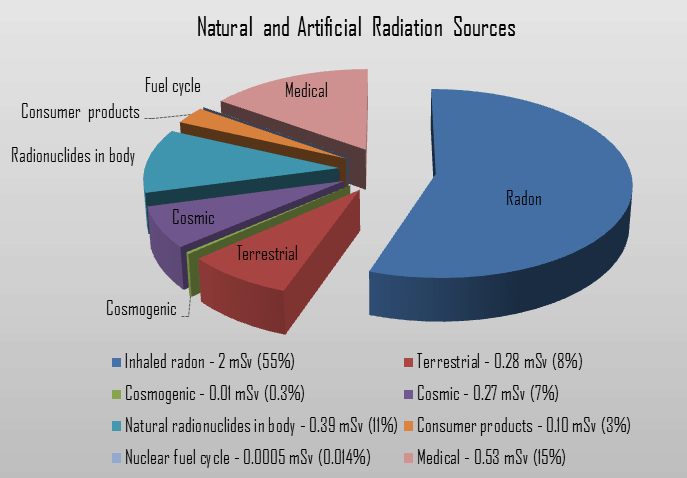
Cosmic Radiation. Cosmic radiation refers to sources of radiation in the form of cosmic rays that come from the sun or from outer space. At ground level the muons, with energies mostly between 1 and 20 GeV, contribute about 75 % of the absorbed dose rate in free air. The remainder comes from electrons produced by the muons or present in the electromagnetic cascade. The annual cosmic ray dose at sea level is around 0.27 mSv (27 mrem). If you live at higher elevations or are a frequent airline passenger, this exposure can be significantly higher, since the atmosphere is thinner here. The effects of the earth’s magnetic field also determines the dose from cosmic radiation.
Terrestrial Radiation. Terrestrial radiation refers to sources of radiation that are in the soil, water, and vegetation. The major isotopes of concern for terrestrial radiation are uranium and the decay products of uranium, such as thorium, radium, and radon. The average dose rate that originates from terrestrial nuclides (except radon exposure) is about 0.057 µGy/hr. The maximum values have been measured on monazite sand in Guarapari, Brazil (up to 50 µGy/hr and in Kerala, India (about 2 µGy/hr), and on rocks with a high radium concentration in Ramsar, Iran (from 1 to 10 µGy/hr). The average annual radiation dose to a person from radon is about 2 mSv/year and it may vary over many orders of magnitude from place to place. Radon is so important, that it is usually treated separately.
Internal Radiation. In addition to the cosmic and terrestrial sources, all people also have radioactive potassium-40, carbon-14, lead-210, and other isotopes inside their bodies from birth. The concentration of potassium-40 is nearly stable in all persons at a level of about 55 Bq/kg (3850 Bq in total), which corresponds to the annual effective dose of 0.2 mSv. The annual dose from carbon-14 is estimated to be about 12 μSv/year.
Background Radiation and Health Hazard
You can not go through life without radiation. The danger of ionizing radiation lies in the fact that the radiation is invisible and not directly detectable by human senses. People can neither see nor feel radiation, yet it deposits energy to the molecules of the body.
Alternative assumptions for the extrapolation of the cancer risk vs. radiation dose to low-dose levels, given a known risk at a high dose: LNT model, and hormesis model.
But don’t worry, the doses from background radiation are usually very small (except radon exposure). Low dose here means additional small doses comparable to the normal background radiation (10 µSv = average daily dose received from natural background). The problem is that, at very low doses, it is practically impossible to correlate any irradiation with certain biological effects. This is because the baseline cancer rate is already very high and the risk of developing cancer fluctuates 40% because of individual life style and environmental effects, obscuring the subtle effects of low-level radiation.
Secondly, and this is crucial, the truth about low-dose radiation health effects still needs to be found. It is not exactly known, whether these low doses of radiation are detrimental or beneficial (and where is the threshold). Government and regulatory bodies assume a LNT model instead of a threshold or hormesis not because it is the more scientifically convincing, but because it is the more conservative estimate. Problem of this model is that it neglects a number of defence biological processes that may be crucial at low doses. The research during the last two decades is very interesting and show that small doses of radiation given at a low dose rate stimulate the defense mechanisms. Therefore the LNT model is not universally accepted with some proposing an adaptive dose–response relationship where low doses are protective and high doses are detrimental. Many studies have contradicted the LNT model and many of these have shown adaptive response to low dose radiation resulting in reduced mutations and cancers. This phenomenon is known as radiation hormesis.
According to the radiation hormesis hypothesis, radiation exposure comparable to and just above the natural background level of radiation is not harmful but beneficial, while accepting that much higher levels of radiation are hazardous. Arguments for hormesis center around some large-scale epidemiological studies and the evidence from animal irradiation experiments, but most notably the recent advances in knowledge of the adaptive response. Proponents of radiation hormesis typically claim that radio-protective responses in cells and the immune system not only counter the harmful effects of radiation but additionally act to inhibit spontaneous cancer not related to radiation exposure.
Robert Reed Burn, Introduction to Nuclear Reactor Operation, 1988.
U.S. Department of Energy, Nuclear Physics and Reactor Theory. DOE Fundamentals Handbook, Volume 1 and 2. January 1993.
Paul Reuss, Neutron Physics. EDP Sciences, 2008. ISBN: 978-2759800414.
See also:
Radiation Protection
We hope, this article, Source of Radiation, helps you. If so, give us a like in the sidebar. Main purpose of this website is to help the public to learn some interesting and important information about radiation and dosimeters.
Cosmic radiation refers to sources of radiation in the form of cosmic rays that come from the Sun or from outer space. The primary cosmic radiation consist of a mixture of high-energy protons (~87%), alpha particles (~11%), high-energy electrons (~1%) and a trace of heavier nuclei (~1%). Radiation Dosimetry
Cosmic Radiation
Source: nasa.gov License: Public Domain
Cosmic radiation refers to sources of radiation in the form of cosmic rays that come from the Sun or from outer space. The earth has always been bombarded by high-energy particles originating in outer space that generate secondary particle showers in the lower atmosphere. Charged particles (especially high-energy protons) from the sun and outer space interact with the earth’s atmosphere and magnetic field to produce a shower of radiation (i.e. air shower), typically beta and gamma radiation. If you live at higher elevations or are a frequent airline passenger, this exposure can be significantly higher, since the atmosphere is thinner here. The effects of the earth’s magnetic field also determines the dose from cosmic radiation.
At ground level the muons, with energies mostly between 1 and 20 GeV, contribute about 75 % of the absorbed dose rate in free air. The remainder comes from electrons produced by the muons or present in the electromagnetic cascade. The annual cosmic ray dose at sea level is around 0.27 mSv (27 mrem).
Composition of Cosmic Radiation
The primary cosmic radiation consist of a mixture of high-energy protons (~87%), alpha particles (~11%), high-energy electrons (~1%) and a trace of heavier nuclei (~1%). The energy of these particles range between 108 eV and 1020 eV. A very small fraction are stable particles of antimatter, such as positrons or antiprotons. The precise nature of this remaining fraction is an area of active research.
Subsequently, a large number of secondary particles, in particular, neutrons and charged pions are produced as a result of interactions between primary particles and the earth’s atmosphere. Since pions are short-lived subatomic particles, the subsequent decay of the pions result in the production of high-energy muons. At ground level the muons, with energies mostly between 1 and 20 GeV, contribute about 75 % of the absorbed dose rate in free air. The dose rate from cosmic radiation varies in different parts of the world and it depends strongly on the geomagnetic field, altitude, and solar cycle. The cosmic radiation dose rate on airplanes is so high that, according to the United Nations UNSCEAR 2000 Report, airline flight crew workers receive more dose on average than any other worker, including those in nuclear power plants.
We also have to include the neutrons at ground level. Cosmic rays interact with nuclei in the atmosphere, and produce also high-energy neutrons. According to UNSCEAR the fluency of neutrons is 0.0123 cm-2s–1 at sea level for a geomagnetic latitude of 45 N. Based on this, the effective annual dose from neutrons at sea level and at 50 degree latitude is estimated to be 0.08 mSv (8 mrem). Noteworthy, in the vicinity of larger heavier objects, e.g. buildings or ships, the neutron flux measures higher. This effect is known as “cosmic ray induced neutron signature”, or “ship effect” as it was first detected with ships at sea. Cosmic rays create showers in the atmosphere that include a broad spectrum of secondary neutrons, muons and protons. The secondary neutrons may be of a very high energy and may induce spallation events in materials at ground level. Therefore in the vicinity of larger heavier objects, these multiple neutrons produced in spallation events are referred to as “ship effect” neutrons.
Neutrons produced in the upper atmosphere are also responsible for generation of radioactive carbon-14, which is the best known cosmogenic radionuclide. Carbon-14 is continuously formed in the upper atmosphere by the interaction of cosmic rays with atmospheric nitrogen. On average just one out of every 1.3 x 10¹² carbon atoms in the atmosphere is a radioactive carbon-14 atom. As a result, all living biological substances contain the same amount of C-14 per gram of carbon, that is 0.3 Bq of carbon-14 activity per gram of carbon. As long as the biological system is alive the level is constant due to constant intake of all isotopes of carbon. When the biological system dies, it stops exchanging carbon with its environment, and from that point onwards the amount of carbon-14 it contains begins to decrease as the carbon-14 undergoes radioactive decay.
Energy of Cosmic Rays
The energies of the most energetic ultra-high-energy cosmic rays (UHECRs) have been observed to approach 3 x 10²⁰ eV, about 40 million times the energy of particles accelerated by the Large Hadron Collider. The origin of the high energy particles is from outer space. It is assumed that particles with an energy up to about 1015 eV are coming from our own galaxy, whereas those with the highest energies probably have an extragalactic origin.
Classification of Cosmic Radiation
Cosmic radiation can be divided into different types according to its origin. There are three main sources of such radiation:
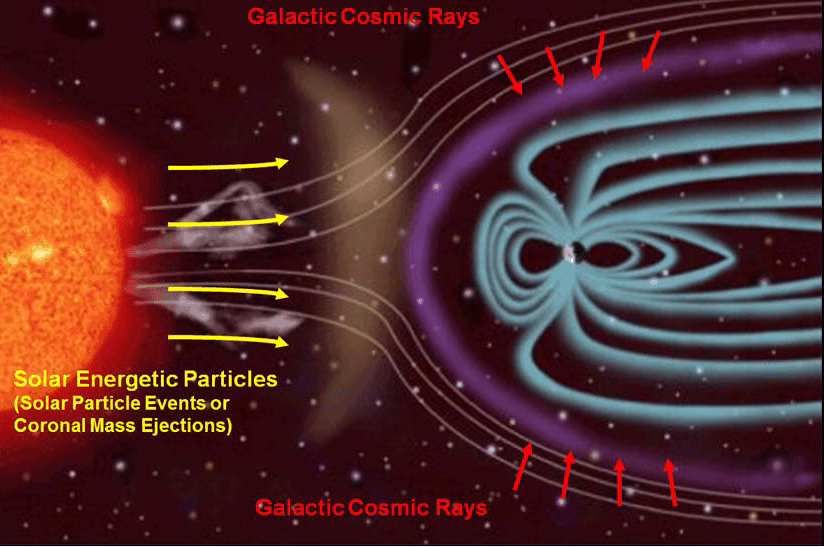
Solar Cosmic Radiation. Solar cosmic radiation refers to sources of radiation in the form of high-energy particles (predominantly protons) emitted by the sun, primarily in solar particle events (SPEs).
Galactic Cosmic Radiation. Galactic cosmic radiation, GCR, refers to sources of radiation in the form of high-energy particles originating outside the solar system, but generally from within our Milky Way galaxy.
Radiation from Earth’s Radiation Belts (van Allen belts). Van Allen radiation belts are zones of high-energy particles (especially protons) trapped by earth’s magnetic field.
Galactic Cosmic Radiation
Galactic cosmic radiation, GCR, refers to sources of radiation in the form of high-energy particles originating outside the solar system. GCR are high-energy nuclei from which all of the surrounding electrons have been stripped away during their high-speed passage through the galaxy. The GCR incident on the upper atmosphere consist of a nucleonic component, which aggregate accounts for 98% of the total (2% are electrons). The nucleonic component then consist of a mixture of high-energy protons (~86%), alpha particles (~12%), and a trace of heavier nuclei (~1%). GCR are trapped by the galactic magnetic field, therefore they have probably been accelerated within the last few million years, and have traveled many times across the galaxy. Their acceleration mechanism is uncertain, but one of possible mechanisms is that the particle are accelerated by shock waves expanding from supernovas. The energy of these particles range between 108 eV and 1020 eV. A very small fraction are stable particles of antimatter, such as positrons or antiprotons.
The precise nature of this remaining fraction is an area of active research. The GCR fluence rate varies with solar activity, being lower when solar activity is higher. At solar minimums, due to lower solar magnetic field shielding, the fluence is significantly higher than at solar maximum.
Solar Cosmic Radiation – Solar Particle Event
Solar cosmic radiation refers to sources of radiation in the form of high-energy particles (predominantly protons) emitted by the Sun, primarily in solar particle events (SPEs). The solar radiation incident on the upper atmosphere consist mostly of protons (99%), with energies generally below 100 MeV. Solar particle events, for example, occur when protons emitted by the Sun become accelerated either close to the Sun during a flare or in interplanetary space by coronal mass ejection shocks. Note that, the Sun has an 11-year cycle, which culminates in a dramatic increase in the number and intensity of solar flares, especially during periods when there are numerous sunspots.
Solar radiation is a significant radiation hazard to spacecraft and astronauts, also produces significant dose rates at high altitudes, but only the most energetic radiation contribute to doses at ground level. Note that, anyone who had been on the Moon’s surface during a particularly violent solar eruption in 2005 would have received a lethal dose.
Radiation from Earth’s Radiation Belts – Van Allen belts
Source: nasa.gov License: Public Domain
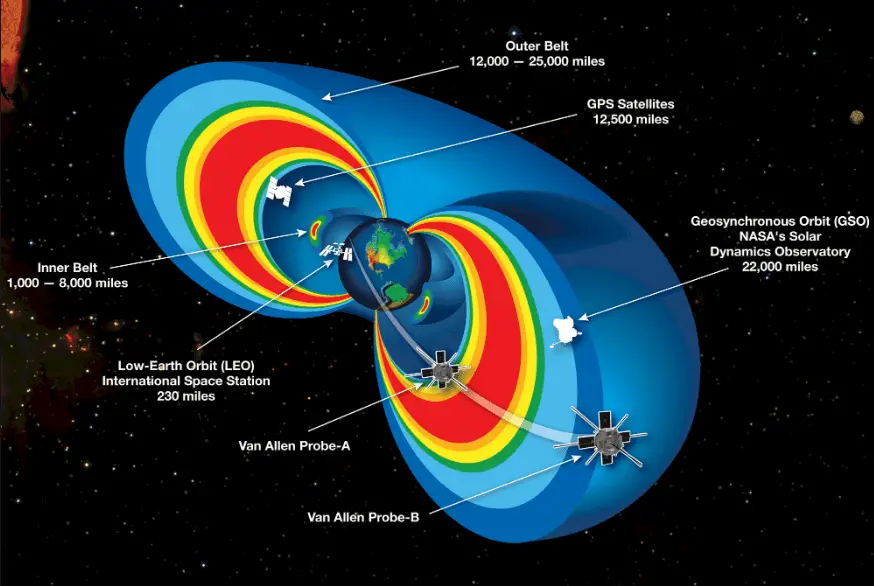
Van Allen radiation belts are zones of high-energy particles (especially protons) trapped by earth’s magnetic field. Most of these high-energy particles originate from the solar wind, that were captured by and held around a planet by that earth’s magnetic field. The van Allen belt is formed like a torus above the equator. There are two van Allen radiation belts, an internal belt is centered at about 3,000 kilometers and an outer belt is centered at about 22,000 kilometers from the earth’s surface. It contains mainly energetic protons in the 10-100 MeV range.
Spacecraft travelling beyond low Earth orbit enter the zone of radiation of the Van Allen belts. Beyond the belts, they face additional hazards from cosmic rays and solar particle events. A region between the inner and outer Van Allen belts lies at two to four Earth radii and is sometimes referred to as the “safe zone”.
Dose Rate in Airplane – Radiation in Flight
Exposure to cosmic radiation increases rapidly with altitude. In flight there are two principal sources of natural radiation to consider: Galactic Cosmic Rays which are always present, and Solar Proton Events, sometimes called Solar Cosmic Ray (SCR) events, which occur sporadically. The dose rate from cosmic radiation varies in different parts of the world and it depends strongly on the geomagnetic field, altitude, and solar cycle. The radiation field at aircraft altitudes consist of neutrons, protons and pions. In flight, neutrons contribute 40 – 80% of the equivalent dose, depending on the geomagnetic field, altitude, and solar cycle. The cosmic radiation dose rate on airplanes is so high (but not dangerous) that, according to the United Nations UNSCEAR 2000 Report, airline flight crew workers receive more dose on average than any other worker, including those in nuclear power plants.
The ground level dose rate is on average about 0.10 μSv/h, but at the maximum flight altitude (8.8 km or 29,000 ft) it can reach about 2.0 μSv/h (or even higher values). A dose rate of 4 μSv/h may be used to represent the average dose rate for all long haul flights (due to higher altitudes). It must be added, for supersonic planes like the Concorde, that could make a transatlantic flight in 3.5 hours, the exposure rate (about 9 μSv/h) at their altitude of 18 km was increased enough to result in the same cosmic ray exposure per crossing as for conventional jets trundling along at about 8 km.
Shielding of Cosmic Radiation
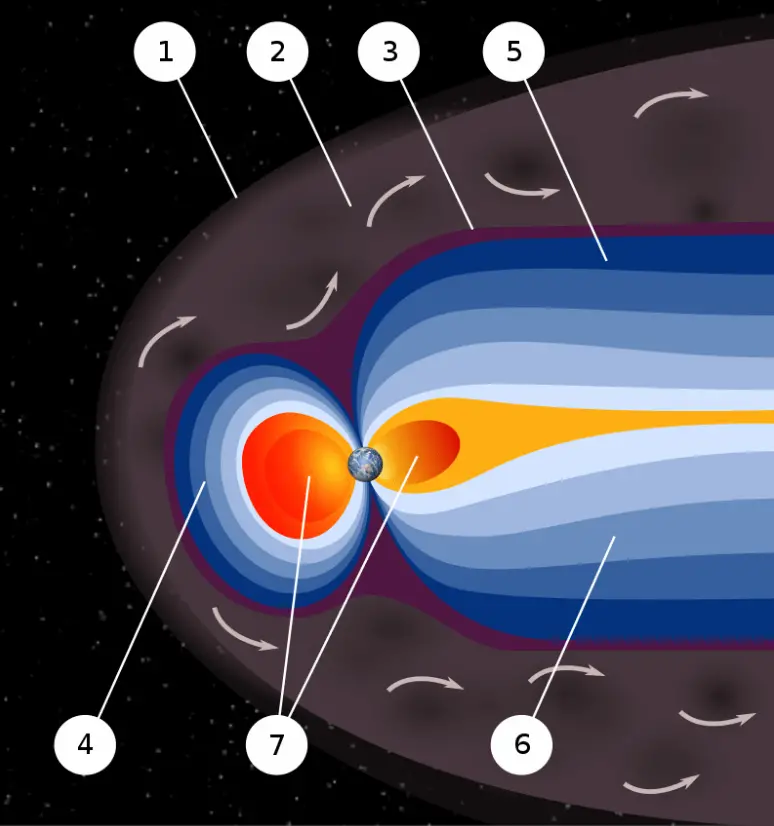
An artist’s rendering of the structure of a magnetosphere: 1) Bow shock. 2) Magnetosheath. 3) Magnetopause. 4) Magnetosphere. 5) Northern tail lobe. 6) Southern tail lobe. 7) Plasmasphere. Source: nasa.gov License: Public Domain
Earth’s magnetic field provides a vital radiation shield of cosmic radiation. In addition to a protective atmosphere, we are also lucky that Earth has a magnetic field. Magnetic field extends several tens of thousands of kilometers into space, protecting the Earth from the charged particles of the solar wind and cosmic rays that would otherwise strip away the upper atmosphere, including the ozone layer that protects the Earth from harmful ultraviolet radiation. It shields us from the full effects of the solar wind and GCR. Without this protection, Earth’s biosphere might not exist as it does today, or would be at least limited to the subsurface. Earth’s magnetic field provides also a radiation shield for astronauts and the ISS itself, because it is in low Earth orbit.
Calculations of the loss of carbon dioxide from the atmosphere of Mars, resulting from scavenging of ions by the solar wind, indicate that the dissipation of the magnetic field of Mars caused a near total loss of its atmosphere.
Cosmic Radiation – Is it dangerous?
We must emphasize, eating bananas, working as airline flight crew or living in locations with, increases your annual dose rate. But it does not mean, that it must be dangerous. In each case, intensity of radiation also matters. It is very similar as for heat from a fire (less energetic radiation). If you are too close, the intensity of heat radiation is high and you can get burned. If you are at the right distance, you can withstand there without any problems and moreover it is comfortable. If you are too far from heat source, the insufficiency of heat can also hurt you. This analogy, in a certain sense, can be applied to radiation also from radiation sources.
Alternative assumptions for the extrapolation of the cancer risk vs. radiation dose to low-dose levels, given a known risk at a high dose: LNT model, and hormesis model.
In case of radiation from cosmic rays, we are talking about so called “low doses”. Low dose here means additional small doses comparable to the normal background radiation (10 µSv = average daily dose received from natural background). The doses are very very low and therefore the probability of cancer induction could be almost negligible. Secondly, and this is crucial, the truth about low-dose radiation health effects still needs to be found. It is not exactly known, whether these low doses of radiation are detrimental or beneficial (and where is the threshold). Government and regulatory bodies assume a LNT model instead of a threshold or hormesis not because it is the more scientifically convincing, but because it is the more conservative estimate. Problem of this model is that it neglects a number of defence biological processes that may be crucial at low doses. The research during the last two decades is very interesting and show that small doses of radiation given at a low dose rate stimulate the defense mechanisms. Therefore the LNT model is not universally accepted with some proposing an adaptive dose–response relationship where low doses are protective and high doses are detrimental. Many studies have contradicted the LNT model and many of these have shown adaptive response to low dose radiation resulting in reduced mutations and cancers. This phenomenon is known as radiation hormesis.
Robert Reed Burn, Introduction to Nuclear Reactor Operation, 1988.
U.S. Department of Energy, Nuclear Physics and Reactor Theory. DOE Fundamentals Handbook, Volume 1 and 2. January 1993.
Paul Reuss, Neutron Physics. EDP Sciences, 2008. ISBN: 978-2759800414.
See also:
Sources
We hope, this article, Cosmic Radiation – Cosmic Ray, helps you. If so, give us a like in the sidebar. Main purpose of this website is to help the public to learn some interesting and important information about radiation and dosimeters.
Composition of Cosmic Radiation. The primary cosmic radiation consist of a mixture of high-energy protons (~87%), alpha particles (~11%), high-energy electrons (~1%) and a trace of heavier nuclei (~1%). Radiation Dosimetry
Source: nasa.gov License: Public Domain
Cosmic radiation refers to sources of radiation in the form of cosmic rays that come from the Sun or from outer space. The earth has always been bombarded by high-energy particles originating in outer space that generate secondary particle showers in the lower atmosphere. Charged particles (especially high-energy protons) from the sun and outer space interact with the earth’s atmosphere and magnetic field to produce a shower of radiation (i.e. air shower), typically beta and gamma radiation.
Composition of Cosmic Radiation
The primary cosmic radiation consist of a mixture of high-energy protons (~87%), alpha particles (~11%), high-energy electrons (~1%) and a trace of heavier nuclei (~1%). The energy of these particles range between 108 eV and 1020 eV. A very small fraction are stable particles of antimatter, such as positrons or antiprotons. The precise nature of this remaining fraction is an area of active research.
Subsequently, a large number of secondary particles, in particular, neutrons and charged pions are produced as a result of interactions between primary particles and the earth’s atmosphere. Since pions are short-lived subatomic particles, the subsequent decay of the pions result in the production of high-energy muons. At ground level the muons, with energies mostly between 1 and 20 GeV, contribute about 75 % of the absorbed dose rate in free air. The dose rate from cosmic radiation varies in different parts of the world and it depends strongly on the geomagnetic field, altitude, and solar cycle. The cosmic radiation dose rate on airplanes is so high that, according to the United Nations UNSCEAR 2000 Report, airline flight crew workers receive more dose on average than any other worker, including those in nuclear power plants.
We also have to include the neutrons at ground level. Cosmic rays interact with nuclei in the atmosphere, and produce also high-energy neutrons. According to UNSCEAR the fluency of neutrons is 0.0123 cm-2s–1 at sea level for a geomagnetic latitude of 45 N. Based on this, the effective annual dose from neutrons at sea level and at 50 degree latitude is estimated to be 0.08 mSv (8 mrem). Noteworthy, in the vicinity of larger heavier objects, e.g. buildings or ships, the neutron flux measures higher. This effect is known as “cosmic ray induced neutron signature”, or “ship effect” as it was first detected with ships at sea. Cosmic rays create showers in the atmosphere that include a broad spectrum of secondary neutrons, muons and protons. The secondary neutrons may be of a very high energy and may induce spallation events in materials at ground level. Therefore in the vicinity of larger heavier objects, these multiple neutrons produced in spallation events are referred to as “ship effect” neutrons.
Neutrons produced in the upper atmosphere are also responsible for generation of radioactive carbon-14, which is the best known cosmogenic radionuclide. Carbon-14 is continuously formed in the upper atmosphere by the interaction of cosmic rays with atmospheric nitrogen. On average just one out of every 1.3 x 10¹² carbon atoms in the atmosphere is a radioactive carbon-14 atom. As a result, all living biological substances contain the same amount of C-14 per gram of carbon, that is 0.3 Bq of carbon-14 activity per gram of carbon. As long as the biological system is alive the level is constant due to constant intake of all isotopes of carbon. When the biological system dies, it stops exchanging carbon with its environment, and from that point onwards the amount of carbon-14 it contains begins to decrease as the carbon-14 undergoes radioactive decay.
Robert Reed Burn, Introduction to Nuclear Reactor Operation, 1988.
U.S. Department of Energy, Nuclear Physics and Reactor Theory. DOE Fundamentals Handbook, Volume 1 and 2. January 1993.
Paul Reuss, Neutron Physics. EDP Sciences, 2008. ISBN: 978-2759800414.
See also:
Cosmic Radiation
We hope, this article, Composition of Cosmic Radiation, helps you. If so, give us a like in the sidebar. Main purpose of this website is to help the public to learn some interesting and important information about radiation and dosimeters.
Ship Effect. In the vicinity of larger heavier objects, e.g. buildings or ships, the neutron flux measures higher. This effect is known as “cosmic ray induced neutron signature”, or “ship effect”.
The primary cosmic radiation consist of a mixture of high-energy protons (~87%), alpha particles (~11%), high-energy electrons (~1%) and a trace of heavier nuclei (~1%). The energy of these particles range between 108 eV and 1020 eV. A very small fraction are stable particles of antimatter, such as positrons or antiprotons. The precise nature of this remaining fraction is an area of active research.
Subsequently, a large number of secondary particles, in particular, neutrons and charged pions are produced as a result of interactions between primary particles and the earth’s atmosphere. Cosmic rays interact with nuclei in the atmosphere, and produce also high-energy neutrons. According to UNSCEAR the fluency of neutrons is 0.0123 cm-2s–1 at sea level for a geomagnetic latitude of 45 N. Based on this, the effective annual dose from neutrons at sea level and at 50 degree latitude is estimated to be 0.08 mSv (8 mrem). Noteworthy, in the vicinity of larger heavier objects, e.g. buildings or ships, the neutron flux measures higher. This effect is known as “cosmic ray induced neutron signature”, or “ship effect” as it was first detected with ships at sea. Cosmic rays create showers in the atmosphere that include a broad spectrum of secondary neutrons, muons and protons. The secondary neutrons may be of a very high energy and may induce spallation events in materials at ground level. Therefore in the vicinity of larger heavier objects, these multiple neutrons produced in spallation events are referred to as “ship effect” neutrons.
Robert Reed Burn, Introduction to Nuclear Reactor Operation, 1988.
U.S. Department of Energy, Nuclear Physics and Reactor Theory. DOE Fundamentals Handbook, Volume 1 and 2. January 1993.
Paul Reuss, Neutron Physics. EDP Sciences, 2008. ISBN: 978-2759800414.
See also:
Cosmic Radiation
We hope, this article, Ship Effect – Cosmic Ray Induced Neutron Signature, helps you. If so, give us a like in the sidebar. Main purpose of this website is to help the public to learn some interesting and important information about radiation and dosimeters.
Natural Neutron Background. We also have to include the neutrons at ground level. Cosmic rays interact with nuclei in the atmosphere, and produce also high-energy neutrons. Radiation Dosimetry
Cosmic radiation refers to sources of radiation in the form of cosmic rays that come from the Sun or from outer space. The earth has always been bombarded by high-energy particles originating in outer space that generate secondary particle showers in the lower atmosphere. Charged particles (especially high-energy protons) from the sun and outer space interact with the earth’s atmosphere and magnetic field to produce a shower of radiation (i.e. air shower), typically beta and gamma radiation.
The primary cosmic radiation consist of a mixture of high-energy protons (~87%), alpha particles (~11%), high-energy electrons (~1%) and a trace of heavier nuclei (~1%). The energy of these particles range between 108 eV and 1020 eV. A very small fraction are stable particles of antimatter, such as positrons or antiprotons. The precise nature of this remaining fraction is an area of active research.
Subsequently, a large number of secondary particles, in particular, neutrons and charged pions are produced as a result of interactions between primary particles and the earth’s atmosphere. Since pions are short-lived subatomic particles, the subsequent decay of the pions result in the production of high-energy muons. At ground level the muons, with energies mostly between 1 and 20 GeV, contribute about 75 % of the absorbed dose rate in free air. The dose rate from cosmic radiation varies in different parts of the world and it depends strongly on the geomagnetic field, altitude, and solar cycle. The cosmic radiation dose rate on airplanes is so high that, according to the United Nations UNSCEAR 2000 Report, airline flight crew workers receive more dose on average than any other worker, including those in nuclear power plants.
Natural Neutron Background
We also have to include the neutrons at ground level. Cosmic rays interact with nuclei in the atmosphere, and produce also high-energy neutrons. According to UNSCEAR the fluency of neutrons is 0.0123 cm-2s–1 at sea level for a geomagnetic latitude of 45 N. Based on this, the effective annual dose from neutrons at sea level and at 50 degree latitude is estimated to be 0.08 mSv (8 mrem). Noteworthy, in the vicinity of larger heavier objects, e.g. buildings or ships, the neutron flux measures higher. This effect is known as “cosmic ray induced neutron signature”, or “ship effect” as it was first detected with ships at sea. Cosmic rays create showers in the atmosphere that include a broad spectrum of secondary neutrons, muons and protons. The secondary neutrons may be of a very high energy and may induce spallation events in materials at ground level. Therefore in the vicinity of larger heavier objects, these multiple neutrons produced in spallation events are referred to as “ship effect” neutrons.
Neutrons produced in the upper atmosphere are also responsible for generation of radioactive carbon-14, which is the best known cosmogenic radionuclide. Carbon-14 is continuously formed in the upper atmosphere by the interaction of cosmic rays with atmospheric nitrogen. On average just one out of every 1.3 x 10¹² carbon atoms in the atmosphere is a radioactive carbon-14 atom. As a result, all living biological substances contain the same amount of C-14 per gram of carbon, that is 0.3 Bq of carbon-14 activity per gram of carbon. As long as the biological system is alive the level is constant due to constant intake of all isotopes of carbon. When the biological system dies, it stops exchanging carbon with its environment, and from that point onwards the amount of carbon-14 it contains begins to decrease as the carbon-14 undergoes radioactive decay.
Dose Rate in Airplane
The radiation field at aircraft altitudes consist of neutrons, protons and pions. In flight, neutrons contribute 40 – 80% of the equivalent dose, depending on the geomagnetic field, altitude, and solar cycle.
Robert Reed Burn, Introduction to Nuclear Reactor Operation, 1988.
U.S. Department of Energy, Nuclear Physics and Reactor Theory. DOE Fundamentals Handbook, Volume 1 and 2. January 1993.
Paul Reuss, Neutron Physics. EDP Sciences, 2008. ISBN: 978-2759800414.
See also:
Cosmic Radiation
We hope, this article, Natural Neutron Background, helps you. If so, give us a like in the sidebar. Main purpose of this website is to help the public to learn some interesting and important information about radiation and dosimeters.
Radiation Dose from Cosmic Rays. The annual cosmic ray dose at sea level is around 0.27 mSv (27 mrem). At ground level the muons, with energies mostly between 1 and 20 GeV, contribute about 75 % of the absorbed dose rate in free air. Radiation Dosimetry
Source: nasa.gov License: Public Domain
Cosmic radiation refers to sources of radiation in the form of cosmic rays that come from the Sun or from outer space. The earth has always been bombarded by high-energy particles originating in outer space that generate secondary particle showers in the lower atmosphere. Charged particles (especially high-energy protons) from the sun and outer space interact with the earth’s atmosphere and magnetic field to produce a shower of radiation (i.e. air shower), typically beta and gamma radiation. If you live at higher elevations or are a frequent airline passenger, this exposure can be significantly higher, since the atmosphere is thinner here. The effects of the earth’s magnetic field also determines the dose from cosmic radiation.
At ground level the muons, with energies mostly between 1 and 20 GeV, contribute about 75 % of the absorbed dose rate in free air. The remainder comes from electrons produced by the muons or present in the electromagnetic cascade. The annual cosmic ray dose at sea level is around 0.27 mSv (27 mrem).
Composition of Cosmic Radiation
The primary cosmic radiation consist of a mixture of high-energy protons (~87%), alpha particles (~11%), high-energy electrons (~1%) and a trace of heavier nuclei (~1%). The energy of these particles range between 108 eV and 1020 eV. A very small fraction are stable particles of antimatter, such as positrons or antiprotons. The precise nature of this remaining fraction is an area of active research.
Subsequently, a large number of secondary particles, in particular, neutrons and charged pions are produced as a result of interactions between primary particles and the earth’s atmosphere. Since pions are short-lived subatomic particles, the subsequent decay of the pions result in the production of high-energy muons. At ground level the muons, with energies mostly between 1 and 20 GeV, contribute about 75 % of the absorbed dose rate in free air. The dose rate from cosmic radiation varies in different parts of the world and it depends strongly on the geomagnetic field, altitude, and solar cycle. The cosmic radiation dose rate on airplanes is so high that, according to the United Nations UNSCEAR 2000 Report, airline flight crew workers receive more dose on average than any other worker, including those in nuclear power plants.
We also have to include the neutrons at ground level. Cosmic rays interact with nuclei in the atmosphere, and produce also high-energy neutrons. According to UNSCEAR the fluency of neutrons is 0.0123 cm-2s–1 at sea level for a geomagnetic latitude of 45 N. Based on this, the effective annual dose from neutrons at sea level and at 50 degree latitude is estimated to be 0.08 mSv (8 mrem). Noteworthy, in the vicinity of larger heavier objects, e.g. buildings or ships, the neutron flux measures higher. This effect is known as “cosmic ray induced neutron signature”, or “ship effect” as it was first detected with ships at sea. Cosmic rays create showers in the atmosphere that include a broad spectrum of secondary neutrons, muons and protons. The secondary neutrons may be of a very high energy and may induce spallation events in materials at ground level. Therefore in the vicinity of larger heavier objects, these multiple neutrons produced in spallation events are referred to as “ship effect” neutrons.
Dose Rate in Airplane – Radiation in Flight
Exposure to cosmic radiation increases rapidly with altitude. In flight there are two principal sources of natural radiation to consider: Galactic Cosmic Rays which are always present, and Solar Proton Events, sometimes called Solar Cosmic Ray (SCR) events, which occur sporadically. The dose rate from cosmic radiation varies in different parts of the world and it depends strongly on the geomagnetic field, altitude, and solar cycle. The radiation field at aircraft altitudes consist of neutrons, protons and pions. In flight, neutrons contribute 40 – 80% of the equivalent dose, depending on the geomagnetic field, altitude, and solar cycle. The cosmic radiation dose rate on airplanes is so high (but not dangerous) that, according to the United Nations UNSCEAR 2000 Report, airline flight crew workers receive more dose on average than any other worker, including those in nuclear power plants.
The ground level dose rate is on average about 0.10 μSv/h, but at the maximum flight altitude (8.8 km or 29,000 ft) it can reach about 2.0 μSv/h (or even higher values). A dose rate of 4 μSv/h may be used to represent the average dose rate for all long haul flights (due to higher altitudes). It must be added, for supersonic planes like the Concorde, that could make a transatlantic flight in 3.5 hours, the exposure rate (about 9 μSv/h) at their altitude of 18 km was increased enough to result in the same cosmic ray exposure per crossing as for conventional jets trundling along at about 8 km.
Robert Reed Burn, Introduction to Nuclear Reactor Operation, 1988.
U.S. Department of Energy, Nuclear Physics and Reactor Theory. DOE Fundamentals Handbook, Volume 1 and 2. January 1993.
Paul Reuss, Neutron Physics. EDP Sciences, 2008. ISBN: 978-2759800414.
See also:
Cosmic Radiation
We hope, this article, Radiation Dose from Cosmic Rays, helps you. If so, give us a like in the sidebar. Main purpose of this website is to help the public to learn some interesting and important information about radiation and dosimeters.
During flight, we are more exposed to cosmic radiation tha at the ground. A dose rate of 4 μSv/h may be used to represent the average dose rate for all long haul flights (due to higher altitudes). Radiation in Flight
During flight, we are more exposed to cosmic radiation than at the ground. Cosmic radiation refers to sources of radiation in the form of cosmic rays that come from the Sun or from outer space. The primary cosmic radiation consist of a mixture of high-energy protons (~87%), alpha particles (~11%), high-energy electrons (~1%) and a trace of heavier nuclei (~1%).
The dose rate from cosmic radiation varies in different parts of the world and it depends strongly on the geomagnetic field, altitude, and solar cycle. Exposure to cosmic radiation increases rapidly with altitude. In flight there are two principal sources of natural radiation to consider: Galactic Cosmic Rays which are always present, and Solar Proton Events, sometimes called Solar Cosmic Ray (SCR) events, which occur sporadically. The dose rate from cosmic radiation varies in different parts of the world and it depends strongly on the geomagnetic field, altitude, and solar cycle. The radiation field at aircraft altitudes consist of neutrons, protons and pions. In flight, neutrons contribute 40 – 80% of the equivalent dose, depending on the geomagnetic field, altitude, and solar cycle. The cosmic radiation dose rate on airplanes is so high (but not dangerous) that, according to the United Nations UNSCEAR 2000 Report, airline flight crew workers receive more dose on average than any other worker, including those in nuclear power plants.
The ground level dose rate is on average about 0.10 μSv/h, but at the maximum flight altitude (8.8 km or 29,000 ft) it can reach about 2.0 μSv/h (or even higher values). A dose rate of 4 μSv/h may be used to represent the average dose rate for all long haul flights (due to higher altitudes). It must be added, for supersonic planes like the Concorde, that could make a transatlantic flight in 3.5 hours, the exposure rate (about 9 μSv/h) at their altitude of 18 km was increased enough to result in the same cosmic ray exposure per crossing as for conventional jets trundling along at about 8 km.
Shielding of Cosmic Radiation
An artist’s rendering of the structure of a magnetosphere: 1) Bow shock. 2) Magnetosheath. 3) Magnetopause. 4) Magnetosphere. 5) Northern tail lobe. 6) Southern tail lobe. 7) Plasmasphere. Source: nasa.gov License: Public Domain
Earth’s magnetic field provides a vital radiation shield of cosmic radiation. During flight, shielding provided by Earth’s magnetic field is much more important than at the ground level, since at the ground level the atmosphere also contributes. Therefore, in addition to a protective atmosphere, we are very lucky that Earth has a magnetic field. Magnetic field extends several tens of thousands of kilometers into space, protecting the Earth from the charged particles of the solar wind and cosmic rays that would otherwise strip away the upper atmosphere, including the ozone layer that protects the Earth from harmful ultraviolet radiation. It shields us from the full effects of the solar wind and GCR. Without this protection, Earth’s biosphere might not exist as it does today, or would be at least limited to the subsurface. Earth’s magnetic field provides also a radiation shield for astronauts and the ISS itself, because it is in low Earth orbit.
Calculations of the loss of carbon dioxide from the atmosphere of Mars, resulting from scavenging of ions by the solar wind, indicate that the dissipation of the magnetic field of Mars caused a near total loss of its atmosphere.
Radiation in Flight – Is it dangerous?
We must emphasize, eating bananas, working as airline flight crew or living in locations with, increases your annual dose rate. But it does not mean, that it must be dangerous. In each case, intensity of radiation also matters. It is very similar as for heat from a fire (less energetic radiation). If you are too close, the intensity of heat radiation is high and you can get burned. If you are at the right distance, you can withstand there without any problems and moreover it is comfortable. If you are too far from heat source, the insufficiency of heat can also hurt you. This analogy, in a certain sense, can be applied to radiation also from radiation sources.
Alternative assumptions for the extrapolation of the cancer risk vs. radiation dose to low-dose levels, given a known risk at a high dose: LNT model, and hormesis model.
In case of radiation in flight, we are talking about so called “low doses”. Low dose here means additional small doses comparable to the normal background radiation (10 µSv = average daily dose received from natural background). The doses are very very low and therefore the probability of cancer induction could be almost negligible. Secondly, and this is crucial, the truth about low-dose radiation health effects still needs to be found. It is not exactly known, whether these low doses of radiation are detrimental or beneficial (and where is the threshold). Government and regulatory bodies assume a LNT model instead of a threshold or hormesis not because it is the more scientifically convincing, but because it is the more conservative estimate. Problem of this model is that it neglects a number of defence biological processes that may be crucial at low doses. The research during the last two decades is very interesting and show that small doses of radiation given at a low dose rate stimulate the defense mechanisms. Therefore the LNT model is not universally accepted with some proposing an adaptive dose–response relationship where low doses are protective and high doses are detrimental. Many studies have contradicted the LNT model and many of these have shown adaptive response to low dose radiation resulting in reduced mutations and cancers. This phenomenon is known as radiation hormesis.
Robert Reed Burn, Introduction to Nuclear Reactor Operation, 1988.
U.S. Department of Energy, Nuclear Physics and Reactor Theory. DOE Fundamentals Handbook, Volume 1 and 2. January 1993.
Paul Reuss, Neutron Physics. EDP Sciences, 2008. ISBN: 978-2759800414.
See also:
Cosmic Radiation
We hope, this article, Dose Rate in Airplane – Radiation in Flight – Is it dangerous?, helps you. If so, give us a like in the sidebar. Main purpose of this website is to help the public to learn some interesting and important information about radiation and dosimeters.
The annual cosmic ray dose at sea level is around 0.27 mSv (27 mrem). But it does not mean, that it must be dangerous. In each case, intensity of radiation also matters. Radiation Dosimetry
Cosmic Radiation
Cosmic radiation refers to sources of radiation in the form of cosmic rays that come from the Sun or from outer space. The earth has always been bombarded by high-energy particles originating in outer space that generate secondary particle showers in the lower atmosphere. Charged particles (especially high-energy protons) from the sun and outer space interact with the earth’s atmosphere and magnetic field to produce a shower of radiation (i.e. air shower), typically beta and gamma radiation. If you live at higher elevations or are a frequent airline passenger, this exposure can be significantly higher, since the atmosphere is thinner here. The effects of the earth’s magnetic field also determines the dose from cosmic radiation.
Dose Rate at Ground Level
The primary cosmic radiation consist of a mixture of high-energy protons (~87%), alpha particles (~11%), high-energy electrons (~1%) and a trace of heavier nuclei (~1%). The energy of these particles range between 108 eV and 1020 eV. A very small fraction are stable particles of antimatter, such as positrons or antiprotons. The precise nature of this remaining fraction is an area of active research.
Subsequently, a large number of secondary particles, in particular, neutrons and charged pions are produced as a result of interactions between primary particles and the earth’s atmosphere. Since pions are short-lived subatomic particles, the subsequent decay of the pions result in the production of high-energy muons. At ground level the muons, with energies mostly between 1 and 20 GeV, contribute about 75 % of the absorbed dose rate in free air. The remainder comes from electrons produced by the muons or present in the electromagnetic cascade. The annual cosmic ray dose at sea level is around 0.27 mSv (27 mrem).
Dose Rate during Flight
During flight, we are more exposed to cosmic radiation than at the ground. At the maximum flight altitude (8.8 km or 29,000 ft) it can reach about 2.0 μSv/h (or even higher values). A dose rate of 4 μSv/h may be used to represent the average dose rate for all long haul flights (due to higher altitudes). It must be added, for supersonic planes like the Concorde, that could make a transatlantic flight in 3.5 hours, the exposure rate (about 9 μSv/h) at their altitude of 18 km was increased enough to result in the same cosmic ray exposure per crossing as for conventional jets trundling along at about 8 km.
Cosmic Radiation – Is it dangerous?
We must emphasize, eating bananas, working as airline flight crew or living in locations with, increases your annual dose rate. But it does not mean, that it must be dangerous. In each case, intensity of radiation also matters. It is very similar as for heat from a fire (less energetic radiation). If you are too close, the intensity of heat radiation is high and you can get burned. If you are at the right distance, you can withstand there without any problems and moreover it is comfortable. If you are too far from heat source, the insufficiency of heat can also hurt you. This analogy, in a certain sense, can be applied to radiation also from radiation sources.
Alternative assumptions for the extrapolation of the cancer risk vs. radiation dose to low-dose levels, given a known risk at a high dose: LNT model, and hormesis model.
In case of radiation from bananas, we are talking about so called “low doses”. Low dose here means additional small doses comparable to the normal background radiation (10 µSv = average daily dose received from natural background). The doses are very very low and therefore the probability of cancer induction could be almost negligible. Secondly, and this is crucial, the truth about low-dose radiation health effects still needs to be found. It is not exactly known, whether these low doses of radiation are detrimental or beneficial (and where is the threshold). Government and regulatory bodies assume a LNT model instead of a threshold or hormesis not because it is the more scientifically convincing, but because it is the more conservative estimate. Problem of this model is that it neglects a number of defence biological processes that may be crucial at low doses. The research during the last two decades is very interesting and show that small doses of radiation given at a low dose rate stimulate the defense mechanisms. Therefore the LNT model is not universally accepted with some proposing an adaptive dose–response relationship where low doses are protective and high doses are detrimental. Many studies have contradicted the LNT model and many of these have shown adaptive response to low dose radiation resulting in reduced mutations and cancers. This phenomenon is known as radiation hormesis.
Robert Reed Burn, Introduction to Nuclear Reactor Operation, 1988.
U.S. Department of Energy, Nuclear Physics and Reactor Theory. DOE Fundamentals Handbook, Volume 1 and 2. January 1993.
Paul Reuss, Neutron Physics. EDP Sciences, 2008. ISBN: 978-2759800414.
See also:
Cosmic Radiation
We hope, this article, Cosmic Radiation – Is it dangerous?, helps you. If so, give us a like in the sidebar. Main purpose of this website is to help the public to learn some interesting and important information about radiation and dosimeters.
Classification of Cosmic Radiation. Cosmic radiation can be divided into different types according to its origin. There are three main sources of such radiation. Radiation Dosimetry
Cosmic Radiation
Cosmic radiation refers to sources of radiation in the form of cosmic rays that come from the Sun or from outer space. The earth has always been bombarded by high-energy particles originating in outer space that generate secondary particle showers in the lower atmosphere. Charged particles (especially high-energy protons) from the sun and outer space interact with the earth’s atmosphere and magnetic field to produce a shower of radiation (i.e. air shower), typically beta and gamma radiation. If you live at higher elevations or are a frequent airline passenger, this exposure can be significantly higher, since the atmosphere is thinner here. The effects of the earth’s magnetic field also determines the dose from cosmic radiation.
Composition of Cosmic Radiation
The primary cosmic radiation consist of a mixture of high-energy protons (~87%), alpha particles (~11%), high-energy electrons (~1%) and a trace of heavier nuclei (~1%). The energy of these particles range between 108 eV and 1020 eV. A very small fraction are stable particles of antimatter, such as positrons or antiprotons. The precise nature of this remaining fraction is an area of active research.
Subsequently, a large number of secondary particles, in particular, neutrons and charged pions are produced as a result of interactions between primary particles and the earth’s atmosphere. Since pions are short-lived subatomic particles, the subsequent decay of the pions result in the production of high-energy muons.
Classification of Cosmic Radiation
Cosmic radiation can be divided into different types according to its origin. There are three main sources of such radiation:
Solar Cosmic Radiation. Solar cosmic radiation refers to sources of radiation in the form of high-energy particles (predominantly protons) emitted by the sun, primarily in solar particle events (SPEs).
Galactic Cosmic Radiation. Galactic cosmic radiation, GCR, refers to sources of radiation in the form of high-energy particles originating outside the solar system, but generally from within our Milky Way galaxy.
Radiation from Earth’s Radiation Belts (van Allen belts). Van Allen radiation belts are zones of high-energy particles (especially protons) trapped by earth’s magnetic field.
Robert Reed Burn, Introduction to Nuclear Reactor Operation, 1988.
U.S. Department of Energy, Nuclear Physics and Reactor Theory. DOE Fundamentals Handbook, Volume 1 and 2. January 1993.
Paul Reuss, Neutron Physics. EDP Sciences, 2008. ISBN: 978-2759800414.
See also:
Cosmic Radiation
We hope, this article, Classification and Types of Cosmic Radiation, helps you. If so, give us a like in the sidebar. Main purpose of this website is to help the public to learn some interesting and important information about radiation and dosimeters.