Facebook Instagram Youtube Twitter

What is Main Isotope of Radon – Definition

Isotopes of Radon. The radon-222 isotope is a natural decay product of uranium-238. The radon-220 isotope, commonly referred to as thoron,  is a natural decay product of thorium-232. Radiation Dosimetry

Radon is a colorless, odorless, tasteless noble gas, occurring naturally as the decay product of radium. All isotopes of radon are radioactive, but the two radon isotopes radon-222 and radon-220 are very important from radiation protection point of view.

Isotopes of Radon

  • radon and thoron
    Source: JANIS (Java-based Nuclear Data Information Software); ENDF/B-VII.1

    Radon-222. The radon-222 isotope is a natural decay product of the most stable uranium isotope (uranium-238), thus it is a member of uranium series. The half-life of radon-222 is 3.8 days and it decays via alpha decay to polonium-218.

  • Radon-220. The radon-220 isotope, commonly referred to as thoron,  is a natural decay product of the most stable thorium isotope (thorium-232), thus it is a member of thorium series. The half-life of radon-220 is 55 seconds and it decays via alpha decay to polonium-216.
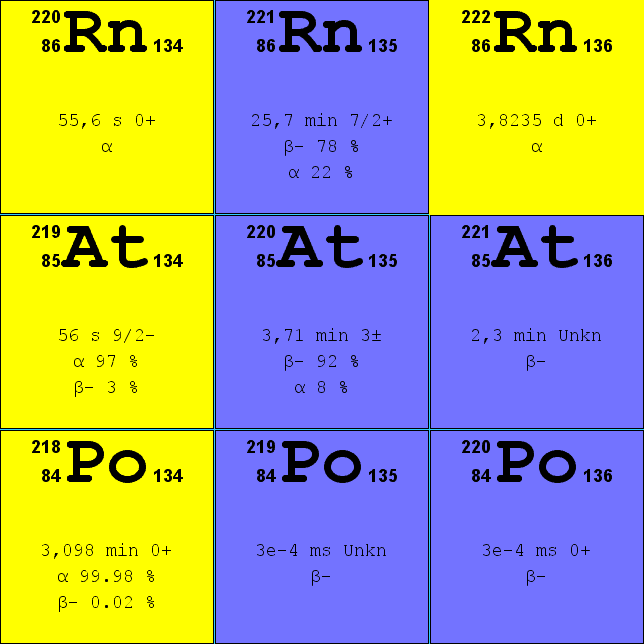
It is important to note that radon is a noble gas, whereas all its decay products are metals. The main mechanism for the entry of radon into the atmosphere is diffusion through the soil. As a gas, radon diffuses through rocks and the soil. When radon disintegrates, the daughter metallic isotopes are ions that will be attached to other molecules like water and to aerosol particles in the air. Therefore all discussions of radon concentrations in the environment refer to radon-222. While the average rate of production of radon-220 (thoron) is about the same as that of radon-222, the amount of radon-220 in the environment is much less than that of radon-222 because of significantly shorter half-life (it has less time to diffuse) of radon-222 (55 seconds, versus 3.8 days respectively). Simply radon-220 has lower chance to escape from bedrock.

Radon-222
radon - source - environment
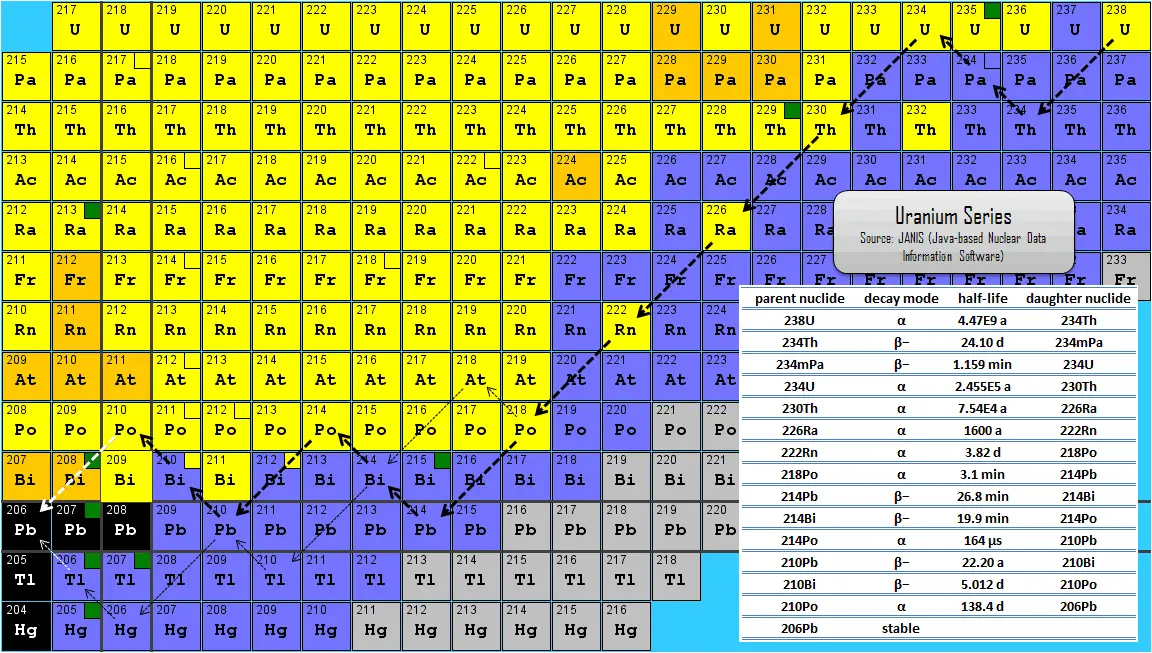
Uranium Series – Source of radon-222.

Radon-222 is a gas produced by the decay of radium-226. Both are a part of the natural uranium series. Since uranium is found in soil throughout the world in varying concentrations, also dose from gaseous radon is varying throughout the world. Radon-222 is the most important and most stable isotope of radon. It has a half-life of only 3.8 days, making radon one of the rarest elements since it decays away so quickly. An important source of natural radiation is radon gas, which seeps continuously from bedrock but can, because of its high density, accumulate in poorly ventilated houses. The fact radon is gas plays a crucial role in spreading of all its daughter nuclei. Simply radon is a transport medium from bedrock to atmosphere (or inside buildings) for its short-lived decay products (Pb-210 and Po-210), that posses much more health risks.

References:

Radiation Protection:

  1. Knoll, Glenn F., Radiation Detection and Measurement 4th Edition, Wiley, 8/2010. ISBN-13: 978-0470131480.
  2. Stabin, Michael G., Radiation Protection and Dosimetry: An Introduction to Health Physics, Springer, 10/2010. ISBN-13: 978-1441923912.
  3. Martin, James E., Physics for Radiation Protection 3rd Edition, Wiley-VCH, 4/2013. ISBN-13: 978-3527411764.
  4. U.S.NRC, NUCLEAR REACTOR CONCEPTS
  5. U.S. Department of Energy, Nuclear Physics and Reactor Theory. DOE Fundamentals Handbook, Volume 1 and 2. January 1993.

Nuclear and Reactor Physics:

  1. J. R. Lamarsh, Introduction to Nuclear Reactor Theory, 2nd ed., Addison-Wesley, Reading, MA (1983).
  2. J. R. Lamarsh, A. J. Baratta, Introduction to Nuclear Engineering, 3d ed., Prentice-Hall, 2001, ISBN: 0-201-82498-1.
  3. W. M. Stacey, Nuclear Reactor Physics, John Wiley & Sons, 2001, ISBN: 0- 471-39127-1.
  4. Glasstone, Sesonske. Nuclear Reactor Engineering: Reactor Systems Engineering, Springer; 4th edition, 1994, ISBN: 978-0412985317
  5. W.S.C. Williams. Nuclear and Particle Physics. Clarendon Press; 1 edition, 1991, ISBN: 978-0198520467
  6. G.R.Keepin. Physics of Nuclear Kinetics. Addison-Wesley Pub. Co; 1st edition, 1965
  7. Robert Reed Burn, Introduction to Nuclear Reactor Operation, 1988.
  8. U.S. Department of Energy, Nuclear Physics and Reactor Theory. DOE Fundamentals Handbook, Volume 1 and 2. January 1993.
  9. Paul Reuss, Neutron Physics. EDP Sciences, 2008. ISBN: 978-2759800414.

See also:

Radon

We hope, this article, Main Isotope of Radon, helps you. If so, give us a like in the sidebar. Main purpose of this website is to help the public to learn some interesting and important information about radiation and dosimeters.
What is Potassium-40 – Characteristics – Half-life – Definition

Potassium-40 is an unstable (radioactive) naturally-occurring isotope of potassium. It has a very long half-life of 1.251×10^9 years. Potassium-40 – Characteristics

Potassium is a naturally-occurring chemical element with atomic number 19 which means there are 19 protons and 19 electrons in the atomic structure. The chemical symbol for potassium is K (from Neo-Latin kalium).

Natural potassium consists primarily of isotope K-39 (93.26%), therefore the atomic mass of potassium element is close to the atomic mass of K-39 isotope (39.098 u).  Natural potassium also consists of two other isotopes: K-41 (6.73%) and K-40 (0.012%). Potassium-40 is an unstable (radioactive) naturally-occurring isotope of potassium. It has a very long half-life of 1.251×10⁹ years. Therefore, this isotope belong to primordial nuclides, because its half-life is comparable to the age of the Earth.

Traces of K-40 are found in all potassium, and it is the most common radioisotope in the human body. K-40 is a radioactive isotope of potassium which has a very long half-life of 1.251×10⁹ years and undergoes both types of beta decay. From this point of view, also a human body can be considered as a source of antimatter.

  • About 89.28% of the time (10.72% is by electron capture), it decays to calcium-40 with emission of a beta particle (β−, an electron) with a maximum energy of 1.33 MeV and an antineutrino, which is an antiparticle to the neutrino.
  • Very rarely (0.001% of the time) it will decay to Ar-40 by emitting a positron (β+) and a neutrino.

Potassium-40 inside Body – Radiation Dose

The potassium concentration in the human body is strictly based on the homeostatic principle. Potassium is more or less distributed in the body (especially in soft tissues) following intake in foods. A 70-kg man contains about 126 g of potassium (0.18%), most of that is located in muscles. The daily consumption of potassium is approximately 2.5 gram. Hence the concentration of potassium-40 is nearly stable in all persons at a level of about 55 Bq/kg (3850 Bq in total), which corresponds to the annual effective dose of 0.2 mSv.

Banana Equivalent Dose – BED

Banana equivalent dose, BED, is an informal dose quantity of ionizing radiation exposure. Banana equivalent dose is intended as a general educational example to compare a dose of radioactivity to the dose one is exposed to by eating one average-sized banana. One BED is often correlated to 10-7 Sievert (0.1 µSv).

Bananas contain significantly high potassium concentrations, which is vital for the functioning of all living cells. The transfer of potassium ions through nerve cell membranes is necessary for normal nerve transmission. But natural potassium also contains a radioactive isotope potassium-40 (0.012%). Potassium-40 is a radioactive isotope of potassium which has a very long half-life of 1.251×10⁹ years and undergoes both types of beta decay.

One BED is often correlated to 10-7 Sievert (0.1 µSv). The radiation exposure from consuming a banana is approximately 1% of the average daily exposure to radiation, which is 100 banana equivalent doses (BED). A chest CT scan delivers 58,000 BED (5.8 mSv). A lethal dose, the dose that kills a human with a 50% risk within 30 days (LD50/30) of radiation, is approximately 50,000,000 BED (5000 mSv). However, in practice, this dose is not cumulative, as the principal radioactive component is excreted to maintain metabolic equilibrium. Moreover, there is also a problem with the collective dose.

The BED is only meant to inform the public about the existence of very low levels of natural radioactivity within a natural food and is not a formally adopted dose measurement.

Internal Radiation – Is it dangerous?

We must emphasize, eating bananas, working as airline flight crew or living in locations with, increases your annual dose rate. But it does not mean, that it must be dangerous. In each case, intensity of radiation also matters. It is very similar as for heat from a fire (less energetic radiation). If you are too close, the intensity of heat radiation is high and you can get burned. If you are at the right distance, you can withstand there without any problems and moreover it is comfortable. If you are too far from heat source, the insufficiency of heat can also hurt you. This analogy, in a certain sense, can be applied to radiation also from radiation sources.

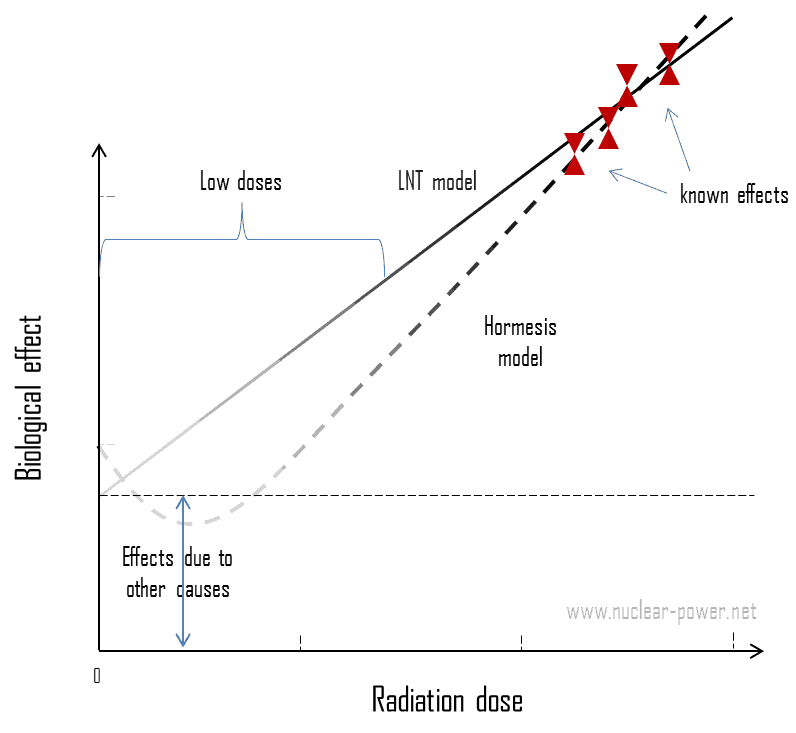
LNT Model and Hormesis Model
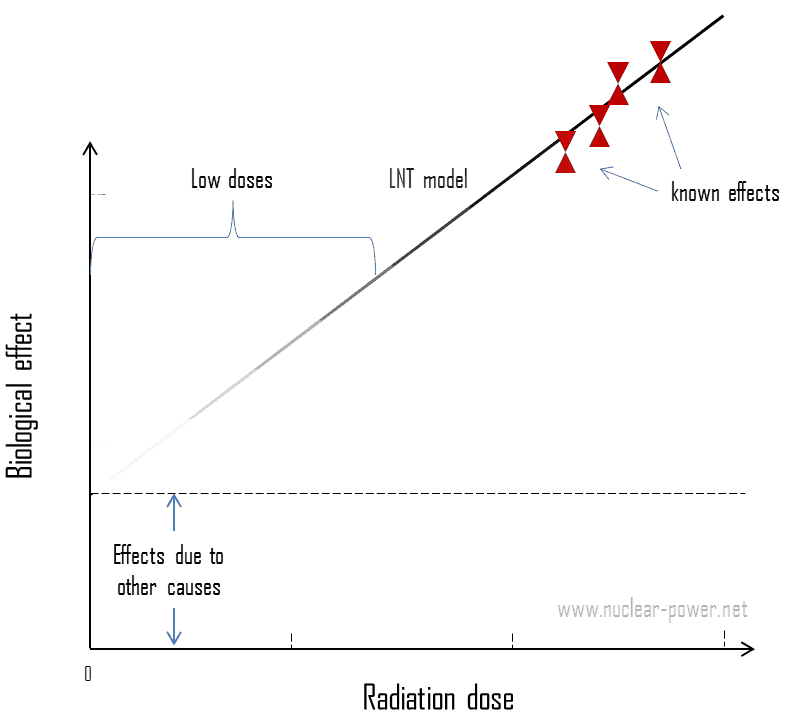
Alternative assumptions for the extrapolation of the cancer risk vs. radiation dose to low-dose levels, given a known risk at a high dose: LNT model, and hormesis model.

In case of internal radiation, we are talking usually about so called “low doses”. Low dose here means additional small doses comparable to the normal background radiation (10 µSv = average daily dose received from natural background). The doses are very very low and therefore the probability of cancer induction could be almost negligible. Secondly, and this is crucial, the truth about low-dose radiation health effects still needs to be found. It is not exactly known, whether these low doses of radiation are detrimental or beneficial (and where is the threshold). Government and regulatory bodies assume a LNT model instead of a threshold or hormesis not because it is the more scientifically convincing, but because it is the more conservative estimate. Problem of this model is that it neglects a number of defence biological processes that may be crucial at low doses. The research during the last two decades is very interesting and show that small doses of radiation given at a low dose rate stimulate the defense mechanisms. Therefore the LNT model is not universally accepted with some proposing an adaptive dose–response relationship where low doses are protective and high doses are detrimental. Many studies have contradicted the LNT model and many of these have shown adaptive response to low dose radiation resulting in reduced mutations and cancers. This phenomenon is known as radiation hormesis.

References:

Radiation Protection:

  1. Knoll, Glenn F., Radiation Detection and Measurement 4th Edition, Wiley, 8/2010. ISBN-13: 978-0470131480.
  2. Stabin, Michael G., Radiation Protection and Dosimetry: An Introduction to Health Physics, Springer, 10/2010. ISBN-13: 978-1441923912.
  3. Martin, James E., Physics for Radiation Protection 3rd Edition, Wiley-VCH, 4/2013. ISBN-13: 978-3527411764.
  4. U.S.NRC, NUCLEAR REACTOR CONCEPTS
  5. U.S. Department of Energy, Nuclear Physics and Reactor Theory. DOE Fundamentals Handbook, Volume 1 and 2. January 1993.

Nuclear and Reactor Physics:

  1. J. R. Lamarsh, Introduction to Nuclear Reactor Theory, 2nd ed., Addison-Wesley, Reading, MA (1983).
  2. J. R. Lamarsh, A. J. Baratta, Introduction to Nuclear Engineering, 3d ed., Prentice-Hall, 2001, ISBN: 0-201-82498-1.
  3. W. M. Stacey, Nuclear Reactor Physics, John Wiley & Sons, 2001, ISBN: 0- 471-39127-1.
  4. Glasstone, Sesonske. Nuclear Reactor Engineering: Reactor Systems Engineering, Springer; 4th edition, 1994, ISBN: 978-0412985317
  5. W.S.C. Williams. Nuclear and Particle Physics. Clarendon Press; 1 edition, 1991, ISBN: 978-0198520467
  6. G.R.Keepin. Physics of Nuclear Kinetics. Addison-Wesley Pub. Co; 1st edition, 1965
  7. Robert Reed Burn, Introduction to Nuclear Reactor Operation, 1988.
  8. U.S. Department of Energy, Nuclear Physics and Reactor Theory. DOE Fundamentals Handbook, Volume 1 and 2. January 1993.
  9. Paul Reuss, Neutron Physics. EDP Sciences, 2008. ISBN: 978-2759800414.

See also:

Internal Sources

We hope, this article, Potassium-40 – Characteristics – Half-life, helps you. If so, give us a like in the sidebar. Main purpose of this website is to help the public to learn some interesting and important information about radiation and dosimeters.
What is Potassium-40 inside Body – Radiation Dose – Definition

Traces of K-40 are found in all potassium, and it is the most common radioisotope in the human body. The annual effective dose from potassium-40 is 0.2 mSv. Radiation Dosimetry

Traces of K-40 are found in all potassium, and it is the most common radioisotope in the human body. K-40 is a radioactive isotope of potassium which has a very long half-life of 1.251×10⁹ years and undergoes both types of beta decay. From this point of view, also a human body can be considered as a source of antimatter.

  • About 89.28% of the time (10.72% is by electron capture), it decays to calcium-40 with emission of a beta particle (β−, an electron) with a maximum energy of 1.33 MeV and an antineutrino, which is an antiparticle to the neutrino.
  • Very rarely (0.001% of the time) it will decay to Ar-40 by emitting a positron (β+) and a neutrino.

The potassium concentration in the human body is strictly based on the homeostatic principle. Potassium is more or less distributed in the body (especially in soft tissues) following intake in foods. A 70-kg man contains about 126 g of potassium (0.18%), most of that is located in muscles. The daily consumption of potassium is approximately 2.5 gram. Hence the concentration of potassium-40 is nearly stable in all persons at a level of about 55 Bq/kg (3850 Bq in total), which corresponds to the annual effective dose of 0.2 mSv.

References:

Radiation Protection:

  1. Knoll, Glenn F., Radiation Detection and Measurement 4th Edition, Wiley, 8/2010. ISBN-13: 978-0470131480.
  2. Stabin, Michael G., Radiation Protection and Dosimetry: An Introduction to Health Physics, Springer, 10/2010. ISBN-13: 978-1441923912.
  3. Martin, James E., Physics for Radiation Protection 3rd Edition, Wiley-VCH, 4/2013. ISBN-13: 978-3527411764.
  4. U.S.NRC, NUCLEAR REACTOR CONCEPTS
  5. U.S. Department of Energy, Nuclear Physics and Reactor Theory. DOE Fundamentals Handbook, Volume 1 and 2. January 1993.

Nuclear and Reactor Physics:

  1. J. R. Lamarsh, Introduction to Nuclear Reactor Theory, 2nd ed., Addison-Wesley, Reading, MA (1983).
  2. J. R. Lamarsh, A. J. Baratta, Introduction to Nuclear Engineering, 3d ed., Prentice-Hall, 2001, ISBN: 0-201-82498-1.
  3. W. M. Stacey, Nuclear Reactor Physics, John Wiley & Sons, 2001, ISBN: 0- 471-39127-1.
  4. Glasstone, Sesonske. Nuclear Reactor Engineering: Reactor Systems Engineering, Springer; 4th edition, 1994, ISBN: 978-0412985317
  5. W.S.C. Williams. Nuclear and Particle Physics. Clarendon Press; 1 edition, 1991, ISBN: 978-0198520467
  6. G.R.Keepin. Physics of Nuclear Kinetics. Addison-Wesley Pub. Co; 1st edition, 1965
  7. Robert Reed Burn, Introduction to Nuclear Reactor Operation, 1988.
  8. U.S. Department of Energy, Nuclear Physics and Reactor Theory. DOE Fundamentals Handbook, Volume 1 and 2. January 1993.
  9. Paul Reuss, Neutron Physics. EDP Sciences, 2008. ISBN: 978-2759800414.

See also:

Internal Sources

We hope, this article, Potassium-40 inside Body – Radiation Dose, helps you. If so, give us a like in the sidebar. Main purpose of this website is to help the public to learn some interesting and important information about radiation and dosimeters.
What is Banana Equivalent Dose – BED – Definition

Banana equivalent dose, BED, is an informal dose quantity of ionizing radiation exposure. Banana equivalent dose is intended as a general educational example to compare a dose of radioactivity to the dose one is exposed to by eating one average-sized banana. Radiation Dosimetry

Banana equivalent dose, BED, is an informal dose quantity of ionizing radiation exposure. Banana equivalent dose is intended as a general educational example to compare a dose of radioactivity to the dose one is exposed to by eating one average-sized banana. One BED is often correlated to 10-7 Sievert (0.1 µSv).

Bananas contain significantly high potassium concentrations, which is vital for the functioning of all living cells. The transfer of potassium ions through nerve cell membranes is necessary for normal nerve transmission. But natural potassium also contains a radioactive isotope potassium-40 (0.012%). Potassium-40 is a radioactive isotope of potassium which has a very long half-life of 1.251×10⁹ years and undergoes both types of beta decay.

  • About 89.28% of the time (10.72% is by electron capture), it decays to calcium-40 with emission of a beta particle (β−, an electron) with a maximum energy of 1.33 MeV and an antineutrino, which is an antiparticle to the neutrino.
  • Very rarely (0.001% of the time) it will decay to Ar-40 by emitting a positron (β+) and a neutrino.

One BED is often correlated to 10-7 Sievert (0.1 µSv). The radiation exposure from consuming a banana is approximately 1% of the average daily exposure to radiation, which is 100 banana equivalent doses (BED). A chest CT scan delivers 58,000 BED (5.8 mSv). A lethal dose, the dose that kills a human with a 50% risk within 30 days (LD50/30) of radiation, is approximately 50,000,000 BED (5000 mSv). However, in practice, this dose is not cumulative, as the principal radioactive component is excreted to maintain metabolic equilibrium. Moreover, there is also a problem with the collective dose.

The BED is only meant to inform the public about the existence of very low levels of natural radioactivity within a natural food and is not a formally adopted dose measurement.

Radiation from Bananas – Is it dangerous?

We must emphasize, eating bananas, working as airline flight crew or living in locations with, increases your annual dose rate. But it does not mean, that it must be dangerous. In each case, intensity of radiation also matters. It is very similar as for heat from a fire (less energetic radiation). If you are too close, the intensity of heat radiation is high and you can get burned. If you are at the right distance, you can withstand there without any problems and moreover it is comfortable. If you are too far from heat source, the insufficiency of heat can also hurt you. This analogy, in a certain sense, can be applied to radiation also from radiation sources.

LNT Model and Hormesis Model
Alternative assumptions for the extrapolation of the cancer risk vs. radiation dose to low-dose levels, given a known risk at a high dose: LNT model, and hormesis model.

In case of internal radiation, we are talking usually about so called “low doses”. Low dose here means additional small doses comparable to the normal background radiation (10 µSv = average daily dose received from natural background). The doses are very very low and therefore the probability of cancer induction could be almost negligible. Secondly, and this is crucial, the truth about low-dose radiation health effects still needs to be found. It is not exactly known, whether these low doses of radiation are detrimental or beneficial (and where is the threshold). Government and regulatory bodies assume a LNT model instead of a threshold or hormesis not because it is the more scientifically convincing, but because it is the more conservative estimate. Problem of this model is that it neglects a number of defence biological processes that may be crucial at low doses. The research during the last two decades is very interesting and show that small doses of radiation given at a low dose rate stimulate the defense mechanisms. Therefore the LNT model is not universally accepted with some proposing an adaptive dose–response relationship where low doses are protective and high doses are detrimental. Many studies have contradicted the LNT model and many of these have shown adaptive response to low dose radiation resulting in reduced mutations and cancers. This phenomenon is known as radiation hormesis.

References:

Radiation Protection:

  1. Knoll, Glenn F., Radiation Detection and Measurement 4th Edition, Wiley, 8/2010. ISBN-13: 978-0470131480.
  2. Stabin, Michael G., Radiation Protection and Dosimetry: An Introduction to Health Physics, Springer, 10/2010. ISBN-13: 978-1441923912.
  3. Martin, James E., Physics for Radiation Protection 3rd Edition, Wiley-VCH, 4/2013. ISBN-13: 978-3527411764.
  4. U.S.NRC, NUCLEAR REACTOR CONCEPTS
  5. U.S. Department of Energy, Nuclear Physics and Reactor Theory. DOE Fundamentals Handbook, Volume 1 and 2. January 1993.

Nuclear and Reactor Physics:

  1. J. R. Lamarsh, Introduction to Nuclear Reactor Theory, 2nd ed., Addison-Wesley, Reading, MA (1983).
  2. J. R. Lamarsh, A. J. Baratta, Introduction to Nuclear Engineering, 3d ed., Prentice-Hall, 2001, ISBN: 0-201-82498-1.
  3. W. M. Stacey, Nuclear Reactor Physics, John Wiley & Sons, 2001, ISBN: 0- 471-39127-1.
  4. Glasstone, Sesonske. Nuclear Reactor Engineering: Reactor Systems Engineering, Springer; 4th edition, 1994, ISBN: 978-0412985317
  5. W.S.C. Williams. Nuclear and Particle Physics. Clarendon Press; 1 edition, 1991, ISBN: 978-0198520467
  6. G.R.Keepin. Physics of Nuclear Kinetics. Addison-Wesley Pub. Co; 1st edition, 1965
  7. Robert Reed Burn, Introduction to Nuclear Reactor Operation, 1988.
  8. U.S. Department of Energy, Nuclear Physics and Reactor Theory. DOE Fundamentals Handbook, Volume 1 and 2. January 1993.
  9. Paul Reuss, Neutron Physics. EDP Sciences, 2008. ISBN: 978-2759800414.

See also:

Internal Sources

We hope, this article, Banana Equivalent Dose – BED, helps you. If so, give us a like in the sidebar. Main purpose of this website is to help the public to learn some interesting and important information about radiation and dosimeters.
What is Radiation from Potassium-40 – Is it dangerous? – Definition

Radiation from Potassium-40 – Is it dangerous? We must emphasize, eating bananas, working as airline flight crew or living in locations with, increases your annual dose rate. But it does not mean, that it must be dangerous. Radiation Dosimetry

Traces of K-40 are found in all potassium, and it is the most common radioisotope in the human body. K-40 is a radioactive isotope of potassium which has a very long half-life of 1.251×10⁹ years and undergoes both types of beta decay. From this point of view, also a human body can be considered as a source of antimatter.

  • About 89.28% of the time (10.72% is by electron capture), it decays to calcium-40 with emission of a beta particle (β−, an electron) with a maximum energy of 1.33 MeV and an antineutrino, which is an antiparticle to the neutrino.
  • Very rarely (0.001% of the time) it will decay to Ar-40 by emitting a positron (β+) and a neutrino.

We must emphasize, eating bananas, working as airline flight crew or living in locations with, increases your annual dose rate. But it does not mean, that it must be dangerous. In each case, intensity of radiation also matters. It is very similar as for heat from a fire (less energetic radiation). If you are too close, the intensity of heat radiation is high and you can get burned. If you are at the right distance, you can withstand there without any problems and moreover it is comfortable. If you are too far from heat source, the insufficiency of heat can also hurt you. This analogy, in a certain sense, can be applied to radiation also from radiation sources.

LNT Model and Hormesis Model
Alternative assumptions for the extrapolation of the cancer risk vs. radiation dose to low-dose levels, given a known risk at a high dose: LNT model, and hormesis model.

In case of internal radiation, we are talking usually about so called “low doses”. Low dose here means additional small doses comparable to the normal background radiation (10 µSv = average daily dose received from natural background). The doses are very very low and therefore the probability of cancer induction could be almost negligible. Secondly, and this is crucial, the truth about low-dose radiation health effects still needs to be found. It is not exactly known, whether these low doses of radiation are detrimental or beneficial (and where is the threshold). Government and regulatory bodies assume a LNT model instead of a threshold or hormesis not because it is the more scientifically convincing, but because it is the more conservative estimate. Problem of this model is that it neglects a number of defence biological processes that may be crucial at low doses. The research during the last two decades is very interesting and show that small doses of radiation given at a low dose rate stimulate the defense mechanisms. Therefore the LNT model is not universally accepted with some proposing an adaptive dose–response relationship where low doses are protective and high doses are detrimental. Many studies have contradicted the LNT model and many of these have shown adaptive response to low dose radiation resulting in reduced mutations and cancers. This phenomenon is known as radiation hormesis.

References:

Radiation Protection:

  1. Knoll, Glenn F., Radiation Detection and Measurement 4th Edition, Wiley, 8/2010. ISBN-13: 978-0470131480.
  2. Stabin, Michael G., Radiation Protection and Dosimetry: An Introduction to Health Physics, Springer, 10/2010. ISBN-13: 978-1441923912.
  3. Martin, James E., Physics for Radiation Protection 3rd Edition, Wiley-VCH, 4/2013. ISBN-13: 978-3527411764.
  4. U.S.NRC, NUCLEAR REACTOR CONCEPTS
  5. U.S. Department of Energy, Nuclear Physics and Reactor Theory. DOE Fundamentals Handbook, Volume 1 and 2. January 1993.

Nuclear and Reactor Physics:

  1. J. R. Lamarsh, Introduction to Nuclear Reactor Theory, 2nd ed., Addison-Wesley, Reading, MA (1983).
  2. J. R. Lamarsh, A. J. Baratta, Introduction to Nuclear Engineering, 3d ed., Prentice-Hall, 2001, ISBN: 0-201-82498-1.
  3. W. M. Stacey, Nuclear Reactor Physics, John Wiley & Sons, 2001, ISBN: 0- 471-39127-1.
  4. Glasstone, Sesonske. Nuclear Reactor Engineering: Reactor Systems Engineering, Springer; 4th edition, 1994, ISBN: 978-0412985317
  5. W.S.C. Williams. Nuclear and Particle Physics. Clarendon Press; 1 edition, 1991, ISBN: 978-0198520467
  6. G.R.Keepin. Physics of Nuclear Kinetics. Addison-Wesley Pub. Co; 1st edition, 1965
  7. Robert Reed Burn, Introduction to Nuclear Reactor Operation, 1988.
  8. U.S. Department of Energy, Nuclear Physics and Reactor Theory. DOE Fundamentals Handbook, Volume 1 and 2. January 1993.
  9. Paul Reuss, Neutron Physics. EDP Sciences, 2008. ISBN: 978-2759800414.

See also:

Internal Sources

We hope, this article, Radiation from Potassium-40 – Is it dangerous?, helps you. If so, give us a like in the sidebar. Main purpose of this website is to help the public to learn some interesting and important information about radiation and dosimeters.
What is Radiation from Bananas – Is it dangerous? – Definition

Radiation from Bananas – Is it dangerous? We must emphasize, eating bananas, working as airline flight crew or living in locations with, increases your annual dose rate. But it does not mean, that it must be dangerous. Radiation Dosimetry

We must emphasize, eating bananas, working as airline flight crew or living in locations with, increases your annual dose rate. But it does not mean, that it must be dangerous. In each case, intensity of radiation also matters. It is very similar as for heat from a fire (less energetic radiation). If you are too close, the intensity of heat radiation is high and you can get burned. If you are at the right distance, you can withstand there without any problems and moreover it is comfortable. If you are too far from heat source, the insufficiency of heat can also hurt you. This analogy, in a certain sense, can be applied to radiation also from radiation sources.

LNT Model and Hormesis Model
Alternative assumptions for the extrapolation of the cancer risk vs. radiation dose to low-dose levels, given a known risk at a high dose: LNT model, and hormesis model.

In case of internal radiation, we are talking usually about so called “low doses”. Low dose here means additional small doses comparable to the normal background radiation (10 µSv = average daily dose received from natural background). The doses are very very low and therefore the probability of cancer induction could be almost negligible. Secondly, and this is crucial, the truth about low-dose radiation health effects still needs to be found. It is not exactly known, whether these low doses of radiation are detrimental or beneficial (and where is the threshold). Government and regulatory bodies assume a LNT model instead of a threshold or hormesis not because it is the more scientifically convincing, but because it is the more conservative estimate. Problem of this model is that it neglects a number of defence biological processes that may be crucial at low doses. The research during the last two decades is very interesting and show that small doses of radiation given at a low dose rate stimulate the defense mechanisms. Therefore the LNT model is not universally accepted with some proposing an adaptive dose–response relationship where low doses are protective and high doses are detrimental. Many studies have contradicted the LNT model and many of these have shown adaptive response to low dose radiation resulting in reduced mutations and cancers. This phenomenon is known as radiation hormesis.

References:

Radiation Protection:

  1. Knoll, Glenn F., Radiation Detection and Measurement 4th Edition, Wiley, 8/2010. ISBN-13: 978-0470131480.
  2. Stabin, Michael G., Radiation Protection and Dosimetry: An Introduction to Health Physics, Springer, 10/2010. ISBN-13: 978-1441923912.
  3. Martin, James E., Physics for Radiation Protection 3rd Edition, Wiley-VCH, 4/2013. ISBN-13: 978-3527411764.
  4. U.S.NRC, NUCLEAR REACTOR CONCEPTS
  5. U.S. Department of Energy, Nuclear Physics and Reactor Theory. DOE Fundamentals Handbook, Volume 1 and 2. January 1993.

Nuclear and Reactor Physics:

  1. J. R. Lamarsh, Introduction to Nuclear Reactor Theory, 2nd ed., Addison-Wesley, Reading, MA (1983).
  2. J. R. Lamarsh, A. J. Baratta, Introduction to Nuclear Engineering, 3d ed., Prentice-Hall, 2001, ISBN: 0-201-82498-1.
  3. W. M. Stacey, Nuclear Reactor Physics, John Wiley & Sons, 2001, ISBN: 0- 471-39127-1.
  4. Glasstone, Sesonske. Nuclear Reactor Engineering: Reactor Systems Engineering, Springer; 4th edition, 1994, ISBN: 978-0412985317
  5. W.S.C. Williams. Nuclear and Particle Physics. Clarendon Press; 1 edition, 1991, ISBN: 978-0198520467
  6. G.R.Keepin. Physics of Nuclear Kinetics. Addison-Wesley Pub. Co; 1st edition, 1965
  7. Robert Reed Burn, Introduction to Nuclear Reactor Operation, 1988.
  8. U.S. Department of Energy, Nuclear Physics and Reactor Theory. DOE Fundamentals Handbook, Volume 1 and 2. January 1993.
  9. Paul Reuss, Neutron Physics. EDP Sciences, 2008. ISBN: 978-2759800414.

See also:

Internal Sources

We hope, this article, Radiation from Bananas – Is it dangerous?, helps you. If so, give us a like in the sidebar. Main purpose of this website is to help the public to learn some interesting and important information about radiation and dosimeters.
What is Internal Dose from Uranium and Thorium – Definition

Internal Dose from Uranium and Thorium. The UNSCEAR 2000 report estimates an annual effective dose of 0.12 mSv, which comes from internal exposure by isotopes of the uranium and thorium series. Radiation Dosimetry

As was written, all people also have some radioactive isotopes inside their bodies from birth. These isotopes are especially potassium-40, carbon-14 and isotopes from the uranium and thorium series. The variation in radiation dose from one person to another is not as great as the variation in dose from cosmic and terrestrial sources. The average annual radiation dose to a person from internal radioactive materials other than radon is about 0.3 mSv/year of which:

  • 0.2 mSv/year comes from potassium-40,
  • 0.12 mSv/year comes from the uranium and thorium series,
  • 12 μSv/year comes from carbon-14.

UNSCEAR have, based on a large number of investigations, presented values about the annual intake by humans of the different isotopes. We can mention the following:

  • Ra-226 (22 Bq/year),
  • Pb-210 (30 Bq/year),
  • Po-210 (58 Bq/year) and
  • Ra-228 (15 Bq/year).

Note that, the dominant component of natural background exposure, which comes from the short-lived decay products of radon, is not involved here. This issue is so important, that it was treated separately in the previous section (Terrestrial Radiation).

As a result, the UNSCEAR 2000 report estimates an annual effective dose of 0.12 mSv, which comes from internal exposure by isotopes of the uranium and thorium series. The main contributor to this dose is Po-210. Note that, polonium-210, the decay product of lead-210, emits a 5.3 MeV alpha particle, which provides most of equivalent dose. The radiation weighting factor for alpha radiation is equal to 20. An absorbed dose of 1 mGy by alpha particles will lead to an equivalent dose of 20 mSv.

Internal Radiation – Is it dangerous?

We must emphasize, eating bananas, working as airline flight crew or living in locations with, increases your annual dose rate. But it does not mean, that it must be dangerous. In each case, intensity of radiation also matters. It is very similar as for heat from a fire (less energetic radiation). If you are too close, the intensity of heat radiation is high and you can get burned. If you are at the right distance, you can withstand there without any problems and moreover it is comfortable. If you are too far from heat source, the insufficiency of heat can also hurt you. This analogy, in a certain sense, can be applied to radiation also from radiation sources.

See also: Internal Source of Radiation

References:

Radiation Protection:

  1. Knoll, Glenn F., Radiation Detection and Measurement 4th Edition, Wiley, 8/2010. ISBN-13: 978-0470131480.
  2. Stabin, Michael G., Radiation Protection and Dosimetry: An Introduction to Health Physics, Springer, 10/2010. ISBN-13: 978-1441923912.
  3. Martin, James E., Physics for Radiation Protection 3rd Edition, Wiley-VCH, 4/2013. ISBN-13: 978-3527411764.
  4. U.S.NRC, NUCLEAR REACTOR CONCEPTS
  5. U.S. Department of Energy, Nuclear Physics and Reactor Theory. DOE Fundamentals Handbook, Volume 1 and 2. January 1993.

Nuclear and Reactor Physics:

  1. J. R. Lamarsh, Introduction to Nuclear Reactor Theory, 2nd ed., Addison-Wesley, Reading, MA (1983).
  2. J. R. Lamarsh, A. J. Baratta, Introduction to Nuclear Engineering, 3d ed., Prentice-Hall, 2001, ISBN: 0-201-82498-1.
  3. W. M. Stacey, Nuclear Reactor Physics, John Wiley & Sons, 2001, ISBN: 0- 471-39127-1.
  4. Glasstone, Sesonske. Nuclear Reactor Engineering: Reactor Systems Engineering, Springer; 4th edition, 1994, ISBN: 978-0412985317
  5. W.S.C. Williams. Nuclear and Particle Physics. Clarendon Press; 1 edition, 1991, ISBN: 978-0198520467
  6. G.R.Keepin. Physics of Nuclear Kinetics. Addison-Wesley Pub. Co; 1st edition, 1965
  7. Robert Reed Burn, Introduction to Nuclear Reactor Operation, 1988.
  8. U.S. Department of Energy, Nuclear Physics and Reactor Theory. DOE Fundamentals Handbook, Volume 1 and 2. January 1993.
  9. Paul Reuss, Neutron Physics. EDP Sciences, 2008. ISBN: 978-2759800414.

See also:

Internal Sources

We hope, this article, Internal Dose from Uranium and Thorium, helps you. If so, give us a like in the sidebar. Main purpose of this website is to help the public to learn some interesting and important information about radiation and dosimeters.
What is Cosmogenic Radionuclide – Definition

Cosmogenic radionuclides are radionuclides generated by the nuclear reactions during the interaction between high-energy cosmic rays and stable nuclei from the atmosphere. Radiation Dosimetry

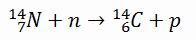
Cosmogenic radionuclides are radionuclides generated by the nuclear reactions during the interaction between high-energy cosmic rays and stable nuclei from the atmosphere. One of the well-known cosmogenic radionuclides is carbon-14, which is generated by the reaction 14N(n,p)14C. The other isotopes generated are as follows: 3H, 7Be, 22Na. Most of cosmogenic radionuclides are products of (n,p), (p,n) and especially spallation reactions. These nuclear reactions are very fast and occur in a time comparable to the time of transit of an incident particle across the nucleus (~10-22 s). The very short interaction time allows for an interaction of a single nucleon only (in extreme cases). These reactions are known as direct nuclear reactions.

Carbon-14

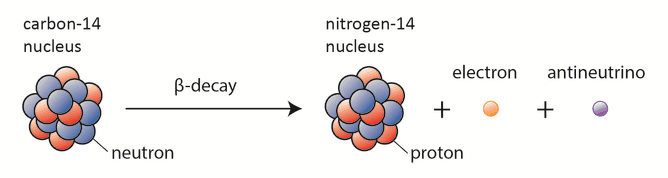
The only cosmogenic radionuclide to make a significant contribution to internal exposure of human is carbon-14. Radioactive carbon-14 has a half-life of 5730 years and undergoes β− decay, where the neutron is converted into a proton, an electron, and an electron antineutrino:

beta decay
Beta decay of C-14 nucleus.

In spite of this short half-life compared to the age of the earth, carbon-14 is a naturally occurring isotope. Its presence can be explained by the following simple observation. Our atmosphere contains many gases, including nitrogen-14. Besides, the atmosphere is constantly bombarded with high energy cosmic rays, consisting of protons, heavier nuclei, or gamma rays. These cosmic rays interact with nuclei in the atmosphere, and produce also high-energy neutrons. These neutrons produced in these collisions can be absorbed by nitrogen-14 to produce an isotope of carbon-14:

carbon-14 dating - formation

Carbon-14 can also be produced in the atmosphere by other neutron reactions, including in particular 13C(n,γ)14C and 17O(n,α)14C. As a result, carbon-14 is continuously formed in the upper atmosphere by the interaction of cosmic rays with atmospheric nitrogen. On average just one out of every 1.3 x 10¹² carbon atoms in the atmosphere is a radioactive carbon-14 atom. As a result, all living biological substances contain the same amount of C-14 per gram of carbon, that is 0.3 Bq of carbon-14 activity per gram of carbon. Carbon-14 is present in the human body (13kg of carbon in 70kg human) at a level of about 3700 Bq (0.1 μCi) with a biological half-life of 40 days. Note that, biological half-life is the time taken for the amount of a particular element in the body to decrease to half of its initial value due to elimination by biological processes alone.  However, a carbon atom is in the genetic information of about half the cells, while potassium is not a component of DNA. The decay of a carbon-14 atom inside DNA in one person happens about 50 times per second, changing a carbon atom to one of nitrogen.

The annual dose from carbon-14 is estimated to be about 12 μSv/year.

As long as the biological system is alive the level is constant due to constant intake of all isotopes of carbon. When the biological system dies, it stops exchanging carbon with its environment, and from that point onwards the amount of carbon-14 it contains begins to decrease as the carbon-14 undergoes radioactive decay.

See also: Carbon-14 Dating

Tritium

Tritium is the only naturally-occurring radioisotope of hydrogen. Its atomic number is naturally 1 which means there is 1 proton and 1 electron in the atomic structure. Unlike the hydrogen nucleus and deuterium nucleus, tritium has 2 neutrons in the nucleus. Tritium is naturally-occurring, but it is extremely rare.

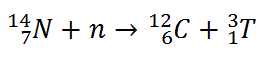
Tritium is produced in the atmosphere when cosmic rays collide with air molecules. In the most important reaction for natural production, a fast neutron (which must have energy greater than 4.0 MeV) interacts with atmospheric nitrogen:

Worldwide, the production of tritium from natural sources is 148 petabecquerels per year. In result, the tritiated water produced participates in the water cycle.

  • about 400 Bq/m3 in continental water
  • about 100 Bq/m3 in oceans

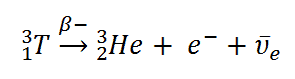
Tritium is a radioactive isotope, but it emits a very weak form of radiation, a low-energy beta particle that is similar to an electron. It is a pure beta emitter (i.e. beta emitter without an accompanying gamma radiation). The electron’s kinetic energy varies, with an average of 5.7 keV, while the remaining energy is carried off by the nearly undetectable electron antineutrino. Such a very low energy of electron causes, that the electron cannot penetrate the skin or even does not travel very far in air. Beta particles from tritium can penetrate only about 6.0 mm of air. Tritium decays via negative beta decay into helium-3 with half-life of 12.3 years.

Decay of TritiumTherefore, tritium poses a risk to health as a result of internal exposure only following ingestion in drinking water or food, or inhalation or absorption through the skin. The tritium taken into the body is uniformly distributed among all soft tissues. An average annual dose from natural tritium intake is 0.01 μSv.

In case of artificial tritium ingestion or inhalation, a biological half-time of tritium is 10 days for HTO and 40 days for OBT (organically bound tritium) formed from HTO in the body of adults. It was also shown that the biological half-time of HTO depends strongly on many variables and varies from about 4 to 18 days. During the warmer months, the average half-life is lower, which is attributed to increased water intake. As well as, drinking larger amounts of alcohol will reduce the biological half-life of water in the body.

References:

Radiation Protection:

  1. Knoll, Glenn F., Radiation Detection and Measurement 4th Edition, Wiley, 8/2010. ISBN-13: 978-0470131480.
  2. Stabin, Michael G., Radiation Protection and Dosimetry: An Introduction to Health Physics, Springer, 10/2010. ISBN-13: 978-1441923912.
  3. Martin, James E., Physics for Radiation Protection 3rd Edition, Wiley-VCH, 4/2013. ISBN-13: 978-3527411764.
  4. U.S.NRC, NUCLEAR REACTOR CONCEPTS
  5. U.S. Department of Energy, Nuclear Physics and Reactor Theory. DOE Fundamentals Handbook, Volume 1 and 2. January 1993.

Nuclear and Reactor Physics:

  1. J. R. Lamarsh, Introduction to Nuclear Reactor Theory, 2nd ed., Addison-Wesley, Reading, MA (1983).
  2. J. R. Lamarsh, A. J. Baratta, Introduction to Nuclear Engineering, 3d ed., Prentice-Hall, 2001, ISBN: 0-201-82498-1.
  3. W. M. Stacey, Nuclear Reactor Physics, John Wiley & Sons, 2001, ISBN: 0- 471-39127-1.
  4. Glasstone, Sesonske. Nuclear Reactor Engineering: Reactor Systems Engineering, Springer; 4th edition, 1994, ISBN: 978-0412985317
  5. W.S.C. Williams. Nuclear and Particle Physics. Clarendon Press; 1 edition, 1991, ISBN: 978-0198520467
  6. G.R.Keepin. Physics of Nuclear Kinetics. Addison-Wesley Pub. Co; 1st edition, 1965
  7. Robert Reed Burn, Introduction to Nuclear Reactor Operation, 1988.
  8. U.S. Department of Energy, Nuclear Physics and Reactor Theory. DOE Fundamentals Handbook, Volume 1 and 2. January 1993.
  9. Paul Reuss, Neutron Physics. EDP Sciences, 2008. ISBN: 978-2759800414.

See also:

Sources


We hope, this article, Cosmogenic Radionuclide, helps you. If so, give us a like in the sidebar. Main purpose of this website is to help the public to learn some interesting and important information about radiation and dosimeters.

What is LNT and Collective Dose – Definition

In case of collective dose, conservativeness of the LNT model has enormous consequences and the model is sometimes wrongly (perhaps intentionally) used to quantify the cancerous effect of collective doses of low-level radioactive contaminations. Radiation Dosimetry
linear no-threshold model
LNT model allows for the extrapolation of the cancer risk vs. radiation dose to low-dose levels, given a known risk at a high dose.

The linear no-threshold model (LNT model) is a conservative model used in radiation protection to estimate the health effects from small radiation doses. According to the LNT model, radiation is always considered harmful with no safety threshold, and the sum of several very small exposures are considered to have the same biological risk as one larger exposure (linearity). .

LNT and Collective Dose

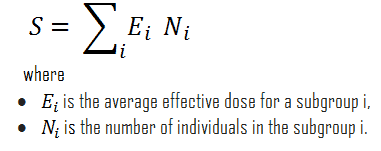
In case of collective dose, conservativeness of the LNT model has enormous consequences and the model is sometimes wrongly (perhaps intentionally) used to quantify the cancerous effect of collective doses of low-level radioactive contamination. A linear dose-effect curve makes it possible to use collective doses to calculate the detrimental effects to an irradiated population. Simply:

collective effective dose

But what does it mean? If ten million people receives an effective dose of 0.1 µSv (an equivalent of eating one banana), then the collective dose will be S = 1 Sv. Does it mean there is 5.5% chance of developing cancer for one person due to eating bananas? Note that, for high doses one sievert represents a 5.5% chance of developing cancer. A number of organisations disagree with this result and with using the linear no-threshold model to estimate risk from environmental and occupational low-level radiation exposure. There is a question, whether the collective dose is meaningful at all.

The ICRP alone states:

“The collective effective dose quantity is an instrument for optimisation, for comparing radiological technologies and protection procedures, predominantly in the context of occupational exposure. Collective effective dose is not intended as a tool for epidemiological risk assessment, and it is inappropriate to use it in risk projections. The aggregation of very low individual doses over extended time periods is inappropriate, and in particular, the calculation of the number of cancer deaths based on collective effective doses from trivial individual doses should be avoided.”

Special Reference: ICRP, 2007. The 2007 Recommendations of the International Commission on Radiological Protection. ICRP Publication 103. Ann. ICRP 37 (2-4).

References:

Radiation Protection:

  1. Knoll, Glenn F., Radiation Detection and Measurement 4th Edition, Wiley, 8/2010. ISBN-13: 978-0470131480.
  2. Stabin, Michael G., Radiation Protection and Dosimetry: An Introduction to Health Physics, Springer, 10/2010. ISBN-13: 978-1441923912.
  3. Martin, James E., Physics for Radiation Protection 3rd Edition, Wiley-VCH, 4/2013. ISBN-13: 978-3527411764.
  4. U.S.NRC, NUCLEAR REACTOR CONCEPTS
  5. U.S. Department of Energy, Nuclear Physics and Reactor Theory. DOE Fundamentals Handbook, Volume 1 and 2. January 1993.

Nuclear and Reactor Physics:

  1. J. R. Lamarsh, Introduction to Nuclear Reactor Theory, 2nd ed., Addison-Wesley, Reading, MA (1983).
  2. J. R. Lamarsh, A. J. Baratta, Introduction to Nuclear Engineering, 3d ed., Prentice-Hall, 2001, ISBN: 0-201-82498-1.
  3. W. M. Stacey, Nuclear Reactor Physics, John Wiley & Sons, 2001, ISBN: 0- 471-39127-1.
  4. Glasstone, Sesonske. Nuclear Reactor Engineering: Reactor Systems Engineering, Springer; 4th edition, 1994, ISBN: 978-0412985317
  5. W.S.C. Williams. Nuclear and Particle Physics. Clarendon Press; 1 edition, 1991, ISBN: 978-0198520467
  6. G.R.Keepin. Physics of Nuclear Kinetics. Addison-Wesley Pub. Co; 1st edition, 1965
  7. Robert Reed Burn, Introduction to Nuclear Reactor Operation, 1988.
  8. U.S. Department of Energy, Nuclear Physics and Reactor Theory. DOE Fundamentals Handbook, Volume 1 and 2. January 1993.
  9. Paul Reuss, Neutron Physics. EDP Sciences, 2008. ISBN: 978-2759800414.

See also:

LNT

We hope, this article, LNT and Collective Dose, helps you. If so, give us a like in the sidebar. Main purpose of this website is to help the public to learn some interesting and important information about radiation and dosimeters.

What is Radiation Hormesis – Definition

Radiation hormesis is a dose-response phenomenon and it is one of alternative hypothesis, that low doses of ionizing radiation induces beneficial health effects. According to radiation hormesis hypothesis, low doses of low LET radiation can stimulate the activation of repair mechanisms, that protect against disease, that are not activated in absence of ionizing radiation. Radiation Dosimetry
LNT Model and Hormesis Model
Alternative assumptions for the extrapolation of the cancer risk vs. radiation dose to low-dose levels, given a known risk at a high dose: LNT model, and hormesis model.

Radiation hormesis is a dose-response phenomenon and it is one of alternative hypothesis, that low doses of ionizing radiation induces beneficial health effects. According to radiation hormesis hypothesis, low doses of low LET radiation can stimulate the activation of repair mechanisms, that protect against disease, that are not activated in absence of ionizing radiation. Low dose here means additional small doses comparable to the normal background radiation (10 µSv = average daily dose received from natural background). Since at high doses the negative effects are irrefutable, there must exist a threshold between the beneficial and the negative effects of radiation. This threshold is known as the Zero Equivalent Point (ZEP).

Radiation hormesis hypothesis proposes that radiation exposure comparable to and just above the natural background level of radiation is not harmful but beneficial, while accepting that much higher levels of radiation are hazardous. Arguments for hormesis center around some large-scale epidemiological studies and the evidence from animal irradiation experiments, but most notably the recent advances in knowledge of the adaptive response. Proponents of radiation hormesis typically claim that radio-protective responses in cells and the immune system not only counter the harmful effects of radiation but additionally act to inhibit spontaneous cancer not related to radiation exposure.

Controversy of LNT Model

As was written previously (LNT model), today the protection system is based on the LNT-hypothesis, which is a conservative model used in radiation protection to estimate the health effects from small radiation doses. This model is excellent for setting up a protection system for all use of ionizing radiation. In comparison to the hormesis model, the LNT model assumes, that there is no threshold point and risk increases linearly with a dose, i.e. the LNT model implies that there is no safe dose of ionizing radiation. If this linear model is correct, then natural background radiation is the most hazardous source of radiation to general public health, followed by medical imaging as a close second.

The LNT model is primarily based on the life span study (LSS) of atomic bomb survivors in Japan. However, while this pattern is undisputed at high doses, this linear extrapolation of risk to low doses is challenged by many recent experiments involving cell mechanisms and there is also high uncertainty involved in estimating risk using only epidemiological studies. The problem is that, at very low doses, it is practically impossible to correlate any irradiation with certain biological effects. This is because the baseline cancer rate is already very high and the risk of developing cancer fluctuates 40% because of individual life style and environmental effects, obscuring the subtle effects of low-level radiation. Government and regulatory bodies assume a LNT model instead of a threshold or hormesis not because it is the more scientifically convincing, but because it is the more conservative estimate.

In case of low doses, its conservativeness (linearity) has enormous consequences and the model is sometimes wrongly (perhaps intentionally) used to quantify the cancerous effect of collective doses of low-level radioactive contaminations. A linear dose-effect curve makes it possible to use collective doses to calculate the detrimental effects to an irradiated population. It is also argued that LNT model had caused an irrational fear of radiation, since every microsievert can be converted to the probability of cancer induction, however small this probability is. For example, if ten million people receives an effective dose of 0.1 µSv (an equivalent of eating one banana), then the collective dose will be S = 1 Sv. Does it mean there is 5.5% chance of developing cancer for one person due to eating banana? Note that, for high doses one sievert represents a 5.5% chance of developing cancer.

Problem of this model is that it neglects a number of defence biological processes that may be crucial at low doses. The research during the last two decades is very interesting and show that small doses of radiation given at a low dose rate stimulate the defense mechanisms. Therefore the LNT model is not universally accepted with some proposing an adaptive dose–response relationship where low doses are protective and high doses are detrimental. Many studies have contradicted the LNT model and many of these have shown adaptive response to low dose radiation resulting in reduced mutations and cancers.


References:

Radiation Protection:

  1. Knoll, Glenn F., Radiation Detection and Measurement 4th Edition, Wiley, 8/2010. ISBN-13: 978-0470131480.
  2. Stabin, Michael G., Radiation Protection and Dosimetry: An Introduction to Health Physics, Springer, 10/2010. ISBN-13: 978-1441923912.
  3. Martin, James E., Physics for Radiation Protection 3rd Edition, Wiley-VCH, 4/2013. ISBN-13: 978-3527411764.
  4. U.S.NRC, NUCLEAR REACTOR CONCEPTS
  5. U.S. Department of Energy, Nuclear Physics and Reactor Theory. DOE Fundamentals Handbook, Volume 1 and 2. January 1993.

Nuclear and Reactor Physics:

  1. J. R. Lamarsh, Introduction to Nuclear Reactor Theory, 2nd ed., Addison-Wesley, Reading, MA (1983).
  2. J. R. Lamarsh, A. J. Baratta, Introduction to Nuclear Engineering, 3d ed., Prentice-Hall, 2001, ISBN: 0-201-82498-1.
  3. W. M. Stacey, Nuclear Reactor Physics, John Wiley & Sons, 2001, ISBN: 0- 471-39127-1.
  4. Glasstone, Sesonske. Nuclear Reactor Engineering: Reactor Systems Engineering, Springer; 4th edition, 1994, ISBN: 978-0412985317
  5. W.S.C. Williams. Nuclear and Particle Physics. Clarendon Press; 1 edition, 1991, ISBN: 978-0198520467
  6. G.R.Keepin. Physics of Nuclear Kinetics. Addison-Wesley Pub. Co; 1st edition, 1965
  7. Robert Reed Burn, Introduction to Nuclear Reactor Operation, 1988.
  8. U.S. Department of Energy, Nuclear Physics and Reactor Theory. DOE Fundamentals Handbook, Volume 1 and 2. January 1993.
  9. Paul Reuss, Neutron Physics. EDP Sciences, 2008. ISBN: 978-2759800414.

See also:

Radiobiology

We hope, this article, Radiation Hormesis, helps you. If so, give us a like in the sidebar. Main purpose of this website is to help the public to learn some interesting and important information about radiation and dosimeters.